ABC Family Arquivos Brasileiros de Cardiologia International Journal of Cardiovascular Sciences ABC Heart Failure & Cardiomyopathy ABC Imagem Cardiovascular
Português English
ABC Family
Português English
  • About
    • About ABC Family
    • Internal Regulation
    • Editorial Board
    • Brazilian Society of Cardiology (SBC)
  • Issues
  • SBC Guidelines
  • Content
    • Videos
    • Podcasts
    • News
  • About
    • About ABC Family
    • Internal Regulation
    • Editorial Board
    • Brazilian Society of Cardiology (SBC)
  • Issues
  • SBC Guidelines
  • Content
    • Videos
    • Podcasts
    • News

ABC Family

  • ABC Family
  • Arquivos Brasileiros de Cardiologia
  • International Journal of Cardiovascular Sciences
  • ABC Heart Failure & Cardiomyopathy
  • ABC Imagem Cardiovascular
Search in

No content found.

Journals
Ordering
Article types
Others

  1. Home
  2. Keyword: Artery Coronary Disease / physiopathology
Figure 1
IJCS
Original Article

Use of GATED-SPECT for Ventricular Desynchronization Evaluation in Patients with Heart Failure Submitted to Cardiac Resynchronization Therapy

Christiane Cigagna Wiefels et al. Erivelton Alessandro do Nascimento Christiane Rodrigues Alves Fernanda Baptista Ribeiro … Fernando de Amorim Fernandes Mario Luiz Ribeiro Claudio Tinoco Mesquita

Abstract

Background:

Approximately 20 to 40% of patients with heart failure do not respond to cardiac resynchronization therapy (CRT). To improve patient selection, phase analysis by myocardial perfusion scintigraphy (GSPECT) was developed.

Objectives:

To evaluate the clinical and scintigraphic response of patients with heart failure (HF) submitted to CRT using GSPECT.

Method:

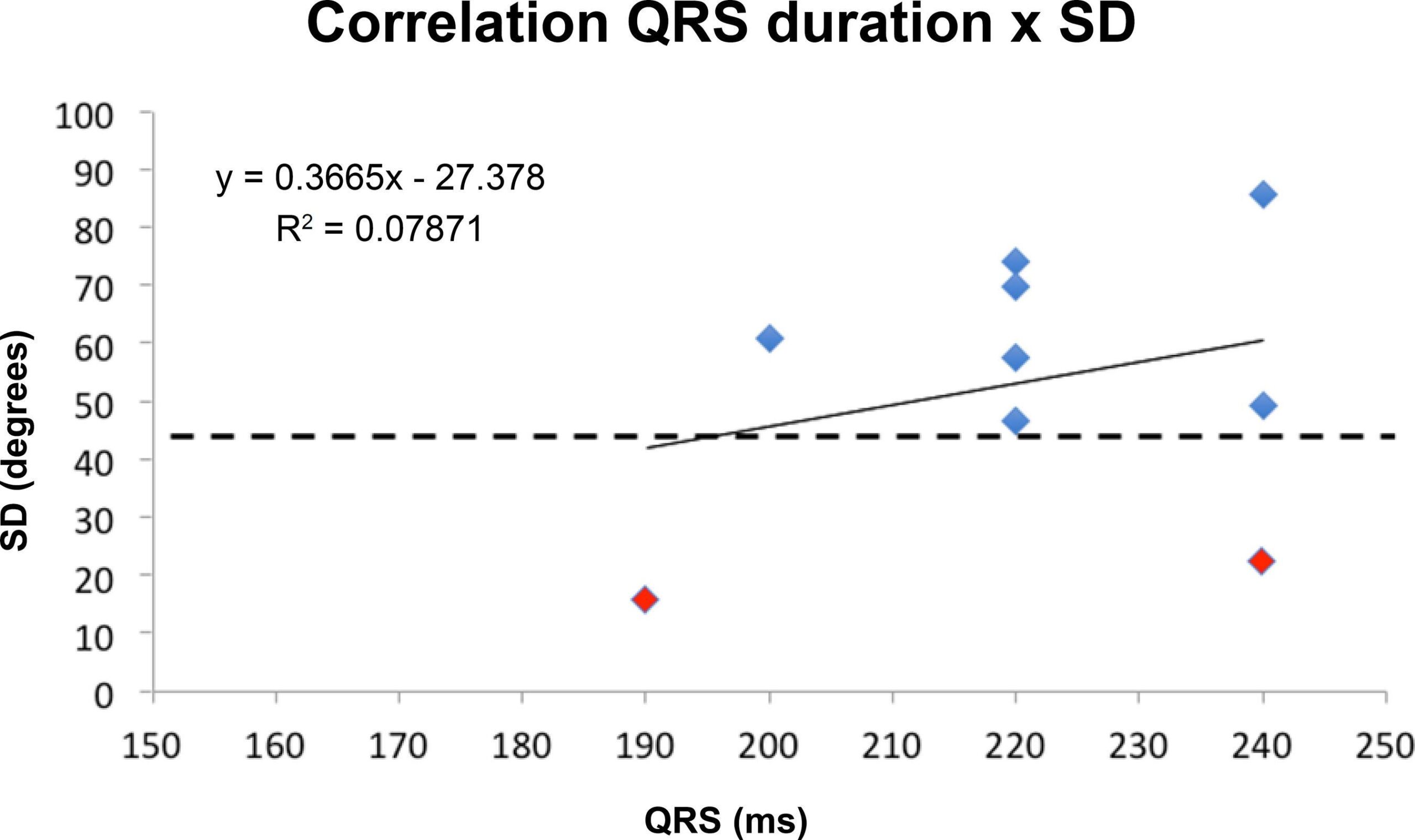
This was an interventional study that included consecutive patients assessed by GSPECT four weeks prior to CRT implantation and six months after it for comparison. These patients also answered the Minnesota Living with Heart Failure Questionnaire (MLHFQ). The categorical variables were compared using Fisher’s exact test and chi-square test, whereas Student’s t-test was used for numerical variables. The level of statistical significance was set at 5%. The scintigraphic variables analyzed were left ventricular ejection fraction, end-systolic volume, end-diastolic volume, left ventricular mass, standard deviation and bandwidth, as well as QRS duration and the Minnesota Quality of Life Questionnaire score. The presence of mechanical dyssynchrony was defined as standard deviation > 43º.

Results:

Nine patients were included in the study. After the cardiac resynchronization therapy, there was a significant improvement (p < 0.05) in the end-systolic volume (206 ± 80 mL vs. 158 ± 108 mL), QRS (180 ± 18 ms vs. 120 ± 9 ms), left ventricular mass (248 ± 65 g vs. 193 ± 52 g) and Minnesota Quality of Life Questionnaire score (63 ± 16 vs. 34 ± 20). All patients with scintigraphic criteria of mechanical dyssynchrony showed clinical improvement. Two patients had only electrical dyssynchrony and did not achieve significant clinical improvement, although they showed QRS duration reduction.

Conclusion:

GSPECT was able to differentiate patients with isolated electrical dyssynchrony from those with associated mechanical dyssynchrony, through the intraventricular dyssynchrony parameters. The cardiac resynchronization therapy is associated with the improvement of both mechanical and electrical dyssynchrony. Pre-implantation GSPECT showed that patients with associated electrical and mechanical dyssynchrony had a better response to cardiac resynchronization therapy than those with isolated electrical dyssynchrony.

  • Artery Coronary Disease / physiopathology
  • Cardiac Resynchronization Therapy
  • Heart Failure
  • Myocardial Infarction
  • Myocardial Perfusion Imaging / scintigraphy
  • Stroke Volume
Read Full Article
Creative Commons Attribution (CC BY) Creative Commons license
01/01/2018 DOI: 10.5935/2359-4802.20180022 Views 2

How to cite this article

EndNote RIS

Electronic Document Format (Vancouver)

Wiefels CC, Nascimento EA, Alves CR, Ribeiro FB, Fernandes FA, Ribeiro ML, Mesquita CT, et al. Use of GATED-SPECT for Ventricular Desynchronization Evaluation in Patients with Heart Failure Submitted to Cardiac Resynchronization Therapy. International Journal of Cardiovascular Sciences 2018;31(3):264-73.

Electronic Document Format (ABNT)

Wiefels, Christiane Cigagna; Nascimento, Erivelton Alessandro do; Alves, Christiane Rodrigues; Ribeiro, Fernanda Baptista; Fernandes, Fernando de Amorim; Ribeiro, Mario Luiz; Mesquita, Claudio Tinoco. Use of GATED-SPECT for Ventricular Desynchronization Evaluation in Patients with Heart Failure Submitted to Cardiac Resynchronization Therapy. International Journal of Cardiovascular Sciences, v. 31, n. 3, p. 264-273, Dec. 2017.

Electronic Document Format (APA)

Wiefels, C. C., Nascimento, E. A. , Alves, C. R., Ribeiro, F. B., Fernandes, F. A., Ribeiro, M. L., & Mesquita, C. T. (2018). Use of GATED-SPECT for Ventricular Desynchronization Evaluation in Patients with Heart Failure Submitted to Cardiac Resynchronization Therapy. International Journal of Cardiovascular Sciences, 31(3), 264-273.

Electronic Document Format (ISO)

Wiefels, Christiane Cigagna and Nascimento, Erivelton Alessandro do and Alves, Christiane Rodrigues and Ribeiro, Fernanda Baptista and Fernandes, Fernando de Amorim and Ribeiro, Mario Luiz and Mesquita, Claudio Tinoco. Use of GATED-SPECT for Ventricular Desynchronization Evaluation in Patients with Heart Failure Submitted to Cardiac Resynchronization Therapy. International Journal of Cardiovascular Sciences [online]. 2018, vol. 31, n. 3, [cited 2026-10-14], pp. 264-273. Available from: <https://journals.cardiol.br/en/article/use-of-gated-spect-for-ventricular-desynchronization-evaluation-in-patients-with-heart-failure-submitted-to-cardiac-resynchronization-therapy/>. ISSN 2359-4802

  • About ABC Family
  • Internal Regulation
  • Editorial Board
  • Brazilian Society of Cardiology (SBC)

Issues

SBC Guidelines

  • Videos
  • Podcasts
  • News