Guilherme Cesar Fernandes de Oliveira da Costa et al. Jose Gregorio Valero Rodriguez Giulia Fernandes de Oliveira da Costa Adriana Munford Lima Pimentel Evandro Tinoco Mesquita
Abstract
Background
Myocarditis remains a diagnostic challenge, and interest in using artificial intelligence to support noninvasive diagnostic evaluation has grown rapidly. Although the literature at the intersection of artificial intelligence and myocarditis has expanded substantially, it remains fragmented and lacks comprehensive synthesis.
Objectives
To map the global scientific output on the application of artificial intelligence to myocarditis by identifying leading contributors, collaboration patterns, and emerging thematic trends.
Methods
We conducted a bibliometric analysis of articles on artificial intelligence applied to myocarditis indexed in the Web of Science Core Collection. The R package bibliometrix and VOSviewer were used to perform bibliometric network and thematic analyses.
Results
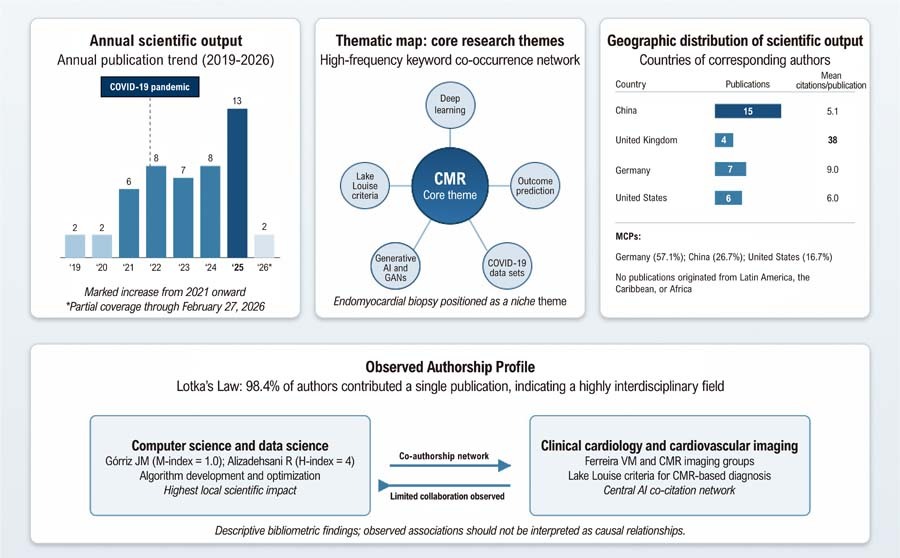
A total of 47 articles were included. Scientific output increased markedly after 2021, coinciding with the COVID-19 pandemic, and peaked in 2025. China led in publication volume, whereas the United Kingdom and Germany achieved the greatest citation impact. No publications originated from Latin America, the Caribbean, or Africa. International collaboration networks remain fragmented. Keyword and thematic analyses identified the integration of deep learning with cardiovascular magnetic resonance imaging as the principal motor theme, reflecting a shift away from traditional endomyocardial biopsy. The most highly cited authors were primarily computer and data scientists.
Conclusions
Research at the intersection of artificial intelligence and myocarditis is an emerging field undergoing methodological consolidation, with growth accelerated by the COVID-19 pandemic. Cardiovascular magnetic resonance imaging has become the primary data source for artificial intelligence-based applications. The principal challenge appears to be translational, underscoring the need for stronger collaboration between algorithm developers and clinicians. The successful integration of these models into routine clinical practice will likely depend on multidisciplinary collaboration and validation across diverse, multicenter populations.