ABC Family Arquivos Brasileiros de Cardiologia International Journal of Cardiovascular Sciences ABC Heart Failure & Cardiomyopathy ABC Imagem Cardiovascular
Português English
ABC Family
Português English
  • About
    • About ABC Family
    • Internal Regulation
    • Editorial Board
    • Brazilian Society of Cardiology (SBC)
  • Issues
  • SBC Guidelines
  • Content
    • Videos
    • Podcasts
    • News
  • About
    • About ABC Family
    • Internal Regulation
    • Editorial Board
    • Brazilian Society of Cardiology (SBC)
  • Issues
  • SBC Guidelines
  • Content
    • Videos
    • Podcasts
    • News

ABC Family

  • ABC Family
  • Arquivos Brasileiros de Cardiologia
  • International Journal of Cardiovascular Sciences
  • ABC Heart Failure & Cardiomyopathy
  • ABC Imagem Cardiovascular
Search in

No content found.

Journals
Ordering
Article types
Others

  1. Home
  2. Keyword: Algorithms
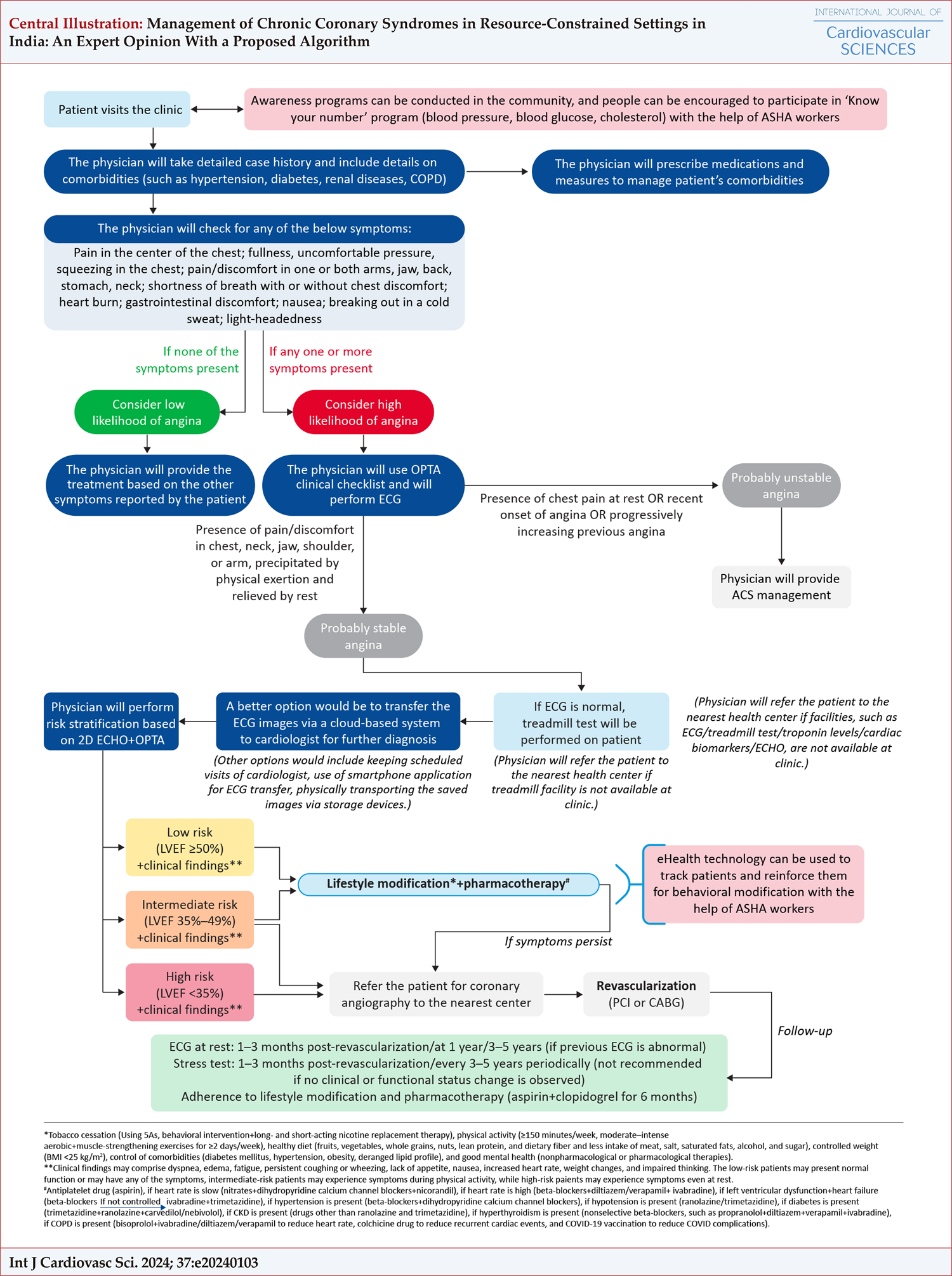
Management of Chronic Coronary Syndromes in Resource-Constrained Settings in India: An Expert Opinion With a Proposed Algorithm
IJCS
Review Article

Management of Chronic Coronary Syndromes in Resource-Constrained Settings in India: An Expert Opinion With a Proposed Algorithm

Vijay Shah et al. Saumitra Ray Devanu Ghosh Roy Samir Kubba … Sarita Rao Jabir Abdullakutty K. P. Suresh Kumar

Abstract

Cardiovascular diseases (CVDs) are associated with considerable morbidity and mortality across the world. The global financial burden caused by CVD emphasizes the importance of preventive strategies and appropriate management. Chronic coronary syndrome (CCS) is a new term recently introduced for stable coronary artery disease (CAD), which is associated with the highest cause-specific mortality in the Indian population. CCS adversely affects the quality of life (QoL) due to anxiety, fatigue, and prolonged disease course. Risk factor modification, adaptation to lifestyle changes, and pharmacotherapy are the optimal treatment options for CCS. Despite the guidelines proposed by numerous groups and societies, such as the European Society of Cardiology (ESC), the American College of Cardiology/American Heart Association (ACC/AHA), and the Taiwan Society of Cardiology, managing CCS in resource-limited situations remains challenging. Lack of awareness about CCS among patients and healthcare professionals (HCPs), limited resources, accessibility and affordability of lifesaving therapies, poor transport facilities for patients, and asymmetrical distribution are among the challenges identified. In India, the scenario of CCS is no different in rural areas and among urban poor populations due to resource constraints. The current expert opinion review based on 48 experts in the field of cardiology from eastern, western, northern, southern, and pan-India regions highlights the management of CCS in resource-constrained settings with a focus on diagnostic modalities, risk stratification, referral pathways, and medical management. Based on expert opinions and a thorough literature search, an algorithm for the management of patients with CCS in resource-constrained settings in India is also proposed.
  • Algorithms
  • Coronary Disease
  • Disease management
  • India
  • Resource-Limited Settings
Read Full Article
Creative Commons Attribution (CC BY) Creative Commons license
10/02/2025 DOI: 10.36660/ijcs.20240103 Views 1
ABC
Editorial

Artificial Algorithms Outperform Traditional Models in Predicting Coronary Artery Disease

Lutfu Askin et al. Okan Tanrıverdi Mustafa Cetin

Recent clinical recommendations indicate that additional tests for assessing anatomical (extent, severity, morphology) or functional (ventricular function, presence/extent of ischemia) aspects of chronic and symptomatic coronary artery disease (CAD) may be helpful in certain cases. Emergency physicians must determine whether to release the patient, do further non-invasive testing, or perform invasive angiography on patients with acute chest discomfort. Accepting anybody with chest pain may have unintended effects if discharged with unstable coronary disease. The likelihood of obstructive CAD should guide medical decisions. Machine learning (ML) algorithms can supplement the diagnostic and prognostic capabilities of conventional regression methods. The disparity between the applicability of such methods and the outcomes achieved with them was due to the data analysis software platforms used.

ML may use thoracic phase signal features to build final mathematical models that evaluate the existence of severe CAD. Cardiac phase space analysis seems similar to the most widely used functional stress tests and needs little patient time. The 2-year results showed that deep learning fractional flow reserve derived from CT (DL-FFRCT) may be used to guide revascularization, with high cancellation rate and low event rate. A positive DL-FFRCT for tandem lesions was linked with reduced major adverse cardiac events (MACEs) after 2 years. The ML-ischemia risk score (ML-IRS) obtained from quantitative coronary CT angiography enhanced the prediction of future revascularization and may be used to identify individuals who are likely to need revascularization if referred for cardiac catheterization. This machine learning score is linked with invasive fractional flow reserve (FFR) measures, providing external validation across two centers and augmenting clinical risk prediction models.

[…]

  • Algorithms
  • Angiography Coronary CT/methods
  • Artificial Intelligence
  • Coronary Artery Disease
  • Deep Learning
  • Machine Learning
  • Support Vector Machine
Read Full Article
Creative Commons Attribution (CC BY) Creative Commons license
03/12/2021 DOI: 10.36660/abc.20210823 Views 2
ABC
Editorial

Simplified Algorithm for Differential Diagnosis of Tachycardias with Wide QRS. Is this the Best Way to Train Young Doctors?

Enrique Indalécio Pachón Mateo

To make the correct diagnosis of ventricular tachycardia in an emergency room (ER), with little time for decision-making and based only on the electrocardiogram is a challenge that depends on a lot of preparation by the doctor. Any instrument that facilitates and streamlines this process, especially increasing the degree of accuracy, is also worthy of praise, especially considering that the physician on duty is not always a cardiologist, or even less likely an arrhythmologist, sufficiently trained to make an accurate diagnosis.

An episode of ventricular tachycardia, supraventricular tachycardia (in a patient with a previous conduction disorder or with a conduction aberrancy) and supraventricular tachycardia caused by anomalous bundles may show similar electrocardiographic tracings, which are sometimes very difficult to differentiate, making the medical decision a risk to the patient’s life. To make this differentiation possible, several algorithms have been created that use electrocardiographic signals to assist and allow the correct diagnosis to be made and, consequently, to establish the adequate treatment, as in the case of the Brugada algorithm which is widely known (and that in fact is a combination of Brugada and Wellens criteria), as well as Vereckei and Pava criteria among others. All the created algorithms have sensitivity and specificity (S/E) variables that make them more or less accurate; however, in the same proportion, these algorithms can be simpler, or more complex (depending on the operator’s better training and greater time to reach the diagnosis).

[…]

  • Algorithms
  • Diagnosis
  • First Aid
  • Tachycardia, Emergencies
Read Full Article
Creative Commons Attribution (CC BY) Creative Commons license
23/04/2021 DOI: 10.36660/abc.20201344 Views 2
ABC
Editorial

Ventricular Repolarization as a Tool to Monitor Electrical Activity of the Heart

Marcelo Souto Nacif

Acute pulmonary embolism has a heterogeneous clinical presentation and the development of clinical tools for better stratification of the patients prognosis is extremely desired. Being able to discern which patient is most likely to have complications or even death is critical in the age of precision medicine. This may assist in choosing a more intensive and individualized treatment.

Computed tomography pulmonary angiography (CTPA) is already the most used method in emergencies for the diagnosis and stratification of patients with APE. The great variability of clinical presentations, whether in patients with cancer or different thrombogenic conditions, makes some quantitative data more attractive than just the qualitative analysis of the exam.–

[…]

  • acute
  • Algorithms
  • Artificial Intelligence/trends
  • Compute Tomography/methods
  • Precision Medicine
  • Prognosis
  • Pulmonary Embolism/complications
  • Software
Read Full Article
Creative Commons Attribution (CC BY) Creative Commons license
07/12/2020 DOI: 10.36660/abc.20200959 Views 1
Adaptation and applicability of a diuretic algorithm for patients with heart failure
ABC
Artigo Original

Adaptation and applicability of a diuretic algorithm for patients with heart failure

Maria Karolina Echer Ferreira Feijó et al. Andreia Biolo Eneida Rejane Rabelo-Silva

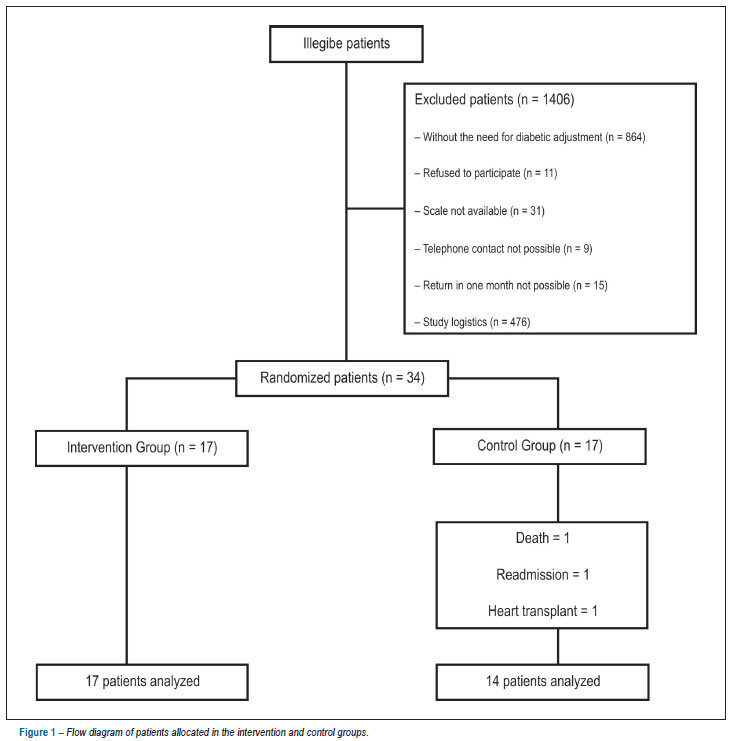
BACKGROUND: Congestive states can be identified and managed through algorithms such as the Diuretic Treatment Algorithm (DTA) to adjust the diuretic over the telephone, focused on the clinical evaluation. However, the DTA is currently available only in English. OBJECTIVE: To adapt the DTA and test its applicability for Brazil in outpatients with heart failure. METHODS: The stages of translation, synthesis, back-translation, review by an expert committee, and pre-test (clinical applicability by means of a random clinical trial) were followed. The Brazilian version of the DTA was called algoritmo de ajuste de diurético (AAD; as per its acronym in Portuguese, standing for diuretic adjustment algorithm). Patients were randomized to the intervention group (IG) – diuretic adjustment according to the AAD – or control group (CG) – conventional adjustment. The clinical congestion score (CCS) and weight values were obtained for both groups. Results: A total of 12 changes were made to the DTA. Thirty-four patients were included. For those with congestion, the increase in the diuretic as guided by the AAD solved their condition, reducing the CCS by two points for 50% of the sample -2 (-3.5; -1.0), while the median for the CG was 0 (-1.25; -1.0), (p < 0.001). The median for weight variation was greater in IG -1.4 (-1.7; -0.5) compared to the CG 0.1 (1.2; -0.6), p = 0.001. CONCLUSIONS: The AAD proved applicable in clinical practice after adaption and appears to result in better congestion management in patients with heart failure. The clinical effectiveness of the tool should be tested in a larger patient sample aiming at validating the instrument for Brazil (Universal Trial Number: U1111-1130-5749) (Arq Bras Cardiol. 2013; [online].ahead print, PP.0-0).

  • Algorithms
  • Diuretics
  • Heart Failure
Read Full Article
Creative Commons Attribution (CC BY) Creative Commons license
19/04/2013 DOI: 10.5935/abc.20130089 Views 2

How to cite this article

EndNote RIS

Electronic Document Format (Vancouver)

Shah V, Ray S, Roy DG, Kubba S, Rao S, Abdullakutty J, Kumar KPS, et al. Management of Chronic Coronary Syndromes in Resource-Constrained Settings in India: An Expert Opinion With a Proposed Algorithm. International Journal of Cardiovascular Sciences 2025;38:e20240103.

Electronic Document Format (ABNT)

Shah, Vijay; Ray, Saumitra; Roy, Devanu Ghosh; Kubba, Samir; Rao, Sarita; Abdullakutty, Jabir; Kumar, K. P. Suresh. Management of Chronic Coronary Syndromes in Resource-Constrained Settings in India: An Expert Opinion With a Proposed Algorithm. International Journal of Cardiovascular Sciences, v. 38, e20240103, Feb. 2025.

Electronic Document Format (APA)

Shah, V., Ray, S., Roy, D. G., Kubba, S., Rao, S., Abdullakutty, J., & Kumar, K. P. S. (2025). Management of Chronic Coronary Syndromes in Resource-Constrained Settings in India: An Expert Opinion With a Proposed Algorithm. International Journal of Cardiovascular Sciences, 38, e20240103.

Electronic Document Format (ISO)

Shah, Vijay and Ray, Saumitra and Roy, Devanu Ghosh and Kubba, Samir and Rao, Sarita and Abdullakutty, Jabir and Kumar, K. P. Suresh. Management of Chronic Coronary Syndromes in Resource-Constrained Settings in India: An Expert Opinion With a Proposed Algorithm. International Journal of Cardiovascular Sciences [online]. 2025, vol. 38, [cited 2026-10-14], e20240103. Available from: <https://journals.cardiol.br/en/article/management-of-chronic-coronary-syndromes-in-resource-constrained-settings-in-india-an-expert-opinion-with-a-proposed-algorithm/>. ISSN 2359-4802

EndNote RIS

Electronic Document Format (Vancouver)

Askin L, Tanrıverdi O, Cetin M. Artificial Algorithms Outperform Traditional Models in Predicting Coronary Artery Disease. Arquivos Brasileiros de Cardiologia 2021;117(6):1071-2.

Electronic Document Format (ABNT)

Askin, Lutfu; Tanrıverdi, Okan; Cetin, Mustafa. Artificial Algorithms Outperform Traditional Models in Predicting Coronary Artery Disease. Arquivos Brasileiros de Cardiologia, v. 117, n. 6, p. 1071-1072, Dec. 2021.

Electronic Document Format (APA)

Askin, L., Tanrıverdi, O., & Cetin, M. (2021). Artificial Algorithms Outperform Traditional Models in Predicting Coronary Artery Disease. Arquivos Brasileiros de Cardiologia, 117(6), 1071-1072.

Electronic Document Format (ISO)

Askin, Lutfu and Tanrıverdi, Okan and Cetin, Mustafa. Artificial Algorithms Outperform Traditional Models in Predicting Coronary Artery Disease. Arquivos Brasileiros de Cardiologia [online]. 2021, vol. 117, n. 6, [cited 2026-10-14], pp. 1071-1072. Available from: <https://journals.cardiol.br/en/article/artificial-algorithms-outperform-traditional-models-in-predicting-coronary-artery-disease/>. ISSN 0066-782X

EndNote RIS

Electronic Document Format (Vancouver)

Mateo EIP. Simplified Algorithm for Differential Diagnosis of Tachycardias with Wide QRS. Is this the Best Way to Train Young Doctors?. Arquivos Brasileiros de Cardiologia 2021;116(3):464-5.

Electronic Document Format (ABNT)

Mateo, Enrique Indalécio Pachón. Simplified Algorithm for Differential Diagnosis of Tachycardias with Wide QRS. Is this the Best Way to Train Young Doctors?. Arquivos Brasileiros de Cardiologia, v. 116, n. 3, p. 464-465, Apr. 2021.

Electronic Document Format (APA)

Mateo, E. I. P. (2021). Simplified Algorithm for Differential Diagnosis of Tachycardias with Wide QRS. Is this the Best Way to Train Young Doctors?. Arquivos Brasileiros de Cardiologia, 116(3), 464-465.

Electronic Document Format (ISO)

Mateo, Enrique Indalécio Pachón. Simplified Algorithm for Differential Diagnosis of Tachycardias with Wide QRS. Is this the Best Way to Train Young Doctors?. Arquivos Brasileiros de Cardiologia [online]. 2021, vol. 116, n. 3, [cited 2026-10-14], pp. 464-465. Available from: <https://journals.cardiol.br/en/article/simplified-algorithm-for-differential-diagnosis-of-tachycardias-with-wide-qrs-is-this-the-best-way-to-train-young-doctors/>. ISSN 0066-782X

EndNote RIS

Electronic Document Format (Vancouver)

Nacif MS. Ventricular Repolarization as a Tool to Monitor Electrical Activity of the Heart. Arquivos Brasileiros de Cardiologia 2020;115(5):819-20.

Electronic Document Format (ABNT)

Nacif, Marcelo Souto. Ventricular Repolarization as a Tool to Monitor Electrical Activity of the Heart. Arquivos Brasileiros de Cardiologia, v. 115, n. 5, p. 819-820, Dec. 2020.

Electronic Document Format (APA)

Nacif, M. S. (2020). Ventricular Repolarization as a Tool to Monitor Electrical Activity of the Heart. Arquivos Brasileiros de Cardiologia, 115(5), 819-820.

Electronic Document Format (ISO)

Nacif, Marcelo Souto. Ventricular Repolarization as a Tool to Monitor Electrical Activity of the Heart. Arquivos Brasileiros de Cardiologia [online]. 2020, vol. 115, n. 5, [cited 2026-10-14], pp. 819-820. Available from: <https://journals.cardiol.br/en/article/ventricular-repolarization-as-a-tool-to-monitor-electrical-activity-of-the-heart-2/>. ISSN 0066-782X

EndNote RIS

Electronic Document Format (Vancouver)

Feijó MKEF, Biolo A, Rabelo-Silva ER. Adaptation and applicability of a diuretic algorithm for patients with heart failure. Arquivos Brasileiros de Cardiologia 2013;100(6):553-60.

Electronic Document Format (ABNT)

Feijó, Maria Karolina Echer Ferreira; Biolo, Andreia; Rabelo-Silva, Eneida Rejane. Adaptation and applicability of a diuretic algorithm for patients with heart failure. Arquivos Brasileiros de Cardiologia, v. 100, n. 6, p. 553-560, Apr. 2013.

Electronic Document Format (APA)

Feijó, M. K. E. F., Biolo, A., & Rabelo-Silva, E. R. (2013). Adaptation and applicability of a diuretic algorithm for patients with heart failure. Arquivos Brasileiros de Cardiologia, 100(6), 553-560.

Electronic Document Format (ISO)

Feijó, Maria Karolina Echer Ferreira and Biolo, Andreia and Rabelo-Silva, Eneida Rejane. Adaptation and applicability of a diuretic algorithm for patients with heart failure. Arquivos Brasileiros de Cardiologia [online]. 2013, vol. 100, n. 6, [cited 2026-10-14], pp. 553-560. Available from: <https://journals.cardiol.br/en/article/adaptation-and-applicability-of-a-diuretic-algorithm-for-patients-with-heart-failure/>. ISSN 0066-782X

  • About ABC Family
  • Internal Regulation
  • Editorial Board
  • Brazilian Society of Cardiology (SBC)

Issues

SBC Guidelines

  • Videos
  • Podcasts
  • News