ABC Family Arquivos Brasileiros de Cardiologia International Journal of Cardiovascular Sciences ABC Heart Failure & Cardiomyopathy ABC Imagem Cardiovascular
Português English
ABC Family
Português English
  • About
    • About ABC Family
    • Internal Regulation
    • Editorial Board
    • Brazilian Society of Cardiology (SBC)
  • Issues
  • SBC Guidelines
  • Content
    • Videos
    • Podcasts
    • News
  • About
    • About ABC Family
    • Internal Regulation
    • Editorial Board
    • Brazilian Society of Cardiology (SBC)
  • Issues
  • SBC Guidelines
  • Content
    • Videos
    • Podcasts
    • News

ABC Family

  • ABC Family
  • Arquivos Brasileiros de Cardiologia
  • International Journal of Cardiovascular Sciences
  • ABC Heart Failure & Cardiomyopathy
  • ABC Imagem Cardiovascular
Search in

No content found.

Journals
Ordering
Article types
Others

  1. Home
  2. Keyword: Myocardial Ischemic
Central Illustration
ABC
Original Article

Investigation of the Relationship Between Triglycerides-Glucose İndex and Coronary Slow Flow: A Retrospective Case-Control Study

Mustafa Kaplangoray et al. Kenan Toprak Fuat Başanalan Ali Palice … Cihan Aydın Aykut Demirkıran Yusuf Cekici

Abstract

Background

Coronary slow flow (CSF) refers to delayed distal vessel opacification in the absence of epicardial coronary artery stenosis. The etiopathogenic mechanism of CSF is still unclear.

Objectives

This study investigates the relationship between CSF and the triglyceride-glucose (TyG) index.

Methods

The study sample consisted of 118 CSF patients and 105 patients with normal coronary flow (NCF). The coronary flow rate was measured via the Thrombolysis in Myocardial Infarction (TIMI) frame count (TFC) method in all patients. The TyG index was calculated as the logarithm of the [fasting triglyceride (mg/dL)×fasting glucose (mg/dL)]/2 value. A significance level of < 0.05 was adopted as statistically significant.

Results

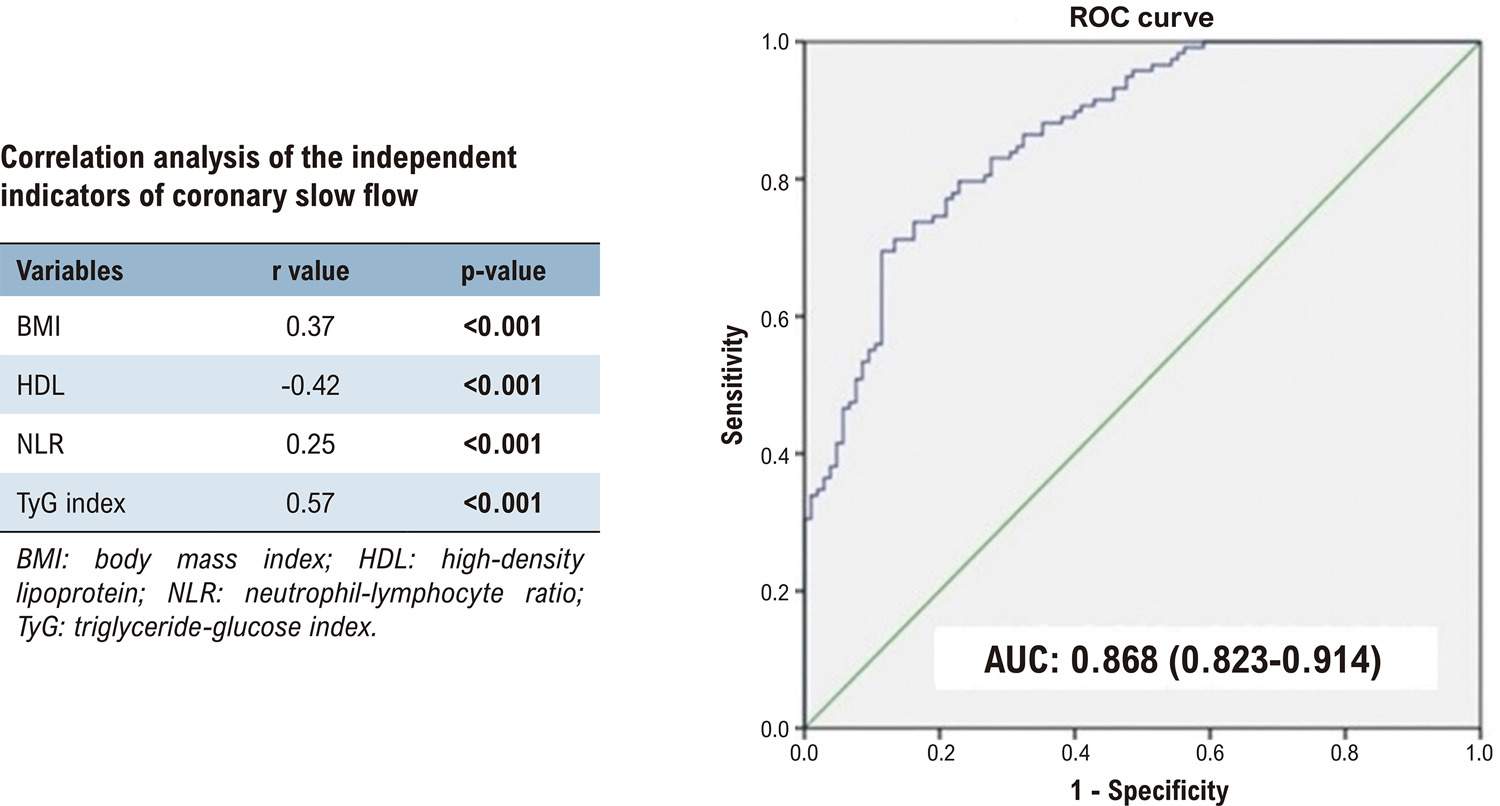
The TyG index, low-density lipoprotein (LDL), body mass index (BMI), neutrophil-to-lymphocyte ratio (NLR) and TFC values, male ratio, and the ratio of smokers were higher, whereas high-density lipoprotein (HDL) levels were significantly lower in the CSF group compared to the NCF group (p<0,05). The correlation analysis revealed that CSF was significantly correlated with TyG index, BMI, NLR, and HDL values. The strongest of these correlations was between CSF and TyG index (r= 0.57, p<0.001). Additionally, the multivariate analysis revealed that TyG index, BMI, NLR ratio, and male gender were independent predictors for CSF (p<0.05). Receiver operating characteristic (ROC) curve analysis indicated that a cut-off value of ≥ 9.28 for the TyG index predicted CSF with a sensitivity of 78% and a specificity of 78.1% [Area under the curve (AUC): 0.868 and 95% Confidence Interval (CI): 0.823-0.914].

Conclusion

The findings of this study revealed a very strong relationship between CSF and TyG index.
  • Blood flow velocity
  • Coronary Artery Disease
  • LDL
  • Lipoproteins
  • Myocardial Ischemic
  • Triglicerideos-Glucose
Read Full Article
Creative Commons Attribution (CC BY) Creative Commons license
26/05/2023 DOI: 10.36660/abc.20220679 Views 1
Figure 1
ABC
Original Article

Diagnostic Performance of a Machine Learning-Based CT-Derived FFR in Detecting Flow-Limiting Stenosis

Thamara Carvalho Morais et al. Antonildes Nascimento Assunção-Jr Roberto Nery Dantas Júnior Carla Franco Grego da Silva … Caroline Bastida de Paula Roberto Almeida Torres Tiago Augusto Magalhães César Higa Nomura Luiz Francisco Rodrigues de Ávila José Rodrigues Parga Filho

Abstract

Background

The non-invasive quantification of the fractional flow reserve (FFRCT) using a more recent version of an artificial intelligence-based software and latest generation CT scanner (384 slices) may show high performance to detect coronary ischemia.

Objectives

To evaluate the diagnostic performance of FFRCT for the detection of significant coronary artery disease (CAD) in contrast to invasive FFR (iFFR) using previous generation CT scanners (128 and 256- detector rows).

Methods

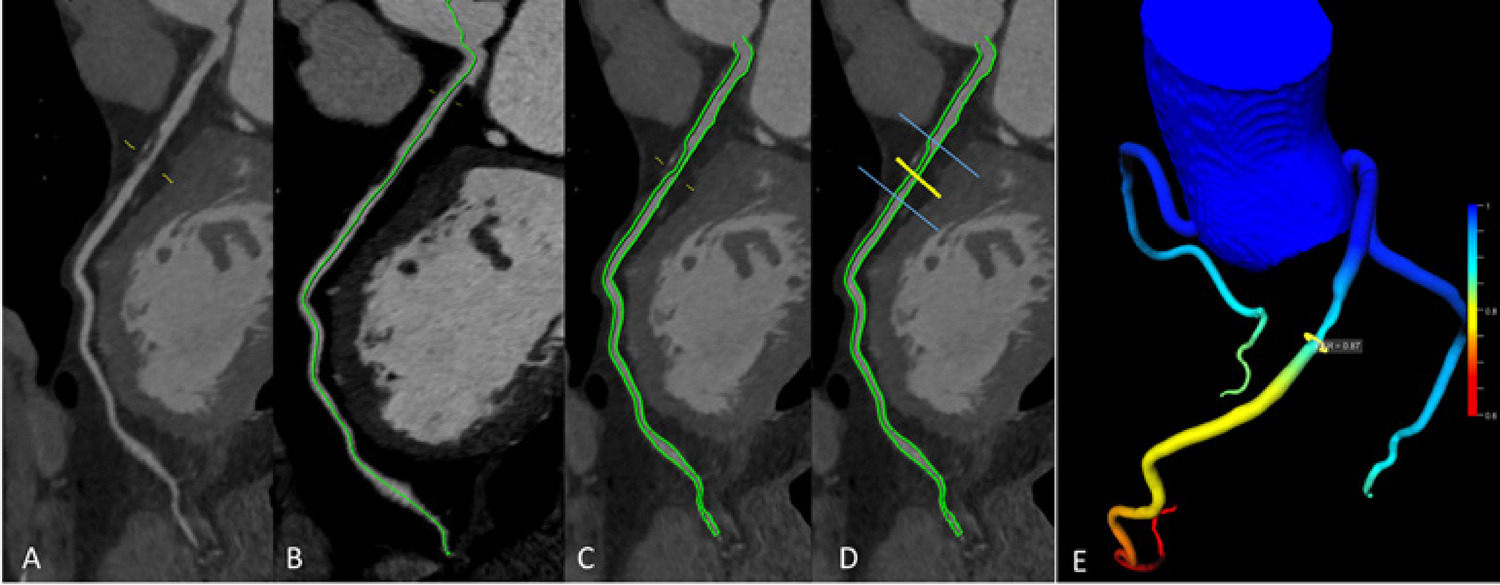
Retrospective study with patients referred to coronary artery CT angiography (CTA) and catheterization (iFFR) procedures. Siemens Somatom Definition Flash (256-detector rows) and AS+ (128-detector rows) CT scanners were used to acquire the images. The FFRCT and the minimal lumen area (MLA) were evaluated using a dedicated software (cFFR version 3.0.0, Siemens Healthineers, Forchheim, Germany). Obstructive CAD was defined as CTA lumen reduction ≥ 50%, and flow-limiting stenosis as iFFR ≤0.8. All reported P values are two-tailed, and when <0.05, they were considered statistically significant.

Results

Ninety-three consecutive patients (152 vessels) were included. There was good agreement between FFRCT and iFFR, with minimal FFRCT overestimation (bias: -0.02; limits of agreement:0.14-0.09). Different CT scanners did not modify the association between FFRCT and FFRi (p for interaction=0.73). The performance of FFRCT was significantly superior compared to the visual classification of coronary stenosis (AUC 0.93vs.0.61, p<0.001) and to MLA (AUC 0.93vs.0.75, p<0.001), reducing the number of false-positive cases. The optimal cut-off point for FFRCT using a Youden index was 0.85 (87% Sensitivity, 86% Specificity, 73% PPV, 94% NPV), with a reduction of false-positives.

Conclusion

Machine learning-based FFRCT using previous generation CT scanners (128 and 256-detector rows) shows good diagnostic performance for the detection of CAD, and can be used to reduce the number of invasive procedures.

  • Computed Tomography
  • Coronary Artery Disease
  • Machine Learning
  • Myocardial Fractional Flow Reserve
  • Myocardial Ischemic
Read Full Article
Creative Commons Attribution (CC BY) Creative Commons license
14/06/2021 DOI: 10.36660/abc.20190329 Views 2
ABC
Editorial

No Reflow in Acute Coronary Syndromes: An Old Foe or a New Frontier?

Stefano Garzon

According to the World Health Organization (WHO), ischemic heart disease is the leading cause of death worldwide, accounting for 16% of the world’s deaths in 2019. However, due to continuous evolution in medical treatment and revascularization techniques, a steady decline in death rates in acute coronary syndromes (ACS) has been observed in recent years.

Currently, percutaneous coronary intervention (PCI) is the gold-standard treatment for ST-elevation myocardial infarction (STEMI) and a mainstay therapeutic option for non-STEMI ACS and stable coronary artery disease. Nonetheless, and particularly in STEMI patients, PCI can be very challenging at times. One of the most dreaded events during PCI in STEMI is the phenomenon commonly referred as “no-reflow”, an impaired myocardial perfusion secondary to microvascular obstruction without angiographic evidence of coronary obstruction(6). Initially described in animal models,, it was also recognized in humans in the following decades,, being first described after PCI for STEMI by Feld in 1992. Its occurrence is related to poorer short- and long-term outcomes following PCI,, and it is present in more than 20% of patients undergoing primary PCI for STEMI.

[…]

  • Cardiovascular Diseases, mortality
  • Coronary Artery Disease
  • Myocardial Infarction
  • Myocardial Ischemic
  • percutaneous coronary interventions
  • Risk Factors
  • Vascular Resistance
Read Full Article
Creative Commons Attribution (CC BY) Creative Commons license
17/05/2021 DOI: 10.36660/abc.20210118 Views 1

How to cite this article

EndNote RIS

Electronic Document Format (Vancouver)

Kaplangoray M, Toprak K, Başanalan F, Palice A, Aydın C, Demirkıran A, Cekici Y, et al. Investigation of the Relationship Between Triglycerides-Glucose İndex and Coronary Slow Flow: A Retrospective Case-Control Study. Arquivos Brasileiros de Cardiologia 2023;120(6):e20220679.

Electronic Document Format (ABNT)

Kaplangoray, Mustafa; Toprak, Kenan; Başanalan, Fuat; Palice, Ali; Aydın, Cihan; Demirkıran, Aykut; Cekici, Yusuf. Investigation of the Relationship Between Triglycerides-Glucose İndex and Coronary Slow Flow: A Retrospective Case-Control Study. Arquivos Brasileiros de Cardiologia, v. 120, n. 6, e20220679, May. 2023.

Electronic Document Format (APA)

Kaplangoray, M., Toprak, K., Başanalan, F., Palice, A., Aydın, C., Demirkıran, A., & Cekici, Y. (2023). Investigation of the Relationship Between Triglycerides-Glucose İndex and Coronary Slow Flow: A Retrospective Case-Control Study. Arquivos Brasileiros de Cardiologia, 120(6), e20220679.

Electronic Document Format (ISO)

Kaplangoray, Mustafa and Toprak, Kenan and Başanalan, Fuat and Palice, Ali and Aydın, Cihan and Demirkıran, Aykut and Cekici, Yusuf. Investigation of the Relationship Between Triglycerides-Glucose İndex and Coronary Slow Flow: A Retrospective Case-Control Study. Arquivos Brasileiros de Cardiologia [online]. 2023, vol. 120, n. 6, [cited 2026-10-14], e20220679. Available from: <https://journals.cardiol.br/en/article/investigation-of-the-relationship-between-triglycerides-glucose-index-and-coronary-slow-flow-a-retrospective-case-control-study/>. ISSN 0066-782X

EndNote RIS

Electronic Document Format (Vancouver)

Morais TC, Assunção-Jr AN, Dantas Júnior RN, Silva CFG, Paula CB, Torres RA, Magalhães TA, et al. Diagnostic Performance of a Machine Learning-Based CT-Derived FFR in Detecting Flow-Limiting Stenosis. Arquivos Brasileiros de Cardiologia 2021;116(6):1091-8.

Electronic Document Format (ABNT)

Morais, Thamara Carvalho; Assunção-Jr, Antonildes Nascimento; Dantas Júnior, Roberto Nery; Silva, Carla Franco Grego da; Paula, Caroline Bastida de; Torres, Roberto Almeida; Magalhães, Tiago Augusto; Nomura, César Higa; Ávila, Luiz Francisco Rodrigues de; Parga Filho, José Rodrigues. Diagnostic Performance of a Machine Learning-Based CT-Derived FFR in Detecting Flow-Limiting Stenosis. Arquivos Brasileiros de Cardiologia, v. 116, n. 6, p. 1091-1098, Jun. 2021.

Electronic Document Format (APA)

Morais, T. C., Assunção-Jr, A. N., Dantas Júnior, R. N., Silva, C. F. G. , Paula, C. B. , Torres, R. A., Magalhães, T. A., Nomura, C. H., Ávila, L. F. R. , & Parga Filho, J. R. (2021). Diagnostic Performance of a Machine Learning-Based CT-Derived FFR in Detecting Flow-Limiting Stenosis. Arquivos Brasileiros de Cardiologia, 116(6), 1091-1098.

Electronic Document Format (ISO)

Morais, Thamara Carvalho and Assunção-Jr, Antonildes Nascimento and Dantas Júnior, Roberto Nery and Silva, Carla Franco Grego da and Paula, Caroline Bastida de and Torres, Roberto Almeida and Magalhães, Tiago Augusto and Nomura, César Higa and Ávila, Luiz Francisco Rodrigues de and Parga Filho, José Rodrigues. Diagnostic Performance of a Machine Learning-Based CT-Derived FFR in Detecting Flow-Limiting Stenosis. Arquivos Brasileiros de Cardiologia [online]. 2021, vol. 116, n. 6, [cited 2026-10-14], pp. 1091-1098. Available from: <https://journals.cardiol.br/en/article/diagnostic-performance-of-a-machine-learning-based-ct-derived-ffr-in-detecting-flow-limiting-stenosis/>. ISSN 0066-782X

EndNote RIS

Electronic Document Format (Vancouver)

Garzon S. No Reflow in Acute Coronary Syndromes: An Old Foe or a New Frontier?. Arquivos Brasileiros de Cardiologia 2021;116(5):968-9.

Electronic Document Format (ABNT)

Garzon, Stefano. No Reflow in Acute Coronary Syndromes: An Old Foe or a New Frontier?. Arquivos Brasileiros de Cardiologia, v. 116, n. 5, p. 968-969, May. 2021.

Electronic Document Format (APA)

Garzon, S. (2021). No Reflow in Acute Coronary Syndromes: An Old Foe or a New Frontier?. Arquivos Brasileiros de Cardiologia, 116(5), 968-969.

Electronic Document Format (ISO)

Garzon, Stefano. No Reflow in Acute Coronary Syndromes: An Old Foe or a New Frontier?. Arquivos Brasileiros de Cardiologia [online]. 2021, vol. 116, n. 5, [cited 2026-10-14], pp. 968-969. Available from: <https://journals.cardiol.br/en/article/no-reflow-in-acute-coronary-syndromes-an-old-foe-or-a-new-frontier/>. ISSN 0066-782X

  • About ABC Family
  • Internal Regulation
  • Editorial Board
  • Brazilian Society of Cardiology (SBC)

Issues

SBC Guidelines

  • Videos
  • Podcasts
  • News