ABC Family Arquivos Brasileiros de Cardiologia International Journal of Cardiovascular Sciences ABC Heart Failure & Cardiomyopathy ABC Imagem Cardiovascular
Português English
ABC Family
Português English
  • About
    • About ABC Family
    • Internal Regulation
    • Editorial Board
    • Brazilian Society of Cardiology (SBC)
  • Issues
  • SBC Guidelines
  • Content
    • Videos
    • Podcasts
    • News
  • About
    • About ABC Family
    • Internal Regulation
    • Editorial Board
    • Brazilian Society of Cardiology (SBC)
  • Issues
  • SBC Guidelines
  • Content
    • Videos
    • Podcasts
    • News

ABC Family

  • ABC Family
  • Arquivos Brasileiros de Cardiologia
  • International Journal of Cardiovascular Sciences
  • ABC Heart Failure & Cardiomyopathy
  • ABC Imagem Cardiovascular
Search in

No content found.

Journals
Ordering
Article types
Others

  1. Home
  2. Keyword: Neural Network
ABC
Editorial

Applicability of Machine Learning Algorithms in the Diagnosis of Arrhythmias – How Long Until The Machine Starts Teaching Us?

Marcelo Martins Pinto Filho

The electrocardiogram (ECG), in clinical use since the early 1900s, remains a beloved tool for cardiologists, clinicians, and medical students. It is arguably the most important bedside instrument in cardiology, essential for managing arrhythmias and acute ischemic syndromes, as well as guiding electrophysiologic care. Still, advances in electrocardiography interpretation have been only modest in the last hundred years. Devices have become more portable, digital, and capable of longer recordings, but core interpretive principles remain rooted in early 20th-century methods. In recent years, this has been reshaped by the rise of computational technologies, especially artificial intelligence (AI). Tools such as deep neural networks (DNNs) and machine learning models (MLMs) are enabling a new era in ECG analysis, the AI-enhanced electrocardiography (AI-enhanced ECG).

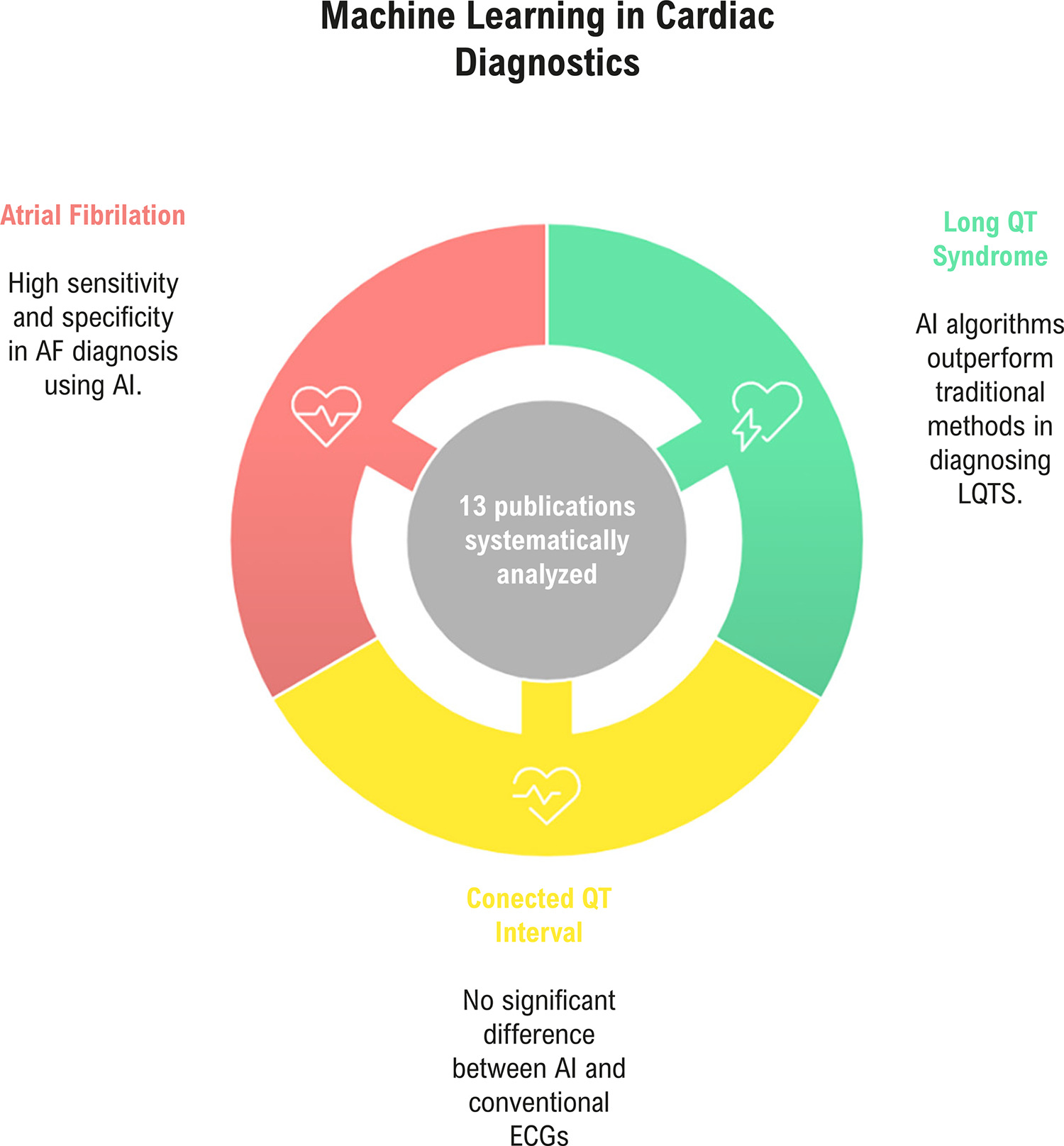
In this issue of the ABC Cardiol, Guimarães do Nascimento et al. report on a systematic review of studies evaluating the applicability of AI-enhanced ECG in the diagnosis of cardiac arrhythmias. They included studies of different methodologies that addressed the role of AI-enhanced ECG in the detection of long-QT syndrome (LQTS) (one study), corrected QT interval (cQTi) (one study), and atrial fibrillation (AF) (eleven studies).

[…]

  • Artificial Intelligence
  • Cardiac, Arrhythmia
  • electrocardiogram
  • Machine Learning
  • Neural Network
Read Full Article
Creative Commons Attribution (CC BY) Creative Commons license
19/09/2025 DOI: 10.36660/abc.20250405i Views 2
Applicability of Machine Learning Algorithms in Diagnosis of Atrial Fibrillation and LQTS by Electrocardiogram Interpretation: A Systematic Review
ABC
Original Article

Applicability of Machine Learning Algorithms in Diagnosis of Atrial Fibrillation and LQTS by Electrocardiogram Interpretation: A Systematic Review

Paulo Cainan Guimarães do Nascimento et al. Matthews Silva Martins Alex Cleber Improta-Caria Roque Aras Junior

Abstract

Background

Machine Learning (ML) is a type of algorithm that autonomously learns to recognize complex patterns. In the diagnostic context of cardiac arrhythmias, these algorithms have shown significant advancements due to their ability to provide automated interpretation and pattern recognition in electrocardiograms (ECGs).

Objective

To analyze and identify the applicability, validity, and feasibility of ML algorithm models in the diagnostic process of cardiac arrhythmias through automated electrocardiogram interpretation.

Methods

This systematic literature review was reported according to the PRISMA guidelines. The searches were conducted in the Cochrane Library, EMBASE, LILACS, and PubMed between February 2022 and November 2022. The study period encompasses articles published between 2017 and 2022.

Results

The database search yielded 119 results, covering three subthemes: Long QT Syndrome (LQTS), corrected QT interval (QTc), and atrial fibrillation (AF). AF was the most prevalent theme. The sample sizes were quite variable. The outcomes were mostly satisfactory. In the diagnosis of LQTS using Artificial Intelligence (AI), the algorithm outperformed conventional methods in diagnostic distinction. In the evaluation of QTc, there was no difference between the AI-integrated ECG and the conventional ECG. In the diagnosis of AF, the algorithms, models, and devices demonstrated high sensitivity and specificity, along with greater accuracy.

Conclusion

ML models in the diagnostic process of cardiac arrhythmias are feasible and rapidly developing. They demonstrate accuracy values between 96.4% and 98.2%, sensitivity between 92.8% and 99.4%, and specificity between 95% and 98.1%, particularly in the diagnosis of atrial fibrillation.

  • Artificial Intelligence
  • Cardiac Arrhythmias
  • Electrocardiography
  • Machine Learning
  • Neural Network
Read Full Article
Creative Commons Attribution (CC BY) Creative Commons license
01/09/2025 DOI: 10.36660/abc.20240843i Views 1

How to cite this article

EndNote RIS

Electronic Document Format (Vancouver)

Pinto Filho MM. Applicability of Machine Learning Algorithms in the Diagnosis of Arrhythmias – How Long Until The Machine Starts Teaching Us?. Arquivos Brasileiros de Cardiologia 2025;122(8):e20250405.

Electronic Document Format (ABNT)

Pinto Filho, Marcelo Martins. Applicability of Machine Learning Algorithms in the Diagnosis of Arrhythmias – How Long Until The Machine Starts Teaching Us?. Arquivos Brasileiros de Cardiologia, v. 122, n. 8, e20250405, Sep. 2025.

Electronic Document Format (APA)

Pinto Filho, M. M. (2025). Applicability of Machine Learning Algorithms in the Diagnosis of Arrhythmias – How Long Until The Machine Starts Teaching Us?. Arquivos Brasileiros de Cardiologia, 122(8), e20250405.

Electronic Document Format (ISO)

Pinto Filho, Marcelo Martins. Applicability of Machine Learning Algorithms in the Diagnosis of Arrhythmias – How Long Until The Machine Starts Teaching Us?. Arquivos Brasileiros de Cardiologia [online]. 2025, vol. 122, n. 8, [cited 2026-10-14], e20250405. Available from: <https://journals.cardiol.br/en/article/applicability-of-machine-learning-algorithms-in-the-diagnosis-of-arrhythmias-how-long-until-the-machine-starts-teaching-us/>. ISSN 0066-782X

EndNote RIS

Electronic Document Format (Vancouver)

Nascimento PCG, Martins MS, Improta-Caria AC, Aras Junior R. Applicability of Machine Learning Algorithms in Diagnosis of Atrial Fibrillation and LQTS by Electrocardiogram Interpretation: A Systematic Review. Arquivos Brasileiros de Cardiologia 2025;122(8):e20240843.

Electronic Document Format (ABNT)

Nascimento, Paulo Cainan Guimarães do; Martins, Matthews Silva; Improta-Caria, Alex Cleber; Aras Junior, Roque. Applicability of Machine Learning Algorithms in Diagnosis of Atrial Fibrillation and LQTS by Electrocardiogram Interpretation: A Systematic Review. Arquivos Brasileiros de Cardiologia, v. 122, n. 8, e20240843, Aug. 2025.

Electronic Document Format (APA)

Nascimento, P. C. G. , Martins, M. S., Improta-Caria, A. C., & Aras Junior, R. (2025). Applicability of Machine Learning Algorithms in Diagnosis of Atrial Fibrillation and LQTS by Electrocardiogram Interpretation: A Systematic Review. Arquivos Brasileiros de Cardiologia, 122(8), e20240843.

Electronic Document Format (ISO)

Nascimento, Paulo Cainan Guimarães do and Martins, Matthews Silva and Improta-Caria, Alex Cleber and Aras Junior, Roque. Applicability of Machine Learning Algorithms in Diagnosis of Atrial Fibrillation and LQTS by Electrocardiogram Interpretation: A Systematic Review. Arquivos Brasileiros de Cardiologia [online]. 2025, vol. 122, n. 8, [cited 2026-10-14], e20240843. Available from: <https://journals.cardiol.br/en/article/applicability-of-machine-learning-algorithms-in-diagnosis-of-atrial-fibrillation-and-lqts-by-electrocardiogram-interpretation-a-systematic-review/>. ISSN 0066-782X

  • About ABC Family
  • Internal Regulation
  • Editorial Board
  • Brazilian Society of Cardiology (SBC)

Issues

SBC Guidelines

  • Videos
  • Podcasts
  • News