ABC Family Arquivos Brasileiros de Cardiologia International Journal of Cardiovascular Sciences ABC Heart Failure & Cardiomyopathy ABC Imagem Cardiovascular
Português English
ABC Family
Português English
  • About
    • About ABC Family
    • Internal Regulation
    • Editorial Board
    • Brazilian Society of Cardiology (SBC)
  • Issues
  • SBC Guidelines
  • Content
    • Videos
    • Podcasts
    • News
  • About
    • About ABC Family
    • Internal Regulation
    • Editorial Board
    • Brazilian Society of Cardiology (SBC)
  • Issues
  • SBC Guidelines
  • Content
    • Videos
    • Podcasts
    • News

ABC Family

  • ABC Family
  • Arquivos Brasileiros de Cardiologia
  • International Journal of Cardiovascular Sciences
  • ABC Heart Failure & Cardiomyopathy
  • ABC Imagem Cardiovascular
Search in

No content found.

Journals
Ordering
Article types
Others

  1. Home
  2. Keyword: Deep Learning
Central Illustration
ABCHF
Original Article

Global Mapping of Research on Artificial Intelligence Applied to Myocarditis

Guilherme Cesar Fernandes de Oliveira da Costa et al. Jose Gregorio Valero Rodriguez Giulia Fernandes de Oliveira da Costa Adriana Munford Lima Pimentel Evandro Tinoco Mesquita

Abstract

Background

Myocarditis remains a diagnostic challenge, and interest in using artificial intelligence to support noninvasive diagnostic evaluation has grown rapidly. Although the literature at the intersection of artificial intelligence and myocarditis has expanded substantially, it remains fragmented and lacks comprehensive synthesis.

Objectives

To map the global scientific output on the application of artificial intelligence to myocarditis by identifying leading contributors, collaboration patterns, and emerging thematic trends.

Methods

We conducted a bibliometric analysis of articles on artificial intelligence applied to myocarditis indexed in the Web of Science Core Collection. The R package bibliometrix and VOSviewer were used to perform bibliometric network and thematic analyses.

Results

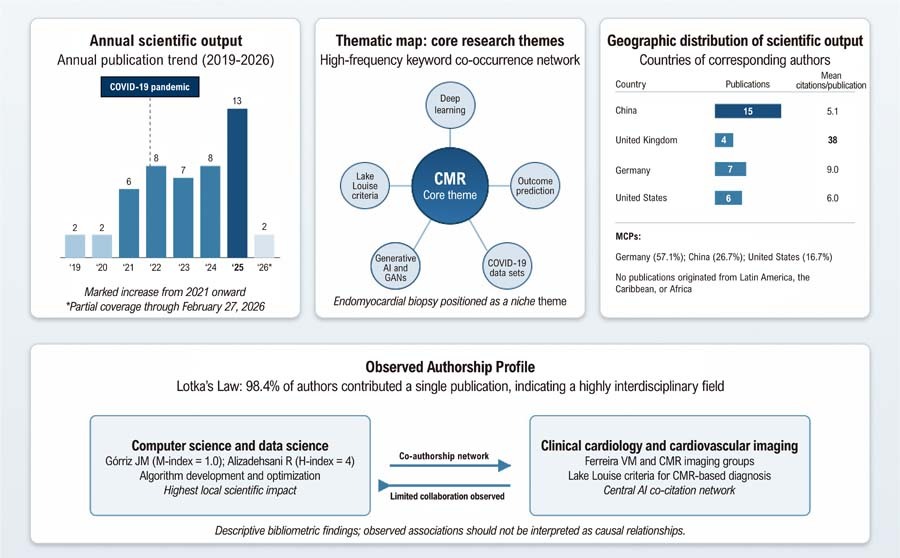
A total of 47 articles were included. Scientific output increased markedly after 2021, coinciding with the COVID-19 pandemic, and peaked in 2025. China led in publication volume, whereas the United Kingdom and Germany achieved the greatest citation impact. No publications originated from Latin America, the Caribbean, or Africa. International collaboration networks remain fragmented. Keyword and thematic analyses identified the integration of deep learning with cardiovascular magnetic resonance imaging as the principal motor theme, reflecting a shift away from traditional endomyocardial biopsy. The most highly cited authors were primarily computer and data scientists.

Conclusions

Research at the intersection of artificial intelligence and myocarditis is an emerging field undergoing methodological consolidation, with growth accelerated by the COVID-19 pandemic. Cardiovascular magnetic resonance imaging has become the primary data source for artificial intelligence-based applications. The principal challenge appears to be translational, underscoring the need for stronger collaboration between algorithm developers and clinicians. The successful integration of these models into routine clinical practice will likely depend on multidisciplinary collaboration and validation across diverse, multicenter populations.
  • Artificial Intelligence
  • Deep Learning
  • Machine Learning
  • Myocarditis
Read Full Article
Creative Commons Attribution (CC BY) Creative Commons license
21/08/2026 DOI: 10.36660/abchf.20260016i Views 1
Artificial Intelligence-Derived ECG-Age as a Predictor of Mortality and Cardiovascular Events: A Systematic Review and Meta-Analysis
ABC
Original Article

Artificial Intelligence-Derived ECG-Age as a Predictor of Mortality and Cardiovascular Events: A Systematic Review and Meta-Analysis

Isadora Cristine Reis Sguizzato Bozzi et al. Maria Clara de Araujo Gontijo Lima Antonio Luiz Pinho Ribeiro Gabriela Miana de Mattos Paixão

Abstract

Background

Artificial intelligence (AI)-derived electrocardiographic age (ECG-age) and the difference between ECG-age and chronological age (delta-age) are emerging biomarkers of cardiovascular aging and adverse outcomes, but their prognostic value remains unclear.

Objectives

We performed a systematic review and meta-analysis to evaluate associations between AI-derived ECG-age or delta-age and clinical outcomes.

Methods

Nine databases were searched through May 1, 2025. Eligible studies evaluated mortality or cardiovascular events and reported measures of association. Pooled hazard ratios (pHRs) with 95% confidence intervals (CIs) were calculated via fixed- or random-effects models, with statistical significance set at p < 0.05. The protocol was registered in PROSPERO (CRD420251042467).

Results

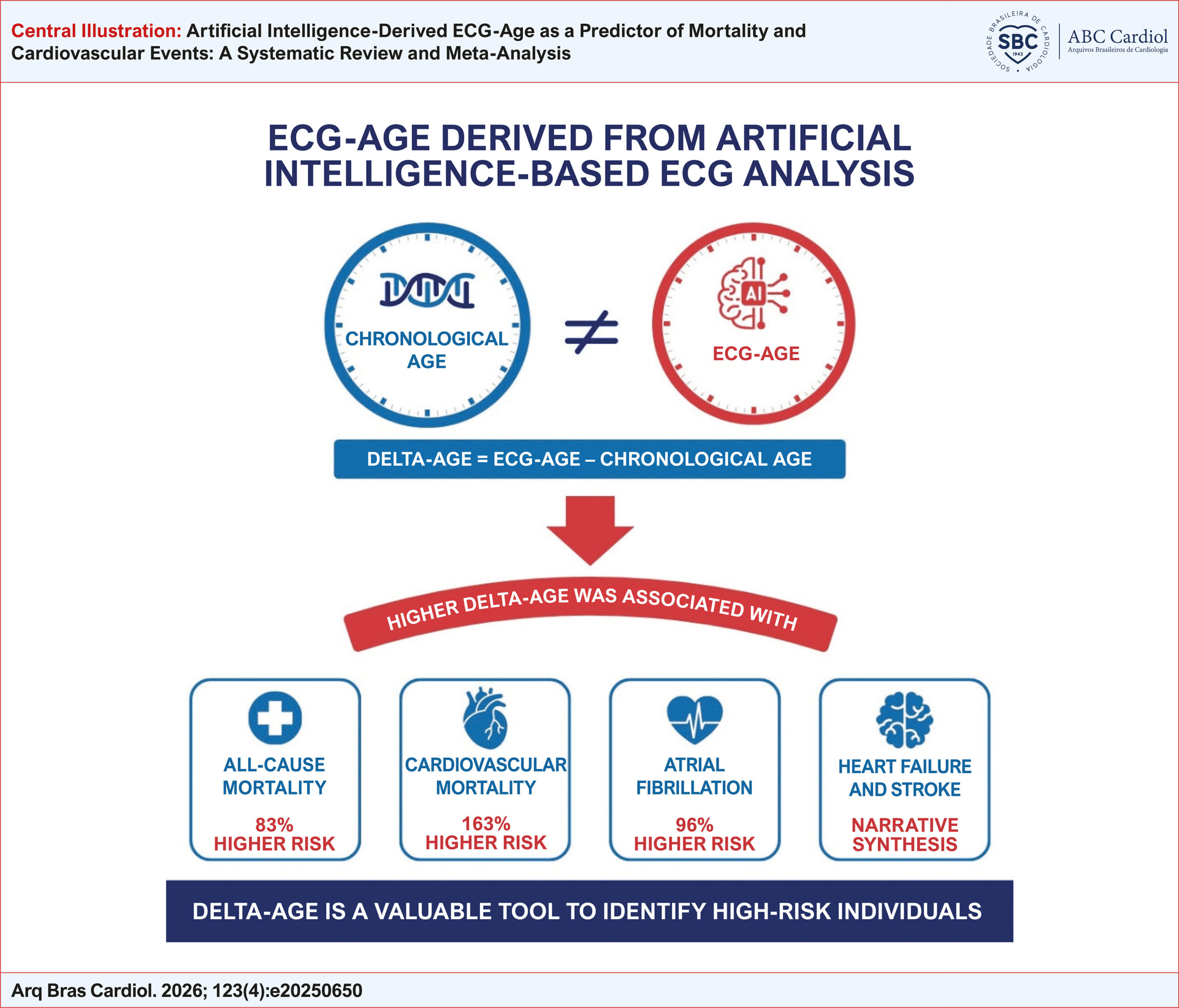
Ten studies (2021–2025) with over 550,000 participants from East Asia, the Americas, and the UK were included. Most used convolutional neural networks to estimate ECG-age; delta-age was calculated as ECG-age minus chronological age. Elevated delta-age was associated with increased all-cause mortality (pHR = 1.83, 95% CI: 1.45–2.32) and cardiovascular mortality (pHR = 2.63, 95% CI: 1.93–3.58). Three studies reported increased risk of atrial fibrillation (pHR = 1.96, 95% CI: 1.43–2.69), although data were limited and heterogeneous. Descriptive analyses suggested that greater delta-age predicts incident heart failure and stroke.

Conclusions

AI-derived ECG-age, particularly delta-age, is associated with all-cause and cardiovascular mortality, supporting its role as a noninvasive biomarker of cardiovascular aging. Evidence for atrial fibrillation is suggestive but limited. Standardized algorithms, robust external validation, and prospective multicenter studies are needed to confirm clinical utility and integrate ECG-age into risk stratification, even in asymptomatic individuals.

  • Artificial Intelligence
  • Deep Learning
  • Electrocardiography
  • Machine Learning
  • Prognosis
Read Full Article
Creative Commons Attribution (CC BY) Creative Commons license
12/06/2026 DOI: 10.36660/abc.20250650i
Artificial intelligence for nuclear cardiology: Perspectives and challenges
IJCS
Review Article

Artificial intelligence for nuclear cardiology: Perspectives and challenges

Caitlyn Gilbert et al. Alec Chunta Robert Miller

Abstract

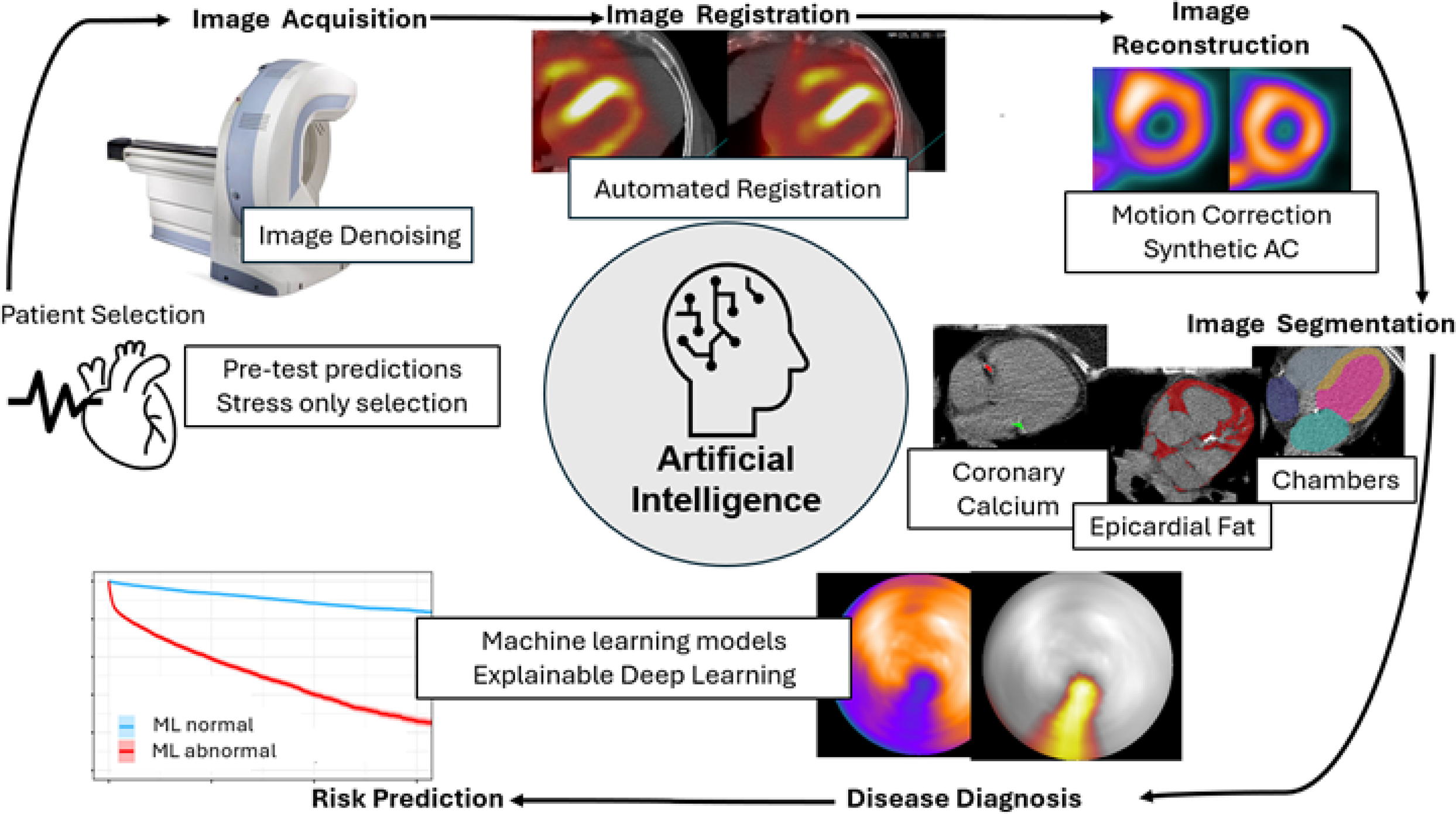
Recent advancements in artificial intelligence (AI) have significantly enhanced the efficiency and quality of nuclear cardiology imaging. AI algorithms, such as generative adversarial networks (GAN) and deep learning (DL) models, are improving image acquisition by reducing noise and correcting motion to minimize radiation exposure while maintaining diagnostic accuracy. AI has also demonstrated the potential to create synthetic attenuation correction (AC) imaging, accounting for soft-tissue attenuation without added computed tomography (CT) imaging. In patients with CT attenuation imaging, AI can automate the segmentation of coronary artery calcification (CAC), epicardial adipose tissue (EAT), and other structures to maximize the clinical information obtained from these added studies. Furthermore, machine learning (ML) models that combine clinical, imaging, and stress test data are advancing risk prediction for coronary artery disease (CAD) and ischemia, assisting clinicians in decision-making and improving patient outcomes. While many of these applications have been developed using myocardial perfusion imaging (MPI), they are increasingly applied to other nuclear cardiology studies. This review explores these AI applications and their impact on diagnostic accuracy, workflow efficiency, and risk stratification while also highlighting potential future directions and challenges.

  • Artificial Intelligence
  • Cardiac Imaging Techniques
  • Deep Learning
  • Machine Learning
  • Nuclear Medicine
Read Full Article
Creative Commons Attribution (CC BY) Creative Commons license
03/03/2025 DOI: 10.36660/ijcs.20240225 Views 1
Figure 1
ABCIC
Original Article

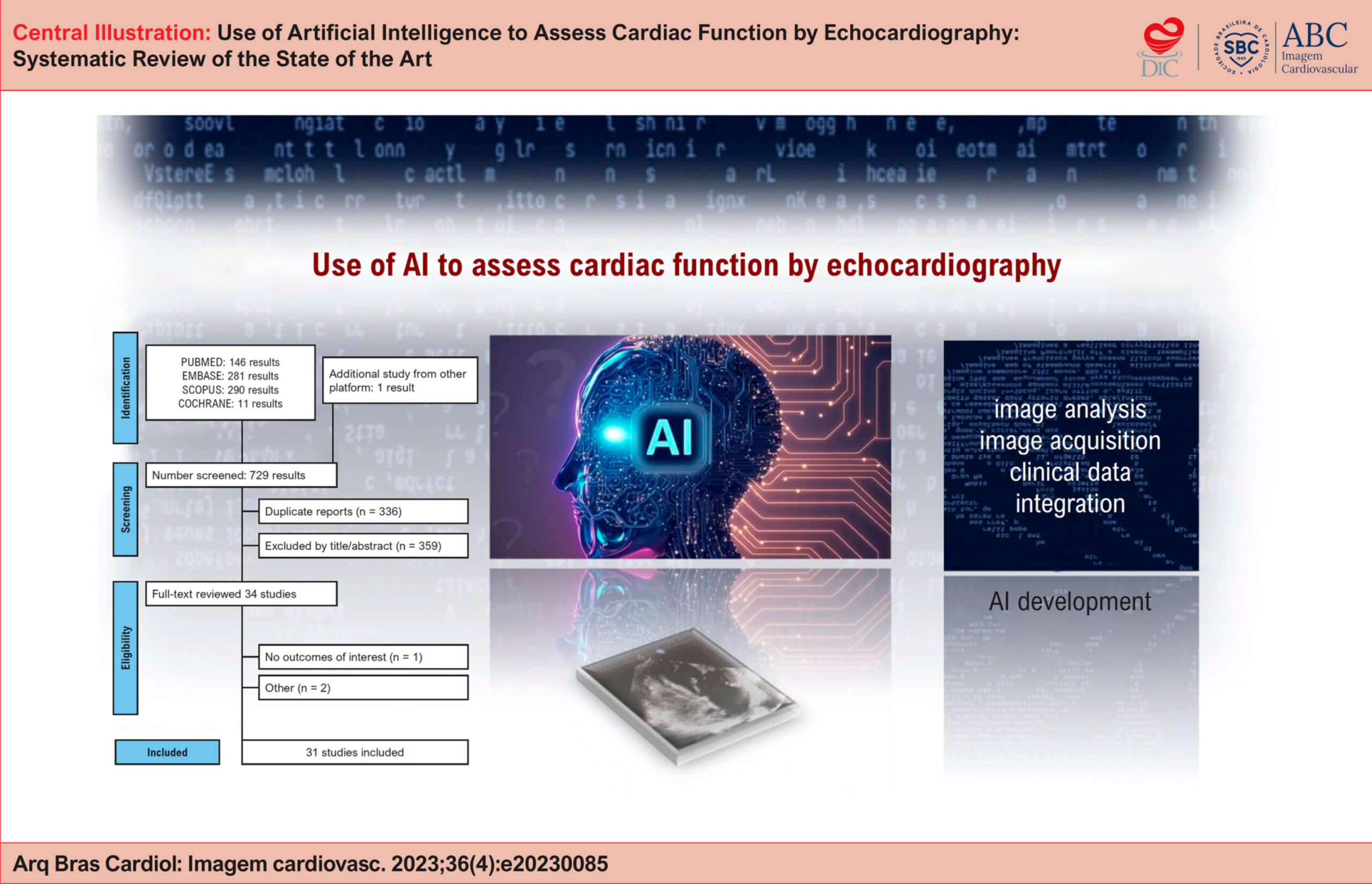
Use of Artificial Intelligence to Assess Cardiac Function by Echocardiography: Systematic Review of the State of the Art

Henrique Alexsander Ferreira Neves et al. Bruna Sadae Yuasa Thamires Hadassa Leite Pereira Costa Isabela Ertes Santos … Yannirê Milagros Roman Benavides Marco Stephan Lofrano-Alves

Abstract

Background:

Echocardiography is part of the routine investigation of most heart diseases. However, its operator-dependent nature and the quality of the image obtained can cause significant variability in measurements and impair their interpretation. The method has advanced on its path of standardization and incorporation of new technologies in an attempt to reduce its deficiencies. Recently, part of this advancement was due to the incorporation of artificial intelligence (AI).

Objectives:

The objective of this work was to investigate the use of AI in the assessment of cardiac function through echocardiography, discussing its potential to improve the method.

Methods:

We conducted a systematic review in accordance with the Preferred Reporting Items for Systematic Reviews and Meta-Analyses (PRISMA), searching for articles within the period of 2000 to 2023.

Results:

A total of 31 articles were included, classified into four categories of studies that used AI: 1) for image analysis and echocardiographic parameters (N = 14); 2) in the image acquisition process (N = 11); 3) for integration with clinical data (N = 3); and 4) for application to the exam flow (N = 3).

Conclusion:

AI provides automation and standardization of images and respective measurements that result in more accurate diagnoses, overcoming the limitations encountered by the conventional method. However, the use of AI is still an evolving reality within echocardiography.

  • Artificial Intelligence
  • Deep Learning
  • Echocardiography
  • Global Longitudinal Strain
  • Machine Learning
Read Full Article
Creative Commons Attribution (CC BY) Creative Commons license
18/12/2023 DOI: 10.36660/abcimg.20230085i Views 2
ABC
Editorial

Artificial Algorithms Outperform Traditional Models in Predicting Coronary Artery Disease

Lutfu Askin et al. Okan Tanrıverdi Mustafa Cetin

Recent clinical recommendations indicate that additional tests for assessing anatomical (extent, severity, morphology) or functional (ventricular function, presence/extent of ischemia) aspects of chronic and symptomatic coronary artery disease (CAD) may be helpful in certain cases. Emergency physicians must determine whether to release the patient, do further non-invasive testing, or perform invasive angiography on patients with acute chest discomfort. Accepting anybody with chest pain may have unintended effects if discharged with unstable coronary disease. The likelihood of obstructive CAD should guide medical decisions. Machine learning (ML) algorithms can supplement the diagnostic and prognostic capabilities of conventional regression methods. The disparity between the applicability of such methods and the outcomes achieved with them was due to the data analysis software platforms used.

ML may use thoracic phase signal features to build final mathematical models that evaluate the existence of severe CAD. Cardiac phase space analysis seems similar to the most widely used functional stress tests and needs little patient time. The 2-year results showed that deep learning fractional flow reserve derived from CT (DL-FFRCT) may be used to guide revascularization, with high cancellation rate and low event rate. A positive DL-FFRCT for tandem lesions was linked with reduced major adverse cardiac events (MACEs) after 2 years. The ML-ischemia risk score (ML-IRS) obtained from quantitative coronary CT angiography enhanced the prediction of future revascularization and may be used to identify individuals who are likely to need revascularization if referred for cardiac catheterization. This machine learning score is linked with invasive fractional flow reserve (FFR) measures, providing external validation across two centers and augmenting clinical risk prediction models.

[…]

  • Algorithms
  • Angiography Coronary CT/methods
  • Artificial Intelligence
  • Coronary Artery Disease
  • Deep Learning
  • Machine Learning
  • Support Vector Machine
Read Full Article
Creative Commons Attribution (CC BY) Creative Commons license
03/12/2021 DOI: 10.36660/abc.20210823 Views 2

How to cite this article

EndNote RIS

Electronic Document Format (Vancouver)

Costa GCFO, Rodriguez JGV, Costa GFO, Pimentel AML, Mesquita ET. Global Mapping of Research on Artificial Intelligence Applied to Myocarditis. ABC Heart Fail Cardiomyop 2026;6:e20260016.

Electronic Document Format (ABNT)

Costa, Guilherme Cesar Fernandes de Oliveira da; Rodriguez, Jose Gregorio Valero; Costa, Giulia Fernandes de Oliveira da; Pimentel, Adriana Munford Lima; Mesquita, Evandro Tinoco. Global Mapping of Research on Artificial Intelligence Applied to Myocarditis. ABC Heart Fail Cardiomyop, v. 6, e20260016, Aug. 2026.

Electronic Document Format (APA)

Costa, G. C. F. O. , Rodriguez, J. G. V., Costa, G. F. O. , Pimentel, A. M. L., & Mesquita, E. T. (2026). Global Mapping of Research on Artificial Intelligence Applied to Myocarditis. ABC Heart Fail Cardiomyop, 6, e20260016.

Electronic Document Format (ISO)

Costa, Guilherme Cesar Fernandes de Oliveira da and Rodriguez, Jose Gregorio Valero and Costa, Giulia Fernandes de Oliveira da and Pimentel, Adriana Munford Lima and Mesquita, Evandro Tinoco. Global Mapping of Research on Artificial Intelligence Applied to Myocarditis. ABC Heart Fail Cardiomyop [online]. 2026, vol. 6, [cited 2026-10-14], e20260016. Available from: <https://journals.cardiol.br/en/article/global-mapping-of-research-on-artificial-intelligence-applied-to-myocarditis/>

EndNote RIS

Electronic Document Format (Vancouver)

Bozzi ICRS, Lima MCAG, Ribeiro ALP, Paixão GMM. Artificial Intelligence-Derived ECG-Age as a Predictor of Mortality and Cardiovascular Events: A Systematic Review and Meta-Analysis. Arquivos Brasileiros de Cardiologia 2026;123(4):e20250650.

Electronic Document Format (ABNT)

Bozzi, Isadora Cristine Reis Sguizzato; Lima, Maria Clara de Araujo Gontijo; Ribeiro, Antonio Luiz Pinho; Paixão, Gabriela Miana de Mattos. Artificial Intelligence-Derived ECG-Age as a Predictor of Mortality and Cardiovascular Events: A Systematic Review and Meta-Analysis. Arquivos Brasileiros de Cardiologia, v. 123, n. 4, e20250650, Jun. 2026.

Electronic Document Format (APA)

Bozzi, I. C. R. S., Lima, M. C. A. G., Ribeiro, A. L. P., & Paixão, G. M. M. (2026). Artificial Intelligence-Derived ECG-Age as a Predictor of Mortality and Cardiovascular Events: A Systematic Review and Meta-Analysis. Arquivos Brasileiros de Cardiologia, 123(4), e20250650.

Electronic Document Format (ISO)

Bozzi, Isadora Cristine Reis Sguizzato and Lima, Maria Clara de Araujo Gontijo and Ribeiro, Antonio Luiz Pinho and Paixão, Gabriela Miana de Mattos. Artificial Intelligence-Derived ECG-Age as a Predictor of Mortality and Cardiovascular Events: A Systematic Review and Meta-Analysis. Arquivos Brasileiros de Cardiologia [online]. 2026, vol. 123, n. 4, [cited 2026-10-14], e20250650. Available from: <https://journals.cardiol.br/en/article/artificial-intelligence-derived-ecg-age-as-a-predictor-of-mortality-and-cardiovascular-events-a-systematic-review-and-meta-analysis/>. ISSN 0066-782X

EndNote RIS

Electronic Document Format (Vancouver)

Gilbert C, Chunta A, Miller R. Artificial intelligence for nuclear cardiology: Perspectives and challenges. International Journal of Cardiovascular Sciences 2025;38:e20240225.

Electronic Document Format (ABNT)

Gilbert, Caitlyn; Chunta, Alec; Miller, Robert. Artificial intelligence for nuclear cardiology: Perspectives and challenges. International Journal of Cardiovascular Sciences, v. 38, e20240225, Mar. 2025.

Electronic Document Format (APA)

Gilbert, C., Chunta, A., & Miller, R. (2025). Artificial intelligence for nuclear cardiology: Perspectives and challenges. International Journal of Cardiovascular Sciences, 38, e20240225.

Electronic Document Format (ISO)

Gilbert, Caitlyn and Chunta, Alec and Miller, Robert. Artificial intelligence for nuclear cardiology: Perspectives and challenges. International Journal of Cardiovascular Sciences [online]. 2025, vol. 38, [cited 2026-10-14], e20240225. Available from: <https://journals.cardiol.br/en/article/artificial-intelligence-for-nuclear-cardiology-perspectives-and-challenges/>. ISSN 2359-4802

EndNote RIS

Electronic Document Format (Vancouver)

Neves HAF, Yuasa BS, Costa THLP, Santos IE, Benavides YMR, Lofrano-Alves MS. Use of Artificial Intelligence to Assess Cardiac Function by Echocardiography: Systematic Review of the State of the Art. ABC Imagem Cardiovascular 2023;36(4):e20230085.

Electronic Document Format (ABNT)

Neves, Henrique Alexsander Ferreira; Yuasa, Bruna Sadae; Costa, Thamires Hadassa Leite Pereira; Santos, Isabela Ertes; Benavides, Yannirê Milagros Roman; Lofrano-Alves, Marco Stephan. Use of Artificial Intelligence to Assess Cardiac Function by Echocardiography: Systematic Review of the State of the Art. ABC Imagem Cardiovascular, v. 36, n. 4, e20230085, Dec. 2023.

Electronic Document Format (APA)

Neves, H. A. F., Yuasa, B. S., Costa, T. H. L. P., Santos, I. E., Benavides, Y. M. R., & Lofrano-Alves, M. S. (2023). Use of Artificial Intelligence to Assess Cardiac Function by Echocardiography: Systematic Review of the State of the Art. ABC Imagem Cardiovascular, 36(4), e20230085.

Electronic Document Format (ISO)

Neves, Henrique Alexsander Ferreira and Yuasa, Bruna Sadae and Costa, Thamires Hadassa Leite Pereira and Santos, Isabela Ertes and Benavides, Yannirê Milagros Roman and Lofrano-Alves, Marco Stephan. Use of Artificial Intelligence to Assess Cardiac Function by Echocardiography: Systematic Review of the State of the Art. ABC Imagem Cardiovascular [online]. 2023, vol. 36, n. 4, [cited 2026-10-14], e20230085. Available from: <https://journals.cardiol.br/en/article/use-of-artificial-intelligence-to-assess-cardiac-function-by-echocardiography-systematic-review-of-the-state-of-the-art/>. ISSN 2318-8219

EndNote RIS

Electronic Document Format (Vancouver)

Askin L, Tanrıverdi O, Cetin M. Artificial Algorithms Outperform Traditional Models in Predicting Coronary Artery Disease. Arquivos Brasileiros de Cardiologia 2021;117(6):1071-2.

Electronic Document Format (ABNT)

Askin, Lutfu; Tanrıverdi, Okan; Cetin, Mustafa. Artificial Algorithms Outperform Traditional Models in Predicting Coronary Artery Disease. Arquivos Brasileiros de Cardiologia, v. 117, n. 6, p. 1071-1072, Dec. 2021.

Electronic Document Format (APA)

Askin, L., Tanrıverdi, O., & Cetin, M. (2021). Artificial Algorithms Outperform Traditional Models in Predicting Coronary Artery Disease. Arquivos Brasileiros de Cardiologia, 117(6), 1071-1072.

Electronic Document Format (ISO)

Askin, Lutfu and Tanrıverdi, Okan and Cetin, Mustafa. Artificial Algorithms Outperform Traditional Models in Predicting Coronary Artery Disease. Arquivos Brasileiros de Cardiologia [online]. 2021, vol. 117, n. 6, [cited 2026-10-14], pp. 1071-1072. Available from: <https://journals.cardiol.br/en/article/artificial-algorithms-outperform-traditional-models-in-predicting-coronary-artery-disease/>. ISSN 0066-782X

  • About ABC Family
  • Internal Regulation
  • Editorial Board
  • Brazilian Society of Cardiology (SBC)

Issues

SBC Guidelines

  • Videos
  • Podcasts
  • News