ABC Family Arquivos Brasileiros de Cardiologia International Journal of Cardiovascular Sciences ABC Heart Failure & Cardiomyopathy ABC Imagem Cardiovascular
Português English
ABC Family
Português English
  • About
    • About ABC Family
    • Internal Regulation
    • Editorial Board
    • Brazilian Society of Cardiology (SBC)
  • Issues
  • SBC Guidelines
  • Content
    • Videos
    • Podcasts
    • News
  • About
    • About ABC Family
    • Internal Regulation
    • Editorial Board
    • Brazilian Society of Cardiology (SBC)
  • Issues
  • SBC Guidelines
  • Content
    • Videos
    • Podcasts
    • News

ABC Family

  • ABC Family
  • Arquivos Brasileiros de Cardiologia
  • International Journal of Cardiovascular Sciences
  • ABC Heart Failure & Cardiomyopathy
  • ABC Imagem Cardiovascular
Search in

No content found.

Journals
Ordering
Article types
Others

  1. Home
  2. Keyword: electrocardiogram
ABC
Editorial

Applicability of Machine Learning Algorithms in the Diagnosis of Arrhythmias – How Long Until The Machine Starts Teaching Us?

Marcelo Martins Pinto Filho

The electrocardiogram (ECG), in clinical use since the early 1900s, remains a beloved tool for cardiologists, clinicians, and medical students. It is arguably the most important bedside instrument in cardiology, essential for managing arrhythmias and acute ischemic syndromes, as well as guiding electrophysiologic care. Still, advances in electrocardiography interpretation have been only modest in the last hundred years. Devices have become more portable, digital, and capable of longer recordings, but core interpretive principles remain rooted in early 20th-century methods. In recent years, this has been reshaped by the rise of computational technologies, especially artificial intelligence (AI). Tools such as deep neural networks (DNNs) and machine learning models (MLMs) are enabling a new era in ECG analysis, the AI-enhanced electrocardiography (AI-enhanced ECG).

In this issue of the ABC Cardiol, Guimarães do Nascimento et al. report on a systematic review of studies evaluating the applicability of AI-enhanced ECG in the diagnosis of cardiac arrhythmias. They included studies of different methodologies that addressed the role of AI-enhanced ECG in the detection of long-QT syndrome (LQTS) (one study), corrected QT interval (cQTi) (one study), and atrial fibrillation (AF) (eleven studies).

[…]

  • Artificial Intelligence
  • Cardiac, Arrhythmia
  • electrocardiogram
  • Machine Learning
  • Neural Network
Read Full Article
Creative Commons Attribution (CC BY) Creative Commons license
19/09/2025 DOI: 10.36660/abc.20250405i Views 2
ABC
Letter to the Editor

Reflections on ECG Preoperative Screening for Asymptomatic Low-Risk Individuals

José Nunes de Alencar

I read with interest the study by Ramos et al. on the ” Prognostic Value of Preoperative Electrocardiogram in Low-Risk Patients Undergoing Surgical Intervention and General Anesthesia”. The authors’ efforts to clarify the predictive efficacy of preoperative electrocardiography (ECG) in a population that appears to have a low-risk profile are meritorious. Nonetheless, I harbor concerns regarding the employed methodology, which may potentially impact the study’s findings.

Directly examining the hypothesis that an abnormal ECG can serve as a predictor of events is essential. This secondary analysis was incorporated by the authors within a subset of the population that underwent ECG. To robustly test their hypothesis, the primary analysis should have been whether an abnormal ECG is a predictor of increased risk compared to normal ECG findings. Implementing this methodology would yield a more precise assessment of the ECG’s ability to forecast postoperative complications.

[…]

  • electrocardiogram
  • Preoperative
Read Full Article
Creative Commons Attribution (CC BY) Creative Commons license
22/07/2024 DOI: 10.36660/abc.20240055i Views 1
ABC
Editorial

The Electrocardiogram in the Pediatric Population in the 21st Century. How to Keep Evolving after 135 Years of the Method Discovery History

Rogerio Braga Andalaft

Knowledge of the electrocardiogram remains constantly evolving in medical practice. The new interfaces for electrocardiogram (ECG) correlation with cardiac images and heart functional changes increase the method’s applicability. However, in children and adolescents, the constant change generated by these young people’s body and functional development often generates doubts in the interpretation of electrocardiographic tracings, even in the most experienced professionals. Recently, important data on ECG interpretation were extensively reviewed in the IV Guidelines of the Sociedade Brasileira de Cardiologia on Analysis and Issuance of Electrocardiographic Reports published in 2022.

But what is the role of the electrocardiogram, especially applied to pediatrics, in the 21st century? What is normal for the child? What is the prevalence of electrocardiogram changes in asymptomatic patients?

[…]

  • Arrhythmias
  • Children
  • electrocardiogram
  • Pediatrics
Read Full Article
Creative Commons Attribution (CC BY) Creative Commons license
25/11/2022 DOI: 10.36660/abc.20220715 Views 1
Cardiac longitudinal study of children perinatally exposed to human immunodeficiency virus type 1
ABC
Artigo Original

Cardiac longitudinal study of children perinatally exposed to human immunodeficiency virus type 1

Maria Suely Bezerra Diógenes et al. Regina Célia de Menezes Succi Daisy M. Machado Valdir Ambrósio Moisés … Neil Ferreira Novo Antonio Carlos Carvalho

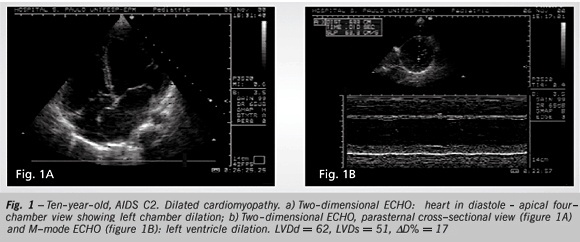
OBJECTIVE: To determine the frequency of cardiac abnormalities and its natural history in children perinatally exposed to HIV-1. METHODS: Eighty-four children exposed to HIV-1 were evaluated by serial clinical, electrocardiographic (ECG), and Doppler-echocardiographic (ECHO) examinations. RESULTS: Group I – (seroreversion) – 43 children (51.2%). Absence of clinical abnormalities. ECG: incomplete right bundle branch block (RBBB) 5 cases. ECHO: atrial septal defect (ASD) and ventricular septal defect (VSD) – 1 case each. Group II – 41 HIV-infected children (48.8%), of whom 51.2% were found to have cardiac abnormalities. Asymptomatic or mildly symptomatic children without immunosuppression: no clinical and echocardiographic abnormalities; ECG: incomplete right bundle branch block (RBBB) – (2 cases). Children with moderate and severe symptoms and immunological impairment: the following abnormalities were found: 1) clinical (31.7%)-isolated tachycardia (1 case), congestive heart failure (12 cases). 2) electrocardiographic (43.9%)- sinus tachycardia associated with other abnormalities (10 cases), incomplete right bundle branch block (5 cases), left anterior hemiblock (1 case), right anterior hemiblock (1 case), changes in ventricular repolarization (11 cases), right ventricular overload (2 cases), left ventricular overload (1 case), right QRS axis deviation (1 case), and arrhythmias (3 cases). 3) echocardiographic (26.8%)- dilated cardiomyopathy (5 cases), pericardial effusion with tamponade (2 cases), pulmonary hypertension (2 cases), and mitral valve prolapse (1 case). CONCLUSION: Cardiac involvement was a characteristic of the HIV-infected group. Higher prevalence of abnormalities was found among children belonging to the most advanced clinical and immunological category. The most commonly observed clinical, electrocardiographic and echocardiographic findings were congestive heart failure (CHF), changes in ventricular repolarization, and dilated cardiomyopathy, respectively. The latter was reversible in one case. Electrocardiogram changes were significantly more frequent than clinical and echocardiographic changes.

  • Echocardiogram
  • electrocardiogram
  • heart disease
  • HIV
  • vertical transmission
Read Full Article
Creative Commons Attribution (CC BY) Creative Commons license
07/11/2005 DOI: 10.1590/S0066-782X2005001700002 Views 1
An analysis of electrocardiographic criteria for determining left ventricular hypertrophy
ABC
Original Article

An analysis of electrocardiographic criteria for determining left ventricular hypertrophy

Carlos Alberto Gasperin et al. Helio Germiniani Carlos Roberto Facin Admar Moraes de Souza Cláudio Leinig Pereira da Cunha

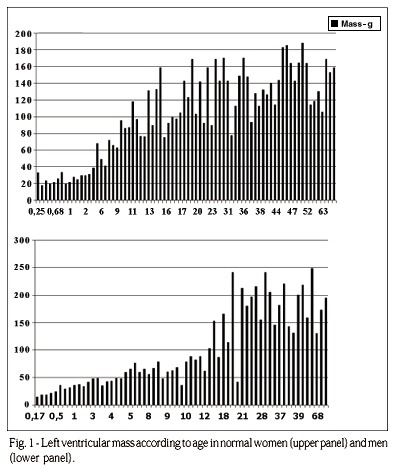
OBJECTIVE: To determine the most sensitive criterion for the detection of left ventricular hypertrophy according to echocardiographically defined left ventricular mass. METHODS: The Sokolow-Lyon voltage, Sokolow-Lyon-Rappaport, Cornell voltage duration product, White-Bock, and Romhilt-Estes point scoring criteria were compared with left ventricular mass index, corrected for body surface, obtained from the echocardiograms of 306 outpatients (176 females, 130 males), of all age groups. RESULTS: The Cornell voltage duration product criteria index had the greatest sensitivity in women (54.90%), and the Sokolow-Lyon-Rappaport index was most sensitive in men (73.53%). When applied to men at the same voltage amplitude (20mm) as that in women, the Cornell index showed increased sensitivity relative to the conventional index (28mm) of 67.65% (P<=0.01) and a sensitivity similar to that of the Sokolow-Lyon-Rappaport index, with higher specificity (P<=0.01). The White-Bock and Romhilt-Estes criteria were the least sensitive in men and women, despite their high specificity. The electrocardiographic criteria were more efficient when dilatation predominated over left ventricular hypertrophy. CONCLUSION: The Cornell index had greater sensitivity in women, and the Sokolow-Lyon-Rappaport index was more sensitive in men. When applied to men at the same voltage amplitude as that of women, the Cornell index had an increase in sensitivity similar to that of the Sokolow-Lyon-Rappaport index.

  • electrocardiogram
  • Hypertrophy
  • Left Ventricular Hypertrophy
Read Full Article
Creative Commons Attribution (CC BY) Creative Commons license
19/02/2002 DOI: 10.1590/S0066-782X2002000100006 Views 1
Analysis of the effects of the continuous electrode paste band on precordial leads of the electrocardiogram
ABC
Original Article

Analysis of the effects of the continuous electrode paste band on precordial leads of the electrocardiogram

Carlos Henrique Purper Petterson et al. Nelson Rudi Koehler Ronaldo Passos Iuri Christmann

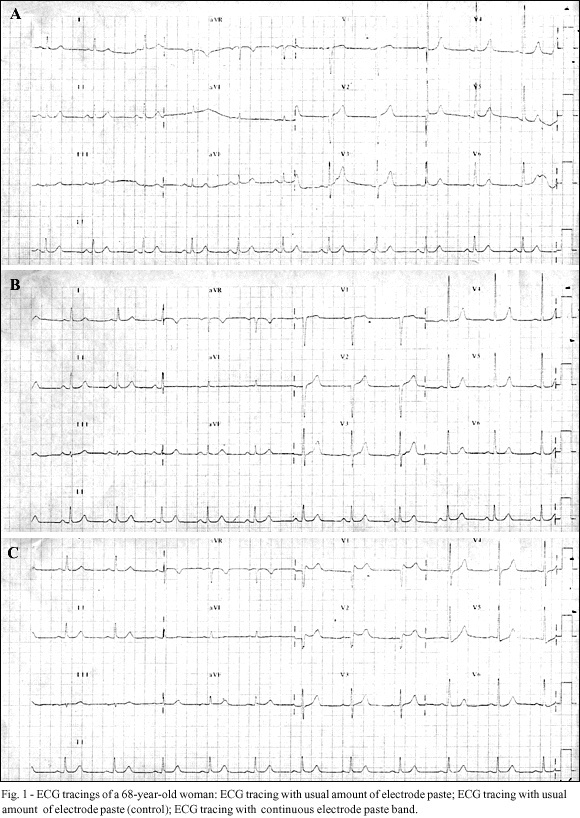
OBJECTIVE – To determine if the application of a continuous electrode paste band on precordial leads results in alteration of the electrocardiographic tracing as compared with an adequate amount of electrode paste, and if the former condition does not cause uniform morphologies from V1 to V6. METHODS – The amplitude and morphology of the electrocardiographic waves on the precordial leads in electrocardiographic tracings, which were performed with standard (control group) or excessive (continuous band) application of the electrode paste, were compared. RESULTS – None of the 106 patients studied showed uniformity of the QRS morphology from V1 to V6. The eletrocardiographic alterations identified in the tracings performed with a continuous electrode paste band that showed statistical significance in relation to the control group were the following: inversion of the P wave in V1; inversion of the T wave in V1, V2, and V3; appearance of R’ waves in V1 and V2; disappearance of S waves in V1; appearance of S waves in V5 and V6; alterations in the amplitude of almost all waves, in all leads. CONCLUSION – Application of a continuous electrode paste band in the precordial leads may cause significant alterations in the electrocardiographic tracing obtained.

  • electrocardiogram
  • electrocardiographic technique
  • electrode paste
  • electrodes
  • precordial leads
Read Full Article
Creative Commons Attribution (CC BY) Creative Commons license
08/01/2002 DOI: 10.1590/S0066-782X1999000900002
ABC
Artigo Original

Athlete's heart in elite disabled athletes

Japy Angelini Oliveira Fº et al. Antonio Carlos Silva Edgar Lira Fº Bráulio Luna Fº … Silvia Helena Covre Flávio Antônio Ascânio Lauro Marcelo Aria Dias Danucalov Wagner Aparecido Leite Sérgio Tuffik José Lázaro Andrade Angelo Amato Vincenzo de Paola Eulógio Martinez Fº

PURPOSE: To assess the prevalence of the athlete’s, heart syndrome in elite disabled Brazilians athletes. METHODS: Seventy-five athletes, age 27.8±6.7 years, 56 men, with various disabilities (47 physical, 12 visual and 16 cerebral paralysis) underwent clinical, electrocardiographic, vectorcardiographic, ergometric and echocardiographic evaluations. RESULTS: Athlete’s heart signs occurred in 33% of the clinical evaluations, in 55% of the electrocardiograms, in 15% of the vectorcardiograms, and in 5% of the echocardiograms. At least one of these signs was presented in 51% of the athletes. There were 2 or more abnormalities in 46% of the athletes and 4 or more signs in 12%. Exercise test was considered not ischemic in 77% of the subjects. There was right bundle branch block in 23% of the tests. CONCLUSION: There were two or more athlete’s heart syndrome signs in 46% of Brazilian disabled athletes.

  • Athlete's heart
  • disabled athletes
  • electrocardiogram
  • Exercise Test
Read Full Article
Creative Commons Attribution (CC BY) Creative Commons license
23/01/2001 DOI: 10.1590/S0066-782X1997001200004 Views 1

How to cite this article

EndNote RIS

Electronic Document Format (Vancouver)

Pinto Filho MM. Applicability of Machine Learning Algorithms in the Diagnosis of Arrhythmias – How Long Until The Machine Starts Teaching Us?. Arquivos Brasileiros de Cardiologia 2025;122(8):e20250405.

Electronic Document Format (ABNT)

Pinto Filho, Marcelo Martins. Applicability of Machine Learning Algorithms in the Diagnosis of Arrhythmias – How Long Until The Machine Starts Teaching Us?. Arquivos Brasileiros de Cardiologia, v. 122, n. 8, e20250405, Sep. 2025.

Electronic Document Format (APA)

Pinto Filho, M. M. (2025). Applicability of Machine Learning Algorithms in the Diagnosis of Arrhythmias – How Long Until The Machine Starts Teaching Us?. Arquivos Brasileiros de Cardiologia, 122(8), e20250405.

Electronic Document Format (ISO)

Pinto Filho, Marcelo Martins. Applicability of Machine Learning Algorithms in the Diagnosis of Arrhythmias – How Long Until The Machine Starts Teaching Us?. Arquivos Brasileiros de Cardiologia [online]. 2025, vol. 122, n. 8, [cited 2026-10-14], e20250405. Available from: <https://journals.cardiol.br/en/article/applicability-of-machine-learning-algorithms-in-the-diagnosis-of-arrhythmias-how-long-until-the-machine-starts-teaching-us/>. ISSN 0066-782X

EndNote RIS

Electronic Document Format (Vancouver)

Alencar JN. Reflections on ECG Preoperative Screening for Asymptomatic Low-Risk Individuals. Arquivos Brasileiros de Cardiologia 2024;121(6):e20240055.

Electronic Document Format (ABNT)

Alencar, José Nunes de. Reflections on ECG Preoperative Screening for Asymptomatic Low-Risk Individuals. Arquivos Brasileiros de Cardiologia, v. 121, n. 6, e20240055, Jul. 2024.

Electronic Document Format (APA)

Alencar, J. N. (2024). Reflections on ECG Preoperative Screening for Asymptomatic Low-Risk Individuals. Arquivos Brasileiros de Cardiologia, 121(6), e20240055.

Electronic Document Format (ISO)

Alencar, José Nunes de. Reflections on ECG Preoperative Screening for Asymptomatic Low-Risk Individuals. Arquivos Brasileiros de Cardiologia [online]. 2024, vol. 121, n. 6, [cited 2026-10-14], e20240055. Available from: <https://journals.cardiol.br/en/article/reflections-on-ecg-preoperative-screening-for-asymptomatic-low-risk-individuals/>. ISSN 0066-782X

EndNote RIS

Electronic Document Format (Vancouver)

Andalaft RB. The Electrocardiogram in the Pediatric Population in the 21st Century. How to Keep Evolving after 135 Years of the Method Discovery History. Arquivos Brasileiros de Cardiologia 2022;119(5):791-2.

Electronic Document Format (ABNT)

Andalaft, Rogerio Braga. The Electrocardiogram in the Pediatric Population in the 21st Century. How to Keep Evolving after 135 Years of the Method Discovery History. Arquivos Brasileiros de Cardiologia, v. 119, n. 5, p. 791-792, Nov. 2022.

Electronic Document Format (APA)

Andalaft, R. B. (2022). The Electrocardiogram in the Pediatric Population in the 21st Century. How to Keep Evolving after 135 Years of the Method Discovery History. Arquivos Brasileiros de Cardiologia, 119(5), 791-792.

Electronic Document Format (ISO)

Andalaft, Rogerio Braga. The Electrocardiogram in the Pediatric Population in the 21st Century. How to Keep Evolving after 135 Years of the Method Discovery History. Arquivos Brasileiros de Cardiologia [online]. 2022, vol. 119, n. 5, [cited 2026-10-14], pp. 791-792. Available from: <https://journals.cardiol.br/en/article/the-electrocardiogram-in-the-pediatric-population-in-the-21st-century-how-to-keep-evolving-after-135-years-of-the-method-discovery-history/>. ISSN 0066-782X

EndNote RIS

Electronic Document Format (Vancouver)

Diógenes MSB, Succi RCM, Machado DM, Moisés VA, Novo NF, Carvalho AC. Cardiac longitudinal study of children perinatally exposed to human immunodeficiency virus type 1. Arquivos Brasileiros de Cardiologia 2005;85(4):233-40.

Electronic Document Format (ABNT)

Diógenes, Maria Suely Bezerra; Succi, Regina Célia de Menezes; Machado, Daisy M.; Moisés, Valdir Ambrósio; Novo, Neil Ferreira; Carvalho, Antonio Carlos. Cardiac longitudinal study of children perinatally exposed to human immunodeficiency virus type 1. Arquivos Brasileiros de Cardiologia, v. 85, n. 4, p. 233-240, Nov. 2005.

Electronic Document Format (APA)

Diógenes, M. S. B., Succi, R. C. M., Machado, D. M., Moisés, V. A., Novo, N. F., & Carvalho, A. C. (2005). Cardiac longitudinal study of children perinatally exposed to human immunodeficiency virus type 1. Arquivos Brasileiros de Cardiologia, 85(4), 233-240.

Electronic Document Format (ISO)

Diógenes, Maria Suely Bezerra and Succi, Regina Célia de Menezes and Machado, Daisy M. and Moisés, Valdir Ambrósio and Novo, Neil Ferreira and Carvalho, Antonio Carlos. Cardiac longitudinal study of children perinatally exposed to human immunodeficiency virus type 1. Arquivos Brasileiros de Cardiologia [online]. 2005, vol. 85, n. 4, [cited 2026-10-14], pp. 233-240. Available from: <https://journals.cardiol.br/en/article/cardiac-longitudinal-study-of-children-perinatally-exposed-to-human-immunodeficiency-virus-type-1/>. ISSN 0066-782X

EndNote RIS

Electronic Document Format (Vancouver)

Gasperin CA, Germiniani H, Facin CR, Souza AM, Cunha CLP. An analysis of electrocardiographic criteria for determining left ventricular hypertrophy. Arquivos Brasileiros de Cardiologia 2002;78(1):72-8.

Electronic Document Format (ABNT)

Gasperin, Carlos Alberto; Germiniani, Helio; Facin, Carlos Roberto; Souza, Admar Moraes de; Cunha, Cláudio Leinig Pereira da. An analysis of electrocardiographic criteria for determining left ventricular hypertrophy. Arquivos Brasileiros de Cardiologia, v. 78, n. 1, p. 72-82, Feb. 2002.

Electronic Document Format (APA)

Gasperin, C. A., Germiniani, H., Facin, C. R., Souza, A. M. , & Cunha, C. L. P. (2002). An analysis of electrocardiographic criteria for determining left ventricular hypertrophy. Arquivos Brasileiros de Cardiologia, 78(1), 72-82.

Electronic Document Format (ISO)

Gasperin, Carlos Alberto and Germiniani, Helio and Facin, Carlos Roberto and Souza, Admar Moraes de and Cunha, Cláudio Leinig Pereira da. An analysis of electrocardiographic criteria for determining left ventricular hypertrophy. Arquivos Brasileiros de Cardiologia [online]. 2002, vol. 78, n. 1, [cited 2026-10-14], pp. 72-82. Available from: <https://journals.cardiol.br/en/article/an-analysis-of-electrocardiographic-criteria-for-determining-left-ventricular-hypertrophy/>. ISSN 0066-782X

EndNote RIS

Electronic Document Format (Vancouver)

Petterson CHP, Koehler NR, Passos R, Christmann I. Analysis of the effects of the continuous electrode paste band on precordial leads of the electrocardiogram. Arquivos Brasileiros de Cardiologia 2002;73(3):266-72.

Electronic Document Format (ABNT)

Petterson, Carlos Henrique Purper; Koehler, Nelson Rudi; Passos, Ronaldo; Christmann, Iuri. Analysis of the effects of the continuous electrode paste band on precordial leads of the electrocardiogram. Arquivos Brasileiros de Cardiologia, v. 73, n. 3, p. 266-272, Jan. 2002.

Electronic Document Format (APA)

Petterson, C. H. P., Koehler, N. R., Passos, R., & Christmann, I. (2002). Analysis of the effects of the continuous electrode paste band on precordial leads of the electrocardiogram. Arquivos Brasileiros de Cardiologia, 73(3), 266-272.

Electronic Document Format (ISO)

Petterson, Carlos Henrique Purper and Koehler, Nelson Rudi and Passos, Ronaldo and Christmann, Iuri. Analysis of the effects of the continuous electrode paste band on precordial leads of the electrocardiogram. Arquivos Brasileiros de Cardiologia [online]. 2002, vol. 73, n. 3, [cited 2026-10-14], pp. 266-272. Available from: <https://journals.cardiol.br/en/article/analysis-of-the-effects-of-the-continuous-electrode-paste-band-on-precordial-leads-of-the-electrocardiogram/>. ISSN 0066-782X

EndNote RIS

Electronic Document Format (Vancouver)

Fº JAO, Silva AC, Fº EL, Fº BL, Covre SH, Lauro FAA, Danucalov MAD, et al. Athlete’s heart in elite disabled athletes. Arquivos Brasileiros de Cardiologia 2001;69(6):385-8.

Electronic Document Format (ABNT)

Fº, Japy Angelini Oliveira; Silva, Antonio Carlos; Fº, Edgar Lira; Fº, Bráulio Luna; Covre, Silvia Helena; Lauro, Flávio Antônio Ascânio; Danucalov, Marcelo Aria Dias; Leite, Wagner Aparecido; Tuffik, Sérgio; Andrade, José Lázaro; Paola, Angelo Amato Vincenzo de; Fº, Eulógio Martinez. Athlete’s heart in elite disabled athletes. Arquivos Brasileiros de Cardiologia, v. 69, n. 6, p. 385-388, Jan. 2001.

Electronic Document Format (APA)

Fº, J. A. O., Silva, A. C., Fº, E. L., Fº, B. L., Covre, S. H., Lauro, F. A. A., Danucalov, M. A. D., Leite, W. A., Tuffik, S., Andrade, J. L., Paola, A. A. V. , & Fº, E. M. (2001). Athlete’s heart in elite disabled athletes. Arquivos Brasileiros de Cardiologia, 69(6), 385-388.

Electronic Document Format (ISO)

Fº, Japy Angelini Oliveira and Silva, Antonio Carlos and Fº, Edgar Lira and Fº, Bráulio Luna and Covre, Silvia Helena and Lauro, Flávio Antônio Ascânio and Danucalov, Marcelo Aria Dias and Leite, Wagner Aparecido and Tuffik, Sérgio and Andrade, José Lázaro and Paola, Angelo Amato Vincenzo de and Fº, Eulógio Martinez. Athlete’s heart in elite disabled athletes. Arquivos Brasileiros de Cardiologia [online]. 2001, vol. 69, n. 6, [cited 2026-10-14], pp. 385-388. Available from: <https://journals.cardiol.br/en/article/athletes-heart-in-elite-disabled-athletes/>. ISSN 0066-782X

  • About ABC Family
  • Internal Regulation
  • Editorial Board
  • Brazilian Society of Cardiology (SBC)

Issues

SBC Guidelines

  • Videos
  • Podcasts
  • News