Maria da Gloria Cruvinel Horta et al. Marcus Carvalho Borin Julia Teixeira Tupinambas Luciano Rios Scherrer … Mateus Goncalves Souza Matheus del-Valle Carina Rejane Martins Daniel Pitchon dos Reis Geraldo Jose Coelho Ribeiro Karina de Castro Zocrato Lelia Maria de Almeida Carvalho Marcela Pinto Freitas Mariana Michel Barbosa Mariza Cristina Torres Talim Fernando Biscione Martin Silvana Marcia Bruschi Kelles
Abstract
Background
Aortic stenosis is a progressive condition that leads to significant morbidity and mortality if untreated. Transcatheter aortic valve implantation (TAVI) provides a less invasive alternative to surgical aortic valve replacement (SAVR), particularly for high-risk patients.
Objectives
This study evaluates the outcomes of TAVI procedures performed in a Health Maintenance Organization (HMO) in Brazil from 2013 to 2023, focusing on the impact of clinical guidelines updated in 2018.
Methods
A retrospective cohort study included 325 patients diagnosed with severe symptomatic aortic stenosis who underwent TAVI. Patients were divided into two groups: those treated before January 2019 (n=56) and those treated from January 2019 onwards (n=269). The primary outcomes included all-cause mortality and major complications, while the secondary outcomes encompassed procedural success rates and specific complication rates. Continuous variables were analyzed using the Mann-Whitney test, and categorical variables were analyzed using the chi-square test or Fisher’s exact test. Statistical significance was defined as p < 0.05.
Results
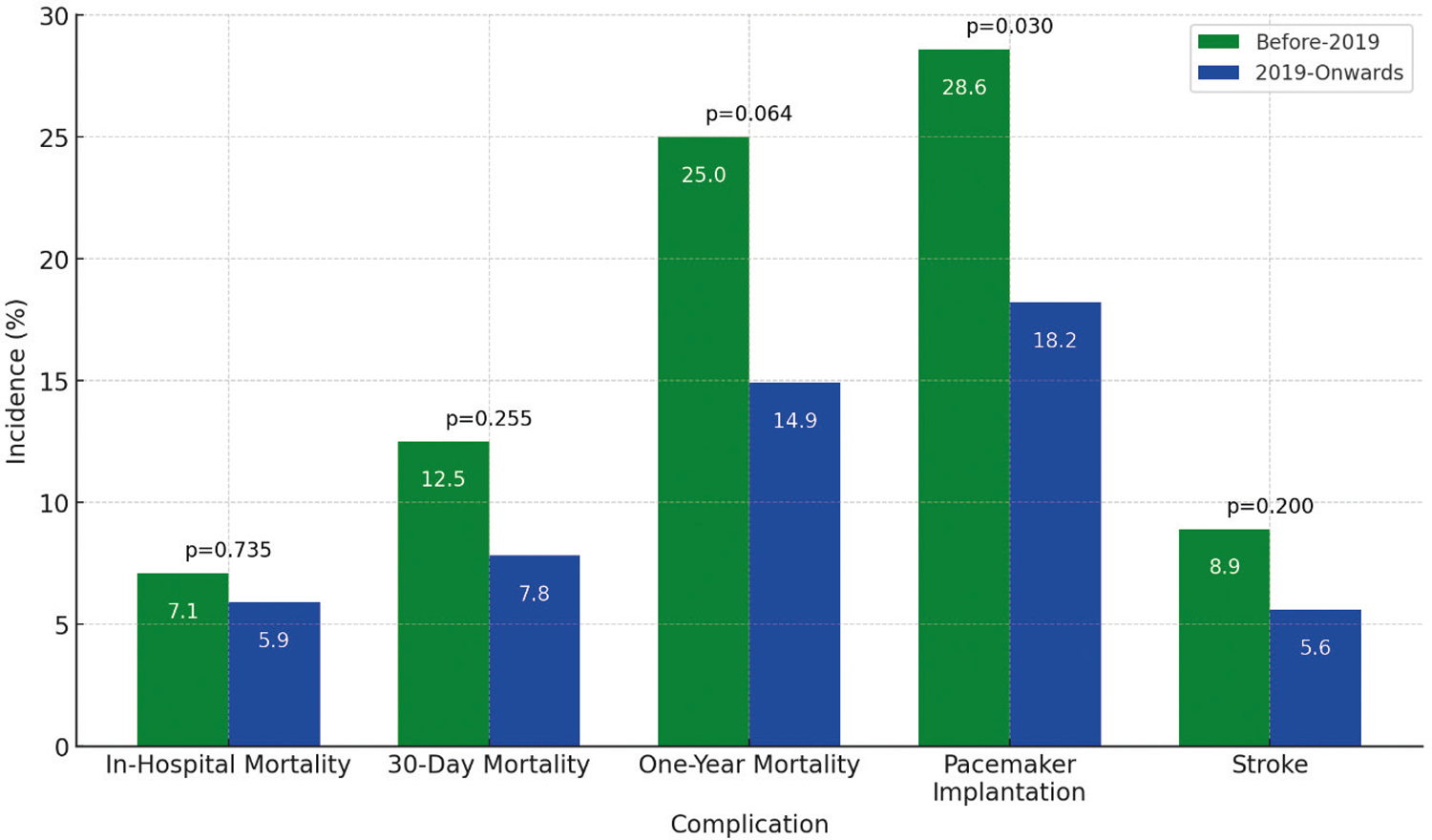
After January 2019, the shift to self-expanding valves was associated with a statistically significant reduction in pacemaker implantation rates (from 28.6% to 18.2%, p=0.03), whereas other outcomes did not reach statistical significance.
Conclusions
The implementation of updated protocols was associated with improved TAVI outcomes, especially a reduced need for pacemaker implantation, supporting its expanded use in intermediate-risk patients.