ABC Family Arquivos Brasileiros de Cardiologia International Journal of Cardiovascular Sciences ABC Heart Failure & Cardiomyopathy ABC Imagem Cardiovascular
Português English
ABC Family
Português English
  • About
    • About ABC Family
    • Internal Regulation
    • Editorial Board
    • Brazilian Society of Cardiology (SBC)
  • Issues
  • SBC Guidelines
  • Content
    • Videos
    • Podcasts
    • News
  • About
    • About ABC Family
    • Internal Regulation
    • Editorial Board
    • Brazilian Society of Cardiology (SBC)
  • Issues
  • SBC Guidelines
  • Content
    • Videos
    • Podcasts
    • News

ABC Family

  • ABC Family
  • Arquivos Brasileiros de Cardiologia
  • International Journal of Cardiovascular Sciences
  • ABC Heart Failure & Cardiomyopathy
  • ABC Imagem Cardiovascular
Search in

No content found.

Journals
Ordering
Article types
Others

  1. Home
  2. Keyword: Medical Records
ABC
Letter to the Editor

Clinical registries in Acute Myocardial Infarction

Miguel Alejandro Rodriguez-Ramos

Dear Editor

I appreciate the efforts of Alves et al.when they tried to evaluate all-cause in-hospital mortality in patients admitted for STEMI and NSTEMI in hospitals in Latin America and the Caribbean from 2000 onward, concluding that in-hospital mortality in low- and middle-income countries was high in comparison with rates reported in high-income countries and to improve these estimates, higher use of reperfusion therapy must be pursued.

[…]

  • Developing Countries
  • Medical Records
  • Myocardial Infarction
Read Full Article
Creative Commons Attribution (CC BY) Creative Commons license
01/09/2023 DOI: 10.36660/abc.20230066
IJCS
Original Article

Methods of Screening for Depression in Outpatients with Heart Failure

Thaís de Rezende Bessa Guerra et al. Isabella Cristina Diniz Venancio Daniel Mählmann de Moura Pinheiro Mauro Vitor Mendlowicz … Ana Carla Dantas Cavalcanti Evandro Tinoco Mesquita

Abstract

Background:

Depression is a syndromic clinical condition underdiagnosed in patients with heart failure. Several instruments are currently applied to screen for depression.

Objective:

To determine the prevalence of depression and the agreement among screening methods for depression in patients with heart failure.

Methods:

Cross-sectional study conducted between March 2015 and January 2017 including 76 outpatients following up at a clinic specialized in heart failure. Depression was screened with the Hamilton Depression Rating Scale (HAM-D), Beck Depression Inventory-II (BDI-II), and Patient Health Questionnaire-9 (PHQ-9). The agreement among the three instruments was analyzed with Fleiss’ kappa coefficient (kF), Krippendorff’s alpha coefficient (Ck) and Cronbach’s alpha coefficient. The accuracy, sensitivity, and specificity, as well as false-positive and false-negative results of the HAM-D and PHQ-9 were calculated considering the BDI-II as the gold-standard instrument in the diagnosis of depression.

Results:

The prevalence rates of depression were 72.4% (n = 55) with the HAM-D, 67.1% (n = 51) with the BDI-II, and 40.8% (n = 31) with the PHQ-9 scales. The prevalence of depression simultaneously identified by all three instruments was 28.9% (n = 22) and the diagnostic agreement (presence or absence of depression) was 47.4% (n = 36). The analysis revealed a superficial agreement (kF = Ck = 0.27) and moderate consistency ((↓C = 0.602, significantly not null, p = 0.000). Sociodemographic and clinical variables were not risk factors for depression in the evaluated sample.

Conclusion:

The screening methods analyzed showed agreement and were useful in detecting depression among outpatients with heart failure.

  • Cross-Sectional Studies
  • Depression / diagnosis
  • Depression / prevalence
  • Heart Failure
  • Medical Records
  • Surveys and Questionnaires
Read Full Article
Creative Commons Attribution (CC BY) Creative Commons license
02/07/2018 DOI: 10.5935/2359-4802.20180037
ABC
Letter to the Editor

Challenges For Percutaneous Left Atrial Appendage Closure: Imaging And Residual Flow

Tarik Yildirim et al. Ibrahim Altun Mustafa Ozcan Soylu

We have read with great interest the paper entitled ‘First results of the Brazilian Registry of Percutaneous Left Atrial Appendage Closure’ by Guérios et al. is a very important study. We have some suggestions about this trial.

Firstly, two-dimensional transeosophageal echocardiography (2D-TEE) can evaluate the morphology of left atrial appendage in multiple views. But real-time three-dimensional transeosophageal echocardiography (3D-TEE) provides more detailed images of the left atrial appendage (LAA) anatomy than 2D-TEE. A competent physician can accurately evaluate the LAA depth and landing zone. Moreover LAA closure depends on an accurate determination of anatomical structure. Therefore the 3D-TEE may show advantantages in relation to 2D-TEE in transcathater LAA closure.

[…]

  • Atrial Appendage
  • Echocardiography, Three-Dimensional
  • Medical Records
  • Septal Occluder Devices
Read Full Article
Creative Commons Attribution (CC BY) Creative Commons license
01/07/2018 DOI: 10.5935/abc.20180135
Figure 1
ABC
Original Article

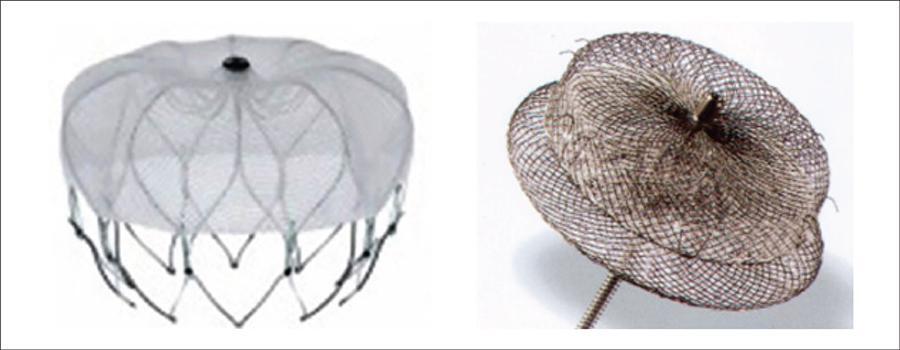
First results of the Brazilian Registry of Percutaneous Left Atrial Appendage Closure

Ênio Eduardo Guérios et al. Francisco Chamié Márcio Montenegro Eduardo Benchimol Saad … Fabio Sandoli de Brito Junior Paulo Avancini Caramori Luiz Carlos Simões Flávio Roberto Azevedo de Oliveira Luiz Carlos Giuliano Cláudio Munhoz da Fontoura Tavares

Abstract

Background:

Left atrial appendage closure (LAAC) is an effective alternative to oral anticoagulation (OA) for the prevention of stroke in patients with non-valvular atrial fibrillation (NVAF).

Objective:

To present the immediate results and late outcomes of patients submitted to LAAC and included in the Brazilian Registry of Percutaneous Left Atrial Appendage Closure.

Methods:

91 patients with NVAF, high stroke risk (CHA2DS2VASc score = 4.5 ± 1.5) and restrictions to OAC (HAS-BLED score = 3.6 ± 1.0) underwent 92 LAAC procedures using either the Amplatzer cardiac plug or the Watchman device in 11 centers in Brazil, between late 2010 and mid 2016.

Results:

Ninety-six devices were used (1.04 device/procedure, including an additional non-dedicated device), with a procedural success rate of 97.8%. Associated procedures were performed in 8.7% of the patients. Complete LAAC was obtained in 93.3% of the successful cases. In cases of incomplete closure, no residual leak was larger than 2.5 mm. One patient needed simultaneous implantation of 2 devices. There were 7 periprocedural major (5 pericardial effusions requiring pericardiocentesis, 1 non-dedicated device embolization and 1 coronary air embolism without sequelae) and 4 minor complications. After 128.6 patient-years of follow-up there were 3 deaths unrelated to the procedure, 2 major bleedings (one of them in a patient with an unsuccessful LAAC), thrombus formation over the device in 2 cases (both resolved after resuming OAC for 3 months) and 2 strokes (2.2%).

Conclusions:

In this multicenter, real world registry, that included patients with NVAF and high thromboembolic and bleeding risks, LAAC effectively prevented stroke and bleeding when compared to the expected rates based on CHA2DS2VASc and HASBLED scores for this population. Complications rate of the procedure was acceptable considering the beginning of the learning curve of most of the involved operators.

  • Atrial Appendage
  • Atrial Fibrillation
  • Cardiovascular Surgical Procedures
  • Medical Records
  • Septal Occluder Devices
  • Stroke
Read Full Article
Creative Commons Attribution (CC BY) Creative Commons license
19/10/2017 DOI: 10.5935/abc.20170150 Views 2
ABC
Special Article

Rationale and design: BREATHE registry – I brazilian registry of heart failure

BACKGROUND: Several local registries have sought to individually depict clinical characteristics of patients hospitalized with heart failure (HF) in Brazilian hospitals and communities. Overall, the analysis of these data suggests that there are important differences in etiology, decompensation factors, treatment and prognosis of patients with HF in different Brazilian regions. OBJECTIVES: To evaluate the demographic, clinical and prognostic characteristics of 1,200 patients admitted with a clinical diagnosis of decompensated HF in a group of 60 hospitals representative of the different Brazilian regions. METHODS: Transversal observational study (registry) with a longitudinal twelve-month follow-up (admission consultations, hospital discharge, three months, six months and twelve months after inclusion), in which patients admitted to public and private hospitals clinical with a primarily defined HF diagnosis will be studied. RESULTS: The results will be shown soon after data collection completion, quality assessment and statistical analysis. CONCLUSIONS: The results of this multicenter registry will allow for a more appropriate planning of financial, technological and personal resource supply for the health care area, as well as the planning of more effective preventive measures in decompensated HF.

  • Brazil
  • Heart Failure
  • Inpatients
  • Medical Records
Read Full Article
Creative Commons Attribution (CC BY) Creative Commons license
28/05/2013 DOI: 10.5935/abc.20130093 Views 1
Use of demonstrably effective therapies in the treatment of acute coronary syndromes: comparison between different brazilian regions. Analysis of the Brazilian Registry on Acute Coronary Syndromes (BRACE)
ABC
Special Article

Use of demonstrably effective therapies in the treatment of acute coronary syndromes: comparison between different brazilian regions. Analysis of the Brazilian Registry on Acute Coronary Syndromes (BRACE)

José Carlos Nicolau et al. Marcelo Franken Paulo Andrade Lotufo Antonio Carlos Carvalho … José Antonio Marin Neto Felipe Gallego Lima Oscar Dutra Elias Knobel Cesar Cardoso de Oliveira Sérgio Timerman Edson Stefanini

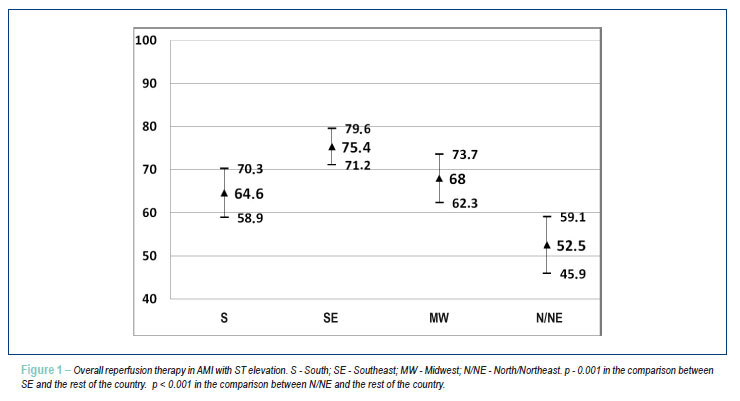
BACKGROUND: Little is known in our country about regional differences in the treatment of acute coronary disease. OBJECTIVE: To analyze the behavior regarding the use of demonstrably effective regional therapies in acute coronary disease. METHODS: A total of 71 hospitals were randomly selected, respecting the proportionality of the country in relation to geographic location, among other criteria. In the overall population was regionally analyzed the use of aspirin, clopidogrel, ACE inhibitors / AT1 blocker, beta-blockers and statins, separately and grouped by individual score ranging from 0 (no drug used) to 100 (all drugs used). In myocardial infarction with ST elevation (STEMI) regional differences were analyzed regarding the use of therapeutic recanalization (fibrinolytics and primary angioplasty). RESULTS: In the overall population, within the first 24 hours of hospitalization, the mean score in the North-Northeast (70.5 ± 22.1) was lower (p <0.05) than in the Southeast (77.7 ± 29.5), Midwest (82 ± 22.1) and South (82.4 ± 21) regions. At hospital discharge, the score of the North-Northeast region (61.4 ± 32.9) was lower (p <0.05) than in the Southeast (69.2 ± 31.6), Midwest (65.3 ± 33.6) and South (73.7 ± 28.1) regions; additionally, the score of the Midwest was lower (p <0.05) than the South region. In STEMI, the use of recanalization therapies was highest in the Southeast (75.4%, p = 0.001 compared to the rest of the country), and lowest in the North-Northeast (52.5%, p <0.001 compared to the rest of the country). CONCLUSION: The use of demonstrably effective therapies in the treatment of acute coronary disease is much to be desired in the country, with important regional differences.

  • Coronary Disease
  • Medical Records
  • Myocardial Infarction
  • Myocardial Ischemia
Read Full Article
Creative Commons Attribution (CC BY) Creative Commons license
21/06/2012 DOI: 10.1590/S0066-782X2012000400001 Views 1
Radial approach in percutaneous coronary interventions: current status in Brazil
ABC
Artigo Original

Radial approach in percutaneous coronary interventions: current status in Brazil

Pedro Beraldo de Andrade et al. Marden André Tebet Mônoca Vieira Athanazio de Andrade André Labrunie Luiz Alberto Piva e Mattos

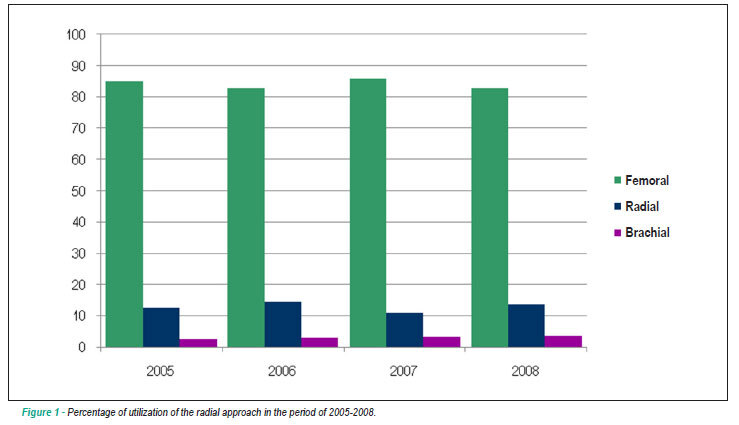
BACKGROUND: Although the radial approach offers an unquestionable result in terms of reduction of vascular complications and occurrence of severe bleeding in comparison to the femoral approach, so far it has only been used in few centers which elected it as the preferential access. OBJECTIVE: To evaluate the current status of percutaneous coronary interventions in Brazil, as regards the use of the radial approach. METHODS: Analysis of data spontaneously recorded in Central Nacional de Intervenções Cardiovasculares – CENIC (National Center for Cardiovascular Interventions) from 2005 to 2008, in a total of 83,376 procedures. RESULTS: The radial approach was used in 12.6% of the procedures performed, and the femoral approach, in 84.3%. The remaining 3.1% corresponded to brachial artery dissection or puncture. With a success rate of 97.5%, the choice of the radial approach was associated with a significant reduction of vascular complications in comparison to the femoral approach (2.5% versus 3.6 %, p < 0.0001). CONCLUSION: The radial approach remains uncommonly used in Brazil, and this is possibly explained by the lack of training programs, uncertainties regarding the learning curve, and the lack of large-scale studies corroborating the benefits demonstrated to date.

  • Angioplasty transluminal percutaneous coronary
  • Brazil
  • femoral artery
  • Medical Records
  • Radial Artery
Read Full Article
Creative Commons Attribution (CC BY) Creative Commons license
04/03/2011 DOI: 10.1590/S0066-782X2011005000026 Views 1

How to cite this article

EndNote RIS

Electronic Document Format (Vancouver)

Rodriguez-Ramos MA. Clinical registries in Acute Myocardial Infarction. Arquivos Brasileiros de Cardiologia 2023;120(8):e20230066.

Electronic Document Format (ABNT)

Rodriguez-Ramos, Miguel Alejandro. Clinical registries in Acute Myocardial Infarction. Arquivos Brasileiros de Cardiologia, v. 120, n. 8, e20230066, Aug. 2023.

Electronic Document Format (APA)

Rodriguez-Ramos, M. A. (2023). Clinical registries in Acute Myocardial Infarction. Arquivos Brasileiros de Cardiologia, 120(8), e20230066.

Electronic Document Format (ISO)

Rodriguez-Ramos, Miguel Alejandro. Clinical registries in Acute Myocardial Infarction. Arquivos Brasileiros de Cardiologia [online]. 2023, vol. 120, n. 8, [cited 2026-10-14], e20230066. Available from: <https://journals.cardiol.br/en/article/clinical-registries-in-acute-myocardial-infarction/>. ISSN 0066-782X

EndNote RIS

Electronic Document Format (Vancouver)

Guerra TRB, Venancio ICD, Pinheiro DMM, Mendlowicz MV, Cavalcanti ACD, Mesquita ET. Methods of Screening for Depression in Outpatients with Heart Failure. International Journal of Cardiovascular Sciences 2018;31(4):414-21.

Electronic Document Format (ABNT)

Guerra, Thaís de Rezende Bessa; Venancio, Isabella Cristina Diniz; Pinheiro, Daniel Mählmann de Moura; Mendlowicz, Mauro Vitor; Cavalcanti, Ana Carla Dantas; Mesquita, Evandro Tinoco. Methods of Screening for Depression in Outpatients with Heart Failure. International Journal of Cardiovascular Sciences, v. 31, n. 4, p. 414-421, Jul. 2018.

Electronic Document Format (APA)

Guerra, T. R. B., Venancio, I. C. D., Pinheiro, D. M. M., Mendlowicz, M. V., Cavalcanti, A. C. D., & Mesquita, E. T. (2018). Methods of Screening for Depression in Outpatients with Heart Failure. International Journal of Cardiovascular Sciences, 31(4), 414-421.

Electronic Document Format (ISO)

Guerra, Thaís de Rezende Bessa and Venancio, Isabella Cristina Diniz and Pinheiro, Daniel Mählmann de Moura and Mendlowicz, Mauro Vitor and Cavalcanti, Ana Carla Dantas and Mesquita, Evandro Tinoco. Methods of Screening for Depression in Outpatients with Heart Failure. International Journal of Cardiovascular Sciences [online]. 2018, vol. 31, n. 4, [cited 2026-10-14], pp. 414-421. Available from: <https://journals.cardiol.br/en/article/methods-of-screening-for-depression-in-outpatients-with-heart-failure/>. ISSN 2359-4802

EndNote RIS

Electronic Document Format (Vancouver)

Yildirim T, Altun I, Soylu MO. Challenges For Percutaneous Left Atrial Appendage Closure: Imaging And Residual Flow. Arquivos Brasileiros de Cardiologia 2018;111(1):117.

Electronic Document Format (ABNT)

Yildirim, Tarik; Altun, Ibrahim; Soylu, Mustafa Ozcan. Challenges For Percutaneous Left Atrial Appendage Closure: Imaging And Residual Flow. Arquivos Brasileiros de Cardiologia, v. 111, n. 1, p. 117-117, Jun. 2018.

Electronic Document Format (APA)

Yildirim, T., Altun, I., & Soylu, M. O. (2018). Challenges For Percutaneous Left Atrial Appendage Closure: Imaging And Residual Flow. Arquivos Brasileiros de Cardiologia, 111(1), 117-117.

Electronic Document Format (ISO)

Yildirim, Tarik and Altun, Ibrahim and Soylu, Mustafa Ozcan. Challenges For Percutaneous Left Atrial Appendage Closure: Imaging And Residual Flow. Arquivos Brasileiros de Cardiologia [online]. 2018, vol. 111, n. 1, [cited 2026-10-14], pp. 117-117. Available from: <https://journals.cardiol.br/en/article/challenges-for-percutaneous-left-atrial-appendage-closure-imaging-and-residual-flow/>. ISSN 0066-782X

EndNote RIS

Electronic Document Format (Vancouver)

Guérios E, Chamié F, Montenegro M, Saad EB, Brito Junior FS, Caramori PA, Simões LC, et al. First results of the Brazilian Registry of Percutaneous Left Atrial Appendage Closure. Arquivos Brasileiros de Cardiologia 2017;109(5):440-7.

Electronic Document Format (ABNT)

Guérios, Ênio Eduardo; Chamié, Francisco; Montenegro, Márcio; Saad, Eduardo Benchimol; Brito Junior, Fabio Sandoli de; Caramori, Paulo Avancini; Simões, Luiz Carlos; Oliveira, Flávio Roberto Azevedo de; Giuliano, Luiz Carlos; Tavares, Cláudio Munhoz da Fontoura. First results of the Brazilian Registry of Percutaneous Left Atrial Appendage Closure. Arquivos Brasileiros de Cardiologia, v. 109, n. 5, p. 440-447, Oct. 2017.

Electronic Document Format (APA)

Guérios, E., Chamié, F., Montenegro, M., Saad, E. B., Brito Junior, F. S. , Caramori, P. A., Simões, L. C., Oliveira, F. R. A. , Giuliano, L. C., & Tavares, C. M. F. (2017). First results of the Brazilian Registry of Percutaneous Left Atrial Appendage Closure. Arquivos Brasileiros de Cardiologia, 109(5), 440-447.

Electronic Document Format (ISO)

Guérios, Ênio Eduardo and Chamié, Francisco and Montenegro, Márcio and Saad, Eduardo Benchimol and Brito Junior, Fabio Sandoli de and Caramori, Paulo Avancini and Simões, Luiz Carlos and Oliveira, Flávio Roberto Azevedo de and Giuliano, Luiz Carlos and Tavares, Cláudio Munhoz da Fontoura. First results of the Brazilian Registry of Percutaneous Left Atrial Appendage Closure. Arquivos Brasileiros de Cardiologia [online]. 2017, vol. 109, n. 5, [cited 2026-10-14], pp. 440-447. Available from: <https://journals.cardiol.br/en/article/first-results-of-the-brazilian-registry-of-percutaneous-left-atrial-appendage-closure/>. ISSN 0066-782X

EndNote RIS

Electronic Document Format (Vancouver)

. Rationale and design: BREATHE registry – I brazilian registry of heart failure. Arquivos Brasileiros de Cardiologia 2013;100(5):390-4.

Electronic Document Format (ABNT)

. Rationale and design: BREATHE registry – I brazilian registry of heart failure. Arquivos Brasileiros de Cardiologia, v. 100, n. 5, p. 390-394, May. 2013.

Electronic Document Format (APA)

(2013). Rationale and design: BREATHE registry – I brazilian registry of heart failure. Arquivos Brasileiros de Cardiologia, 100(5), 390-394.

Electronic Document Format (ISO)

. Rationale and design: BREATHE registry – I brazilian registry of heart failure. Arquivos Brasileiros de Cardiologia [online]. 2013, vol. 100, n. 5, [cited 2026-10-14], pp. 390-394. Available from: <https://journals.cardiol.br/en/article/rationale-and-design-breathe-registry-i-brazilian-registry-of-heart-failure/>. ISSN 0066-782X

EndNote RIS

Electronic Document Format (Vancouver)

Nicolau JC, Franken M, Lotufo PA, Carvalho AC, Marin Neto JA, Lima FG, Dutra O, et al. Use of demonstrably effective therapies in the treatment of acute coronary syndromes: comparison between different brazilian regions. Analysis of the Brazilian Registry on Acute Coronary Syndromes (BRACE). Arquivos Brasileiros de Cardiologia 2012;98(4):282-9.

Electronic Document Format (ABNT)

Nicolau, José Carlos; Franken, Marcelo; Lotufo, Paulo Andrade; Carvalho, Antonio Carlos; Marin Neto, José Antonio; Lima, Felipe Gallego; Dutra, Oscar; Knobel, Elias; Oliveira, Cesar Cardoso de; Timerman, Sérgio; Stefanini, Edson. Use of demonstrably effective therapies in the treatment of acute coronary syndromes: comparison between different brazilian regions. Analysis of the Brazilian Registry on Acute Coronary Syndromes (BRACE). Arquivos Brasileiros de Cardiologia, v. 98, n. 4, p. 282-289, Jun. 2012.

Electronic Document Format (APA)

Nicolau, J. C., Franken, M., Lotufo, P. A., Carvalho, A. C., Marin Neto, J. A., Lima, F. G., Dutra, O., Knobel, E., Oliveira, C. C. , Timerman, S., & Stefanini, E. (2012). Use of demonstrably effective therapies in the treatment of acute coronary syndromes: comparison between different brazilian regions. Analysis of the Brazilian Registry on Acute Coronary Syndromes (BRACE). Arquivos Brasileiros de Cardiologia, 98(4), 282-289.

Electronic Document Format (ISO)

Nicolau, José Carlos and Franken, Marcelo and Lotufo, Paulo Andrade and Carvalho, Antonio Carlos and Marin Neto, José Antonio and Lima, Felipe Gallego and Dutra, Oscar and Knobel, Elias and Oliveira, Cesar Cardoso de and Timerman, Sérgio and Stefanini, Edson. Use of demonstrably effective therapies in the treatment of acute coronary syndromes: comparison between different brazilian regions. Analysis of the Brazilian Registry on Acute Coronary Syndromes (BRACE). Arquivos Brasileiros de Cardiologia [online]. 2012, vol. 98, n. 4, [cited 2026-10-14], pp. 282-289. Available from: <https://journals.cardiol.br/en/article/use-of-demonstrably-effective-therapies-in-the-treatment-of-acute-coronary-syndromes-comparison-between-different-brazilian-regions-analysis-of-the-brazilian-registry-on-acute-coronary-syndromes-br/>. ISSN 0066-782X

EndNote RIS

Electronic Document Format (Vancouver)

Andrade PB, Tebet MA, Andrade MVA, Labrunie A, Mattos LAP. Radial approach in percutaneous coronary interventions: current status in Brazil. Arquivos Brasileiros de Cardiologia 2011;96(4):312-6.

Electronic Document Format (ABNT)

Andrade, Pedro Beraldo de; Tebet, Marden André; Andrade, Mônoca Vieira Athanazio de; Labrunie, André; Mattos, Luiz Alberto Piva e. Radial approach in percutaneous coronary interventions: current status in Brazil. Arquivos Brasileiros de Cardiologia, v. 96, n. 4, p. 312-316, Mar. 2011.

Electronic Document Format (APA)

Andrade, P. B. , Tebet, M. A., Andrade, M. V. A. , Labrunie, A., & Mattos, L. A. P. (2011). Radial approach in percutaneous coronary interventions: current status in Brazil. Arquivos Brasileiros de Cardiologia, 96(4), 312-316.

Electronic Document Format (ISO)

Andrade, Pedro Beraldo de and Tebet, Marden André and Andrade, Mônoca Vieira Athanazio de and Labrunie, André and Mattos, Luiz Alberto Piva e. Radial approach in percutaneous coronary interventions: current status in Brazil. Arquivos Brasileiros de Cardiologia [online]. 2011, vol. 96, n. 4, [cited 2026-10-14], pp. 312-316. Available from: <https://journals.cardiol.br/en/article/radial-approach-in-percutaneous-coronary-interventions-current-status-in-brazil/>. ISSN 0066-782X

  • About ABC Family
  • Internal Regulation
  • Editorial Board
  • Brazilian Society of Cardiology (SBC)

Issues

SBC Guidelines

  • Videos
  • Podcasts
  • News