Heleutério da Conceição Nicolau Madogolele et al. Manuela Cristina Ribeiro Dias Barroso Hernán Patricio García Mejía Cristhian Espinoza … Vinicius Machado Correia Vagner Madrini José Augusto Duncan Ricardo Ribeiro Dias Fábio Fernandes
Abstract
Background
Cardiac myxoma is the second most common primary cardiac tumor; however, contemporary single-center series integrating operative strategy with clinical outcomes remain limited.
Objectives
To describe the operative approaches and clinical outcomes of patients undergoing surgical resection of cardiac myxomas at a single center.
Methods
We conducted a retrospective review of 74 consecutive patients who underwent surgical resection of histologically confirmed cardiac myxomas between 2014 and 2024 at a tertiary referral center in Brazil. Clinical, imaging, surgical, and follow-up data were collected. The primary outcome was the incidence of thromboembolic events. A significance level of 5% was adopted for all statistical analyses.
Results
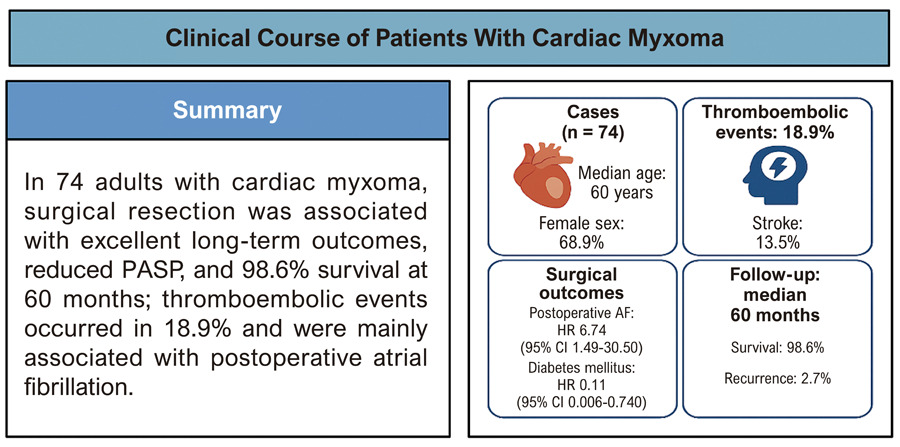
The median age was 60 years (range 52-66), and 68.9% of patients were female. Median follow-up was 60 months (interquartile range 40-79). Thromboembolic events occurred in 14 patients (18.9%), including stroke (13.5%), embolic myocardial infarction (2.7%), and pulmonary embolism (2.7%). In multivariable Cox analysis, diabetes was independently associated with a lower hazard of thromboembolic events (HR 0.11; 95% CI 0.006-0.740; p < 0.05), whereas postoperative atrial fibrillation was associated with a higher thromboembolic risk (HR 6.74; 95% CI 1.490-30.510; p < 0.05). Tumor recurrence occurred in 2.7% of cases. Only one death was recorded during follow-up.
Conclusion
Cardiac myxomas are associated with significant thromboembolic and hemodynamic risks. Early surgical resection provides excellent long-term outcomes and should be considered even in asymptomatic patients. In our cohort, tumor morphology showed a non-significant trend toward a higher risk of thromboembolic events.