ABC Family Arquivos Brasileiros de Cardiologia International Journal of Cardiovascular Sciences ABC Heart Failure & Cardiomyopathy ABC Imagem Cardiovascular
Português English
ABC Family
Português English
  • About
    • About ABC Family
    • Internal Regulation
    • Editorial Board
    • Brazilian Society of Cardiology (SBC)
  • Issues
  • SBC Guidelines
  • Content
    • Videos
    • Podcasts
    • News
  • About
    • About ABC Family
    • Internal Regulation
    • Editorial Board
    • Brazilian Society of Cardiology (SBC)
  • Issues
  • SBC Guidelines
  • Content
    • Videos
    • Podcasts
    • News

ABC Family

  • ABC Family
  • Arquivos Brasileiros de Cardiologia
  • International Journal of Cardiovascular Sciences
  • ABC Heart Failure & Cardiomyopathy
  • ABC Imagem Cardiovascular
Search in

No content found.

Journals
Ordering
Article types
Others

  1. Home
  2. Keyword: Acquired Immunodeficiency Syndrome/complications
ABC
Editorial

Estimating Cardiovascular Risk in HIV-Infected Patients

Marcio Sommer Bittencourt

From the initial reports of HIV infections in 1981, substantial progress in the prevention, detection and treatment have led to a marked reduction in mortality. Among them, the use of highly active antiretroviral therapy (HAART) with the combination of multiple antiretroviral drugs acting in different phases of the viral cycle resulted in impressive reductions in transmission and infectious complications. This increase in survival led to a large and growing population of persons living with HIV (PLWH) as a chronic condition in a setting where other non-infectious complications became more common.

Among those novel conditions affecting PLWH, cardiovascular complications became the leading cause of morbidity and mortality, at least in countries with adequate access to care and widespread use of HAART. The increase in cardiovascular risk in PLWH is multifactorial. First, studies suggest that PLWH are more likely to be diabetics and smokers. Second, those individuals are more likely to have higher triglycerides and lower HDL-C, though LDL-C and total cholesterol were also reduced. It also seems possible that HIV infection is responsible for increases in blood pressure and glucose levels by different mechanisms. However, considerable evidence supports the concept that traditional risk factors do not fully account for the higher cardiovascular risk in those individuals, as the changes in the cardiovascular system in PWLH is multifactorial and at least partially mediated by inflammation and immune activation, leading to endothelial dysfunction, changes in vascular elasticity, coagulation.

[…]

  • Acquired Immunodeficiency Syndrome/complications
  • Antiretroviral Therapy
  • Carotid Artery Diseases
  • Highly Active
  • HIV
  • Risk Factors
Read Full Article
Creative Commons Attribution (CC BY) Creative Commons license
10/02/2020 DOI: 10.36660/abc.20190747 Views 1
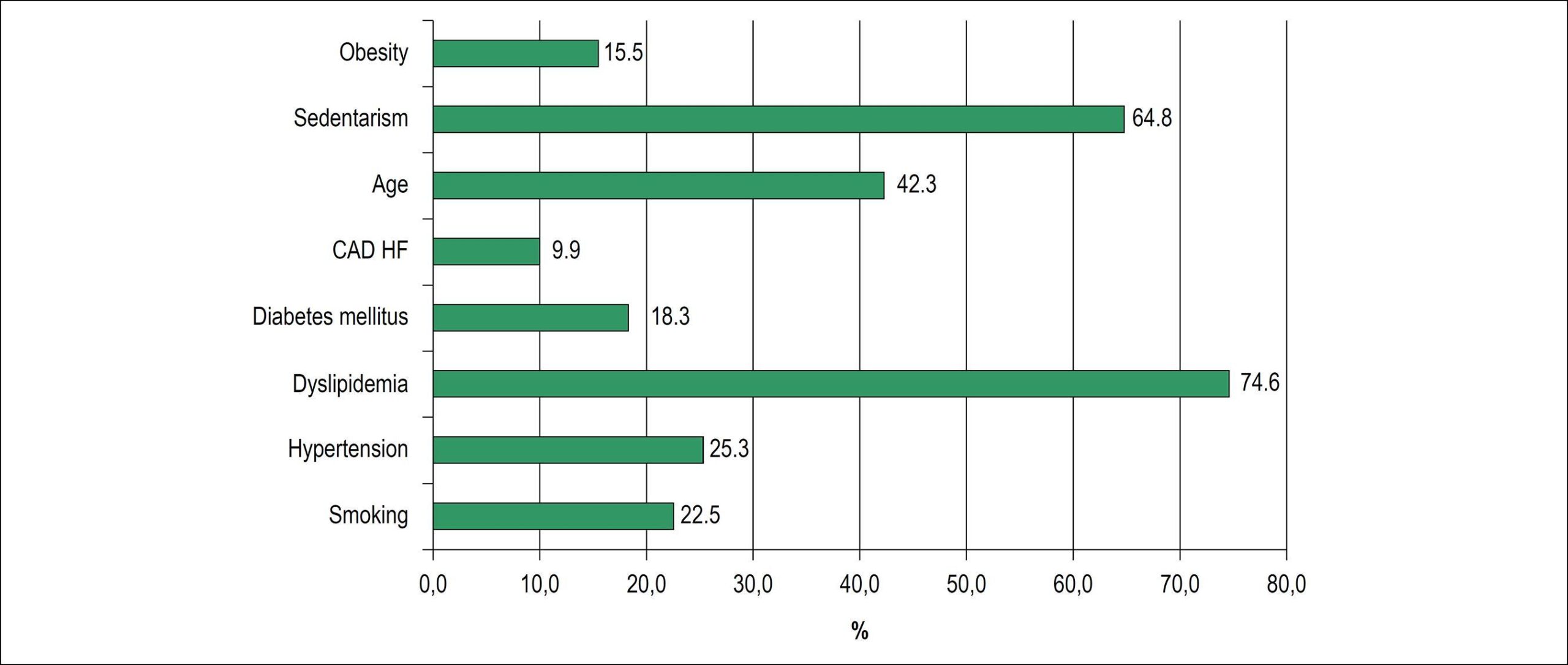
Figure 1
ABC
Original Article

Subclinical Carotid Atherosclerosis and Reduced DAD Score for Cardiovascular Risk Stratification in HIV-Positive Patients

Achilles Gustavo Silva et al. Rafael Vieira Paulo Mario León Silva-Vergara

Abstract

Background:

HIV-positive patients are twice as likely than the general population to have a heart attack and are four times at greater risk of sudden death. In addition to the increased risk, these individuals present with cardiovascular events on average approximately 10 years earlier than the general population.

Objective:

To compare Framingham and reduced DAD (Data Collection on Adverse Effects of Anti-HIV Drugs Cohort) scores for cardiovascular risk assessment in HIV-positive patients and potential impact on clinical decision after evaluation of subclinical carotid atherosclerosis.

Methods:

Seventy-one HIV-positive patients with no history of cardiovascular disease were clinically evaluated, stratified by the Framingham 2008 and reduced DAD scores and submitted to subclinical carotid atherosclerosis evaluation. Agreement between scores was assessed by Kappa index and p < 0.05 was considered statistically significant.

Results:

mean age was 47.2 and 53.5% among males. The rate of subclinical atherosclerosis was 39.4%. Agreement between scores was 49% with Kappa of 0.735 in high-risk patients. There was no significant difference between scores by ROC curve discrimination analysis. Among patients with intermediate risk and Framingham and reduced DAD scores, 62.5% and 30.8% had carotid atherosclerosis, respectively.

Conclusion:

The present study showed a correlation between the scores and medium-intimal thickening, besides a high correlation between patients classified as high risk by the Framingham 2008 and reduced DAD scores. The high prevalence of carotid atherosclerosis in intermediate risk patients suggests that most of them could be reclassified as high risk.

  • Acquired Immunodeficiency Syndrome/complications
  • Antiretroviral Therapy Highly Active
  • Carotid Artery Diseases
  • HIV
  • Indicators of Morbidity
  • Risk Factors
Read Full Article
Creative Commons Attribution (CC BY) Creative Commons license
28/10/2019 DOI: 10.5935/abc.20190227 Views 1

How to cite this article

EndNote RIS

Electronic Document Format (Vancouver)

Bittencourt MS. Estimating Cardiovascular Risk in HIV-Infected Patients. Arquivos Brasileiros de Cardiologia 2020;114(1):76-7.

Electronic Document Format (ABNT)

Bittencourt, Marcio Sommer. Estimating Cardiovascular Risk in HIV-Infected Patients. Arquivos Brasileiros de Cardiologia, v. 114, n. 1, p. 76-77, Feb. 2020.

Electronic Document Format (APA)

Bittencourt, M. S. (2020). Estimating Cardiovascular Risk in HIV-Infected Patients. Arquivos Brasileiros de Cardiologia, 114(1), 76-77.

Electronic Document Format (ISO)

Bittencourt, Marcio Sommer. Estimating Cardiovascular Risk in HIV-Infected Patients. Arquivos Brasileiros de Cardiologia [online]. 2020, vol. 114, n. 1, [cited 2026-10-14], pp. 76-77. Available from: <https://journals.cardiol.br/en/article/estimating-cardiovascular-risk-in-hiv-infected-patients/>. ISSN 0066-782X

EndNote RIS

Electronic Document Format (Vancouver)

Silva AG, Paulo RV, Silva-Vergara ML. Subclinical Carotid Atherosclerosis and Reduced DAD Score for Cardiovascular Risk Stratification in HIV-Positive Patients. Arquivos Brasileiros de Cardiologia 2019;114(1):68-75.

Electronic Document Format (ABNT)

Silva, Achilles Gustavo; Paulo, Rafael Vieira; Silva-Vergara, Mario León. Subclinical Carotid Atherosclerosis and Reduced DAD Score for Cardiovascular Risk Stratification in HIV-Positive Patients. Arquivos Brasileiros de Cardiologia, v. 114, n. 1, p. 68-75, Oct. 2019.

Electronic Document Format (APA)

Silva, A. G., Paulo, R. V., & Silva-Vergara, M. L. (2019). Subclinical Carotid Atherosclerosis and Reduced DAD Score for Cardiovascular Risk Stratification in HIV-Positive Patients. Arquivos Brasileiros de Cardiologia, 114(1), 68-75.

Electronic Document Format (ISO)

Silva, Achilles Gustavo and Paulo, Rafael Vieira and Silva-Vergara, Mario León. Subclinical Carotid Atherosclerosis and Reduced DAD Score for Cardiovascular Risk Stratification in HIV-Positive Patients. Arquivos Brasileiros de Cardiologia [online]. 2019, vol. 114, n. 1, [cited 2026-10-14], pp. 68-75. Available from: <https://journals.cardiol.br/en/article/subclinical-carotid-atherosclerosis-and-reduced-dad-score-for-cardiovascular-risk-stratification-in-hiv-positive-patients/>. ISSN 0066-782X

  • About ABC Family
  • Internal Regulation
  • Editorial Board
  • Brazilian Society of Cardiology (SBC)

Issues

SBC Guidelines

  • Videos
  • Podcasts
  • News