ABC Family Arquivos Brasileiros de Cardiologia International Journal of Cardiovascular Sciences ABC Heart Failure & Cardiomyopathy ABC Imagem Cardiovascular
Português English
ABC Family
Português English
  • About
    • About ABC Family
    • Internal Regulation
    • Editorial Board
    • Brazilian Society of Cardiology (SBC)
  • Issues
  • SBC Guidelines
  • Content
    • Videos
    • Podcasts
    • News
  • About
    • About ABC Family
    • Internal Regulation
    • Editorial Board
    • Brazilian Society of Cardiology (SBC)
  • Issues
  • SBC Guidelines
  • Content
    • Videos
    • Podcasts
    • News

ABC Family

  • ABC Family
  • Arquivos Brasileiros de Cardiologia
  • International Journal of Cardiovascular Sciences
  • ABC Heart Failure & Cardiomyopathy
  • ABC Imagem Cardiovascular
Search in

No content found.

Journals
Ordering
Article types
Others

  1. Home
  2. Keyword: Methods
Figure 1
IJCS
Original Article

The Association between Tp-e interval, Tp-e/QT , and Tp-e/QTc Ratios and Coronary Artery Disease Spectrum and Syntax Score

Serkan Kahraman et al. Ali Dogan Gokhan Demirci Arda Guler … Ali Kemal Kalkan Fatih Uzun Nuri Kurtoglu Mehmet Erturk Mehmet Emin Kalkan

Abstract

Background

Coronary artery disease (CAD) causes electrical heterogeneity on ventricular myocardium and ventricular arrhythmia due to myocardial ischemia linked to ventricular repolarization abnormalities.

Objective

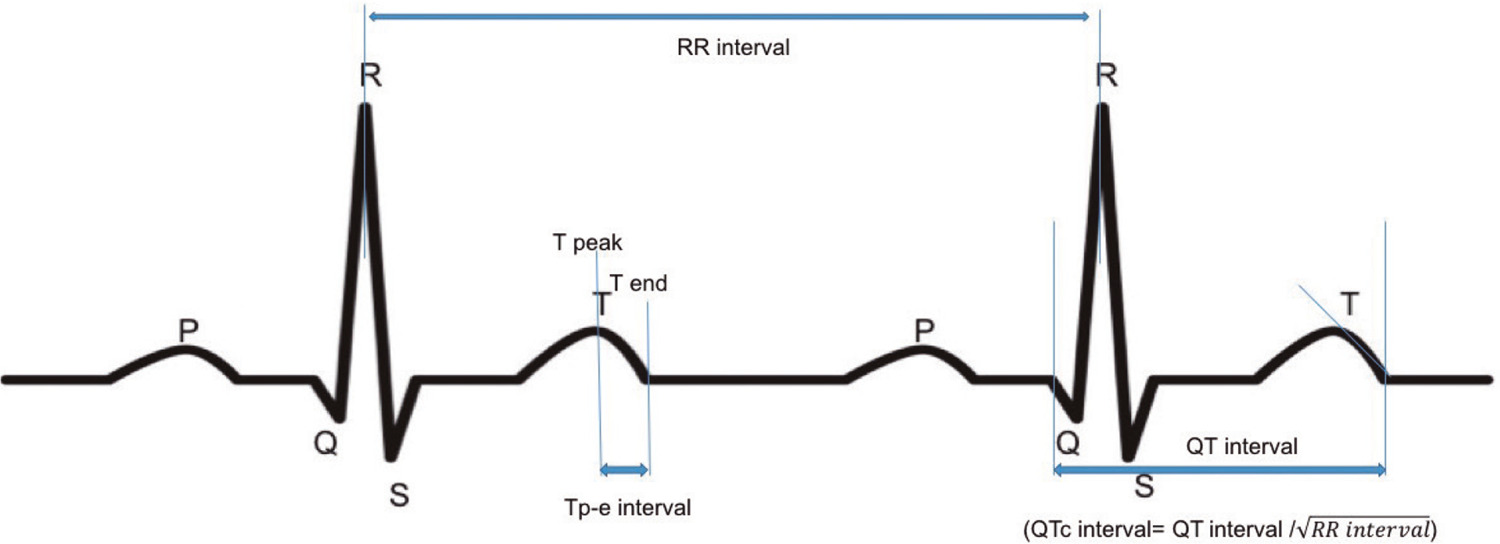
Our aim is to investigate the impact of increased level of CAD spectrum and severity on ventricular repolarization via Tp-e interval, Tp-e/QT and Tp-e/QTc ratios.

Methods

127 patients with normal coronary artery (group 1), 129 patients with stable CAD (group 2) and 121 patients with acute coronary syndrome (group 3) were enrolled. Tp-e interval, Tp-e/QT and Tp-e/QTc ratios were evaluated as well as baseline demographic and clinical parameters. Kruskal-Wallis one-way ANOVA test was used for comparing quantitative variables with abnormal distribution while One-Way ANOVA test was used for comparing the means between groups with normal distribution. Tukey HSD and Welch tests were used for subgroups analyses with normal distribution. Spearman analysis was used to evaluate the correlation between clinical variables and repolarization markers. A p-value < 0.05 was considered statistically significant.

Results

Tp-e interval [66(50-83), 71(59-82) and 76(64-86); group 1,2 and 3 respectively, p<0.001], Tp-e/QT (0.170.02, 0.180.01 and 0,190.01; group 1,2 and 3 respectively, p<0.001) and Tp-e/QTc (0.150.02, 0.160.02 and 0.170.02; group 1,2 and 3 respectively, p<0.001) ratios were found to be associated with increased level of CAD spectrum. Syntax score was positively correlated with Tp-e interval (r=0.514, p<0.001), Tp-e/QT (r=0.407, p<0.001), and Tp-e/QTc ratios (r=0.240, p<0.001).

Conclusion

Prolonged Tp-e interval and increased Tp-e/QT and Tp-e/QTc ratios were detected in the presence of CAD and especially in patients with acute ischemic syndromes. (Int J Cardiovasc Sci. 2020; [online].ahead print, PP.0-0)
  • Anthropometry
  • Arrhythmias Cardiac
  • Cardiovascular Diseases
  • Coronary Artery Disease
  • Electrocardiography
  • Methods
  • Score Sintax
Read Full Article
Creative Commons Attribution (CC BY) Creative Commons license
22/01/2021 DOI: 10.36660/ijcs.20190149 Views 3
Figure 1
ABC
Original Article

A Multivariate Model for Prediction of Obstructive Coronary Disease in Patients with Acute Chest Pain: Development and Validation

Luis Cláudio Lemos Correia et al. Maurício Cerqueira Manuela Carvalhal Felipe Ferreira … Guilherme Garcia André Barcelos da Silva Nicole de Sá Fernanda Lopes Ana Clara Barcelos Márcia Noya-Rabelo

Abstract

Background:

Currently, there is no validated multivariate model to predict probability of obstructive coronary disease in patients with acute chest pain.

Objective:

To develop and validate a multivariate model to predict coronary artery disease (CAD) based on variables assessed at admission to the coronary care unit (CCU) due to acute chest pain.

Methods:

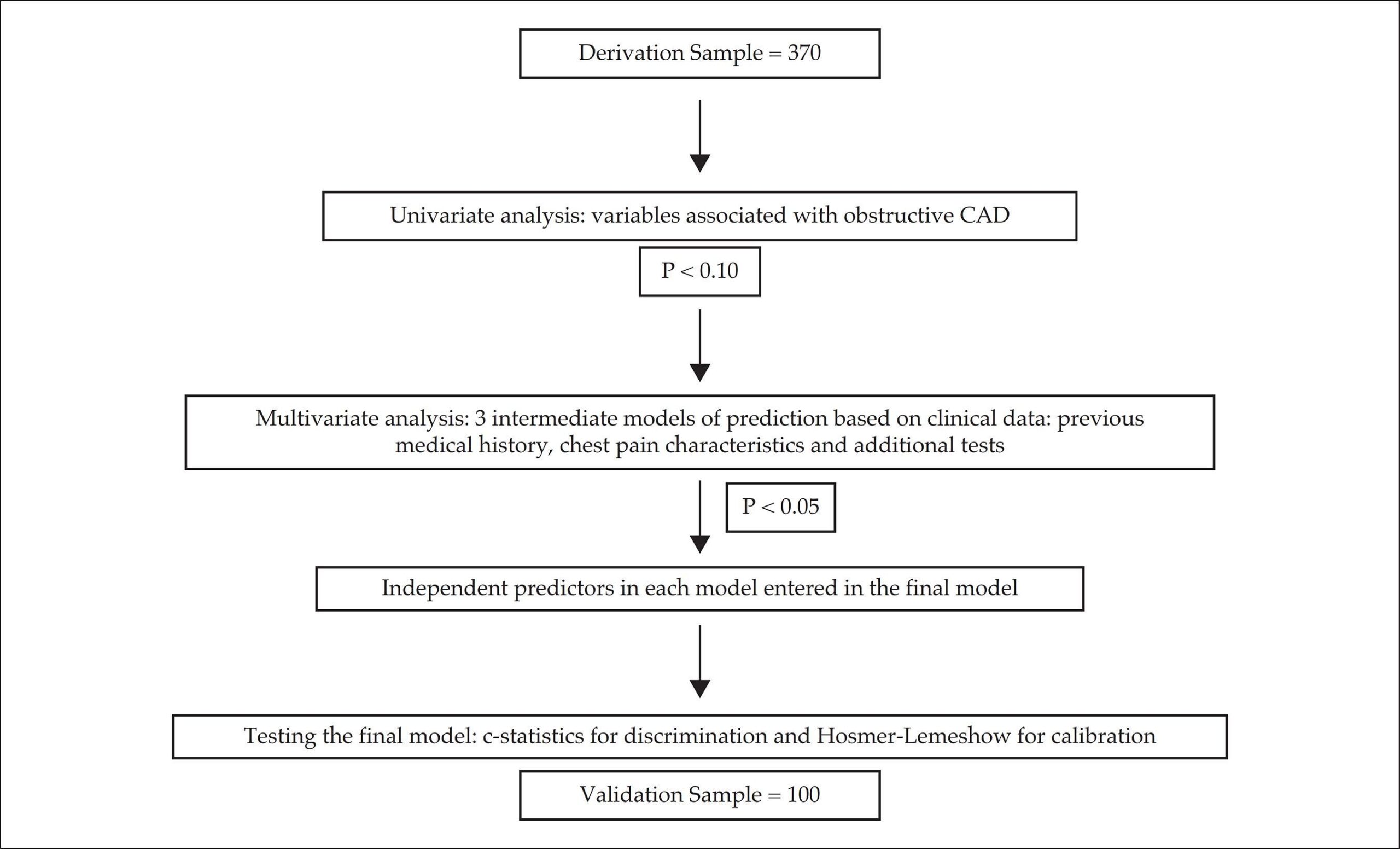
A total of 470 patients were studied, 370 utilized as the derivation sample and the subsequent 100 patients as the validation sample. As the reference standard, angiography was required to rule in CAD (stenosis ≥ 70%), while either angiography or a negative noninvasive test could be used to rule it out. As predictors, 13 baseline variables related to medical history, 14 characteristics of chest discomfort, and eight variables from physical examination or laboratory tests were tested.

Results:

The prevalence of CAD was 48%. By logistic regression, six variables remained independent predictors of CAD: age, male gender, relief with nitrate, signs of heart failure, positive electrocardiogram, and troponin. The area under the curve (AUC) of this final model was 0.80 (95% confidence interval [95%CI] = 0.75 – 0.84) in the derivation sample and 0.86 (95%CI = 0.79 – 0.93) in the validation sample. Hosmer-Lemeshow’s test indicated good calibration in both samples (p = 0.98 and p = 0.23, respectively). Compared with a basic model containing electrocardiogram and troponin, the full model provided an AUC increment of 0.07 in both derivation (p = 0.0002) and validation (p = 0.039) samples. Integrated discrimination improvement was 0.09 in both derivation (p < 0.001) and validation (p < 0.0015) samples.

Conclusion:

A multivariate model was derived and validated as an accurate tool for estimating the pretest probability of CAD in patients with acute chest pain.

  • Chest Pain
  • Coronary Angiography
  • CoronaryArtery Disease
  • Electrocardiography
  • Methods
  • Models Statistical
  • Troponin
Read Full Article
Creative Commons Attribution (CC BY) Creative Commons license
01/04/2017 DOI: 10.5935/abc.20170037
Valve replacement with chordal preservation and valvuloplasty for chronic mitral insufficiency
ABC
Artigo Original

Valve replacement with chordal preservation and valvuloplasty for chronic mitral insufficiency

José Luiz Dancini et al. Pablo Maria Alberto Pomerantzeff Guilherme Sobreira Spina Mírian Magalhães Pardi … Maria Clementina Pinto Giorgi Roney Orismar Sampaio Max Grinberg Sérgio Almeida de Oliveira

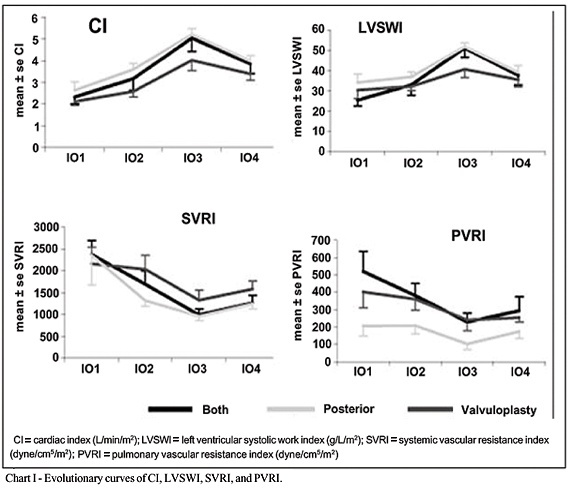
OBJECTIVE: To compare, from the clinical and laboratory points of view, 3 groups of patients undergoing surgical treatment for isolated chronic mitral insufficiency. One group underwent valvuloplasty, and the other 2 groups underwent mitral valve replacement with different techniques for chordal preservation. METHODS: Twenty-eight patients with a mean age of 54.1 years, no coronary or multivalvular disease, and no reoperation, underwent surgery as follows: 9 underwent valvuloplasty; 10 underwent mitral valve replacement with chordal preservation in both leaflets; and 9 underwent mitral valve replacement with chordal preservation only in the posterior leaflet. Clinical, Doppler echocardiographic, and radionuclide ventriculographic assessments were performed until the 6th month of follow-up. RESULTS: At the end, 88.8% of the patients were in functional class I. One died due to intracranial hemorrhage during anticoagulant treatment. The left ventricular diastolic diameter (P<0.0001) and end-diastolic volume (P<0.0001) decreased in the 3 groups. Only the patients undergoing valvuloplasty had a decrease in systolic diameter (P=0.0003) and in end-systolic volume (P=0.0040), with no change in the ejection fraction (P=0.5586). The patients undergoing mitral valve replacement had a similar drop in ejection fraction (P=0.0001 and P=0.0296). CONCLUSION: The 3 surgical techniques used provided clinical improvement. Patients undergoing valvuloplasty had better preservation of ventricular function. No significant difference was observed in cardiac performance between the 2 groups undergoing mitral valve replacement with chordal preservation within a 6-month follow-up.

  • chordae tendineae
  • Methods
  • Mitral Valve Insufficiency
  • Surgery
  • valvular prosthesis implantation
Read Full Article
Creative Commons Attribution (CC BY) Creative Commons license
05/04/2004 DOI: 10.1590/S0066-782X2004000300004 Views 1
Surgical treatment of coarctation of the aorta using trapezoidal aortoplasty
ABC
Artigo Original

Surgical treatment of coarctation of the aorta using trapezoidal aortoplasty

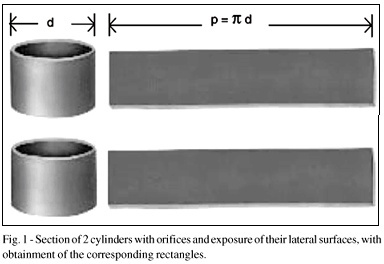
Jarbas Jakson Dinkhuysen et al. Tarcisio Luiz Valle de Almeida Ibraim Masciarelli Francisco Pinto Luiz Carlos Bento de Souza

OBJECTIVE: Trapezoidal aortoplasty is a technical variant of end-to-end anastomosis, which, based on elements of geometry, aims at increasing the diameter of the aorta at the level of the suture, therefore reducing the occurrence of residual or recurrent pressure gradients in the short and long run. METHODS: After resecting the coarcted area and ductal tissue, 3 trapezoids are confected in each aortic stump, which, when confronted, create a suture line with a sinusoidal aspect (zigzag). Thirty-three patients underwent surgery with this technique, 22 (66.7%) males, with ages ranging from 3 months to 36 years (mean of 9.84 ± 9.69). RESULTS: No immediate or late deaths occurred. Follow-up ranged from 1.1 to 7.6 years (mean of 3.6 ± 3.4). Most patients became asymptomatic with normal blood pressure levels, enabling the discontinuation of antihypertensive therapy (P<0.0001). A significant reduction in the pressure gradients was observed on Doppler echocardiography and during cardiac catheterization (P<0.001). The analysis of the images of aortography showed good anatomical continuity in the region of the anastomosis, and the morphometric study of the aorta revealed the beneficial effects of the technique indicated by the increase in the caliber of the aorta in the distal segment of the arch, isthmus, and descending portion. CONCLUSION: Trapezoidal aortoplasty showed satisfactory clinical results that allow its application in all cases indicated for end-to-end anastomosis.

  • Clinical Evolution
  • coarctation of the aorta
  • Methods
  • Surgery
  • surgical anastomosis
Read Full Article
Creative Commons Attribution (CC BY) Creative Commons license
12/02/2004 DOI: 10.1590/S0066-782X2004000100002

How to cite this article

EndNote RIS

Electronic Document Format (Vancouver)

Kahraman S, Dogan A, Demirci G, Guler A, Kalkan AK, Uzun F, Kurtoglu N, et al. The Association between Tp-e interval, Tp-e/QT , and Tp-e/QTc Ratios and Coronary Artery Disease Spectrum and Syntax Score. International Journal of Cardiovascular Sciences 2021;34(2):179-87.

Electronic Document Format (ABNT)

Kahraman, Serkan; Dogan, Ali; Demirci, Gokhan; Guler, Arda; Kalkan, Ali Kemal; Uzun, Fatih; Kurtoglu, Nuri; Erturk, Mehmet; Kalkan, Mehmet Emin. The Association between Tp-e interval, Tp-e/QT , and Tp-e/QTc Ratios and Coronary Artery Disease Spectrum and Syntax Score. International Journal of Cardiovascular Sciences, v. 34, n. 2, p. 179-187, Jan. 2021.

Electronic Document Format (APA)

Kahraman, S., Dogan, A., Demirci, G., Guler, A., Kalkan, A. K., Uzun, F., Kurtoglu, N., Erturk, M., & Kalkan, M. E. (2021). The Association between Tp-e interval, Tp-e/QT , and Tp-e/QTc Ratios and Coronary Artery Disease Spectrum and Syntax Score. International Journal of Cardiovascular Sciences, 34(2), 179-187.

Electronic Document Format (ISO)

Kahraman, Serkan and Dogan, Ali and Demirci, Gokhan and Guler, Arda and Kalkan, Ali Kemal and Uzun, Fatih and Kurtoglu, Nuri and Erturk, Mehmet and Kalkan, Mehmet Emin. The Association between Tp-e interval, Tp-e/QT , and Tp-e/QTc Ratios and Coronary Artery Disease Spectrum and Syntax Score. International Journal of Cardiovascular Sciences [online]. 2021, vol. 34, n. 2, [cited 2026-10-14], pp. 179-187. Available from: <https://journals.cardiol.br/en/article/the-association-between-tp-e-interval-tp-e-qt-and-tp-e-qtc-ratios-and-coronary-artery-disease-spectrum-and-syntax-score/>. ISSN 2359-4802

EndNote RIS

Electronic Document Format (Vancouver)

Correia LCL, Cerqueira M, Carvalhal M, Ferreira F, Garcia G, Silva AB, Sá N, et al. A Multivariate Model for Prediction of Obstructive Coronary Disease in Patients with Acute Chest Pain: Development and Validation. Arquivos Brasileiros de Cardiologia 2017;108(4):304-1.

Electronic Document Format (ABNT)

Correia, Luis Cláudio Lemos; Cerqueira, Maurício; Carvalhal, Manuela; Ferreira, Felipe; Garcia, Guilherme; Silva, André Barcelos da; Sá, Nicole de; Lopes, Fernanda; Barcelos, Ana Clara; Noya-Rabelo, Márcia. A Multivariate Model for Prediction of Obstructive Coronary Disease in Patients with Acute Chest Pain: Development and Validation. Arquivos Brasileiros de Cardiologia, v. 108, n. 4, p. 304-314, Mar. 2017.

Electronic Document Format (APA)

Correia, L. C. L., Cerqueira, M., Carvalhal, M., Ferreira, F., Garcia, G., Silva, A. B. , Sá, N. , Lopes, F., Barcelos, A. C., & Noya-Rabelo, M. (2017). A Multivariate Model for Prediction of Obstructive Coronary Disease in Patients with Acute Chest Pain: Development and Validation. Arquivos Brasileiros de Cardiologia, 108(4), 304-314.

Electronic Document Format (ISO)

Correia, Luis Cláudio Lemos and Cerqueira, Maurício and Carvalhal, Manuela and Ferreira, Felipe and Garcia, Guilherme and Silva, André Barcelos da and Sá, Nicole de and Lopes, Fernanda and Barcelos, Ana Clara and Noya-Rabelo, Márcia. A Multivariate Model for Prediction of Obstructive Coronary Disease in Patients with Acute Chest Pain: Development and Validation. Arquivos Brasileiros de Cardiologia [online]. 2017, vol. 108, n. 4, [cited 2026-10-14], pp. 304-314. Available from: <https://journals.cardiol.br/en/article/a-multivariate-model-for-prediction-of-obstructive-coronary-disease-in-patients-with-acute-chest-pain-development-and-validation/>. ISSN 0066-782X

EndNote RIS

Electronic Document Format (Vancouver)

Dancini JL, Pomerantzeff PMA, Spina GS, Pardi MM, Giorgi MCP, Sampaio RO, Grinberg M, et al. Valve replacement with chordal preservation and valvuloplasty for chronic mitral insufficiency. Arquivos Brasileiros de Cardiologia 2004;82(3):235-42.

Electronic Document Format (ABNT)

Dancini, José Luiz; Pomerantzeff, Pablo Maria Alberto; Spina, Guilherme Sobreira; Pardi, Mírian Magalhães; Giorgi, Maria Clementina Pinto; Sampaio, Roney Orismar; Grinberg, Max; Oliveira, Sérgio Almeida de. Valve replacement with chordal preservation and valvuloplasty for chronic mitral insufficiency. Arquivos Brasileiros de Cardiologia, v. 82, n. 3, p. 235-242, Apr. 2004.

Electronic Document Format (APA)

Dancini, J. L., Pomerantzeff, P. M. A., Spina, G. S., Pardi, M. M., Giorgi, M. C. P., Sampaio, R. O., Grinberg, M., & Oliveira, S. A. (2004). Valve replacement with chordal preservation and valvuloplasty for chronic mitral insufficiency. Arquivos Brasileiros de Cardiologia, 82(3), 235-242.

Electronic Document Format (ISO)

Dancini, José Luiz and Pomerantzeff, Pablo Maria Alberto and Spina, Guilherme Sobreira and Pardi, Mírian Magalhães and Giorgi, Maria Clementina Pinto and Sampaio, Roney Orismar and Grinberg, Max and Oliveira, Sérgio Almeida de. Valve replacement with chordal preservation and valvuloplasty for chronic mitral insufficiency. Arquivos Brasileiros de Cardiologia [online]. 2004, vol. 82, n. 3, [cited 2026-10-14], pp. 235-242. Available from: <https://journals.cardiol.br/en/article/valve-replacement-with-chordal-preservation-and-valvuloplasty-for-chronic-mitral-insufficiency/>. ISSN 0066-782X

EndNote RIS

Electronic Document Format (Vancouver)

Dinkhuysen JJ, Almeida TLV, Pinto IMF, Souza LCB. Surgical treatment of coarctation of the aorta using trapezoidal aortoplasty. Arquivos Brasileiros de Cardiologia 2004;82(1):9-17.

Electronic Document Format (ABNT)

Dinkhuysen, Jarbas Jakson; Almeida, Tarcisio Luiz Valle de; Pinto, Ibraim Masciarelli Francisco; Souza, Luiz Carlos Bento de. Surgical treatment of coarctation of the aorta using trapezoidal aortoplasty. Arquivos Brasileiros de Cardiologia, v. 82, n. 1, p. 9-17, Feb. 2004.

Electronic Document Format (APA)

Dinkhuysen, J. J., Almeida, T. L. V. , Pinto, I. M. F., & Souza, L. C. B. (2004). Surgical treatment of coarctation of the aorta using trapezoidal aortoplasty. Arquivos Brasileiros de Cardiologia, 82(1), 9-17.

Electronic Document Format (ISO)

Dinkhuysen, Jarbas Jakson and Almeida, Tarcisio Luiz Valle de and Pinto, Ibraim Masciarelli Francisco and Souza, Luiz Carlos Bento de. Surgical treatment of coarctation of the aorta using trapezoidal aortoplasty. Arquivos Brasileiros de Cardiologia [online]. 2004, vol. 82, n. 1, [cited 2026-10-14], pp. 9-17. Available from: <https://journals.cardiol.br/en/article/surgical-treatment-of-coarctation-of-the-aorta-using-trapezoidal-aortoplasty/>. ISSN 0066-782X

  • About ABC Family
  • Internal Regulation
  • Editorial Board
  • Brazilian Society of Cardiology (SBC)

Issues

SBC Guidelines

  • Videos
  • Podcasts
  • News