ABC Family Arquivos Brasileiros de Cardiologia International Journal of Cardiovascular Sciences ABC Heart Failure & Cardiomyopathy ABC Imagem Cardiovascular
Português English
ABC Family
Português English
  • About
    • About ABC Family
    • Internal Regulation
    • Editorial Board
    • Brazilian Society of Cardiology (SBC)
  • Issues
  • SBC Guidelines
  • Content
    • Videos
    • Podcasts
    • News
  • About
    • About ABC Family
    • Internal Regulation
    • Editorial Board
    • Brazilian Society of Cardiology (SBC)
  • Issues
  • SBC Guidelines
  • Content
    • Videos
    • Podcasts
    • News

ABC Family

  • ABC Family
  • Arquivos Brasileiros de Cardiologia
  • International Journal of Cardiovascular Sciences
  • ABC Heart Failure & Cardiomyopathy
  • ABC Imagem Cardiovascular
Search in

No content found.

Journals
Ordering
Article types
Others

  1. Home
  2. Keyword: cardiac transplantation
Evaluation of heart failure prognostic factors in patients referred for heart transplantation
ABC
Artigo Original

Evaluation of heart failure prognostic factors in patients referred for heart transplantation

Cleópatra Medina Noronha Areosa et al. Dirceu Rodrigues Almeida Antônio Carlos C. de Carvalho Angelo A. V. de Paola

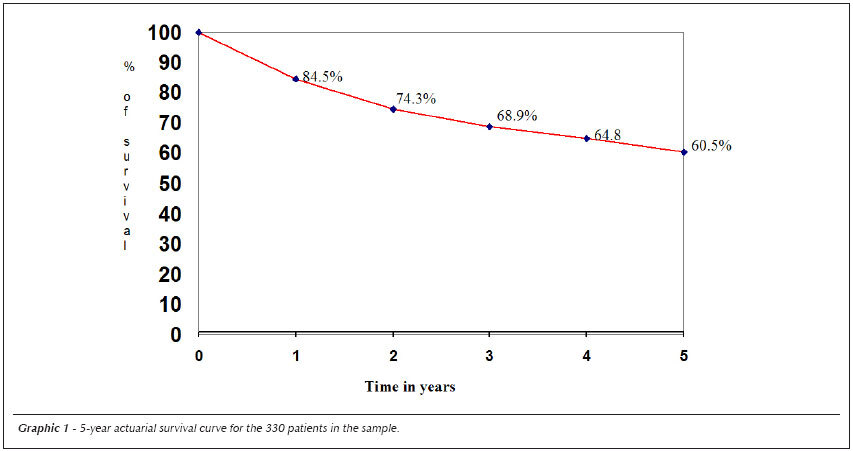
OBJECTIVES: To evaluate the survival of patients with heart failure submitted to cardiac transplantation screening as well as identify poor prognostic factors using a risk score to identify patients with higher death risk. METHODS: 330 male and female patients aged 12 to 74 years old, referred for heart transplantation from January 1986 to November 2001 were evaluated. Clinical, laboratory, electrocardiographic, Holter monitoring, echocardiographic and radionuclide ventriculography data were analyzed. RESULTS: The median follow up period was 5 years; patients’ survival rate was 84.5% in the first year, 74.3% in the second year, 68.9% in the third year and 60.5% in the fifth year. The prognostic variables selected through the univariate analysis were: age, Chagas’ disease etiology for cardiomyopathy, NYHA functional classes III and IV, orthopnea, systolic blood pressure, mean blood pressure, pulse pressure, plasma urea, sodium, glucose, albumin, bilirubin, hemoglobin, and mean heart rate. The prognostic variables at the multivariate analysis were: ejection fraction, blood urea, and hemoglobin. The risk score: RR=exp[(-0.0942401 x ejection fraction) + (0.0105207 x blood urea) + (-0.2974991 x hemoglobin) + (-0.0132898 x age) + (-0.0099115 x blood glucose)] discriminated the population with a higher death risk. CONCLUSION: Patients’ survival was satisfactory despite heart failure severity, suggesting they can be maintained on optimized clinical treatment until persistent clinical deterioration takes place. Ejection fraction, ventricular diameters, and clinical functional class alone should not be used as an indication for heart transplantation. The risk score could help discriminate the population with the poorest prognosis.
  • cardiac transplantation
  • Heart Failure
  • prognostic factors
  • Survival
Read Full Article
Creative Commons Attribution (CC BY) Creative Commons license
23/07/2007 DOI: 10.1590/S0066-782X2007000600007 Views 1
Cardiac transplantation and neoplasms: experiences at Escola Paulista de Medicina of the Federal University of São Paulo
ABC
Artigo Original

Cardiac transplantation and neoplasms: experiences at Escola Paulista de Medicina of the Federal University of São Paulo

Walter Teixeira de Mello Junior et al. João Nelson R. Branco Roberto Catani Luciano de Figueiredo Aguiar … Rodrigo Pereira Paez Enio Buffolo

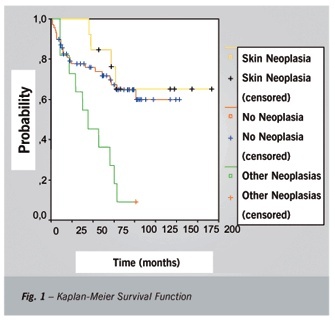
OBJECTIVE: To study the occurrence and types of neoplasms developed by patients who underwent an orthotopic cardiac transplantation under the Program of Cardiac Transplantation of Escola Paulista de Medicina, Federal University of São Paulo. METHODS: This is an observational study of 106 patients who underwent orthotopic cardiac transplantation from November 1986 to September 2002 and survived at least thirty days following the procedure. The triple immunosuppressive regimen given included cyclosporin A, azathioprine and a corticosteroid agent. Only two patients received OKT3 in addition to the regimen established. Mean follow-up was 61.4 months (ranging from two months to 192 months). RESULTS: Twenty-three patients (21.3%) developed neoplasms – 56.5% of these were skin neoplasm, 30.1%, solid tumors, and 13.4% of post-transplant lymphoproliferative disease (PTLD). Mean interval between transplantation and diagnosis of neoplasm was: 54.9 months for skin neoplasm; 24.8 months for solid tumors and 70.3 months for PTLD. CONCLUSION: Malignant neoplasms are relatively common in the population studied. Skin cancer was the most common type compared to the other types of neoplasms. Solid tumors were more frequently diagnosed than the lymphoproliferative diseases in the population examined.

  • cardiac transplantation
  • Neoplasms
  • Surgery
Read Full Article
Creative Commons Attribution (CC BY) Creative Commons license
20/02/2006 DOI: 10.1590/S0066-782X2006000200006
ABC
Original Article

Mediastinitis after cardiac transplantation

Noedir A. G. Stolf et al. Alfredo I. Fiorelli Fernando Bacal Luiz F. Camargo … Edimar A. Bocchi Andréa Freitas André Nicoletti Daniela Meira

OBJECTIVE: Assessment of incidence and behavior of mediastinitis after cardiac transplantation. METHODS: From 1985 to 1999, 214 cardiac transplantations were performed, 12 (5.6%) of the transplanted patients developed confirmed mediastinitis. Patient’s ages ranged from 42 to 66 years (mean of 52.3±10.0 years) and 10 (83.3%) patients were males. Seven (58.3%) patients showed sternal stability on palpation, 4 (33.3%) patients had pleural empyema, and 2 (16.7%) patients did not show purulent secretion draining through the wound. RESULTS: Staphylococcus aureus was the infectious agent identified in the wound secretion or in the mediastinum, or both, in 8 (66.7%) patients. Staphylococcus epidermidis was identified in 2 (16.7%) patients, Enterococcus faecalis in 1 (8.3%) patient, and the cause of mediastinitis could not be determined in 1 (8.3%) patient. Surgical treatment was performed on an emergency basis, and the extension of the débridement varied with local conditions. In 2 (16.7%) patients, we chose to leave the surgical wound open and performed daily dressings with granulated sugar. Total sternal resection was performed in only 1 (8.3%) patient. Out of this series, 5 (41.7%) patients died, and the causes of death were related to the infection. Autopsy revealed persistence of mediastinitis in 1 (8.3%) patient. CONCLUSION: Promptness in diagnosing mediastinitis and precocious surgical drainage have changed the natural evolution of this disease. Nevertheless, observance of the basic precepts of prophylaxis of infection is still the best way to treat mediastinitis.

  • cardiac transplantation
  • immunosuppression
  • Mediastinitis
Read Full Article
Creative Commons Attribution (CC BY) Creative Commons license
08/01/2002 DOI: 10.1590/S0066-782X2000000500003
Analysis of the risk factors for allograft vasculopathy in asymptomatic patients after cardiac transplantation
ABC
Original Article

Analysis of the risk factors for allograft vasculopathy in asymptomatic patients after cardiac transplantation

Fernando Bacal et al. Viviane Cordeiro Veiga Alfredo Inácio Fiorelli Giovanni Bellotti … Edimar Alcides Bocchi Noedir Antonio Groppo Stolf José Antonio Franchini Ramires

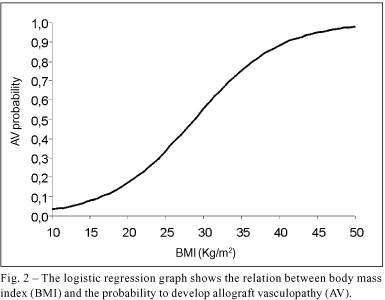
OBJECTIVE: To study the influence of immune and nonimmune risk factors on the development of allograft vasculopathy after cardiac transplantation. METHODS: We studied 39 patients with a mean age of 46±12 years. The following variables were analyzed: weight (kg), body mass index (kg/m²), donor’s age and sex, rejection episodes in the first and second years after transplantation, systolic and diastolic blood pressures (mmHg), total cholesterol and fractions (mg/dL), triglycerides (mg/dL), diabetes, and cytomegalovirus infection. The presence of allograft vasculopathy was established through coronary angiography. RESULTS: Allograft vasculopathy was observed in 15 (38%) patients. No statistically significant difference was observed between the two groups in regard to hypertension, cytomegalovirus infection, diabetes, donor’s sex and age, rejection episodes in the first and second years after transplantation, and cholesterol levels. We observed a tendency toward higher levels of triglycerides in the group with disease. Univariate and multivariate analyses showed statistically significant differences between the two groups when we analyzed the body mass index (24.53±4.3 versus 28.11±4.6; p=0.019). CONCLUSION: Body mass index was an important marker of allograft vasculopathy in the population studied.

  • allograft vasculopathy
  • body mass index
  • cardiac transplantation
  • Risk Factors
Read Full Article
Creative Commons Attribution (CC BY) Creative Commons license
21/11/2000 DOI: 10.1590/S0066-782X2000001100006 Views 1
ABC
Original Article

Permanent and temporary pacemaker implantation after orthotopic heart transplantation

Fernando Bacal et al. Edimar A. Bocchi Marcelo L. C. Vieira Neusa Lopes … Luiz Felipe Moreira Alfredo Fiorelli Roberto Costa Martino Martinelli Noedir A. G. Stolf Giovanni Bellotti José Antonio F. Ramires

PURPOSE:To determine the indication for and incidence and evolution of temporary and permanent pacemaker implantation in cardiac transplant recipients. METHODS: A retrospective review of 114 patients who underwent orthotopic heart transplantation InCor (Heart Institute USP BR) between March 1985 and May 1993. We studied the incidence of and indication for temporary pacing, the relationship between pacing and rejection, the need for pemanent pacing and the clinical follow-up. RESULTS: Fourteen of 114 (12%)heart transplant recipients required temporary pacing and 4 of 114 (3.5%) patients required permanent pacing. The indication for temporary pacing was sinus node dysfunction in 11 patients (78.5%) and atrioventricular (AV) block in 3 patients (21.4%). The indication for permanent pacemaker implantation was sinus node dysfunction in 3 patients (75%) and atrioventricular (AV) block in 1 patient (25%). We observed rejection in 3 patients (21.4%) who required temporary pacing and in 2 patients (50%) who required permanent pacing. The previous use of amiodarone was observed in 10 patients (71.4%) with temporary pacing. Seven of the 14 patients (50%) died during follow-up. CONCLUSION: Sinus node dysfunction was the principal indication for temporary and permanent pacemaker implantation in cardiac transplant recipients. The need for pacing was related to worse prognosis after cardiac transplantation.

  • cardiac transplantation
  • Pacemaker
Read Full Article
Creative Commons Attribution (CC BY) Creative Commons license
05/09/2000 DOI: 10.1590/S0066-782X2000000100002 Views 1

How to cite this article

EndNote RIS

Electronic Document Format (Vancouver)

Areosa CMN, Almeida DR, Carvalho ACC, Paola AAV. Evaluation of heart failure prognostic factors in patients referred for heart transplantation. Arquivos Brasileiros de Cardiologia 2007;88(6):667-73.

Electronic Document Format (ABNT)

Areosa, Cleópatra Medina Noronha; Almeida, Dirceu Rodrigues; Carvalho, Antônio Carlos C. de; Paola, Angelo A. V. de. Evaluation of heart failure prognostic factors in patients referred for heart transplantation. Arquivos Brasileiros de Cardiologia, v. 88, n. 6, p. 667-673, Jul. 2007.

Electronic Document Format (APA)

Areosa, C. M. N., Almeida, D. R., Carvalho, A. C. C. , & Paola, A. A. V. (2007). Evaluation of heart failure prognostic factors in patients referred for heart transplantation. Arquivos Brasileiros de Cardiologia, 88(6), 667-673.

Electronic Document Format (ISO)

Areosa, Cleópatra Medina Noronha and Almeida, Dirceu Rodrigues and Carvalho, Antônio Carlos C. de and Paola, Angelo A. V. de. Evaluation of heart failure prognostic factors in patients referred for heart transplantation. Arquivos Brasileiros de Cardiologia [online]. 2007, vol. 88, n. 6, [cited 2026-10-14], pp. 667-673. Available from: <https://journals.cardiol.br/en/article/evaluation-of-heart-failure-prognostic-factors-in-patients-referred-for-heart-transplantation/>. ISSN 0066-782X

EndNote RIS

Electronic Document Format (Vancouver)

Mello Junior WT, Branco JNR, Catani R, Aguiar LF, Paez RP, Buffolo E. Cardiac transplantation and neoplasms: experiences at Escola Paulista de Medicina of the Federal University of São Paulo. Arquivos Brasileiros de Cardiologia 2006;86(2):113-9.

Electronic Document Format (ABNT)

Mello Junior, Walter Teixeira de; Branco, João Nelson R.; Catani, Roberto; Aguiar, Luciano de Figueiredo; Paez, Rodrigo Pereira; Buffolo, Enio. Cardiac transplantation and neoplasms: experiences at Escola Paulista de Medicina of the Federal University of São Paulo. Arquivos Brasileiros de Cardiologia, v. 86, n. 2, p. 113-119, Feb. 2006.

Electronic Document Format (APA)

Mello Junior, W. T. , Branco, J. N. R., Catani, R., Aguiar, L. F., Paez, R. P., & Buffolo, E. (2006). Cardiac transplantation and neoplasms: experiences at Escola Paulista de Medicina of the Federal University of São Paulo. Arquivos Brasileiros de Cardiologia, 86(2), 113-119.

Electronic Document Format (ISO)

Mello Junior, Walter Teixeira de and Branco, João Nelson R. and Catani, Roberto and Aguiar, Luciano de Figueiredo and Paez, Rodrigo Pereira and Buffolo, Enio. Cardiac transplantation and neoplasms: experiences at Escola Paulista de Medicina of the Federal University of São Paulo. Arquivos Brasileiros de Cardiologia [online]. 2006, vol. 86, n. 2, [cited 2026-10-14], pp. 113-119. Available from: <https://journals.cardiol.br/article/cardiac-transplantation-and-neoplasms-experiences-at-escola-paulista-de-medicina-of-the-federal-university-of-sao-paulo/>. ISSN 0066-782X

EndNote RIS

Electronic Document Format (Vancouver)

Stolf NAG, Fiorelli AI, Bacal F, Camargo LF, Bocchi EA, Freitas A, Nicoletti A, et al. Mediastinitis after cardiac transplantation. Arquivos Brasileiros de Cardiologia 2002;74(5):425-30.

Electronic Document Format (ABNT)

Stolf, Noedir A. G.; Fiorelli, Alfredo I.; Bacal, Fernando; Camargo, Luiz F.; Bocchi, Edimar A.; Freitas, Andréa; Nicoletti, André; Meira, Daniela. Mediastinitis after cardiac transplantation. Arquivos Brasileiros de Cardiologia, v. 74, n. 5, p. 425-430, Jan. 2002.

Electronic Document Format (APA)

Stolf, N. A. G., Fiorelli, A. I., Bacal, F., Camargo, L. F., Bocchi, E. A., Freitas, A., Nicoletti, A., & Meira, D. (2002). Mediastinitis after cardiac transplantation. Arquivos Brasileiros de Cardiologia, 74(5), 425-430.

Electronic Document Format (ISO)

Stolf, Noedir A. G. and Fiorelli, Alfredo I. and Bacal, Fernando and Camargo, Luiz F. and Bocchi, Edimar A. and Freitas, Andréa and Nicoletti, André and Meira, Daniela. Mediastinitis after cardiac transplantation. Arquivos Brasileiros de Cardiologia [online]. 2002, vol. 74, n. 5, [cited 2026-10-14], pp. 425-430. Available from: <https://journals.cardiol.br/en/article/mediastinitis-after-cardiac-transplantation/>. ISSN 0066-782X

EndNote RIS

Electronic Document Format (Vancouver)

Bacal F, Veiga VC, Fiorelli AI, Bellotti G, Bocchi EA, Stolf NAG, Ramires JAF, et al. Analysis of the risk factors for allograft vasculopathy in asymptomatic patients after cardiac transplantation. Arquivos Brasileiros de Cardiologia 2000;75(5):421-8.

Electronic Document Format (ABNT)

Bacal, Fernando; Veiga, Viviane Cordeiro; Fiorelli, Alfredo Inácio; Bellotti, Giovanni; Bocchi, Edimar Alcides; Stolf, Noedir Antonio Groppo; Ramires, José Antonio Franchini. Analysis of the risk factors for allograft vasculopathy in asymptomatic patients after cardiac transplantation. Arquivos Brasileiros de Cardiologia, v. 75, n. 5, p. 421-428, Nov. 2000.

Electronic Document Format (APA)

Bacal, F., Veiga, V. C., Fiorelli, A. I., Bellotti, G., Bocchi, E. A., Stolf, N. A. G., & Ramires, J. A. F. (2000). Analysis of the risk factors for allograft vasculopathy in asymptomatic patients after cardiac transplantation. Arquivos Brasileiros de Cardiologia, 75(5), 421-428.

Electronic Document Format (ISO)

Bacal, Fernando and Veiga, Viviane Cordeiro and Fiorelli, Alfredo Inácio and Bellotti, Giovanni and Bocchi, Edimar Alcides and Stolf, Noedir Antonio Groppo and Ramires, José Antonio Franchini. Analysis of the risk factors for allograft vasculopathy in asymptomatic patients after cardiac transplantation. Arquivos Brasileiros de Cardiologia [online]. 2000, vol. 75, n. 5, [cited 2026-10-14], pp. 421-428. Available from: <https://journals.cardiol.br/en/article/analysis-of-the-risk-factors-for-allograft-vasculopathy-in-asymptomatic-patients-after-cardiac-transplantation/>. ISSN 0066-782X

EndNote RIS

Electronic Document Format (Vancouver)

Bacal F, Bocchi EA, Vieira MLC, Lopes N, Moreira LF, Fiorelli A, Costa R, et al. Permanent and temporary pacemaker implantation after orthotopic heart transplantation. Arquivos Brasileiros de Cardiologia 2000;74(1):09-12.

Electronic Document Format (ABNT)

Bacal, Fernando; Bocchi, Edimar A.; Vieira, Marcelo L. C.; Lopes, Neusa; Moreira, Luiz Felipe; Fiorelli, Alfredo; Costa, Roberto; Martinelli, Martino; Stolf, Noedir A. G.; Bellotti, Giovanni; Ramires, José Antonio F.. Permanent and temporary pacemaker implantation after orthotopic heart transplantation. Arquivos Brasileiros de Cardiologia, v. 74, n. 1, p. 09-12, Sep. 2000.

Electronic Document Format (APA)

Bacal, F., Bocchi, E. A., Vieira, M. L. C., Lopes, N., Moreira, L. F., Fiorelli, A., Costa, R., Martinelli, M., Stolf, N. A. G., Bellotti, G., & Ramires, J. A. F. (2000). Permanent and temporary pacemaker implantation after orthotopic heart transplantation. Arquivos Brasileiros de Cardiologia, 74(1), 09-12.

Electronic Document Format (ISO)

Bacal, Fernando and Bocchi, Edimar A. and Vieira, Marcelo L. C. and Lopes, Neusa and Moreira, Luiz Felipe and Fiorelli, Alfredo and Costa, Roberto and Martinelli, Martino and Stolf, Noedir A. G. and Bellotti, Giovanni and Ramires, José Antonio F.. Permanent and temporary pacemaker implantation after orthotopic heart transplantation. Arquivos Brasileiros de Cardiologia [online]. 2000, vol. 74, n. 1, [cited 2026-10-14], pp. 09-12. Available from: <https://journals.cardiol.br/en/article/permanent-and-temporary-pacemaker-implantation-after-orthotopic-heart-transplantation/>. ISSN 0066-782X

  • About ABC Family
  • Internal Regulation
  • Editorial Board
  • Brazilian Society of Cardiology (SBC)

Issues

SBC Guidelines

  • Videos
  • Podcasts
  • News