ABC Family Arquivos Brasileiros de Cardiologia International Journal of Cardiovascular Sciences ABC Heart Failure & Cardiomyopathy ABC Imagem Cardiovascular
Português English
ABC Family
Português English
  • About
    • About ABC Family
    • Internal Regulation
    • Editorial Board
    • Brazilian Society of Cardiology (SBC)
  • Issues
  • SBC Guidelines
  • Content
    • Videos
    • Podcasts
    • News
  • About
    • About ABC Family
    • Internal Regulation
    • Editorial Board
    • Brazilian Society of Cardiology (SBC)
  • Issues
  • SBC Guidelines
  • Content
    • Videos
    • Podcasts
    • News

ABC Family

  • ABC Family
  • Arquivos Brasileiros de Cardiologia
  • International Journal of Cardiovascular Sciences
  • ABC Heart Failure & Cardiomyopathy
  • ABC Imagem Cardiovascular
Search in

No content found.

Journals
Ordering
Article types
Others

  1. Home
  2. Keyword: Time Factors
ABC
Editorial

Time is Muscle

Luiz Maurino Abreu

Before the 80’s, the treatment of patients with ST–segment elevation myocardial infarction (STEMI) had as main goals the control of pain, arrhythmia and reduction of cardiac work, aiming to limit the extent of myocardial necrosis. These measures were partially effective, but the morbidity and mortality of acute myocardial infarction (AMI) remained high.

From the findings of Dewood, angiographically showing the presence of coronary occlusion by a thrombus in the culprit artery of the STEMI, strategies of reperfusion have emerged both thrombolytic therapy and primary percutaneous transluminal coronary angioplasty (PCI). The treatment of STEMI changes from contemplation to intervention.

[…]

  • Angioplasty
  • Myocardal Infarction/diagnosis
  • Myocardial Infarction/mortality
  • Myocardial Infarction/therapy
  • ST Elevation Myocardial Infarction/physiopathology
  • Survival Rate
  • Thrombolytic Therapy
  • Time Factors
Read Full Article
Creative Commons Attribution (CC BY) Creative Commons license
15/04/2019 DOI: 10.5935/abc.20190059
ABC
Editorial

Reperfusion Criteria in Patients Submitted to Fibrinolysis: Is There Room for Improvement?

Milena Soriano Marcolino et al. Antonio Luiz Pinho Ribeiro

Many ST-elevation acute myocardial infarction (STEMI) patients seek care in hospitals without percutaneous coronary intervention (PCI) capability and cannot be submitted to PCI within the guideline-recommended timelines, and, instead, they are often submitted to fibrinolysis as the initial reperfusion therapy. Rapid, simple and readily available bedside measures are of utmost importance for timely assessment of the efficacy of reperfusion therapy early after fibrinolysis in acute STEMI, in order to immediately identify the ones who require rescue PCI.,

In an editorial for Circulation in 2001, Gibson stated “In a time of dizzying advances in diagnostic modalities, it is refreshing to see what a useful, simple, noninvasive, broadly accessible, easily repeatable/applied, and affordable tool the electrocardiography (ECG) is”. This is still up to date. Multiple studies have demonstrated improved outcomes among patients who achieve complete ST resolution at 60-90 minutes after fibrinolytic therapy, and it is recommended that the absence of > 50% reduction in ST elevation in the worst lead at 60-90 minutes should prompt strong consideration of coronary angiography and rescue PCI. , However, this measure, combined with the absence of reperfusion arrhythmias at 2 hours after treatment, has a positive predictive value of 87% and a negative predictive value of 83% to predict failure of reperfusion, , indicating that there is still room for improvement in accuracy.

[…]

  • Electrocardiography/methods
  • Fibrinolysis
  • Percutaneous Coronary Intervention/economics
  • ST Elevation Myocardial Infarction/mortality
  • Thrombolytic THerapy/methods
  • Time Factors
Read Full Article
Creative Commons Attribution (CC BY) Creative Commons license
01/01/2019 DOI: 10.5935/abc.20180245
IJCS
Editorial

Continuous Aerobic and High-Intensity Interval Exercise: Which one Produces greater Post-Exercise Hypotension?

André L. Teixeira and Lauro C. Vianna

Exercise training is a key recommendation for maintenance of a healthy life style. It is well established that regular physical exercise provides innumerous physiological and psychological benefits not only to young healthy subjects, but also individuals with diabetes, heart failure, Parkinson disease, multiple sclerosis, claudication, autonomic failure, hypertension, among others. A well-documented physiological response to exercise is called post-exercise hypotension (PEH), in which a single bout of exercise leads to a decrease in arterial blood pressure. The first study showing PEH was published in 1898 by Dr. L. Hill. Thereafter, several authors confirmed these results showing that a single bout of exercise can reduce arterial blood pressure below pre-exercise values. However, one question that remains to be answered is which exercise modality produces greater PEH?

Previous studies have shown that continuous aerobic (CONT) exercise, high-intensity interval (HIIE) training, isometric exercise and resistance-based exercise can lead to a PEH. Studies comparing CONT and HIIE showed that the magnitude of PEH was slightly superior following HIIE compared with CONT exercise., However, in these studies, the exercise protocols were not matched by volume. This is important because longer exercise duration and higher-intensity exercise results in greater decreases in arterial blood pressure and longer PEH duration when compared with a short bout of low-intensity exercise.,

[…]

  • Blood Pressure
  • Exercise Therapy
  • Hypertension/diagnosis
  • Hypertension/physiopathology
  • Hypertension/therapy, Physical Endurance
  • Time Factors
  • Treatment Outcome
Read Full Article
Creative Commons Attribution (CC BY) Creative Commons license
01/01/2019 DOI: 10.5935/2359-4802.20180104
Figure 1
ABC
Original Article

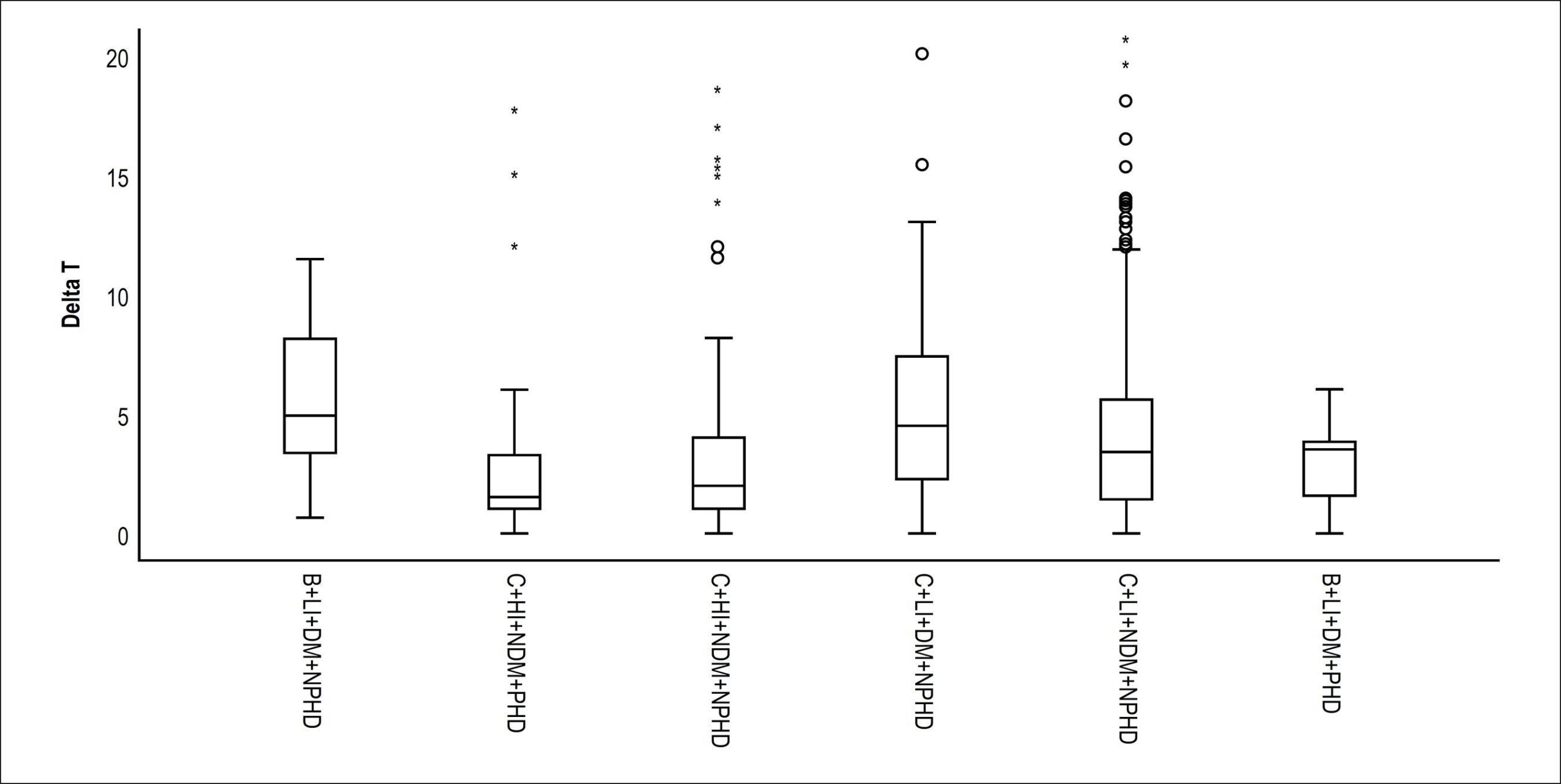
Independent Predictors of Late Presentation in Patients with ST-Segment Elevation Myocardial Infarction

Juliane Araujo Rodrigues et al. Karina Melleu Márcia Moura Schmidt Carlos Antonio Mascia Gottschall … Maria Antonieta Pereira de Moraes Alexandre Schaan de Quadros

Abstract

Background:

In patients with acute ST-segment elevation myocardial infarction (STEMI), the time elapsed from symptom onset to receiving medical care is one of the main mortality predictors.

Objective:

To identify independent predictors of late presentation in patients STEMI representative of daily clinical practice.

Methods:

All patients admitted with a diagnosis of STEMI in a reference center between December 2009 and November 2014 were evaluated and prospectively followed during hospitalization and for 30 days after discharge. Late presentation was defined as a time interval > 6 hours from chest pain onset until hospital arrival. Multiple logistic regression analysis was used to identify independent predictors of late presentation. Values of p < 0.05 were considered statistically significant.

Results:

A total of 1,297 patients were included, with a mean age of 60.7 ± 11.6 years, of which 71% were males, 85% Caucasians, 72% had a mean income lower than five minimum wages and 66% had systemic arterial hypertension. The median time of clinical presentation was 3.00 [1.40-5.48] hours, and approximately one-quarter of the patients had a late presentation, with their mortality being significantly higher. The independent predictors of late presentation were Black ethnicity, low income and diabetes mellitus, and a history of previous heart disease was a protective factor.

Conclusion:

Black ethnicity, low income and diabetes mellitus are independent predictors of late presentation in STEMI. The identification of subgroups of patients prone to late presentation may help to stimulate prevention policies for these high-risk individuals.

  • Emergency Medical Services
  • First Aid
  • ST Elevation Myocardial Infarction
  • Time Factors
Read Full Article
Creative Commons Attribution (CC BY) Creative Commons license
21/09/2018 DOI: 10.5935/abc.20180178 Views 1
Emergency service admission time and in-hospital mortality in acute coronary syndrome
ABC
Artigo Original

Emergency service admission time and in-hospital mortality in acute coronary syndrome

Julio Yoshio Takada et al. Larissa Cardoso Roza Rogério Bicudo Ramos Solange Desiree Avakian … José Antonio Franchini Ramires Antonio de Pádua Mansur

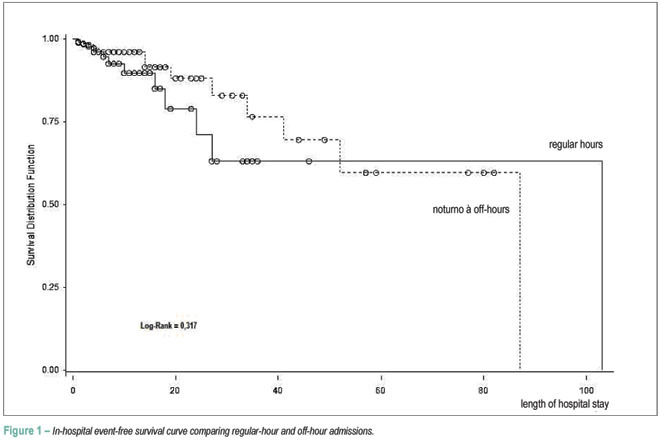
BACKGROUND: The relationship between admission time to an emergency service and in-hospital outcomes in acute coronary syndrome (ACS) is controversial. Admission during off-hours would be associated with worse prognosis. OBJECTIVE: To assess the influence of admission time on prolonged hospitalization and mortality for ACS patients, regarding regular hours (7AM-7PM) and off-hours (7PM-7AM). METHODS: The study assessed prospectively 1,104 consecutive ACS patients. In-hospital mortality and length of hospital stay > 5 days were the outcomes analyzed. RESULTS: Admission during regular hours was greater as compared with that during off-hours (63% vs. 37%; p < 0.001). Unstable angina was more prevalent during regular hours (43% vs. 32%; p 5 days were as follows: age [OR 1.042 (95%CI: 1.025 – 1.058), p < 0.001]; ejection fraction (EF) [OR 0.977 (95%CI: 0.966 – 0.988), p < 0.001]; NSTEMI [OR 1.699 (95%CI: 1.221 – 2.366), p = 0.001]; and smoking [OR 1.723 (95%CI: 1.113 – 2.668), p = 0.014]. Predictive factors for in-hospital mortality were as follows: age [OR 1.090 (95%CI: 1.047 – 1.134), p < 0.001]; EF [OR 0.936 (95%CI: 0.909 – 0.964), p < 0.001]; and surgical treatment [OR 3.781 (95%CI: 1.374 – 10.409), p = 0.01]. CONCLUSION: Prolonged length of hospital stay and in-hospital mortality in ACS patients do not depend on admission time.

  • First Aid
  • Hospitalization
  • Myocardial Infarction
  • patient admission
  • Time Factors
Read Full Article
Creative Commons Attribution (CC BY) Creative Commons license
06/01/2012 DOI: 10.1590/S0066-782X2012005000005 Views 1

How to cite this article

EndNote RIS

Electronic Document Format (Vancouver)

Abreu LM. Time is Muscle. Arquivos Brasileiros de Cardiologia 2019;112(4):408-9.

Electronic Document Format (ABNT)

Abreu, Luiz Maurino. Time is Muscle. Arquivos Brasileiros de Cardiologia, v. 112, n. 4, p. 408-409, Apr. 2019.

Electronic Document Format (APA)

Abreu, L. M. (2019). Time is Muscle. Arquivos Brasileiros de Cardiologia, 112(4), 408-409.

Electronic Document Format (ISO)

Abreu, Luiz Maurino. Time is Muscle. Arquivos Brasileiros de Cardiologia [online]. 2019, vol. 112, n. 4, [cited 2026-10-14], pp. 408-409. Available from: <https://journals.cardiol.br/en/article/time-is-muscle/>. ISSN 0066-782X

EndNote RIS

Electronic Document Format (Vancouver)

Marcolino MS, Ribeiro ALP. Reperfusion Criteria in Patients Submitted to Fibrinolysis: Is There Room for Improvement?. Arquivos Brasileiros de Cardiologia 2019;112(1):30-1.

Electronic Document Format (ABNT)

Marcolino, Milena Soriano; Ribeiro, Antonio Luiz Pinho. Reperfusion Criteria in Patients Submitted to Fibrinolysis: Is There Room for Improvement?. Arquivos Brasileiros de Cardiologia, v. 112, n. 1, p. 30-31, Dec. 2018.

Electronic Document Format (APA)

Marcolino, M. S., & Ribeiro, A. L. P. (2019). Reperfusion Criteria in Patients Submitted to Fibrinolysis: Is There Room for Improvement?. Arquivos Brasileiros de Cardiologia, 112(1), 30-31.

Electronic Document Format (ISO)

Marcolino, Milena Soriano and Ribeiro, Antonio Luiz Pinho. Reperfusion Criteria in Patients Submitted to Fibrinolysis: Is There Room for Improvement?. Arquivos Brasileiros de Cardiologia [online]. 2019, vol. 112, n. 1, [cited 2026-10-14], pp. 30-31. Available from: <https://journals.cardiol.br/en/article/reperfusion-criteria-in-patients-submitted-to-fibrinolysis-is-there-room-for-improvement/>. ISSN 0066-782X

EndNote RIS

Electronic Document Format (Vancouver)

Vianna ALTLC. Continuous Aerobic and High-Intensity Interval Exercise: Which one Produces greater Post-Exercise Hypotension?. International Journal of Cardiovascular Sciences 2019;32(1):1-2.

Electronic Document Format (ABNT)

Vianna, André L. Teixeira and Lauro C.. Continuous Aerobic and High-Intensity Interval Exercise: Which one Produces greater Post-Exercise Hypotension?. International Journal of Cardiovascular Sciences, v. 32, n. 1, p. 1-2, Dec. 2018.

Electronic Document Format (APA)

Vianna, A. L. T. L. C. (2019). Continuous Aerobic and High-Intensity Interval Exercise: Which one Produces greater Post-Exercise Hypotension?. International Journal of Cardiovascular Sciences, 32(1), 1-2.

Electronic Document Format (ISO)

Vianna, André L. Teixeira and Lauro C.. Continuous Aerobic and High-Intensity Interval Exercise: Which one Produces greater Post-Exercise Hypotension?. International Journal of Cardiovascular Sciences [online]. 2019, vol. 32, n. 1, [cited 2026-10-14], pp. 1-2. Available from: <https://journals.cardiol.br/en/article/continuous-aerobic-and-high-intensity-interval-exercise-which-one-produces-greater-post-exercise-hypotension/>. ISSN 2359-4802

EndNote RIS

Electronic Document Format (Vancouver)

Rodrigues JA, Melleu K, Schmidt MM, Gottschall CAM, Moraes MAP, Quadros AS. Independent Predictors of Late Presentation in Patients with ST-Segment Elevation Myocardial Infarction. Arquivos Brasileiros de Cardiologia 2018;111(4):587-93.

Electronic Document Format (ABNT)

Rodrigues, Juliane Araujo; Melleu, Karina; Schmidt, Márcia Moura; Gottschall, Carlos Antonio Mascia; Moraes, Maria Antonieta Pereira de; Quadros, Alexandre Schaan de. Independent Predictors of Late Presentation in Patients with ST-Segment Elevation Myocardial Infarction. Arquivos Brasileiros de Cardiologia, v. 111, n. 4, p. 587-593, Sep. 2018.

Electronic Document Format (APA)

Rodrigues, J. A., Melleu, K., Schmidt, M. M., Gottschall, C. A. M., Moraes, M. A. P. , & Quadros, A. S. (2018). Independent Predictors of Late Presentation in Patients with ST-Segment Elevation Myocardial Infarction. Arquivos Brasileiros de Cardiologia, 111(4), 587-593.

Electronic Document Format (ISO)

Rodrigues, Juliane Araujo and Melleu, Karina and Schmidt, Márcia Moura and Gottschall, Carlos Antonio Mascia and Moraes, Maria Antonieta Pereira de and Quadros, Alexandre Schaan de. Independent Predictors of Late Presentation in Patients with ST-Segment Elevation Myocardial Infarction. Arquivos Brasileiros de Cardiologia [online]. 2018, vol. 111, n. 4, [cited 2026-10-14], pp. 587-593. Available from: <https://journals.cardiol.br/en/article/independent-predictors-of-late-presentation-in-patients-with-st-segment-elevation-myocardial-infarction/>. ISSN 0066-782X

EndNote RIS

Electronic Document Format (Vancouver)

Takada JY, Roza LC, Ramos RB, Avakian SD, Ramires JAF, Mansur AP. Emergency service admission time and in-hospital mortality in acute coronary syndrome. Arquivos Brasileiros de Cardiologia 2012;98(2):104-10.

Electronic Document Format (ABNT)

Takada, Julio Yoshio; Roza, Larissa Cardoso; Ramos, Rogério Bicudo; Avakian, Solange Desiree; Ramires, José Antonio Franchini; Mansur, Antonio de Pádua. Emergency service admission time and in-hospital mortality in acute coronary syndrome. Arquivos Brasileiros de Cardiologia, v. 98, n. 2, p. 104-110, Jan. 2012.

Electronic Document Format (APA)

Takada, J. Y., Roza, L. C., Ramos, R. B., Avakian, S. D., Ramires, J. A. F., & Mansur, A. P. (2012). Emergency service admission time and in-hospital mortality in acute coronary syndrome. Arquivos Brasileiros de Cardiologia, 98(2), 104-110.

Electronic Document Format (ISO)

Takada, Julio Yoshio and Roza, Larissa Cardoso and Ramos, Rogério Bicudo and Avakian, Solange Desiree and Ramires, José Antonio Franchini and Mansur, Antonio de Pádua. Emergency service admission time and in-hospital mortality in acute coronary syndrome. Arquivos Brasileiros de Cardiologia [online]. 2012, vol. 98, n. 2, [cited 2026-10-14], pp. 104-110. Available from: <https://journals.cardiol.br/en/article/emergency-service-admission-time-and-in-hospital-mortality-in-acute-coronary-syndrome/>. ISSN 0066-782X

  • About ABC Family
  • Internal Regulation
  • Editorial Board
  • Brazilian Society of Cardiology (SBC)

Issues

SBC Guidelines

  • Videos
  • Podcasts
  • News