ABC Family Arquivos Brasileiros de Cardiologia International Journal of Cardiovascular Sciences ABC Heart Failure & Cardiomyopathy ABC Imagem Cardiovascular
Português English
ABC Family
Português English
  • About
    • About ABC Family
    • Internal Regulation
    • Editorial Board
    • Brazilian Society of Cardiology (SBC)
  • Issues
  • SBC Guidelines
  • Content
    • Videos
    • Podcasts
    • News
  • About
    • About ABC Family
    • Internal Regulation
    • Editorial Board
    • Brazilian Society of Cardiology (SBC)
  • Issues
  • SBC Guidelines
  • Content
    • Videos
    • Podcasts
    • News

ABC Family

  • ABC Family
  • Arquivos Brasileiros de Cardiologia
  • International Journal of Cardiovascular Sciences
  • ABC Heart Failure & Cardiomyopathy
  • ABC Imagem Cardiovascular
Search in

No content found.

Journals
Ordering
Article types
Others

  1. Home
  2. Keyword: patient admission
Figure 1
ABC
Editorial

In-Hospital Worsening Heart Failure: Can We Predict It At Admission?

Humberto Villacorta

Acute decompensated heart failure (ADHF) is a risk marker in the patient’s heart failure (HF) journey. It may be the initial presentation (de novo HF) or an acute exacerbation of chronic HF. Most patients with ADHF present to the emergency department (ED) with congestion and usually respond well to treatment with diuretics. However, some high-risk patients may have a complicated course during hospitalization, including in-hospital worsening HF (WHF), defined as persistent or worsening signs and symptoms requiring an escalation in therapy. Identifying such patients is important since they are at greater risk of in-hospital and post-discharge events.,

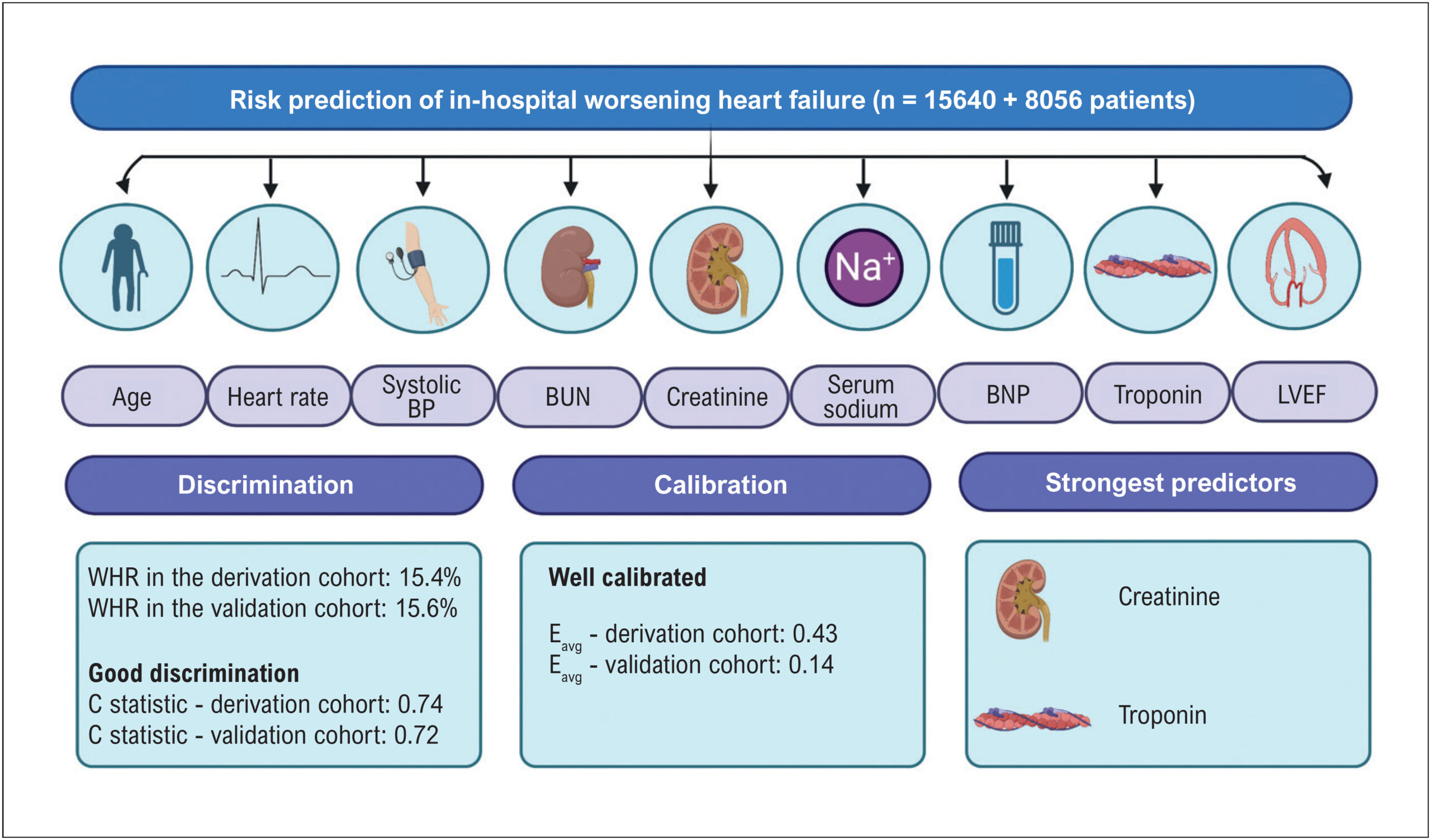
In the early 2000s, ADHF began to attract the attention of many researchers in the field of HF. In that period, a large registry of patients with ADHF – the ADHERE Registry – was set up in the United States of America. The ADHERE Registry gave enormous contributions to the field of ADHF. They taught us about these patients’ clinical characteristics and outcomes, but more importantly, they created prediction rules for patients admitted with ADHF. They initially reported a regression tree analysis, using three simple variables to predict in-hospital mortality – blood urea nitrogen (BUN), creatinine, and systolic blood pressure. Two years later, they reported the value of B-type natriuretic peptide (BNP) in predicting in-hospital mortality. In 2016 they developed and validated a model to predict in-hospital WHF, which included clinical variables (age, heart rate, systolic blood pressure), laboratory tests (BUN, creatinine, serum sodium), biomarkers (BNP and troponin), and the left ventricle ejection fraction (LVEF). Their model had good discrimination, with c-statistics of 0.74 and 0.72 for the derivation and validation cohorts, respectively, as shown in . Nevertheless, discrimination was modest in the external validation cohort (ASCEND-HF study) (c-statistic 0.63).

[…]

  • Heart Decompensation
  • Heart Failure
  • patient admission
  • Prognosis
  • Risk Factors
Read Full Article
Creative Commons Attribution (CC BY) Creative Commons license
10/11/2023 DOI: 10.36660/abc.20230525 Views 1
Emergency service admission time and in-hospital mortality in acute coronary syndrome
ABC
Artigo Original

Emergency service admission time and in-hospital mortality in acute coronary syndrome

Julio Yoshio Takada et al. Larissa Cardoso Roza Rogério Bicudo Ramos Solange Desiree Avakian … José Antonio Franchini Ramires Antonio de Pádua Mansur

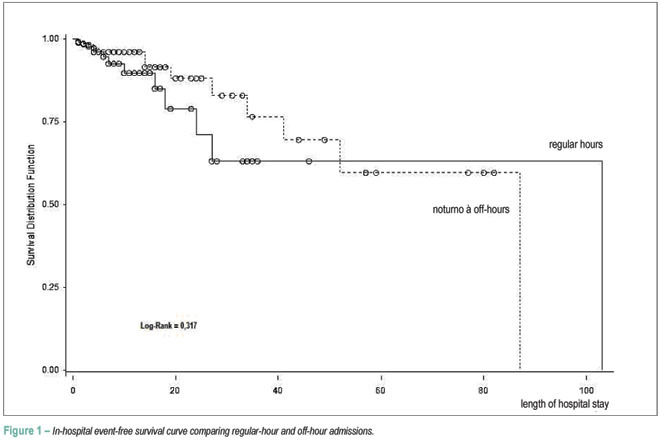
BACKGROUND: The relationship between admission time to an emergency service and in-hospital outcomes in acute coronary syndrome (ACS) is controversial. Admission during off-hours would be associated with worse prognosis. OBJECTIVE: To assess the influence of admission time on prolonged hospitalization and mortality for ACS patients, regarding regular hours (7AM-7PM) and off-hours (7PM-7AM). METHODS: The study assessed prospectively 1,104 consecutive ACS patients. In-hospital mortality and length of hospital stay > 5 days were the outcomes analyzed. RESULTS: Admission during regular hours was greater as compared with that during off-hours (63% vs. 37%; p < 0.001). Unstable angina was more prevalent during regular hours (43% vs. 32%; p 5 days were as follows: age [OR 1.042 (95%CI: 1.025 – 1.058), p < 0.001]; ejection fraction (EF) [OR 0.977 (95%CI: 0.966 – 0.988), p < 0.001]; NSTEMI [OR 1.699 (95%CI: 1.221 – 2.366), p = 0.001]; and smoking [OR 1.723 (95%CI: 1.113 – 2.668), p = 0.014]. Predictive factors for in-hospital mortality were as follows: age [OR 1.090 (95%CI: 1.047 – 1.134), p < 0.001]; EF [OR 0.936 (95%CI: 0.909 – 0.964), p < 0.001]; and surgical treatment [OR 3.781 (95%CI: 1.374 – 10.409), p = 0.01]. CONCLUSION: Prolonged length of hospital stay and in-hospital mortality in ACS patients do not depend on admission time.

  • First Aid
  • Hospitalization
  • Myocardial Infarction
  • patient admission
  • Time Factors
Read Full Article
Creative Commons Attribution (CC BY) Creative Commons license
06/01/2012 DOI: 10.1590/S0066-782X2012005000005 Views 1

How to cite this article

EndNote RIS

Electronic Document Format (Vancouver)

Villacorta H. In-Hospital Worsening Heart Failure: Can We Predict It At Admission?. Arquivos Brasileiros de Cardiologia 2023;120(8):e20230525.

Electronic Document Format (ABNT)

Villacorta, Humberto. In-Hospital Worsening Heart Failure: Can We Predict It At Admission?. Arquivos Brasileiros de Cardiologia, v. 120, n. 8, e20230525, Nov. 2023.

Electronic Document Format (APA)

Villacorta, H. (2023). In-Hospital Worsening Heart Failure: Can We Predict It At Admission?. Arquivos Brasileiros de Cardiologia, 120(8), e20230525.

Electronic Document Format (ISO)

Villacorta, Humberto. In-Hospital Worsening Heart Failure: Can We Predict It At Admission?. Arquivos Brasileiros de Cardiologia [online]. 2023, vol. 120, n. 8, [cited 2026-10-14], e20230525. Available from: <https://journals.cardiol.br/en/article/in-hospital-worsening-heart-failure-can-we-predict-it-at-admission/>. ISSN 0066-782X

EndNote RIS

Electronic Document Format (Vancouver)

Takada JY, Roza LC, Ramos RB, Avakian SD, Ramires JAF, Mansur AP. Emergency service admission time and in-hospital mortality in acute coronary syndrome. Arquivos Brasileiros de Cardiologia 2012;98(2):104-10.

Electronic Document Format (ABNT)

Takada, Julio Yoshio; Roza, Larissa Cardoso; Ramos, Rogério Bicudo; Avakian, Solange Desiree; Ramires, José Antonio Franchini; Mansur, Antonio de Pádua. Emergency service admission time and in-hospital mortality in acute coronary syndrome. Arquivos Brasileiros de Cardiologia, v. 98, n. 2, p. 104-110, Jan. 2012.

Electronic Document Format (APA)

Takada, J. Y., Roza, L. C., Ramos, R. B., Avakian, S. D., Ramires, J. A. F., & Mansur, A. P. (2012). Emergency service admission time and in-hospital mortality in acute coronary syndrome. Arquivos Brasileiros de Cardiologia, 98(2), 104-110.

Electronic Document Format (ISO)

Takada, Julio Yoshio and Roza, Larissa Cardoso and Ramos, Rogério Bicudo and Avakian, Solange Desiree and Ramires, José Antonio Franchini and Mansur, Antonio de Pádua. Emergency service admission time and in-hospital mortality in acute coronary syndrome. Arquivos Brasileiros de Cardiologia [online]. 2012, vol. 98, n. 2, [cited 2026-10-14], pp. 104-110. Available from: <https://journals.cardiol.br/en/article/emergency-service-admission-time-and-in-hospital-mortality-in-acute-coronary-syndrome/>. ISSN 0066-782X

  • About ABC Family
  • Internal Regulation
  • Editorial Board
  • Brazilian Society of Cardiology (SBC)

Issues

SBC Guidelines

  • Videos
  • Podcasts
  • News