ABC Family Arquivos Brasileiros de Cardiologia International Journal of Cardiovascular Sciences ABC Heart Failure & Cardiomyopathy ABC Imagem Cardiovascular
Português English
ABC Family
Português English
  • About
    • About ABC Family
    • Internal Regulation
    • Editorial Board
    • Brazilian Society of Cardiology (SBC)
  • Issues
  • SBC Guidelines
  • Content
    • Videos
    • Podcasts
    • News
  • About
    • About ABC Family
    • Internal Regulation
    • Editorial Board
    • Brazilian Society of Cardiology (SBC)
  • Issues
  • SBC Guidelines
  • Content
    • Videos
    • Podcasts
    • News

ABC Family

  • ABC Family
  • Arquivos Brasileiros de Cardiologia
  • International Journal of Cardiovascular Sciences
  • ABC Heart Failure & Cardiomyopathy
  • ABC Imagem Cardiovascular
Search in

No content found.

Journals
Ordering
Article types
Others

  1. Home
  2. Keyword: Hypertension/diagnosis
Figure 1
IJCS
Original Article

Potential Impact of the New American High Blood Pressure Guidelines on Hypertension Prevalence in a Primary Health Care Unit in Rio de Janeiro – the LapARC Study

Marcelle Guimarães de Oliveira et al. Angélica Furriel de Almeida da Silva Taissa Lorena dos Santos Mariana Loureiro Cunha … Bruna Rosenbrock Ferreira Taveira Elizabeth Silaid Muxfeldt

Abstract

Background

The new American Heart Association guidelines for hypertension (HT) proposed a reduction of the diagnostic cut-off point, leading to a substantial increase in the prevalence of HT.

Objectives

To assess the prevalence of HT determined by the traditional criteria, the AHA criteria, and home blood pressure monitoring (HBPM) in a population of young adults attending a primary healthcare unit, and its association with cardiovascular risk.

Methods

A cross-sectional population study on adults aged from 20 to 50 years attending a primary healthcare unit, in Rio de Janeiro, Brazil. Sociodemographic and anthropometric data, cardiovascular risk factors, office blood pressure and HBPM were registered. The diagnosis of HT was defined by traditional criteria (office BP ≥ 140 x 90 mmHg) and by the new (AHA) criteria (office BP ≥ 130 x 80 mmHg). Bivariate analysis was used for comparisons between the two diagnostic criteria, and Kappa coefficient was used to assess the agreement in diagnosis between office BP and HBPM. The level of significance adopted was 5% (p<0.05).

Results

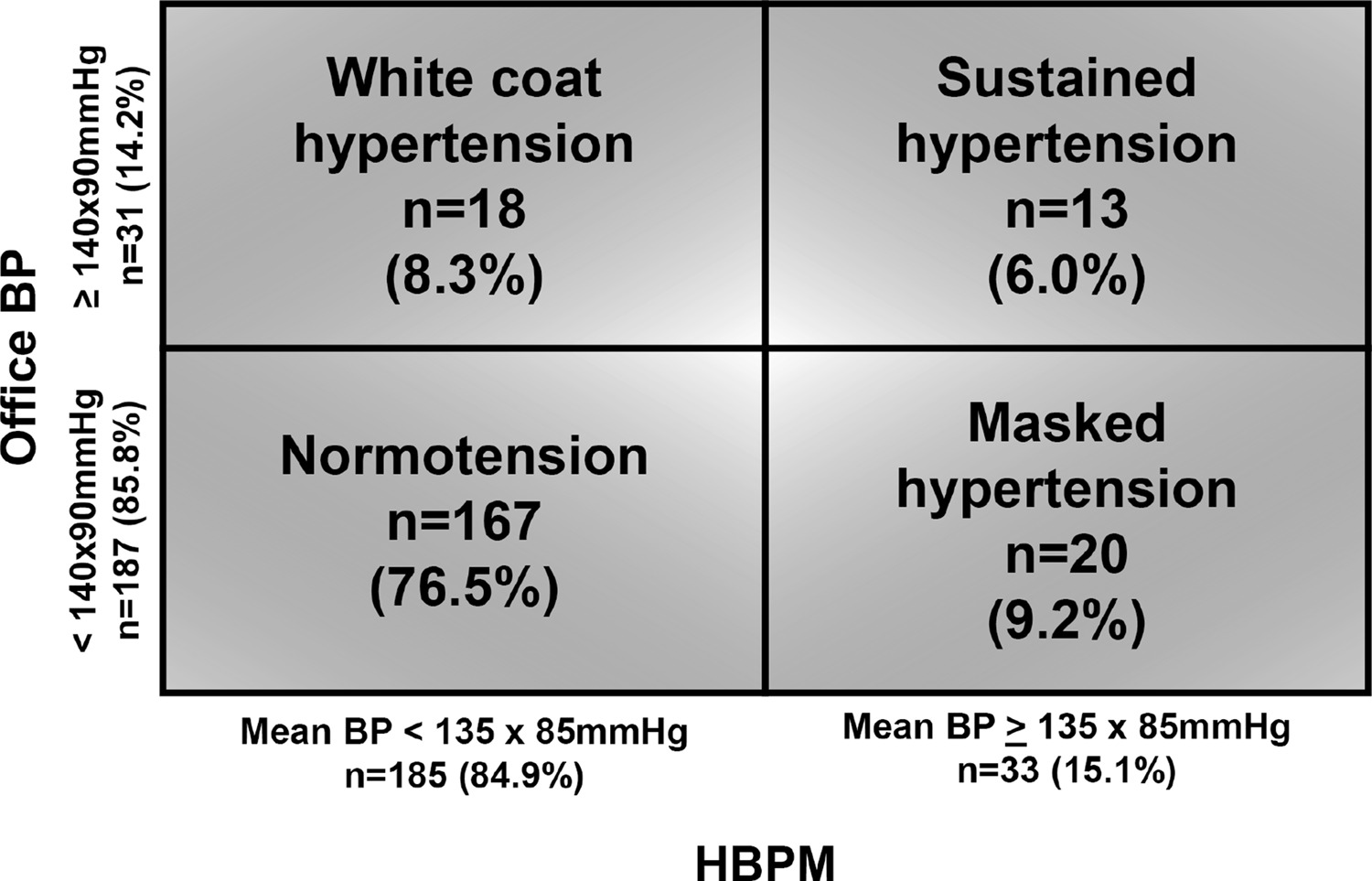
A total of 472 individuals were evaluated (male: 39%; mean age: 38.5 ± 8.7 years). The prevalence of HT was 23.5% and raised to 41.1% with the new AHA criteria. The prevalence of HT using HBPM was 25.5%, but the diagnostic agreement was low (kappa=0.028) with changes in diagnosis in 18% of the cases.

Conclusion

The prevalence of HT almost doubled with the new AHA diagnostic criteria for HT. HBPM seemed to be an important instrument in HT diagnosis in this population. (Int J Cardiovasc Sci. 2021; [online].ahead print, PP.0-0)
  • Blood Pressure
  • Cardiovascular Diseases
  • Epidemiology
  • Hypertension/diagnosis
  • Primary Health Care
Read Full Article
Creative Commons Attribution (CC BY) Creative Commons license
26/02/2021 DOI: 10.36660/ijcs.20190205
Figure 1
ABC
Original Article

Prevalence of Masked and White-Coat Hypertension in Pre-Hypertensive and Stage 1 Hypertensive patients with the use of TeleMRPA

Weimar Kunz Sebba Barroso et al. Audes Diógenes Magalhães Feitosa Eduardo Costa Duarte Barbosa Roberto Dischinger Miranda … Andréa Araújo Brandão Priscila Valverde Oliveira Vitorino Lúcio Paulo de Souza Ribeiro Marco Mota Gomes

Abstract

Background:

The diagnosis of arterial hypertension based on measurements of blood pressure in the office has low accuracy.

Objective:

To evaluate the prevalence of masked hypertension (MH) and white-coat hypertension through home blood pressure monitoring (HBPM) in pre-hypertensive and stage 1 hypertensive patients.

Method:

Retrospective study, of which sample consisted of individuals with BP ≥ 120/80 mmHg and < 160/100 mmHg at the medical office without the use of antihypertensive medication and who underwent exams on the HBPM platform by telemedicine (TeleMRPA) between May 2017 and September 2018. The four-day MRPA protocol was used, with 24 measurements, using automated, validated, calibrated equipment with a memory function.

Results:

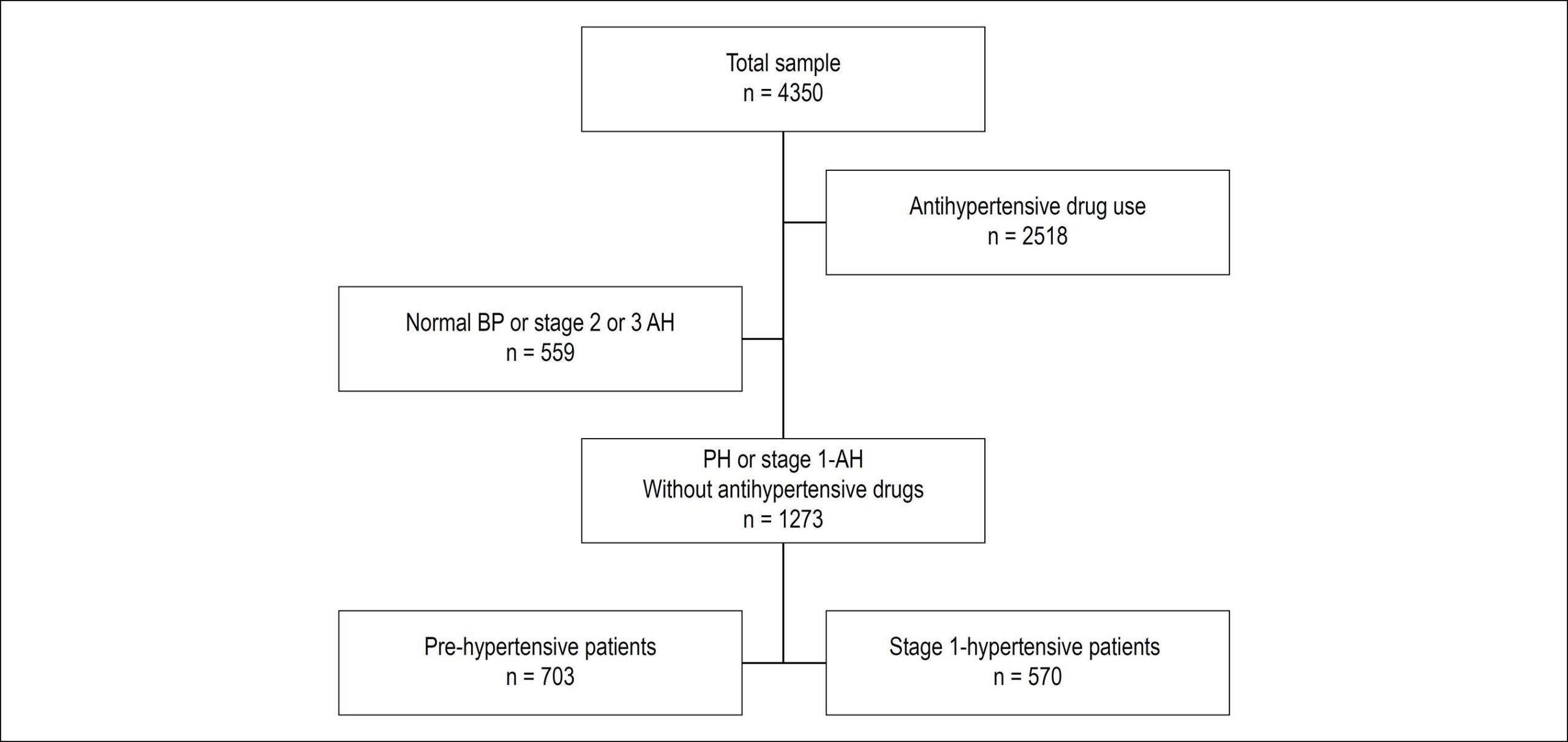
The sample consisted of 1,273 participants, of which 739 (58.1%) were women. The mean age was 52.4 ± 14.9 years, mean body mass index (BMI) 28.4 ± 5.1 kg/m2. The casual BP was higher than the HBPM in 7.6 mmHg for systolic blood pressure (SBP) and 5.2 mmHg for diastolic blood pressure (DBP), both with statistical significance (p < 0.001). There were 558 (43.8%) normotensive individuals; 291 (22.9%) with sustained hypertension; 145 (11.4%) with MH and 279 (21.9%) with white-coat hypertension (WCH), with a diagnostic error by casual BP in the total sample in 424 (33.3%) patients. In stage 1 hypertensive individuals, the prevalence of WCH was 48.9%; in prehypertensive patients, the prevalence of MH was 20.6%.

Conclusion:

MH and WCH have a high prevalence rate in the adult population; however, in prehypertensive or stage 1 hypertensive patients, the prevalence is higher. Out-of-office BP measurements in these subgroups should be performed whenever possible to prevent misdiagnosis.

  • Hypertension Self-Monitoring
  • Hypertension/diagnosis
  • Masked Hypertension
  • Telemedicine
  • White Coat Hypertensin
Read Full Article
Creative Commons Attribution (CC BY) Creative Commons license
15/08/2019 DOI: 10.5935/abc.20190147
IJCS
Editorial

Continuous Aerobic and High-Intensity Interval Exercise: Which one Produces greater Post-Exercise Hypotension?

André L. Teixeira and Lauro C. Vianna

Exercise training is a key recommendation for maintenance of a healthy life style. It is well established that regular physical exercise provides innumerous physiological and psychological benefits not only to young healthy subjects, but also individuals with diabetes, heart failure, Parkinson disease, multiple sclerosis, claudication, autonomic failure, hypertension, among others. A well-documented physiological response to exercise is called post-exercise hypotension (PEH), in which a single bout of exercise leads to a decrease in arterial blood pressure. The first study showing PEH was published in 1898 by Dr. L. Hill. Thereafter, several authors confirmed these results showing that a single bout of exercise can reduce arterial blood pressure below pre-exercise values. However, one question that remains to be answered is which exercise modality produces greater PEH?

Previous studies have shown that continuous aerobic (CONT) exercise, high-intensity interval (HIIE) training, isometric exercise and resistance-based exercise can lead to a PEH. Studies comparing CONT and HIIE showed that the magnitude of PEH was slightly superior following HIIE compared with CONT exercise., However, in these studies, the exercise protocols were not matched by volume. This is important because longer exercise duration and higher-intensity exercise results in greater decreases in arterial blood pressure and longer PEH duration when compared with a short bout of low-intensity exercise.,

[…]

  • Blood Pressure
  • Exercise Therapy
  • Hypertension/diagnosis
  • Hypertension/physiopathology
  • Hypertension/therapy, Physical Endurance
  • Time Factors
  • Treatment Outcome
Read Full Article
Creative Commons Attribution (CC BY) Creative Commons license
01/01/2019 DOI: 10.5935/2359-4802.20180104

How to cite this article

EndNote RIS

Electronic Document Format (Vancouver)

Oliveira MG, Silva AFA, Santos TL, Cunha ML, Taveira BRF, Muxfeldt ES. Potential Impact of the New American High Blood Pressure Guidelines on Hypertension Prevalence in a Primary Health Care Unit in Rio de Janeiro – the LapARC Study. International Journal of Cardiovascular Sciences 2021;34(3):284-93.

Electronic Document Format (ABNT)

Oliveira, Marcelle Guimarães de; Silva, Angélica Furriel de Almeida da; Santos, Taissa Lorena dos; Cunha, Mariana Loureiro; Taveira, Bruna Rosenbrock Ferreira; Muxfeldt, Elizabeth Silaid. Potential Impact of the New American High Blood Pressure Guidelines on Hypertension Prevalence in a Primary Health Care Unit in Rio de Janeiro – the LapARC Study. International Journal of Cardiovascular Sciences, v. 34, n. 3, p. 284-293, Feb. 2021.

Electronic Document Format (APA)

Oliveira, M. G. , Silva, A. F. A. , Santos, T. L. , Cunha, M. L., Taveira, B. R. F., & Muxfeldt, E. S. (2021). Potential Impact of the New American High Blood Pressure Guidelines on Hypertension Prevalence in a Primary Health Care Unit in Rio de Janeiro – the LapARC Study. International Journal of Cardiovascular Sciences, 34(3), 284-293.

Electronic Document Format (ISO)

Oliveira, Marcelle Guimarães de and Silva, Angélica Furriel de Almeida da and Santos, Taissa Lorena dos and Cunha, Mariana Loureiro and Taveira, Bruna Rosenbrock Ferreira and Muxfeldt, Elizabeth Silaid. Potential Impact of the New American High Blood Pressure Guidelines on Hypertension Prevalence in a Primary Health Care Unit in Rio de Janeiro – the LapARC Study. International Journal of Cardiovascular Sciences [online]. 2021, vol. 34, n. 3, [cited 2026-10-14], pp. 284-293. Available from: <https://journals.cardiol.br/en/article/potential-impact-of-the-new-american-high-blood-pressure-guidelines-on-hypertension-prevalence-in-a-primary-health-care-unit-in-rio-de-janeiro-the-laparc-study/>. ISSN 2359-4802

EndNote RIS

Electronic Document Format (Vancouver)

Barroso WKS, Feitosa ADM, Barbosa ECD, Miranda RD, Brandão AA, Vitorino PVO, Ribeiro LPS, et al. Prevalence of Masked and White-Coat Hypertension in Pre-Hypertensive and Stage 1 Hypertensive patients with the use of TeleMRPA. Arquivos Brasileiros de Cardiologia 2019;113(5):970-5.

Electronic Document Format (ABNT)

Barroso, Weimar Kunz Sebba; Feitosa, Audes Diógenes Magalhães; Barbosa, Eduardo Costa Duarte; Miranda, Roberto Dischinger; Brandão, Andréa Araújo; Vitorino, Priscila Valverde Oliveira; Ribeiro, Lúcio Paulo de Souza; Gomes, Marco Mota. Prevalence of Masked and White-Coat Hypertension in Pre-Hypertensive and Stage 1 Hypertensive patients with the use of TeleMRPA. Arquivos Brasileiros de Cardiologia, v. 113, n. 5, p. 970-975, Aug. 2019.

Electronic Document Format (APA)

Barroso, W. K. S., Feitosa, A. D. M., Barbosa, E. C. D., Miranda, R. D., Brandão, A. A., Vitorino, P. V. O., Ribeiro, L. P. S., & Gomes, M. M. (2019). Prevalence of Masked and White-Coat Hypertension in Pre-Hypertensive and Stage 1 Hypertensive patients with the use of TeleMRPA. Arquivos Brasileiros de Cardiologia, 113(5), 970-975.

Electronic Document Format (ISO)

Barroso, Weimar Kunz Sebba and Feitosa, Audes Diógenes Magalhães and Barbosa, Eduardo Costa Duarte and Miranda, Roberto Dischinger and Brandão, Andréa Araújo and Vitorino, Priscila Valverde Oliveira and Ribeiro, Lúcio Paulo de Souza and Gomes, Marco Mota. Prevalence of Masked and White-Coat Hypertension in Pre-Hypertensive and Stage 1 Hypertensive patients with the use of TeleMRPA. Arquivos Brasileiros de Cardiologia [online]. 2019, vol. 113, n. 5, [cited 2026-10-14], pp. 970-975. Available from: <https://journals.cardiol.br/en/article/prevalence-of-masked-and-white-coat-hypertension-in-pre-hypertensive-and-stage-1-hypertensive-patients-with-the-use-of-telemrpa/>. ISSN 0066-782X

EndNote RIS

Electronic Document Format (Vancouver)

Vianna ALTLC. Continuous Aerobic and High-Intensity Interval Exercise: Which one Produces greater Post-Exercise Hypotension?. International Journal of Cardiovascular Sciences 2019;32(1):1-2.

Electronic Document Format (ABNT)

Vianna, André L. Teixeira and Lauro C.. Continuous Aerobic and High-Intensity Interval Exercise: Which one Produces greater Post-Exercise Hypotension?. International Journal of Cardiovascular Sciences, v. 32, n. 1, p. 1-2, Dec. 2018.

Electronic Document Format (APA)

Vianna, A. L. T. L. C. (2019). Continuous Aerobic and High-Intensity Interval Exercise: Which one Produces greater Post-Exercise Hypotension?. International Journal of Cardiovascular Sciences, 32(1), 1-2.

Electronic Document Format (ISO)

Vianna, André L. Teixeira and Lauro C.. Continuous Aerobic and High-Intensity Interval Exercise: Which one Produces greater Post-Exercise Hypotension?. International Journal of Cardiovascular Sciences [online]. 2019, vol. 32, n. 1, [cited 2026-10-14], pp. 1-2. Available from: <https://journals.cardiol.br/en/article/continuous-aerobic-and-high-intensity-interval-exercise-which-one-produces-greater-post-exercise-hypotension/>. ISSN 2359-4802

  • About ABC Family
  • Internal Regulation
  • Editorial Board
  • Brazilian Society of Cardiology (SBC)

Issues

SBC Guidelines

  • Videos
  • Podcasts
  • News