Emergency service admission time and in-hospital mortality in acute coronary syndrome
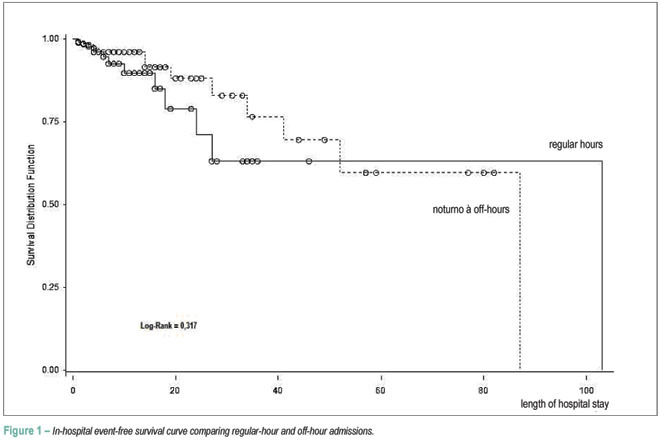
BACKGROUND: The relationship between admission time to an emergency service and in-hospital outcomes in acute coronary syndrome (ACS) is controversial. Admission during off-hours would be associated with worse prognosis. OBJECTIVE: To assess the influence of admission time on prolonged hospitalization and mortality for ACS patients, regarding regular hours (7AM-7PM) and off-hours (7PM-7AM). METHODS: The study assessed prospectively 1,104 consecutive ACS patients. In-hospital mortality and length of hospital stay > 5 days were the outcomes analyzed. RESULTS: Admission during regular hours was greater as compared with that during off-hours (63% vs. 37%; p < 0.001). Unstable angina was more prevalent during regular hours (43% vs. 32%; p 5 days were as follows: age [OR 1.042 (95%CI: 1.025 – 1.058), p < 0.001]; ejection fraction (EF) [OR 0.977 (95%CI: 0.966 – 0.988), p < 0.001]; NSTEMI [OR 1.699 (95%CI: 1.221 – 2.366), p = 0.001]; and smoking [OR 1.723 (95%CI: 1.113 – 2.668), p = 0.014]. Predictive factors for in-hospital mortality were as follows: age [OR 1.090 (95%CI: 1.047 – 1.134), p < 0.001]; EF [OR 0.936 (95%CI: 0.909 – 0.964), p < 0.001]; and surgical treatment [OR 3.781 (95%CI: 1.374 – 10.409), p = 0.01]. CONCLUSION: Prolonged length of hospital stay and in-hospital mortality in ACS patients do not depend on admission time.
Images
Image gallery fullscreen viewer
Comments are moderated by the editorial team before publication. Discussions should be evidence-based and use scientific language. Conflicts of interest should be declared.