ABC Family Arquivos Brasileiros de Cardiologia International Journal of Cardiovascular Sciences ABC Heart Failure & Cardiomyopathy ABC Imagem Cardiovascular
Português English
ABC Family
Português English
  • About
    • About ABC Family
    • Internal Regulation
    • Editorial Board
    • Brazilian Society of Cardiology (SBC)
  • Issues
  • SBC Guidelines
  • Content
    • Videos
    • Podcasts
    • News
  • About
    • About ABC Family
    • Internal Regulation
    • Editorial Board
    • Brazilian Society of Cardiology (SBC)
  • Issues
  • SBC Guidelines
  • Content
    • Videos
    • Podcasts
    • News

ABC Family

  • ABC Family
  • Arquivos Brasileiros de Cardiologia
  • International Journal of Cardiovascular Sciences
  • ABC Heart Failure & Cardiomyopathy
  • ABC Imagem Cardiovascular
Search in

No content found.

Journals
Ordering
Article types
Others

  1. Home
  2. Keyword: First Aid
ABC
Editorial

Simplified Algorithm for Differential Diagnosis of Tachycardias with Wide QRS. Is this the Best Way to Train Young Doctors?

Enrique Indalécio Pachón Mateo

To make the correct diagnosis of ventricular tachycardia in an emergency room (ER), with little time for decision-making and based only on the electrocardiogram is a challenge that depends on a lot of preparation by the doctor. Any instrument that facilitates and streamlines this process, especially increasing the degree of accuracy, is also worthy of praise, especially considering that the physician on duty is not always a cardiologist, or even less likely an arrhythmologist, sufficiently trained to make an accurate diagnosis.

An episode of ventricular tachycardia, supraventricular tachycardia (in a patient with a previous conduction disorder or with a conduction aberrancy) and supraventricular tachycardia caused by anomalous bundles may show similar electrocardiographic tracings, which are sometimes very difficult to differentiate, making the medical decision a risk to the patient’s life. To make this differentiation possible, several algorithms have been created that use electrocardiographic signals to assist and allow the correct diagnosis to be made and, consequently, to establish the adequate treatment, as in the case of the Brugada algorithm which is widely known (and that in fact is a combination of Brugada and Wellens criteria), as well as Vereckei and Pava criteria among others. All the created algorithms have sensitivity and specificity (S/E) variables that make them more or less accurate; however, in the same proportion, these algorithms can be simpler, or more complex (depending on the operator’s better training and greater time to reach the diagnosis).

[…]

  • Algorithms
  • Diagnosis
  • First Aid
  • Tachycardia, Emergencies
Read Full Article
Creative Commons Attribution (CC BY) Creative Commons license
23/04/2021 DOI: 10.36660/abc.20201344 Views 2
Figure 1
ABC
Original Article

Independent Predictors of Late Presentation in Patients with ST-Segment Elevation Myocardial Infarction

Juliane Araujo Rodrigues et al. Karina Melleu Márcia Moura Schmidt Carlos Antonio Mascia Gottschall … Maria Antonieta Pereira de Moraes Alexandre Schaan de Quadros

Abstract

Background:

In patients with acute ST-segment elevation myocardial infarction (STEMI), the time elapsed from symptom onset to receiving medical care is one of the main mortality predictors.

Objective:

To identify independent predictors of late presentation in patients STEMI representative of daily clinical practice.

Methods:

All patients admitted with a diagnosis of STEMI in a reference center between December 2009 and November 2014 were evaluated and prospectively followed during hospitalization and for 30 days after discharge. Late presentation was defined as a time interval > 6 hours from chest pain onset until hospital arrival. Multiple logistic regression analysis was used to identify independent predictors of late presentation. Values of p < 0.05 were considered statistically significant.

Results:

A total of 1,297 patients were included, with a mean age of 60.7 ± 11.6 years, of which 71% were males, 85% Caucasians, 72% had a mean income lower than five minimum wages and 66% had systemic arterial hypertension. The median time of clinical presentation was 3.00 [1.40-5.48] hours, and approximately one-quarter of the patients had a late presentation, with their mortality being significantly higher. The independent predictors of late presentation were Black ethnicity, low income and diabetes mellitus, and a history of previous heart disease was a protective factor.

Conclusion:

Black ethnicity, low income and diabetes mellitus are independent predictors of late presentation in STEMI. The identification of subgroups of patients prone to late presentation may help to stimulate prevention policies for these high-risk individuals.

  • Emergency Medical Services
  • First Aid
  • ST Elevation Myocardial Infarction
  • Time Factors
Read Full Article
Creative Commons Attribution (CC BY) Creative Commons license
21/09/2018 DOI: 10.5935/abc.20180178 Views 1
Emergency service admission time and in-hospital mortality in acute coronary syndrome
ABC
Artigo Original

Emergency service admission time and in-hospital mortality in acute coronary syndrome

Julio Yoshio Takada et al. Larissa Cardoso Roza Rogério Bicudo Ramos Solange Desiree Avakian … José Antonio Franchini Ramires Antonio de Pádua Mansur

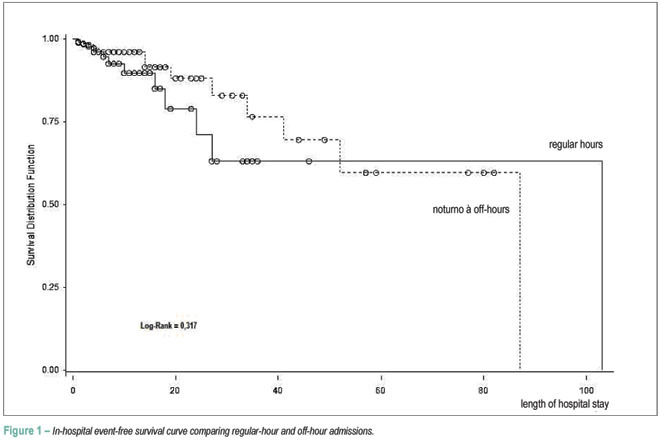
BACKGROUND: The relationship between admission time to an emergency service and in-hospital outcomes in acute coronary syndrome (ACS) is controversial. Admission during off-hours would be associated with worse prognosis. OBJECTIVE: To assess the influence of admission time on prolonged hospitalization and mortality for ACS patients, regarding regular hours (7AM-7PM) and off-hours (7PM-7AM). METHODS: The study assessed prospectively 1,104 consecutive ACS patients. In-hospital mortality and length of hospital stay > 5 days were the outcomes analyzed. RESULTS: Admission during regular hours was greater as compared with that during off-hours (63% vs. 37%; p < 0.001). Unstable angina was more prevalent during regular hours (43% vs. 32%; p 5 days were as follows: age [OR 1.042 (95%CI: 1.025 – 1.058), p < 0.001]; ejection fraction (EF) [OR 0.977 (95%CI: 0.966 – 0.988), p < 0.001]; NSTEMI [OR 1.699 (95%CI: 1.221 – 2.366), p = 0.001]; and smoking [OR 1.723 (95%CI: 1.113 – 2.668), p = 0.014]. Predictive factors for in-hospital mortality were as follows: age [OR 1.090 (95%CI: 1.047 – 1.134), p < 0.001]; EF [OR 0.936 (95%CI: 0.909 – 0.964), p < 0.001]; and surgical treatment [OR 3.781 (95%CI: 1.374 – 10.409), p = 0.01]. CONCLUSION: Prolonged length of hospital stay and in-hospital mortality in ACS patients do not depend on admission time.

  • First Aid
  • Hospitalization
  • Myocardial Infarction
  • patient admission
  • Time Factors
Read Full Article
Creative Commons Attribution (CC BY) Creative Commons license
06/01/2012 DOI: 10.1590/S0066-782X2012005000005 Views 1

How to cite this article

EndNote RIS

Electronic Document Format (Vancouver)

Mateo EIP. Simplified Algorithm for Differential Diagnosis of Tachycardias with Wide QRS. Is this the Best Way to Train Young Doctors?. Arquivos Brasileiros de Cardiologia 2021;116(3):464-5.

Electronic Document Format (ABNT)

Mateo, Enrique Indalécio Pachón. Simplified Algorithm for Differential Diagnosis of Tachycardias with Wide QRS. Is this the Best Way to Train Young Doctors?. Arquivos Brasileiros de Cardiologia, v. 116, n. 3, p. 464-465, Apr. 2021.

Electronic Document Format (APA)

Mateo, E. I. P. (2021). Simplified Algorithm for Differential Diagnosis of Tachycardias with Wide QRS. Is this the Best Way to Train Young Doctors?. Arquivos Brasileiros de Cardiologia, 116(3), 464-465.

Electronic Document Format (ISO)

Mateo, Enrique Indalécio Pachón. Simplified Algorithm for Differential Diagnosis of Tachycardias with Wide QRS. Is this the Best Way to Train Young Doctors?. Arquivos Brasileiros de Cardiologia [online]. 2021, vol. 116, n. 3, [cited 2026-10-14], pp. 464-465. Available from: <https://journals.cardiol.br/en/article/simplified-algorithm-for-differential-diagnosis-of-tachycardias-with-wide-qrs-is-this-the-best-way-to-train-young-doctors/>. ISSN 0066-782X

EndNote RIS

Electronic Document Format (Vancouver)

Rodrigues JA, Melleu K, Schmidt MM, Gottschall CAM, Moraes MAP, Quadros AS. Independent Predictors of Late Presentation in Patients with ST-Segment Elevation Myocardial Infarction. Arquivos Brasileiros de Cardiologia 2018;111(4):587-93.

Electronic Document Format (ABNT)

Rodrigues, Juliane Araujo; Melleu, Karina; Schmidt, Márcia Moura; Gottschall, Carlos Antonio Mascia; Moraes, Maria Antonieta Pereira de; Quadros, Alexandre Schaan de. Independent Predictors of Late Presentation in Patients with ST-Segment Elevation Myocardial Infarction. Arquivos Brasileiros de Cardiologia, v. 111, n. 4, p. 587-593, Sep. 2018.

Electronic Document Format (APA)

Rodrigues, J. A., Melleu, K., Schmidt, M. M., Gottschall, C. A. M., Moraes, M. A. P. , & Quadros, A. S. (2018). Independent Predictors of Late Presentation in Patients with ST-Segment Elevation Myocardial Infarction. Arquivos Brasileiros de Cardiologia, 111(4), 587-593.

Electronic Document Format (ISO)

Rodrigues, Juliane Araujo and Melleu, Karina and Schmidt, Márcia Moura and Gottschall, Carlos Antonio Mascia and Moraes, Maria Antonieta Pereira de and Quadros, Alexandre Schaan de. Independent Predictors of Late Presentation in Patients with ST-Segment Elevation Myocardial Infarction. Arquivos Brasileiros de Cardiologia [online]. 2018, vol. 111, n. 4, [cited 2026-10-14], pp. 587-593. Available from: <https://journals.cardiol.br/en/article/independent-predictors-of-late-presentation-in-patients-with-st-segment-elevation-myocardial-infarction/>. ISSN 0066-782X

EndNote RIS

Electronic Document Format (Vancouver)

Takada JY, Roza LC, Ramos RB, Avakian SD, Ramires JAF, Mansur AP. Emergency service admission time and in-hospital mortality in acute coronary syndrome. Arquivos Brasileiros de Cardiologia 2012;98(2):104-10.

Electronic Document Format (ABNT)

Takada, Julio Yoshio; Roza, Larissa Cardoso; Ramos, Rogério Bicudo; Avakian, Solange Desiree; Ramires, José Antonio Franchini; Mansur, Antonio de Pádua. Emergency service admission time and in-hospital mortality in acute coronary syndrome. Arquivos Brasileiros de Cardiologia, v. 98, n. 2, p. 104-110, Jan. 2012.

Electronic Document Format (APA)

Takada, J. Y., Roza, L. C., Ramos, R. B., Avakian, S. D., Ramires, J. A. F., & Mansur, A. P. (2012). Emergency service admission time and in-hospital mortality in acute coronary syndrome. Arquivos Brasileiros de Cardiologia, 98(2), 104-110.

Electronic Document Format (ISO)

Takada, Julio Yoshio and Roza, Larissa Cardoso and Ramos, Rogério Bicudo and Avakian, Solange Desiree and Ramires, José Antonio Franchini and Mansur, Antonio de Pádua. Emergency service admission time and in-hospital mortality in acute coronary syndrome. Arquivos Brasileiros de Cardiologia [online]. 2012, vol. 98, n. 2, [cited 2026-10-14], pp. 104-110. Available from: <https://journals.cardiol.br/en/article/emergency-service-admission-time-and-in-hospital-mortality-in-acute-coronary-syndrome/>. ISSN 0066-782X

  • About ABC Family
  • Internal Regulation
  • Editorial Board
  • Brazilian Society of Cardiology (SBC)

Issues

SBC Guidelines

  • Videos
  • Podcasts
  • News