ABC Family Arquivos Brasileiros de Cardiologia International Journal of Cardiovascular Sciences ABC Heart Failure & Cardiomyopathy ABC Imagem Cardiovascular
Português English
ABC Family
Português English
  • About
    • About ABC Family
    • Internal Regulation
    • Editorial Board
    • Brazilian Society of Cardiology (SBC)
  • Issues
  • SBC Guidelines
  • Content
    • Videos
    • Podcasts
    • News
  • About
    • About ABC Family
    • Internal Regulation
    • Editorial Board
    • Brazilian Society of Cardiology (SBC)
  • Issues
  • SBC Guidelines
  • Content
    • Videos
    • Podcasts
    • News

ABC Family

  • ABC Family
  • Arquivos Brasileiros de Cardiologia
  • International Journal of Cardiovascular Sciences
  • ABC Heart Failure & Cardiomyopathy
  • ABC Imagem Cardiovascular
Search in

No content found.

Journals
Ordering
Article types
Others

  1. Home
  2. Keyword: Percutaneous Coronary Intervention/economics
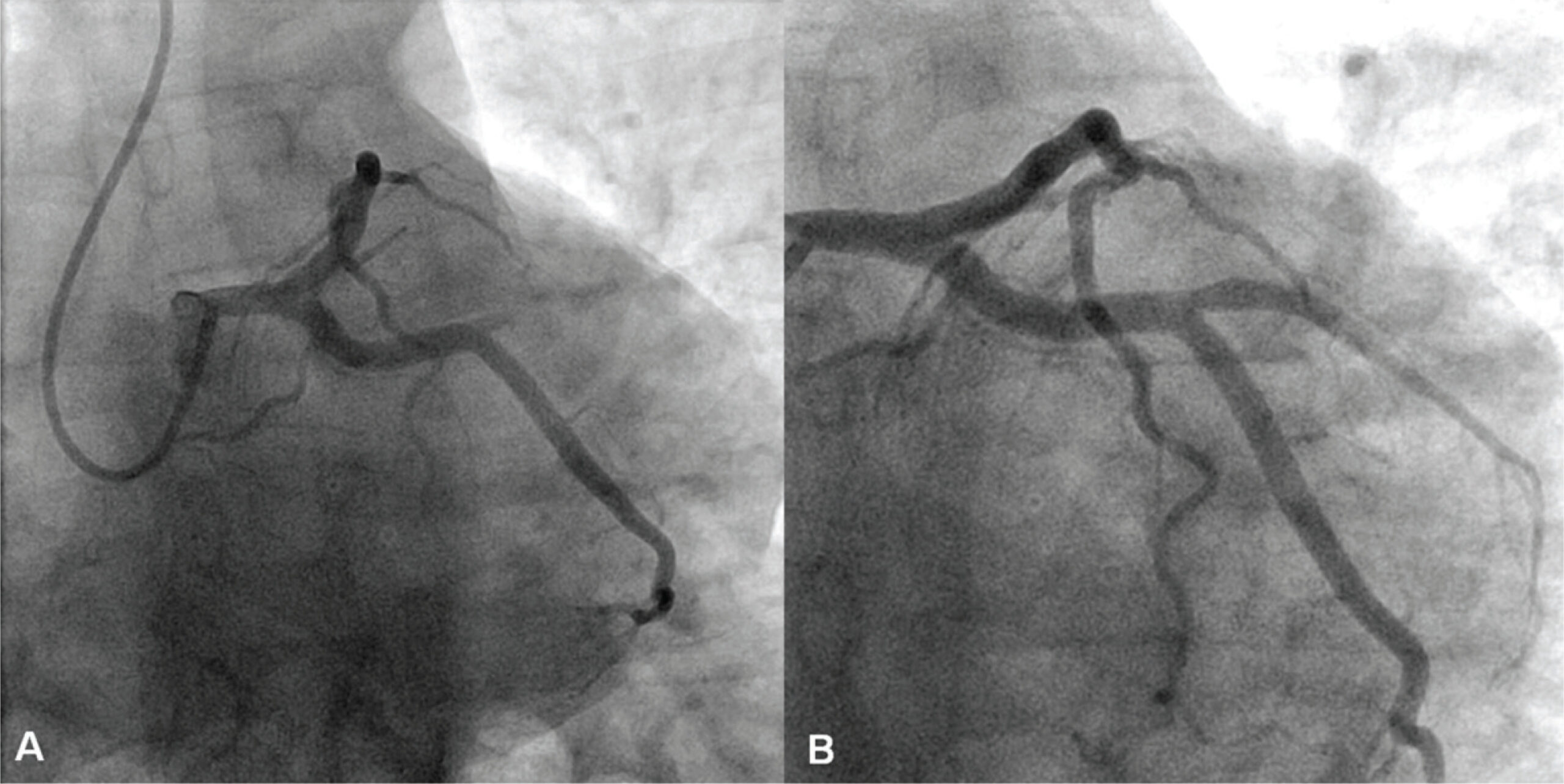
Figure 1
IJCS
Case Report

Acute Myocardial Infarction as the Initial Clinical Manifestation of Pernicious Anemia

Leonardo Marostica Alves Silva et al. Assis Xavier da Silva Barros Junior João Antonio de Toledo Galina Alexandre Rodrigues … Igor Ribeiro de Castro Bienert Pedro Beraldo de Andrade

Introduction

Despite its lower prevalence in young individuals, acute myocardial infarction (AMI) causes significant morbidity and socioeconomic impact when occurs in this group. In 2010, considering only the hospitals accredited by the Brazilian Unified Health System, there were 8,368 hospitalizations and 2,556 deaths from ischemic heart diseases among patients younger than 40 years. Although hospitalization rates are lower at this age range, the importance of this theme lies mainly in the absolute numbers of cases.

Acute coronary syndrome (ACS) in young patients has characteristics that differ from older patients. Although coronary atherosclerotic disease is a common cause, the prevalence of AMI without obstruction in the coronary arteries is higher among the young. Among the causes of AMI without atheromatous disease, thromboembolism is a differential diagnosis, with hypercoagulability correlated with formation of coronary embolism. Thus, it is important to identify alternative etiologies in the approach of AMI in young patients since modifiable factors can be diagnosed and treated. In this article, we present a case in which an autoimmune disease may be the cause of ACS in a young patient with few attributable risk factors for cardiovascular disease.

[…]

  • Anemia, Pericious
  • homocysteine
  • Mortality & Morbidity
  • Myocardial Infarction/economics
  • Percutaneous Coronary Intervention/economics
Read Full Article
Creative Commons Attribution (CC BY) Creative Commons license
12/03/2021 DOI: 10.36660/ijcs.20190039 Views 1
ABC
Editorial

Reperfusion Criteria in Patients Submitted to Fibrinolysis: Is There Room for Improvement?

Milena Soriano Marcolino et al. Antonio Luiz Pinho Ribeiro

Many ST-elevation acute myocardial infarction (STEMI) patients seek care in hospitals without percutaneous coronary intervention (PCI) capability and cannot be submitted to PCI within the guideline-recommended timelines, and, instead, they are often submitted to fibrinolysis as the initial reperfusion therapy. Rapid, simple and readily available bedside measures are of utmost importance for timely assessment of the efficacy of reperfusion therapy early after fibrinolysis in acute STEMI, in order to immediately identify the ones who require rescue PCI.,

In an editorial for Circulation in 2001, Gibson stated “In a time of dizzying advances in diagnostic modalities, it is refreshing to see what a useful, simple, noninvasive, broadly accessible, easily repeatable/applied, and affordable tool the electrocardiography (ECG) is”. This is still up to date. Multiple studies have demonstrated improved outcomes among patients who achieve complete ST resolution at 60-90 minutes after fibrinolytic therapy, and it is recommended that the absence of > 50% reduction in ST elevation in the worst lead at 60-90 minutes should prompt strong consideration of coronary angiography and rescue PCI. , However, this measure, combined with the absence of reperfusion arrhythmias at 2 hours after treatment, has a positive predictive value of 87% and a negative predictive value of 83% to predict failure of reperfusion, , indicating that there is still room for improvement in accuracy.

[…]

  • Electrocardiography/methods
  • Fibrinolysis
  • Percutaneous Coronary Intervention/economics
  • ST Elevation Myocardial Infarction/mortality
  • Thrombolytic THerapy/methods
  • Time Factors
Read Full Article
Creative Commons Attribution (CC BY) Creative Commons license
01/01/2019 DOI: 10.5935/abc.20180245
ABC
Editorial

Real World of Percutaneous Coronary Interventions in the Public Health System in Rio de Janeiro: How Can It Be Improved?

Stefano Garzon et al. Expedito E. Ribeiro

Cardiovascular diseases (CVD) are currently the leading cause of death in Brazil and in the world, with 80% of the cases occurring in low- and middle-income countries. It impacts these countries economies negatively, with reductions in the Gross Domestic Product (GDP), and increases in the burden on already precarious health care systems. The risk factors associated with CVD are largely preventable, and raising awareness and increasing access to primary health care for prevention are key factors for reducing events.

The present study examined mortality rates in patients who underwent percutaneous coronary interventions (PCI) for both stable coronary disease (SCD) and acute coronary syndromes (ACS) in the State of Rio de Janeiro Public Health System (SUS) from 1999 to 2010. It provides us with interesting data regarding mortality outcomes in such patients, dividing them by gender, age groups, and type of intervention (balloon coronary angioplasty, stenting with bare metal stents and primary PCI for STEMI). It has obvious limitations: it is a retrospective populational cohort; its data were extracted from different databases, and the information had to be paired (hospital admissions versus death certificates, which are not in the same dataset); the mortality outcome was death by any cause, and although the authors cite that the cause of death was divided into two groups (cardiovascular death and any other cause), it is not clear which data was used; there is no information regarding comorbidities, single vessel versus multivessel disease, or medications prescribed; and patients with more than one PCI were excluded.

[…]

  • Coronary Artery Disease
  • Epidemiology
  • Morbidity
  • Mortality
  • Percutaneous Coronary Intervention/economics
  • Unified Health System/economics
Read Full Article
Creative Commons Attribution (CC BY) Creative Commons license
01/11/2018 DOI: 10.5935/abc.20180227 Views 1

How to cite this article

EndNote RIS

Electronic Document Format (Vancouver)

Silva LMA, Barros Junior AXS, Galina JAT, Rodrigues A, Bienert IRC, Andrade PB. Acute Myocardial Infarction as the Initial Clinical Manifestation of Pernicious Anemia. International Journal of Cardiovascular Sciences 2021;34(2):236-9.

Electronic Document Format (ABNT)

Silva, Leonardo Marostica Alves; Barros Junior, Assis Xavier da Silva; Galina, João Antonio de Toledo; Rodrigues, Alexandre; Bienert, Igor Ribeiro de Castro; Andrade, Pedro Beraldo de. Acute Myocardial Infarction as the Initial Clinical Manifestation of Pernicious Anemia. International Journal of Cardiovascular Sciences, v. 34, n. 2, p. 236-239, Mar. 2021.

Electronic Document Format (APA)

Silva, L. M. A., Barros Junior, A. X. S., Galina, J. A. T., Rodrigues, A., Bienert, I. R. C., & Andrade, P. B. (2021). Acute Myocardial Infarction as the Initial Clinical Manifestation of Pernicious Anemia. International Journal of Cardiovascular Sciences, 34(2), 236-239.

Electronic Document Format (ISO)

Silva, Leonardo Marostica Alves and Barros Junior, Assis Xavier da Silva and Galina, João Antonio de Toledo and Rodrigues, Alexandre and Bienert, Igor Ribeiro de Castro and Andrade, Pedro Beraldo de. Acute Myocardial Infarction as the Initial Clinical Manifestation of Pernicious Anemia. International Journal of Cardiovascular Sciences [online]. 2021, vol. 34, n. 2, [cited 2026-10-14], pp. 236-239. Available from: <https://journals.cardiol.br/en/article/acute-myocardial-infarction-as-the-initial-clinical-manifestation-of-pernicious-anemia/>. ISSN 2359-4802

EndNote RIS

Electronic Document Format (Vancouver)

Marcolino MS, Ribeiro ALP. Reperfusion Criteria in Patients Submitted to Fibrinolysis: Is There Room for Improvement?. Arquivos Brasileiros de Cardiologia 2019;112(1):30-1.

Electronic Document Format (ABNT)

Marcolino, Milena Soriano; Ribeiro, Antonio Luiz Pinho. Reperfusion Criteria in Patients Submitted to Fibrinolysis: Is There Room for Improvement?. Arquivos Brasileiros de Cardiologia, v. 112, n. 1, p. 30-31, Dec. 2018.

Electronic Document Format (APA)

Marcolino, M. S., & Ribeiro, A. L. P. (2019). Reperfusion Criteria in Patients Submitted to Fibrinolysis: Is There Room for Improvement?. Arquivos Brasileiros de Cardiologia, 112(1), 30-31.

Electronic Document Format (ISO)

Marcolino, Milena Soriano and Ribeiro, Antonio Luiz Pinho. Reperfusion Criteria in Patients Submitted to Fibrinolysis: Is There Room for Improvement?. Arquivos Brasileiros de Cardiologia [online]. 2019, vol. 112, n. 1, [cited 2026-10-14], pp. 30-31. Available from: <https://journals.cardiol.br/en/article/reperfusion-criteria-in-patients-submitted-to-fibrinolysis-is-there-room-for-improvement/>. ISSN 0066-782X

EndNote RIS

Electronic Document Format (Vancouver)

Garzon S, Ribeiro EE. Real World of Percutaneous Coronary Interventions in the Public Health System in Rio de Janeiro: How Can It Be Improved?. Arquivos Brasileiros de Cardiologia 2018;111(5):731-2.

Electronic Document Format (ABNT)

Garzon, Stefano; Ribeiro, Expedito E.. Real World of Percutaneous Coronary Interventions in the Public Health System in Rio de Janeiro: How Can It Be Improved?. Arquivos Brasileiros de Cardiologia, v. 111, n. 5, p. 731-732, Oct. 2018.

Electronic Document Format (APA)

Garzon, S., & Ribeiro, E. E. (2018). Real World of Percutaneous Coronary Interventions in the Public Health System in Rio de Janeiro: How Can It Be Improved?. Arquivos Brasileiros de Cardiologia, 111(5), 731-732.

Electronic Document Format (ISO)

Garzon, Stefano and Ribeiro, Expedito E.. Real World of Percutaneous Coronary Interventions in the Public Health System in Rio de Janeiro: How Can It Be Improved?. Arquivos Brasileiros de Cardiologia [online]. 2018, vol. 111, n. 5, [cited 2026-10-14], pp. 731-732. Available from: <https://journals.cardiol.br/en/article/real-world-of-percutaneous-coronary-interventions-in-the-public-health-system-in-rio-de-janeiro-how-can-it-be-improved/>. ISSN 0066-782X

  • About ABC Family
  • Internal Regulation
  • Editorial Board
  • Brazilian Society of Cardiology (SBC)

Issues

SBC Guidelines

  • Videos
  • Podcasts
  • News