ABC Family Arquivos Brasileiros de Cardiologia International Journal of Cardiovascular Sciences ABC Heart Failure & Cardiomyopathy ABC Imagem Cardiovascular
Português English
ABC Family
Português English
  • About
    • About ABC Family
    • Internal Regulation
    • Editorial Board
    • Brazilian Society of Cardiology (SBC)
  • Issues
  • SBC Guidelines
  • Content
    • Videos
    • Podcasts
    • News
  • About
    • About ABC Family
    • Internal Regulation
    • Editorial Board
    • Brazilian Society of Cardiology (SBC)
  • Issues
  • SBC Guidelines
  • Content
    • Videos
    • Podcasts
    • News

ABC Family

  • ABC Family
  • Arquivos Brasileiros de Cardiologia
  • International Journal of Cardiovascular Sciences
  • ABC Heart Failure & Cardiomyopathy
  • ABC Imagem Cardiovascular
Search in

No content found.

Journals
Ordering
Article types
Others

  1. Home
  2. Keyword: Blood Arterial
Figure 1
ABC
Original Article

Breaks in Sedentary Time and Cardiometabolic Markers in Adolescents

Natália Maria Mesquita de Lima Quirino et al. Alcides Prazeres Filho Arthur Oliveira Barbosa Gerfeson Mendonça José Cazuza de Farias Júnior

Abstract

Background:

The interruption of the time spent in sedentary behavior (breaks) has been associated with better levels of cardiometabolic indicators in the adult population, but in adolescents, further investigations are still needed to confirm these findings.

Objectives:

To analyze the association of the number of breaks per day in sedentary behaviors with cardiometabolic markers and whether it was moderated by nutritional status and excessive time on sedentary behavior in adolescents.

Methods:

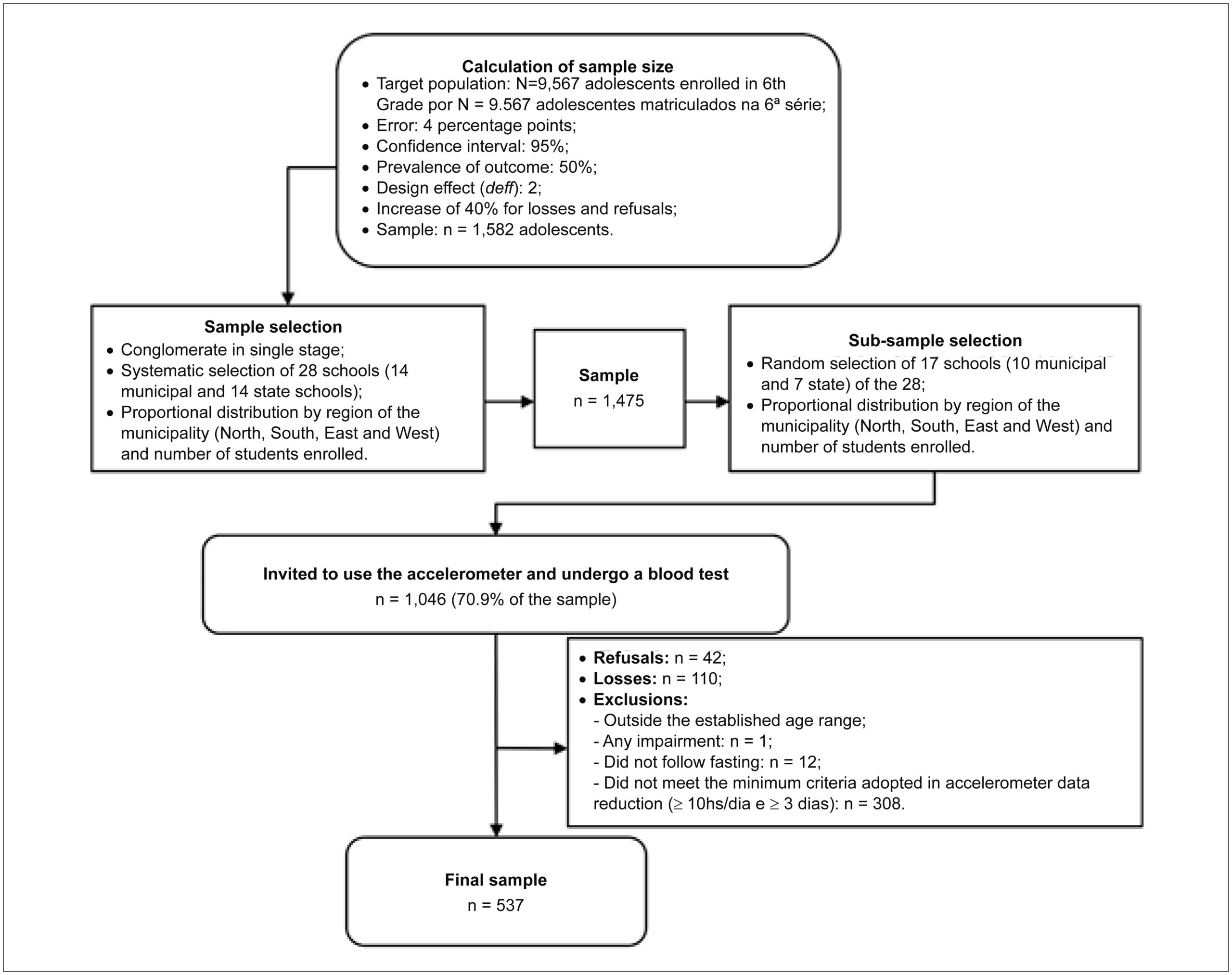
This is a cross-sectional study of 537 adolescents (52.3% girls), aged between 10 and 14 years, enrolled in public schools in the city of João Pessoa, Paraíba state, Brazil. The number of daily breaks (>100 counts/minutes) in sedentary time was measured by Actigraph GT3X+ accelerometers. The following cardiometabolic markers were analyzed: systolic and diastolic blood pressure (mmHg), fasting blood glucose levels, total cholesterol, triglycerides, HDL-c, LDL-c (all in mg/dL) and body mass index (BMI) (kg/m). Linear regression was used to analyze the association between the number of breaks and cardiometabolic markers and whether this association was moderated by nutritional status and excessive time in sedentary behavior. The significance level of p<0.05 was adopted for all analyses.

Results:

The number of daily breaks was negatively associated with BMI (boys – ß = −0.083; 95%CI: −0.132; −0.034 and girls – ß = −0.115; 95%CI: −0.169; −0.061), but not with the remaining cardiometabolic markers. The number of breaks per day was negatively associated with BMI (ß = −0.069; 95% CI: −0.102; −0.035), but not with the other cardiometabolic markers and this association was not moderated by the adolescents’ nutritional status (p=0.221), or by excessive time in sedentary behavior (p=0.176).

Conclusions:

Including breaks in sedentary time seems to contribute to lower BMI values in adolescents.
  • Adiposity
  • Adolescent
  • Blood Arterial
  • Cardiometabolic Markers
  • Cholesterol
  • Glucose
  • Sedentarism
  • Sedentary Behavior
  • Triglycerides
Read Full Article
Creative Commons Attribution (CC BY) Creative Commons license
06/09/2021 DOI: 10.36660/abc.20200047
Figure 1
ABC
Original Article

Sensitivity and Specificity of Cutoff Points of Resting Heart Rate from 6,794 Brazilian Adolescents: A Cross-Sectional Study

Breno Quintella Farah et al. Diego Giulliano Destro Christofaro Aluísio Andrade-Lima Antonio Henrique Germano-Soares … William Rodrigues Tebar Mauro Virgílio Gomes de Barros Raphael Mendes Ritti-Dias

Abstract

Background

Resting heart rate (RHR) may be a useful screening tool for cardiovascular risk. However, RHR cutoff points, an interesting clinical approach, have never been described in young populations.

Objective

To establish RHR cutoff points in Brazilian adolescents and to analyze whether cutoff points are associated with cardiovascular risk factors.

Methods

The sample was composed of 6,794 adolescents (10 to 19 years old). Blood pressure and RHR were assessed by oscillometric device. Body mass index and waist circumference were also assessed. Receiver operating characteristic curve was adopted to analyze the sensitivity and specificity, and associations of high RHR with cardiovascular risk factors were analyzed by binary logistic regression. A p value < 0.05 was considered statistically significant for all the analyses.

Results

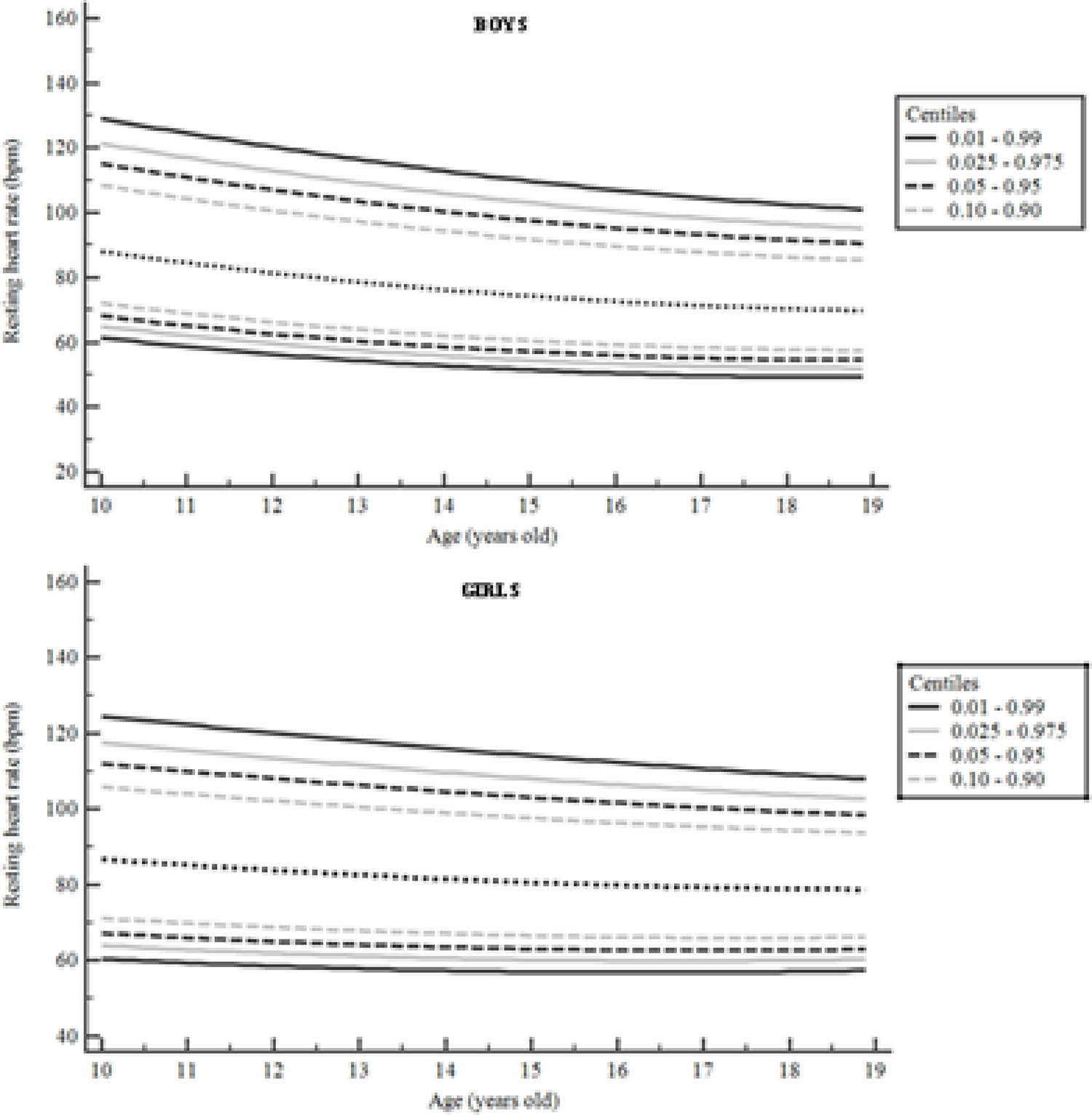
Mean RHR values were higher among participants ages 10 to 14 years than 15 to 19 years, for boys (p < 0.001) and girls ( 92 bpm) and 15 to 19 years (> 82 bpm), as well as for girls ages 15 to 19 years (> 82 bpm) (p 0.05). Proposed RHR cutoff points were associated with abdominal obesity, overweight, and high blood pressure in boys in girls. RHR cutoff points were associated with the cluster of cardiovascular risk factors in adolescents ages 15 to 19 years.

Conclusion

The proposed RHR cutoff points were associated with cardiovascular risk factors in adolescents.

  • Adiposity
  • Adolescent
  • Blood Arterial
  • Cross-Sectional Studies
  • Epidemiology
  • Heart Rate
  • Obesity
  • Risk Factors
Read Full Article
Creative Commons Attribution (CC BY) Creative Commons license
26/07/2021 DOI: 10.36660/abc.20200111 Views 1
Figure 1
ABC
Original Article

Association between Serum Uric Acid and Pre-hypertension and Hypertension among Chinese Adults

Lijun Zhu et al. Xiaoyu Zhang Zhengmei Fang Yuelong Jin … Weiwei Chang Yan Chen Yingshui Yao

Abstract

Background

Uric acid (UA), the end product of purine nucleotide metabolism, participates in the processes of metabolic and cardiovascular diseases. Experimental evidence suggests it is an important mediator in the physiological response to blood pressure increase.

Objective

To evaluate the association between serum UA levels and pre-hypertension and hypertension in a Chinese population.

Methods

A cross-sectional study was conducted from March to September 2017, and 1,138 participants aged 35 to 75 were enrolled in this study, where 223 normotensive, 316 pre-hypertensive, and 599 hypertensive subjects were selected to evaluate the association between serum UA levels and hypertension. A p-value <0.05 was considered statistically significant.

Results

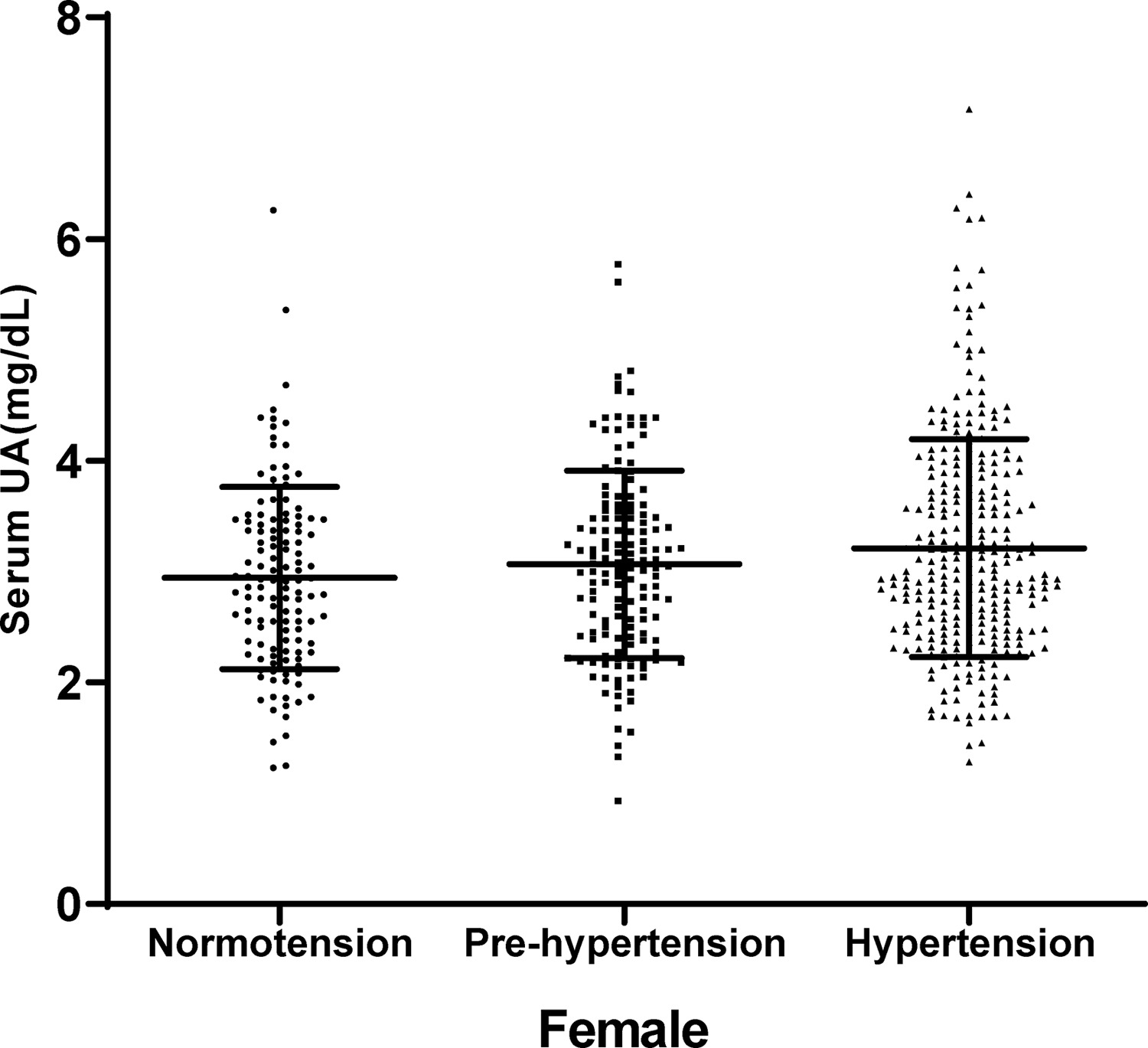
Serum UA levels were significantly higher in the pre-hypertension and hypertension group compared to the control group in the entire population (p<0.05 for all). Quantitative trait analysis indicated that serum UA levels were (2.92±0.81, 3.06±0.85, 3.22±0.98 mg/d) linearly increased in normotensive, pre-hypertensive and hypertensive females, with a p value of 0.008. Serum UA levels in the quartiles were positively correlated with DBP (p<0.05), particularly in females. After adjusting for age, gender, body mass index (BMI), glucose (GLU), total cholesterol (TC), triglycerides (TG), high-density lipoprotein cholesterol (HDL-c), the odds ratios (ORs) and 95% confidence intervals (CIs) of pre-hypertension from the lowest (referent) to the highest levels of serum UA were 1.718 (1.028–2.872), 1.018 (0.627–1.654) and 1.738 (1.003–3.010). Additionally, the second quartile of serum UA levels were significantly associated with hypertension, with an OR (95% CI) of 2.036 (1.256–3.298).

Conclusions

This study suggests that higher serum UA levels are positively associated with pre-hypertension and hypertension among Chinese adults.

  • Blood Arterial
  • Cardiovascular Diseases / epidemiology
  • Hypertension
  • Hyperuricemia
  • Risk Factors
  • uric acid
Read Full Article
Creative Commons Attribution (CC BY) Creative Commons license
14/06/2021 DOI: 10.36660/abc.20200098 Views 1
ABC
Editorial

Blood Pressure in Children. The Key Role of Physical Activity and Body Fatness

César A. Agostinis-Sobrinho et al. Katiane Vilan

High blood pressure is the leading global risk factor for chronic kidney disease and cardiovascular diseases and is the leading cause of premature death worldwide. The number of adults with high blood pressure increased from 594 million in 1975 to 1.13 billion in 2015. The World Health Organization (WHO) estimates 1 in 4 men and 1 in 5 women had hypertension and that by 2025, 1.56 billion adults will be living with hypertension.

Childhood raised blood pressure is becoming more common in the general pediatric population, representing a considerable public health challenge worldwide. Studies have suggested that childhood high blood pressure seems to track from childhood to adulthood and is associated with detrimental lifelong cardiovascular events. However, raised blood pressure is one of the most important preventable contributors to disease and death and is considered to be one of the major modifiable risk factors for cardiovascular disease with roots in childhood., Studies indicate that high blood pressure levels during childhood are a multifactorial condition. Genetics, age, gender, ethnicity, overweight/obesity, sodium and potassium intake, physical inactivity, and socioeconomic factors have been named as the main risk factors for hypertension.

[…]

  • Blood Arterial
  • Child
  • Exercise
  • Hypertension/heredity
  • Obesity
  • Overweight
  • Physical activity
  • Public Health
  • Risk Factors
  • Sedentarism
Read Full Article
Creative Commons Attribution (CC BY) Creative Commons license
17/05/2021 DOI: 10.36660/abc.20210117 Views 2

How to cite this article

EndNote RIS

Electronic Document Format (Vancouver)

Quirino NMML, Prazeres Filho A, Barbosa AO, Mendonça G, Farias Júnior JC. Breaks in Sedentary Time and Cardiometabolic Markers in Adolescents. Arquivos Brasileiros de Cardiologia 2021;117(2):352-6.

Electronic Document Format (ABNT)

Quirino, Natália Maria Mesquita de Lima; Prazeres Filho, Alcides; Barbosa, Arthur Oliveira; Mendonça, Gerfeson; Farias Júnior, José Cazuza de. Breaks in Sedentary Time and Cardiometabolic Markers in Adolescents. Arquivos Brasileiros de Cardiologia, v. 117, n. 2, p. 352-362, Sep. 2021.

Electronic Document Format (APA)

Quirino, N. M. M. L., Prazeres Filho, A., Barbosa, A. O., Mendonça, G., & Farias Júnior, J. C. (2021). Breaks in Sedentary Time and Cardiometabolic Markers in Adolescents. Arquivos Brasileiros de Cardiologia, 117(2), 352-362.

Electronic Document Format (ISO)

Quirino, Natália Maria Mesquita de Lima and Prazeres Filho, Alcides and Barbosa, Arthur Oliveira and Mendonça, Gerfeson and Farias Júnior, José Cazuza de. Breaks in Sedentary Time and Cardiometabolic Markers in Adolescents. Arquivos Brasileiros de Cardiologia [online]. 2021, vol. 117, n. 2, [cited 2026-10-14], pp. 352-362. Available from: <https://journals.cardiol.br/en/article/breaks-in-sedentary-time-and-cardiometabolic-markers-in-adolescents/>. ISSN 0066-782X

EndNote RIS

Electronic Document Format (Vancouver)

Farah BQ, Christofaro DGD, Andrade-Lima A, Germano-Soares AH, Tebar WR, Barros MVG, Ritti-Dias RM, et al. Sensitivity and Specificity of Cutoff Points of Resting Heart Rate from 6,794 Brazilian Adolescents: A Cross-Sectional Study. Arquivos Brasileiros de Cardiologia 2021;117(1):74-81.

Electronic Document Format (ABNT)

Farah, Breno Quintella; Christofaro, Diego Giulliano Destro; Andrade-Lima, Aluísio; Germano-Soares, Antonio Henrique; Tebar, William Rodrigues; Barros, Mauro Virgílio Gomes de; Ritti-Dias, Raphael Mendes. Sensitivity and Specificity of Cutoff Points of Resting Heart Rate from 6,794 Brazilian Adolescents: A Cross-Sectional Study. Arquivos Brasileiros de Cardiologia, v. 117, n. 1, p. 74-81, Jul. 2021.

Electronic Document Format (APA)

Farah, B. Q., Christofaro, D. G. D., Andrade-Lima, A., Germano-Soares, A. H., Tebar, W. R., Barros, M. V. G. , & Ritti-Dias, R. M. (2021). Sensitivity and Specificity of Cutoff Points of Resting Heart Rate from 6,794 Brazilian Adolescents: A Cross-Sectional Study. Arquivos Brasileiros de Cardiologia, 117(1), 74-81.

Electronic Document Format (ISO)

Farah, Breno Quintella and Christofaro, Diego Giulliano Destro and Andrade-Lima, Aluísio and Germano-Soares, Antonio Henrique and Tebar, William Rodrigues and Barros, Mauro Virgílio Gomes de and Ritti-Dias, Raphael Mendes. Sensitivity and Specificity of Cutoff Points of Resting Heart Rate from 6,794 Brazilian Adolescents: A Cross-Sectional Study. Arquivos Brasileiros de Cardiologia [online]. 2021, vol. 117, n. 1, [cited 2026-10-14], pp. 74-81. Available from: <https://journals.cardiol.br/en/article/sensitivity-and-specificity-of-cutoff-points-of-resting-heart-rate-from-6794-brazilian-adolescents-a-cross-sectional-study/>. ISSN 0066-782X

EndNote RIS

Electronic Document Format (Vancouver)

Zhu L, Zhang X, Fang Z, Jin Y, Chang W, Chen Y, Yao Y, et al. Association between Serum Uric Acid and Pre-hypertension and Hypertension among Chinese Adults. Arquivos Brasileiros de Cardiologia 2021;116(6):1072-8.

Electronic Document Format (ABNT)

Zhu, Lijun; Zhang, Xiaoyu; Fang, Zhengmei; Jin, Yuelong; Chang, Weiwei; Chen, Yan; Yao, Yingshui. Association between Serum Uric Acid and Pre-hypertension and Hypertension among Chinese Adults. Arquivos Brasileiros de Cardiologia, v. 116, n. 6, p. 1072-1078, Jun. 2021.

Electronic Document Format (APA)

Zhu, L., Zhang, X., Fang, Z., Jin, Y., Chang, W., Chen, Y., & Yao, Y. (2021). Association between Serum Uric Acid and Pre-hypertension and Hypertension among Chinese Adults. Arquivos Brasileiros de Cardiologia, 116(6), 1072-1078.

Electronic Document Format (ISO)

Zhu, Lijun and Zhang, Xiaoyu and Fang, Zhengmei and Jin, Yuelong and Chang, Weiwei and Chen, Yan and Yao, Yingshui. Association between Serum Uric Acid and Pre-hypertension and Hypertension among Chinese Adults. Arquivos Brasileiros de Cardiologia [online]. 2021, vol. 116, n. 6, [cited 2026-10-14], pp. 1072-1078. Available from: <https://journals.cardiol.br/en/article/association-between-serum-uric-acid-and-pre-hypertension-and-hypertension-among-chinese-adults/>. ISSN 0066-782X

EndNote RIS

Electronic Document Format (Vancouver)

Agostinis-Sobrinho CA, Vilan K. Blood Pressure in Children. The Key Role of Physical Activity and Body Fatness. Arquivos Brasileiros de Cardiologia 2021;116(5):957-8.

Electronic Document Format (ABNT)

Agostinis-Sobrinho, César A.; Vilan, Katiane. Blood Pressure in Children. The Key Role of Physical Activity and Body Fatness. Arquivos Brasileiros de Cardiologia, v. 116, n. 5, p. 957-958, May. 2021.

Electronic Document Format (APA)

Agostinis-Sobrinho, C. A., & Vilan, K. (2021). Blood Pressure in Children. The Key Role of Physical Activity and Body Fatness. Arquivos Brasileiros de Cardiologia, 116(5), 957-958.

Electronic Document Format (ISO)

Agostinis-Sobrinho, César A. and Vilan, Katiane. Blood Pressure in Children. The Key Role of Physical Activity and Body Fatness. Arquivos Brasileiros de Cardiologia [online]. 2021, vol. 116, n. 5, [cited 2026-10-14], pp. 957-958. Available from: <https://journals.cardiol.br/en/article/blood-pressure-in-children-the-key-role-of-physical-activity-and-body-fatness/>. ISSN 0066-782X

  • About ABC Family
  • Internal Regulation
  • Editorial Board
  • Brazilian Society of Cardiology (SBC)

Issues

SBC Guidelines

  • Videos
  • Podcasts
  • News