ABC Family Arquivos Brasileiros de Cardiologia International Journal of Cardiovascular Sciences ABC Heart Failure & Cardiomyopathy ABC Imagem Cardiovascular
Português English
ABC Family
Português English
  • About
    • About ABC Family
    • Internal Regulation
    • Editorial Board
    • Brazilian Society of Cardiology (SBC)
  • Issues
  • SBC Guidelines
  • Content
    • Videos
    • Podcasts
    • News
  • About
    • About ABC Family
    • Internal Regulation
    • Editorial Board
    • Brazilian Society of Cardiology (SBC)
  • Issues
  • SBC Guidelines
  • Content
    • Videos
    • Podcasts
    • News

ABC Family

  • ABC Family
  • Arquivos Brasileiros de Cardiologia
  • International Journal of Cardiovascular Sciences
  • ABC Heart Failure & Cardiomyopathy
  • ABC Imagem Cardiovascular
Search in

No content found.

Journals
Ordering
Article types
Others

  1. Home
  2. Keyword: Fever
ABC
Letter to the Editor

Circulatory System Diseases in Patients with COVID-19: Description of Clinical and Epidemiological Profile of 197 Deaths

Carlos Dornels Freire de Souza et al. Thiago Cavalcanti Leal Lucas Gomes Santos

Dear Editor,

On December 31, 2019, China notified the World Health Organization (WHO) of an outbreak of pneumonia in the city of Wuhan, capital of the Hubei province. A few days later, the causative agent, severe acute respiratory syndrome coronavirus 2 (SARS-CoV-2) was identified.

[…]

  • Coronavirus-19/complications
  • Diabetes Mellitus
  • Dyspnea
  • Fever
  • Hypertension
  • Respiration Disorders
  • Risk Factors
  • Severe Acute Respiratory Syndrome
Read Full Article
Creative Commons Attribution (CC BY) Creative Commons license
28/08/2020 DOI: 10.36660/abc.20200453 Views 1
Figure 1
IJCS
Viewpoint

Challenges in Pharmacological Management of Cardiovascular Diseases in Covid-19: do Benefits Outweigh Risks?

Samuel de Sousa Pedro et al. Fernanda Carla Ferreira de Brito Christianne Bretas Vieira Scaramello

Introduction

Cardiovascular diseases (CVD) are the main cause not only of global mortality but also of reduced quality of life. They cover ischemic heart disease, stroke, heart failure, peripheral artery disease, and various other heart and vascular conditions. In 2017, CVDs caused about 17.8 million deaths worldwide, corresponding to 330 million years of life lost and another 35.6 million years of life with disabilities. Almost 80% of deaths occur in low- and middle-income countries, such as Brazil, where the occurrence of CVDs and their risk factors are on the rise as a result of an ongoing epidemiological transition. In low-income countries CVDs greatly affect working-age populations, and the total economic loss resulting from this group of diseases is high, representing 2% of Gross Domestic Product. In addition, the disability caused by CVDs has economic consequences at multiple levels: individual, family, economic agents, public institutions, government, and society as a whole.

Recent studies also show that chronic conditions, such as CVD, increase the risk of aggravation and death associated with the new coronavirus 2019 disease (COVID-19), whose outbreak was characterized as a pandemic by the World Health Organization (WHO) in March 2020. The new coronavirus is a betacoronavirus called SARS-CoV-2 (Severe Acute Respiratory Syndrome coronavirus 2), phylogenetically identical to other coronaviruses capable of determining acute respiratory distress syndrome (ARDS), which is responsible for numerous deaths. The most common symptoms of COVID-19 include fever, cough, dyspnea, myalgia, fatigue, diarrhea, sore throat, chest pain, confusion, and lethargy. Acute and chronic cardiovascular complications have also been observed in the course of COVID-19, being attributed to several mechanisms, such as relative ischemia, systemic inflammation mediated by pathogens, with increased levels of several biomarkers. In this context, studies point to the relevance not only of chronic conditions, such as hypertension, but also of the age and immunological status of the host, characterizing a complex, multifactorial, and bidirectional model that can comprehend the drugs used to treat these pathologies.

[…]

  • Anticoagulants
  • Cardiovascular Diseases, mortality
  • Coronavirus/complications
  • Covid-19/complications
  • Dyspnea
  • Fever
  • Pandemics
  • SARS Severe Acute Respiratory Syndrome
Read Full Article
Creative Commons Attribution (CC BY) Creative Commons license
31/07/2020 DOI: 10.36660/ijcs.20200081
Figure 1
IJCS
Viewpoint

Covid-19 and Safety in the Cath Lab: Where We Are and Where We Are Headed

Giordana Zeferino Mariano et al. Viviana Guzzo Lemke Maria Sanali Moura Paiva Gláucia Maria Moraes de Oliveira

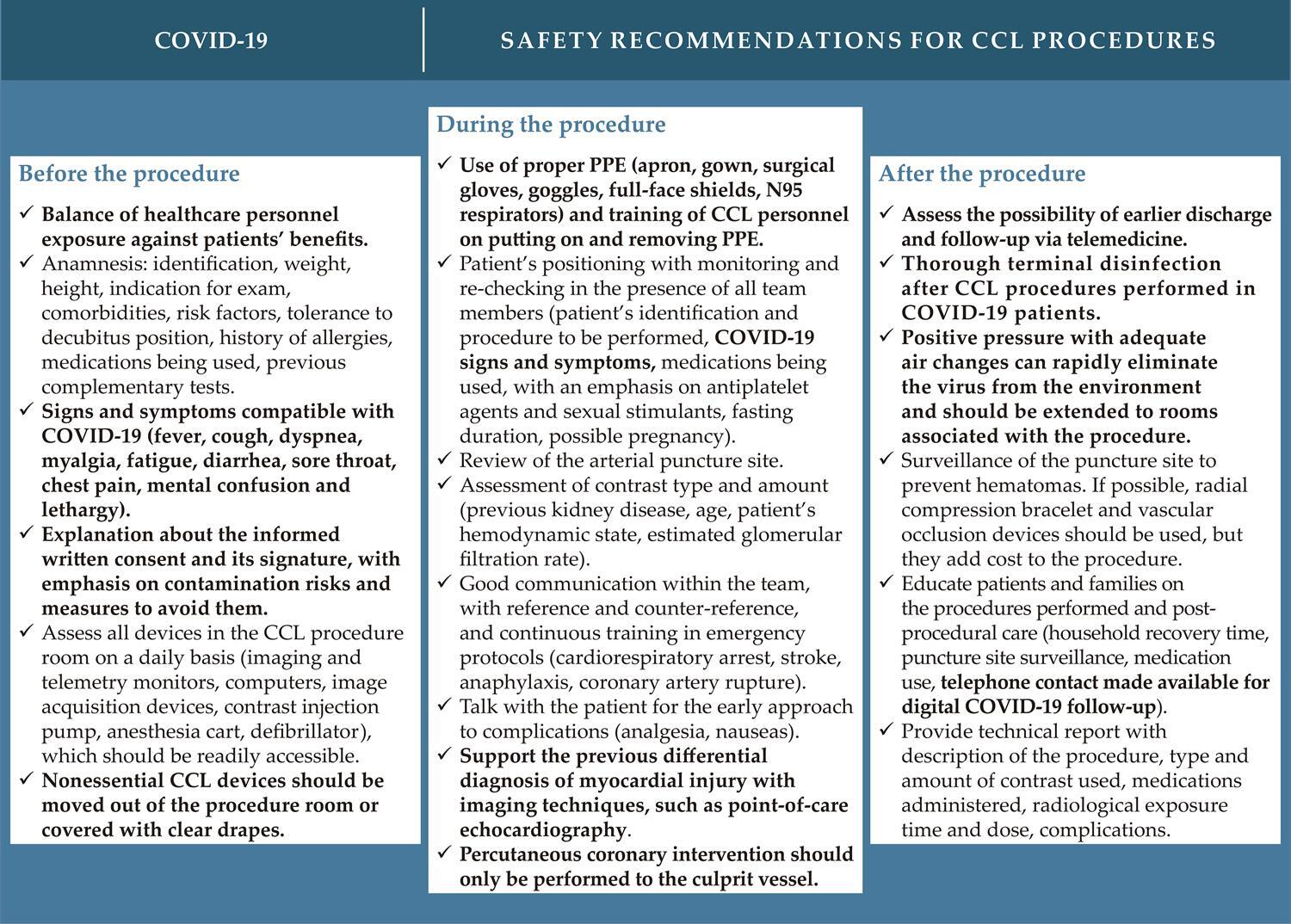
Safety measures in the procedure preparation stage

A study conducted in China with 72,314 patients with COVID-19 (44,672 laboratory-confirmed cases, 16,186 suspected cases, and 10,567 clinically diagnosed cases) has reported fever, cough, dyspnea, myalgia, fatigue and diarrhea as the most common symptoms. Other signs and symptoms have been reported, such as sore throat, chest pain, mental confusion, and lethargy. The authors have highlighted that COVID-19 had a benign course in 80% of the cases, and that many patients, although asymptomatic, could carry the virus. It is worth noting the importance of the differential diagnosis of dyspnea and fatigue, especially when associated with the other symptoms.

During a respiratory pandemic, patients and their families should be informed about the risks of contamination, despite all additional measures taken to minimize them. Because the number of elective procedures will be drastically reduced during that period, the length of hospital stay is predicted to be the minimum necessary for each protocol consensually elaborated. Moreover, defining a procedure as elective requires clinical judgement, because postponing it might have effects that will increase the likelihood of decompensation and adverse events during the pandemic, such as in high-risk patients with unstable angina. Therefore, the decision about performing a procedure should be individualized and based on the patient’s risk and benefit analysis.

[…]

  • Chest Pain
  • Coronavirus
  • Cough
  • COVID-19
  • Diarrhea
  • Dyspnea
  • Fatigue
  • Fever
  • Mental Confusion
  • Myalgia, Cardiovascular Diseases/complications
  • Pandemics
  • Pathological Conditions, Signs and Symptoms
  • Safety
Read Full Article
Creative Commons Attribution (CC BY) Creative Commons license
29/05/2020 DOI: 10.36660/ijcs.20200080 Views 1
IJCS
Editorial

COVID-19: A Matter Close to the Heart

Gláucia Maria Moraes de Oliveira et al. Fausto J. Pinto

The world is facing a new challenge, the novel coronavirus disease 2019 (COVID-19), caused by a betacoronavirus named severe acute respiratory syndrome coronavirus 2 (SARS-CoV-2), phylogenetically identical to the SARS-CoV (severe acute respiratory syndrome coronavirus) and the MERS-CoV (Middle East respiratory syndrome coronavirus) responsible for innumerable deaths in China in 2003 and in the Middle East in 2012, respectively.

On March 11, 2020, the COVID-19 outbreak was characterized as a pandemic by the World Health Organization (WHO). Twenty-three days after that announcement, the cases reported reached 1,056,777 in 182 countries, with 55,781 deaths, most of which occurring in Italy, Spain, France, China and Iran. So far, Brazil has registered 8,195 cases and 335 deaths, while Portugal, 9,886 cases and 246 deaths, figures that have increased steeply since the beginning of the pandemic.

[…]

  • Cardiovascular Diseases/complications
  • Coronavirus-19 (COVID-19
  • Dyspnea
  • Fever
  • Mortality
  • Pandemics
  • Risk Factors
  • Severe Acute Respiratory Syndrome
Read Full Article
Creative Commons Attribution (CC BY) Creative Commons license
17/04/2020 DOI: 10.36660/ijcs.20200057
Figure 1
ABC
Editorial

COVID-19 and the Heart

Tânia Mara Varejão Strabelli et al. David Everson Uip

We have been living with the new coronavirus pandemic since March 11, 2020. Initially, on January 1, 2020, the World Health Organization (WHO) declared the new coronavirus infection a global emergency and proceeded to name the disease COVID-19. The Coronavirus Study Group of the International Committee on Taxonomy of Viruses proposed the adoption of the name SARS-Cov-2. Genomic sequencing and phylogenetic analysis have indicated that it is a betacoronavirus from the same subgenus as the severe acute respiratory syndrome (SARS) that caused an epidemic in China in 2003 and the Middle East respiratory syndrome (MERS) that caused the same condition in the Middle East in 2012. It has 96.2% genetic identity with betaCoV/bat/Yunnan, a virus isolated in bats. The structure of the virus’s cell-binding receptor gene is very similar to that of the SARS coronavirus, and the virus appears to use the same angiotensive-converting enzyme 2 (ACE2) receptor to enter the cell.

The clinical picture of COVID-19 is similar to that of other respiratory viruses, namely, fever, generally dry cough, fatigue, and, in severer cases (5%), dyspnea, pulmonary bleeding, severe lymphopenia, and renal failure. Symptoms are mild in 80% of cases. Diagnosis of symptomatic cases should be confirmed by testing for the virus via polymerase chain reaction (PCR) of a nasal swab.

[…]

  • betaCoV/bat/Yunnan/complications
  • Coronavirus-19/complications
  • Diabetes Mellitus
  • Dyspnea
  • Fever
  • Hypertension
  • Respiration Disorders
  • Risk Factors
  • Severe Acute Respiratory Syndrome
Read Full Article
Creative Commons Attribution (CC BY) Creative Commons license
30/03/2020 DOI: 10.36660/abc.20200209
ABC
Editorial

Coronary Artery Dilation in Children with Febrile Exanthematous Illness without Criteria for Kawasaki Disease -An Enigmatic Disease

Vitor Coimbra Guerra

More than half a century has elapsed since Prof. Tomisaku Kawasaki’s did the first description of a unique disease. He saw the first 4-year-old patient with fever and rash in 1961…. At that time, he described the diagnosis “unknown”. The published paper title was Infantile acute febrile mucocutaneous lymph node syndrome with specific desquamation of the fingers and toes. Clinical observation of 50 cases. From This “unknown diagnosis”, which now we call Kawasaki disease (KD) until the current era, this vasculitis of unknown cause became the leading cause of acquired heart disease among children in United States.

Historically, the presence of coronary abnormalities was not noticed until patients died suddenly of cardiac complications. An angiographic study of 1100 patients showed coronary artery lesions in 24%, with aneurysms in 8% and a number of patients with stenoses and occlusions. As soon as the Coronary arteries became the key structure for risk stratification, treatment and outcome, extensive research and worldwide effort has been done targeting the correct diagnostic. Unfortunately, to make things more challenging, there are forms of “uncomplete KD” which overlaps with other forms of febrile Exanthematous illness in children.

[…]

  • coronary artery
  • Doenças Cardiovasculares/ diagnosis
  • Echocardiography/diagnostic Imaging
  • Exantemous
  • Fever
  • Kawasaki disease
Read Full Article
Creative Commons Attribution (CC BY) Creative Commons license
02/12/2019 DOI: 10.36660/abc.20190730 Views 1
ABC
Original Article

Coronary Artery Dilation in Children with Febrile Exanthematous Illness without Criteria for Kawasaki Disease

Jesus Reyna et al. Luz Marina Reyes Lorenzo Reyes Freya Helena Campos … Patricia Meza Alfredo Lagunas Carla Contreras Ana Elena Limón

Abstract

Background:

Coronary dilatation is the most important complication of Kawasaki disease (KD) and, in addition to some clinical characteristics, is common to KD and febrile exanthematous illnesses (FEIs).

Objective:

To assess whether children with FEI, who do not meet the criteria for KD, have changes in coronary arteries dimensions.

Methods:

Echocardiography was performed within the first two weeks of the disease in patients < 10 years with fever and exanthema without other KD criteria. To make a comparison with KD patients, we reviewed the echocardiograms and medical records of patients with a diagnosis of KD of the last five years. Coronary ectasia was assessed using Z scores of coronary arteries. The means of the dimensions of the coronary arteries were compared with a z test and a level of significance of 0.05 was adopted.

Results:

A total of 34 patients were included, 22 (64.7%) with FEI, and 12(35.2%) with a diagnosis of KD. Using the Z scores of coronary artery, a dilation of any of the coronary artery branches was observed in six (27.2%) patients with FEI.

Conclusions:

An important percentage of patients with FEI has coronary artery dilation.

  • Child
  • Coronary Disease
  • Echocardiography/methods
  • Evanthema
  • Fever
  • Kawasali Disease
  • Mucocutaneous Lymph Node Syndrome
Read Full Article
Creative Commons Attribution (CC BY) Creative Commons license
23/09/2019 DOI: 10.5935/abc.20190191
Figure 1
IJCS
Case Report

Acute Pericarditis in Crohn's Disease under Pharmacological Immunosuppression: A Diagnostic and Therapeutic Dilemma

Maria Trêpa et al. Isabel Neves Marta Salgado Graziela Carvalheiras Vasco Dias

Introduction

Acute pericarditis in young patients usually has a benign course. However, in those with autoimmune diseases it is mandatory to consider the risk of opportunistic infections, and of association with the underlying disease or immunomodulatory drugs. This case report aims to show possible strategies for diagnosis and treatment of this particularly complex group of patients.

[…]

  • Anti-Bacterial Agents
  • Antibiotic Prophylaxis
  • Crohn Disease
  • Fever
  • Pericarditis, Tuberculous
  • Tuberculosis
Read Full Article
Creative Commons Attribution (CC BY) Creative Commons license
15/04/2019 DOI: 10.5935/2359-4802.20190033 Views 1
Figure 1
ABC
Anatomopathological Session

Case 3/2016 – 58 Year-Old Hypertensive Male with End-Stage Renal Disease, Aortic Dissection, Fever and Hemoptysis

Desiderio Favarato et al. Paulo Sampaio Gutierrez

Clinical aspects

The patient had a previous diagnosis of arterial hypertension and chronic renal disease, with renal failure, being on renal replacement therapy via hemodialysis. He had chest pain and dyspnea. His clinical and laboratory assessments revealed coronary artery disease and chronic aortic dissection.

Chronic renal disease significantly progresses as age and cardiovascular disease advance, culminating with renal function worsening. The ARIC Study reports an increase in cardiovascular disease prevalence from 18% to 40% before the age of 65 years, from normal renal function to a glomerular filtration rate drop of 15 mL/min/1.73m2, while, over the age of 65 years, that prevalence increases from 20% to 50%, with progressive renal function worsening.

[…]

  • Aortic Dissection
  • End-stage Renal Failure
  • Fever
  • Hemoptysis
  • systemic hypertension
Read Full Article
Creative Commons Attribution (CC BY) Creative Commons license
01/07/2016 DOI: 10.5935/abc.20160108

How to cite this article

EndNote RIS

Electronic Document Format (Vancouver)

Souza CDF, Leal TC, Santos LG. Circulatory System Diseases in Patients with COVID-19: Description of Clinical and Epidemiological Profile of 197 Deaths. Arquivos Brasileiros de Cardiologia 2020;115(2):281-3.

Electronic Document Format (ABNT)

Souza, Carlos Dornels Freire de; Leal, Thiago Cavalcanti; Santos, Lucas Gomes. Circulatory System Diseases in Patients with COVID-19: Description of Clinical and Epidemiological Profile of 197 Deaths. Arquivos Brasileiros de Cardiologia, v. 115, n. 2, p. 281-283, Aug. 2020.

Electronic Document Format (APA)

Souza, C. D. F. , Leal, T. C., & Santos, L. G. (2020). Circulatory System Diseases in Patients with COVID-19: Description of Clinical and Epidemiological Profile of 197 Deaths. Arquivos Brasileiros de Cardiologia, 115(2), 281-283.

Electronic Document Format (ISO)

Souza, Carlos Dornels Freire de and Leal, Thiago Cavalcanti and Santos, Lucas Gomes. Circulatory System Diseases in Patients with COVID-19: Description of Clinical and Epidemiological Profile of 197 Deaths. Arquivos Brasileiros de Cardiologia [online]. 2020, vol. 115, n. 2, [cited 2026-10-14], pp. 281-283. Available from: <https://journals.cardiol.br/en/article/circulatory-system-diseases-in-patients-with-covid-19-description-of-clinical-and-epidemiological-profile-of-197-deaths/>. ISSN 0066-782X

EndNote RIS

Electronic Document Format (Vancouver)

Pedro SS, Brito FCF, Scaramello CBV. Challenges in Pharmacological Management of Cardiovascular Diseases in Covid-19: do Benefits Outweigh Risks?. International Journal of Cardiovascular Sciences 2020;33(4):404-11.

Electronic Document Format (ABNT)

Pedro, Samuel de Sousa; Brito, Fernanda Carla Ferreira de; Scaramello, Christianne Bretas Vieira. Challenges in Pharmacological Management of Cardiovascular Diseases in Covid-19: do Benefits Outweigh Risks?. International Journal of Cardiovascular Sciences, v. 33, n. 4, p. 404-411, Jul. 2020.

Electronic Document Format (APA)

Pedro, S. S., Brito, F. C. F. , & Scaramello, C. B. V. (2020). Challenges in Pharmacological Management of Cardiovascular Diseases in Covid-19: do Benefits Outweigh Risks?. International Journal of Cardiovascular Sciences, 33(4), 404-411.

Electronic Document Format (ISO)

Pedro, Samuel de Sousa and Brito, Fernanda Carla Ferreira de and Scaramello, Christianne Bretas Vieira. Challenges in Pharmacological Management of Cardiovascular Diseases in Covid-19: do Benefits Outweigh Risks?. International Journal of Cardiovascular Sciences [online]. 2020, vol. 33, n. 4, [cited 2026-10-14], pp. 404-411. Available from: <https://journals.cardiol.br/en/article/challenges-in-pharmacological-management-of-cardiovascular-diseases-in-covid-19-do-benefits-outweigh-risks/>. ISSN 2359-4802

EndNote RIS

Electronic Document Format (Vancouver)

Mariano GZ, Lemke VG, Paiva MSM, Oliveira GMM. Covid-19 and Safety in the Cath Lab: Where We Are and Where We Are Headed. International Journal of Cardiovascular Sciences 2020;33(3):288-94.

Electronic Document Format (ABNT)

Mariano, Giordana Zeferino; Lemke, Viviana Guzzo; Paiva, Maria Sanali Moura; Oliveira, Gláucia Maria Moraes de. Covid-19 and Safety in the Cath Lab: Where We Are and Where We Are Headed. International Journal of Cardiovascular Sciences, v. 33, n. 3, p. 288-294, May. 2020.

Electronic Document Format (APA)

Mariano, G. Z., Lemke, V. G., Paiva, M. S. M., & Oliveira, G. M. M. (2020). Covid-19 and Safety in the Cath Lab: Where We Are and Where We Are Headed. International Journal of Cardiovascular Sciences, 33(3), 288-294.

Electronic Document Format (ISO)

Mariano, Giordana Zeferino and Lemke, Viviana Guzzo and Paiva, Maria Sanali Moura and Oliveira, Gláucia Maria Moraes de. Covid-19 and Safety in the Cath Lab: Where We Are and Where We Are Headed. International Journal of Cardiovascular Sciences [online]. 2020, vol. 33, n. 3, [cited 2026-10-14], pp. 288-294. Available from: <https://journals.cardiol.br/en/article/covid-19-and-safety-in-the-cath-lab-where-we-are-and-where-we-are-headed/>. ISSN 2359-4802

EndNote RIS

Electronic Document Format (Vancouver)

Oliveira GMM, Pinto FJ. COVID-19: A Matter Close to the Heart. International Journal of Cardiovascular Sciences 2020;33(3):199-202.

Electronic Document Format (ABNT)

Oliveira, Gláucia Maria Moraes de; Pinto, Fausto J.. COVID-19: A Matter Close to the Heart. International Journal of Cardiovascular Sciences, v. 33, n. 3, p. 199-202, Apr. 2020.

Electronic Document Format (APA)

Oliveira, G. M. M. , & Pinto, F. J. (2020). COVID-19: A Matter Close to the Heart. International Journal of Cardiovascular Sciences, 33(3), 199-202.

Electronic Document Format (ISO)

Oliveira, Gláucia Maria Moraes de and Pinto, Fausto J.. COVID-19: A Matter Close to the Heart. International Journal of Cardiovascular Sciences [online]. 2020, vol. 33, n. 3, [cited 2026-10-14], pp. 199-202. Available from: <https://journals.cardiol.br/en/article/covid-19-a-matter-close-to-the-heart/>. ISSN 2359-4802

EndNote RIS

Electronic Document Format (Vancouver)

Strabelli TMV, Uip DE. COVID-19 and the Heart. Arquivos Brasileiros de Cardiologia 2020;114(4):598-600.

Electronic Document Format (ABNT)

Strabelli, Tânia Mara Varejão; Uip, David Everson. COVID-19 and the Heart. Arquivos Brasileiros de Cardiologia, v. 114, n. 4, p. 598-600, Mar. 2020.

Electronic Document Format (APA)

Strabelli, T. M. V., & Uip, D. E. (2020). COVID-19 and the Heart. Arquivos Brasileiros de Cardiologia, 114(4), 598-600.

Electronic Document Format (ISO)

Strabelli, Tânia Mara Varejão and Uip, David Everson. COVID-19 and the Heart. Arquivos Brasileiros de Cardiologia [online]. 2020, vol. 114, n. 4, [cited 2026-10-14], pp. 598-600. Available from: <https://journals.cardiol.br/en/article/covid-19-and-the-heart/>. ISSN 0066-782X

EndNote RIS

Electronic Document Format (Vancouver)

Guerra VC. Coronary Artery Dilation in Children with Febrile Exanthematous Illness without Criteria for Kawasaki Disease -An Enigmatic Disease. Arquivos Brasileiros de Cardiologia 2019;113(6):1119-20.

Electronic Document Format (ABNT)

Guerra, Vitor Coimbra. Coronary Artery Dilation in Children with Febrile Exanthematous Illness without Criteria for Kawasaki Disease -An Enigmatic Disease. Arquivos Brasileiros de Cardiologia, v. 113, n. 6, p. 1119-1120, Dec. 2019.

Electronic Document Format (APA)

Guerra, V. C. (2019). Coronary Artery Dilation in Children with Febrile Exanthematous Illness without Criteria for Kawasaki Disease -An Enigmatic Disease. Arquivos Brasileiros de Cardiologia, 113(6), 1119-1120.

Electronic Document Format (ISO)

Guerra, Vitor Coimbra. Coronary Artery Dilation in Children with Febrile Exanthematous Illness without Criteria for Kawasaki Disease -An Enigmatic Disease. Arquivos Brasileiros de Cardiologia [online]. 2019, vol. 113, n. 6, [cited 2026-10-14], pp. 1119-1120. Available from: <https://journals.cardiol.br/en/article/coronary-artery-dilation-in-children-with-febrile-exanthematous-illness-without-criteria-for-kawasaki-disease-an-enigmatic-disease/>. ISSN 0066-782X

EndNote RIS

Electronic Document Format (Vancouver)

Reyna J, Reyes LM, Reyes L, Campos FH, Meza P, Lagunas A, Contreras C, et al. Coronary Artery Dilation in Children with Febrile Exanthematous Illness without Criteria for Kawasaki Disease. Arquivos Brasileiros de Cardiologia 2019;113(6):1114-8.

Electronic Document Format (ABNT)

Reyna, Jesus; Reyes, Luz Marina; Reyes, Lorenzo; Campos, Freya Helena; Meza, Patricia; Lagunas, Alfredo; Contreras, Carla; Limón, Ana Elena. Coronary Artery Dilation in Children with Febrile Exanthematous Illness without Criteria for Kawasaki Disease. Arquivos Brasileiros de Cardiologia, v. 113, n. 6, p. 1114-1118, Sep. 2019.

Electronic Document Format (APA)

Reyna, J., Reyes, L. M., Reyes, L., Campos, F. H., Meza, P., Lagunas, A., Contreras, C., & Limón, A. E. (2019). Coronary Artery Dilation in Children with Febrile Exanthematous Illness without Criteria for Kawasaki Disease. Arquivos Brasileiros de Cardiologia, 113(6), 1114-1118.

Electronic Document Format (ISO)

Reyna, Jesus and Reyes, Luz Marina and Reyes, Lorenzo and Campos, Freya Helena and Meza, Patricia and Lagunas, Alfredo and Contreras, Carla and Limón, Ana Elena. Coronary Artery Dilation in Children with Febrile Exanthematous Illness without Criteria for Kawasaki Disease. Arquivos Brasileiros de Cardiologia [online]. 2019, vol. 113, n. 6, [cited 2026-10-14], pp. 1114-1118. Available from: <https://journals.cardiol.br/en/article/coronary-artery-dilation-in-children-with-febrile-exanthematous-illness-without-criteria-for-kawasaki-disease/>. ISSN 0066-782X

EndNote RIS

Electronic Document Format (Vancouver)

Trêpa M, Neves I, Salgado M, Carvalheiras G, Dias V. Acute Pericarditis in Crohn’s Disease under Pharmacological Immunosuppression: A Diagnostic and Therapeutic Dilemma. International Journal of Cardiovascular Sciences 2019;33(3):295-8.

Electronic Document Format (ABNT)

Trêpa, Maria; Neves, Isabel; Salgado, Marta; Carvalheiras, Graziela; Dias, Vasco. Acute Pericarditis in Crohn’s Disease under Pharmacological Immunosuppression: A Diagnostic and Therapeutic Dilemma. International Journal of Cardiovascular Sciences, v. 33, n. 3, p. 295-298, Apr. 2019.

Electronic Document Format (APA)

Trêpa, M., Neves, I., Salgado, M., Carvalheiras, G., & Dias, V. (2019). Acute Pericarditis in Crohn’s Disease under Pharmacological Immunosuppression: A Diagnostic and Therapeutic Dilemma. International Journal of Cardiovascular Sciences, 33(3), 295-298.

Electronic Document Format (ISO)

Trêpa, Maria and Neves, Isabel and Salgado, Marta and Carvalheiras, Graziela and Dias, Vasco. Acute Pericarditis in Crohn’s Disease under Pharmacological Immunosuppression: A Diagnostic and Therapeutic Dilemma. International Journal of Cardiovascular Sciences [online]. 2019, vol. 33, n. 3, [cited 2026-10-14], pp. 295-298. Available from: <https://journals.cardiol.br/en/article/acute-pericarditis-in-crohns-disease-under-pharmacological-immunosuppression-a-diagnostic-and-therapeutic-dilemma/>. ISSN 2359-4802

EndNote RIS

Electronic Document Format (Vancouver)

Favarato D, Gutierrez PS. Case 3/2016 – 58 Year-Old Hypertensive Male with End-Stage Renal Disease, Aortic Dissection, Fever and Hemoptysis. Arquivos Brasileiros de Cardiologia 2016;107(1):71-6.

Electronic Document Format (ABNT)

Favarato, Desiderio; Gutierrez, Paulo Sampaio. Case 3/2016 – 58 Year-Old Hypertensive Male with End-Stage Renal Disease, Aortic Dissection, Fever and Hemoptysis. Arquivos Brasileiros de Cardiologia, v. 107, n. 1, p. 71-76, Jun. 2016.

Electronic Document Format (APA)

Favarato, D., & Gutierrez, P. S. (2016). Case 3/2016 – 58 Year-Old Hypertensive Male with End-Stage Renal Disease, Aortic Dissection, Fever and Hemoptysis. Arquivos Brasileiros de Cardiologia, 107(1), 71-76.

Electronic Document Format (ISO)

Favarato, Desiderio and Gutierrez, Paulo Sampaio. Case 3/2016 – 58 Year-Old Hypertensive Male with End-Stage Renal Disease, Aortic Dissection, Fever and Hemoptysis. Arquivos Brasileiros de Cardiologia [online]. 2016, vol. 107, n. 1, [cited 2026-10-14], pp. 71-76. Available from: <https://journals.cardiol.br/en/article/case-3-2016-58-year-old-hypertensive-male-with-end-stage-renal-disease-aortic-dissection-fever-and-hemoptysis/>. ISSN 0066-782X

  • About ABC Family
  • Internal Regulation
  • Editorial Board
  • Brazilian Society of Cardiology (SBC)

Issues

SBC Guidelines

  • Videos
  • Podcasts
  • News