ABC Family Arquivos Brasileiros de Cardiologia International Journal of Cardiovascular Sciences ABC Heart Failure & Cardiomyopathy ABC Imagem Cardiovascular
Português English
ABC Family
Português English
  • About
    • About ABC Family
    • Internal Regulation
    • Editorial Board
    • Brazilian Society of Cardiology (SBC)
  • Issues
  • SBC Guidelines
  • Content
    • Videos
    • Podcasts
    • News
  • About
    • About ABC Family
    • Internal Regulation
    • Editorial Board
    • Brazilian Society of Cardiology (SBC)
  • Issues
  • SBC Guidelines
  • Content
    • Videos
    • Podcasts
    • News

ABC Family

  • ABC Family
  • Arquivos Brasileiros de Cardiologia
  • International Journal of Cardiovascular Sciences
  • ABC Heart Failure & Cardiomyopathy
  • ABC Imagem Cardiovascular
Search in

No content found.

Journals
Ordering
Article types
Others

  1. Home
  2. Keyword: femoral artery
Figure 1
IJCS
Original Article

Option for the Radial versus Femoral Access in Coronary Intervention in Acute Coronary Syndromes: A Risk-Treatment Paradox

Yasmin Falcon Lacerda et al. Nicole Cruz de Sá Jessica Gonzalez Suerdieck Letícia Fonseca … Fernanda Lopes Gabriella Sant'Ana Sodré Mateus dos Santos Viana Marcia Maria Noya Rabelo Luis Claudio Lemos Correia

Abstract

Background:

In coronary procedures, although the radial approach protects patients from hemorrhagic complications, it is technically more complex than the femoral approach.

Objectives:

To test the hypothesis that the radial approach is the procedure of choice in ACS patients due to the high risk of bleeding; and to identify independent predictors of the choice for radial access.

Methods:

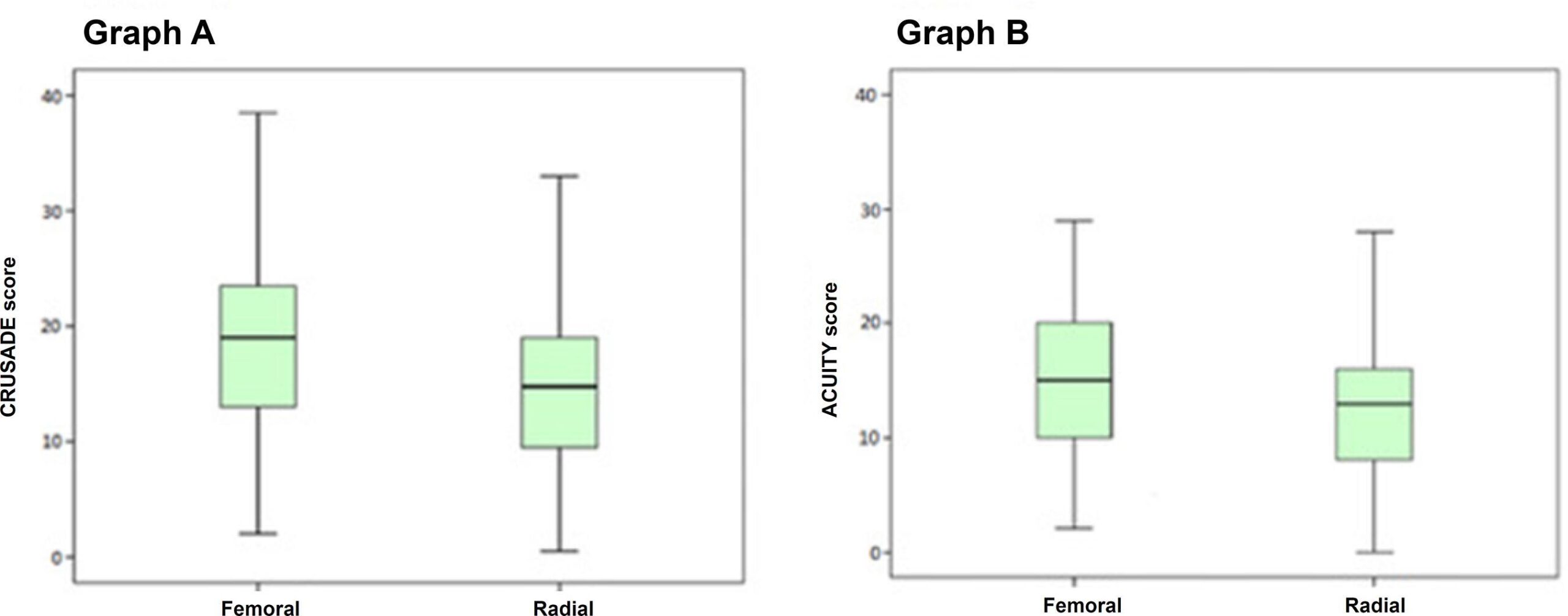
Patients admitted for ACS who underwent invasive coronary procedure were included. We registered the type of access (femoral or radial) chosen by the physician for the first angiography; the investigators did not interfere with this choosing process. Student’s t-test was used for comparisons between the CRUSADE and ACUITY scores. Predictors of radial access were compared between the groups. Statistical significance was defined by p < 0,05.

Results: Radial access was chosen in 67% of 347 consecutive patients. Patients who underwent radial approach had lower risk of bleeding determined by CRUSADE (30 ± 14 vs. 37 ± 15; p < 0.001) as compared with femoral access. In multivariate analysis, four variables were identified as independent predictors negatively associated with radial access – age (OR = 0.98; 95%CI = 0.96 – 0.99), creatinine (OR = 0.54; 95%CI = 0.3 – 0.98), signs of left ventricular failure (OR = 0.45; 95% CI = 0.22 – 0.92) and previous CABG (OR = 0.022; 95%CI = 0.003 – 0.166).

Conclusion:

The propensity to choose radial over femoral access in coronary intervention was not primarily influenced by patients’ bleeding risk. Predictors of this decision, identified in the study, indicated less complex patients, suggesting that the difficulty in performing the technique was a stronger determinant than its potential antihemorrhagic effect. (Int J Cardiovasc Sci. 2018; [online].ahead print, PP.0-0)
  • Angioplasty
  • Catheterism
  • Coronary Artery Disease
  • femoral artery
  • Percutaneous Coronary Intervention
  • Radial Artery
  • Stents
Read Full Article
Creative Commons Attribution (CC BY) Creative Commons license
27/08/2018 DOI: 10.5935/2359-4802.20180066 Views 1
Interaction between serotoninergic-and β-adrenergic receptors signaling pathways in rat femoral artery
ABC
Artigo Original

Interaction between serotoninergic-and β-adrenergic receptors signaling pathways in rat femoral artery

Maria Andréia Delbin et al. Alexandre Sérgio Silva Edson Antunes Angelina Zanesco

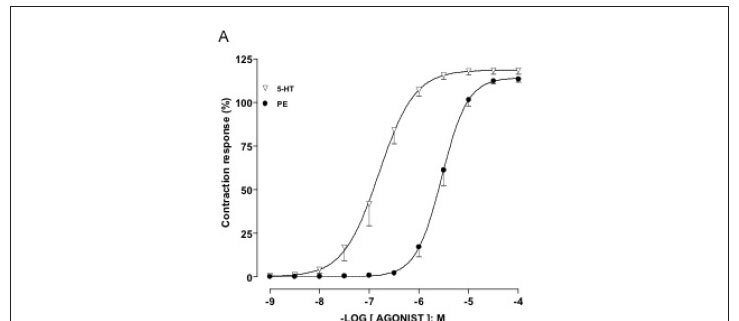
BACKGROUND: Coronary heart disease has been widely studied in cardiovascular research. However, patients with peripheral artery disease (PAD) have worst outcomes compared to those with coronary artery disease. Therefore, pharmacological studies using femoral artery are highly relevant for a better understanding of the pathophysiologic responses of the PAD. OBJECTIVE: The aim of this study was to evaluate the pharmacologic properties of the contractile and relaxing agents in rat femoral artery. METHODS: Concentration response curves to the contractile phenylephrine (PE) and serotonin (5-HT) and the relaxing agents isoproterenol (ISO) and forskolin were obtained in isolated rat femoral artery. For relaxing responses, tissues were precontracted with PE or 5-HT. RESULTS: The order rank potency in femoral artery was 5-HT > PE for contractile responses. In tissues precontracted with 5-HT, relaxing responses to isoproterenol was virtually abolished as compared to PE-contracted tissues. Forskolin, a stimulant of adenylyl cyclase, partially restored the relaxing response to ISO in 5-HT-precontracted tissues. CONCLUSION: An interaction between β-adrenergic- and serotoninergic- receptors signaling pathway occurs in femoral artery. Moreover, this study provides a new model to study serotoninergic signaling pathway under normal and pathological conditions which can help understanding clinical outcomes in the PAD.

  • arteria femoral
  • femoral artery
  • Peripheral Arterial Disease
  • receptors, adrenergic
  • receptors, serotonin
Read Full Article
Creative Commons Attribution (CC BY) Creative Commons license
15/12/2011 DOI: 10.1590/S0066-782X2011005000121
Radial approach in percutaneous coronary interventions: current status in Brazil
ABC
Artigo Original

Radial approach in percutaneous coronary interventions: current status in Brazil

Pedro Beraldo de Andrade et al. Marden André Tebet Mônoca Vieira Athanazio de Andrade André Labrunie Luiz Alberto Piva e Mattos

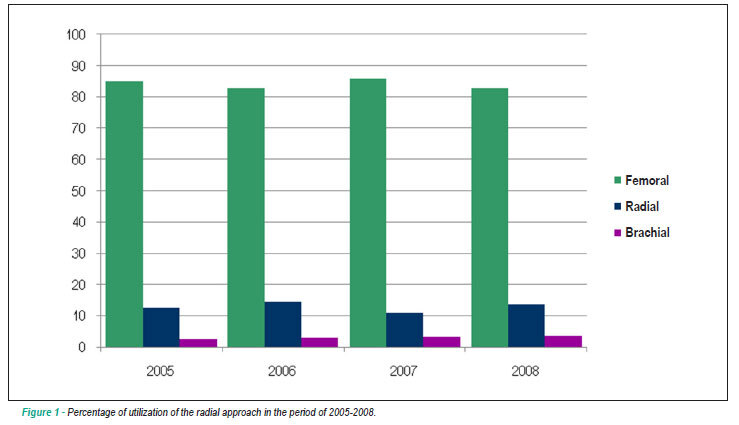
BACKGROUND: Although the radial approach offers an unquestionable result in terms of reduction of vascular complications and occurrence of severe bleeding in comparison to the femoral approach, so far it has only been used in few centers which elected it as the preferential access. OBJECTIVE: To evaluate the current status of percutaneous coronary interventions in Brazil, as regards the use of the radial approach. METHODS: Analysis of data spontaneously recorded in Central Nacional de Intervenções Cardiovasculares – CENIC (National Center for Cardiovascular Interventions) from 2005 to 2008, in a total of 83,376 procedures. RESULTS: The radial approach was used in 12.6% of the procedures performed, and the femoral approach, in 84.3%. The remaining 3.1% corresponded to brachial artery dissection or puncture. With a success rate of 97.5%, the choice of the radial approach was associated with a significant reduction of vascular complications in comparison to the femoral approach (2.5% versus 3.6 %, p < 0.0001). CONCLUSION: The radial approach remains uncommonly used in Brazil, and this is possibly explained by the lack of training programs, uncertainties regarding the learning curve, and the lack of large-scale studies corroborating the benefits demonstrated to date.

  • Angioplasty transluminal percutaneous coronary
  • Brazil
  • femoral artery
  • Medical Records
  • Radial Artery
Read Full Article
Creative Commons Attribution (CC BY) Creative Commons license
04/03/2011 DOI: 10.1590/S0066-782X2011005000026 Views 1

How to cite this article

EndNote RIS

Electronic Document Format (Vancouver)

Lacerda YF, Sá NC, Suerdieck JG, Fonseca L, Lopes F, Sodré GS, Viana MS, et al. Option for the Radial versus Femoral Access in Coronary Intervention in Acute Coronary Syndromes: A Risk-Treatment Paradox. International Journal of Cardiovascular Sciences 2018;31(6):562-8.

Electronic Document Format (ABNT)

Lacerda, Yasmin Falcon; Sá, Nicole Cruz de; Suerdieck, Jessica Gonzalez; Fonseca, Letícia; Lopes, Fernanda; Sodré, Gabriella Sant’Ana; Viana, Mateus dos Santos; Rabelo, Marcia Maria Noya; Correia, Luis Claudio Lemos. Option for the Radial versus Femoral Access in Coronary Intervention in Acute Coronary Syndromes: A Risk-Treatment Paradox. International Journal of Cardiovascular Sciences, v. 31, n. 6, p. 562-568, Aug. 2018.

Electronic Document Format (APA)

Lacerda, Y. F., Sá, N. C. , Suerdieck, J. G., Fonseca, L., Lopes, F., Sodré, G. S., Viana, M. S., Rabelo, M. M. N., & Correia, L. C. L. (2018). Option for the Radial versus Femoral Access in Coronary Intervention in Acute Coronary Syndromes: A Risk-Treatment Paradox. International Journal of Cardiovascular Sciences, 31(6), 562-568.

Electronic Document Format (ISO)

Lacerda, Yasmin Falcon and Sá, Nicole Cruz de and Suerdieck, Jessica Gonzalez and Fonseca, Letícia and Lopes, Fernanda and Sodré, Gabriella Sant’Ana and Viana, Mateus dos Santos and Rabelo, Marcia Maria Noya and Correia, Luis Claudio Lemos. Option for the Radial versus Femoral Access in Coronary Intervention in Acute Coronary Syndromes: A Risk-Treatment Paradox. International Journal of Cardiovascular Sciences [online]. 2018, vol. 31, n. 6, [cited 2026-10-14], pp. 562-568. Available from: <https://journals.cardiol.br/en/article/option-for-the-radial-versus-femoral-access-in-coronary-intervention-in-acute-coronary-syndromes-a-risk-treatment-paradox/>. ISSN 2359-4802

EndNote RIS

Electronic Document Format (Vancouver)

Delbin MA, Silva AS, Antunes E, Zanesco A. Interaction between serotoninergic-and β-adrenergic receptors signaling pathways in rat femoral artery. Arquivos Brasileiros de Cardiologia 2011;98(1):29-34.

Electronic Document Format (ABNT)

Delbin, Maria Andréia; Silva, Alexandre Sérgio; Antunes, Edson; Zanesco, Angelina. Interaction between serotoninergic-and β-adrenergic receptors signaling pathways in rat femoral artery. Arquivos Brasileiros de Cardiologia, v. 98, n. 1, p. 29-34, Dec. 2011.

Electronic Document Format (APA)

Delbin, M. A., Silva, A. S., Antunes, E., & Zanesco, A. (2011). Interaction between serotoninergic-and β-adrenergic receptors signaling pathways in rat femoral artery. Arquivos Brasileiros de Cardiologia, 98(1), 29-34.

Electronic Document Format (ISO)

Delbin, Maria Andréia and Silva, Alexandre Sérgio and Antunes, Edson and Zanesco, Angelina. Interaction between serotoninergic-and β-adrenergic receptors signaling pathways in rat femoral artery. Arquivos Brasileiros de Cardiologia [online]. 2011, vol. 98, n. 1, [cited 2026-10-14], pp. 29-34. Available from: <https://journals.cardiol.br/en/article/interaction-between-serotoninergic-and-%ce%b2-adrenergic-receptors-signaling-pathways-in-rat-femoral-artery/>. ISSN 0066-782X

EndNote RIS

Electronic Document Format (Vancouver)

Andrade PB, Tebet MA, Andrade MVA, Labrunie A, Mattos LAP. Radial approach in percutaneous coronary interventions: current status in Brazil. Arquivos Brasileiros de Cardiologia 2011;96(4):312-6.

Electronic Document Format (ABNT)

Andrade, Pedro Beraldo de; Tebet, Marden André; Andrade, Mônoca Vieira Athanazio de; Labrunie, André; Mattos, Luiz Alberto Piva e. Radial approach in percutaneous coronary interventions: current status in Brazil. Arquivos Brasileiros de Cardiologia, v. 96, n. 4, p. 312-316, Mar. 2011.

Electronic Document Format (APA)

Andrade, P. B. , Tebet, M. A., Andrade, M. V. A. , Labrunie, A., & Mattos, L. A. P. (2011). Radial approach in percutaneous coronary interventions: current status in Brazil. Arquivos Brasileiros de Cardiologia, 96(4), 312-316.

Electronic Document Format (ISO)

Andrade, Pedro Beraldo de and Tebet, Marden André and Andrade, Mônoca Vieira Athanazio de and Labrunie, André and Mattos, Luiz Alberto Piva e. Radial approach in percutaneous coronary interventions: current status in Brazil. Arquivos Brasileiros de Cardiologia [online]. 2011, vol. 96, n. 4, [cited 2026-10-14], pp. 312-316. Available from: <https://journals.cardiol.br/en/article/radial-approach-in-percutaneous-coronary-interventions-current-status-in-brazil/>. ISSN 0066-782X

  • About ABC Family
  • Internal Regulation
  • Editorial Board
  • Brazilian Society of Cardiology (SBC)

Issues

SBC Guidelines

  • Videos
  • Podcasts
  • News