ABC Family Arquivos Brasileiros de Cardiologia International Journal of Cardiovascular Sciences ABC Heart Failure & Cardiomyopathy ABC Imagem Cardiovascular
Português English
ABC Family
Português English
  • About
    • About ABC Family
    • Internal Regulation
    • Editorial Board
    • Brazilian Society of Cardiology (SBC)
  • Issues
  • SBC Guidelines
  • Content
    • Videos
    • Podcasts
    • News
  • About
    • About ABC Family
    • Internal Regulation
    • Editorial Board
    • Brazilian Society of Cardiology (SBC)
  • Issues
  • SBC Guidelines
  • Content
    • Videos
    • Podcasts
    • News

ABC Family

  • ABC Family
  • Arquivos Brasileiros de Cardiologia
  • International Journal of Cardiovascular Sciences
  • ABC Heart Failure & Cardiomyopathy
  • ABC Imagem Cardiovascular
Search in

No content found.

Journals
Ordering
Article types
Others

  1. Home
  2. Keyword: Swimming
ABC
Editorial

Statin Associated With Physical Training: A Perfect Combination

Stephanie Bastos da Motta et al. Vanessa Caroline Toledes Leandro Franzoni

Dyslipidemia and metabolic syndrome have grown exponentially over the recent years, including in children, mainly due to the low quality of food and the high level of a sedentary lifestyle.– These two diseases are important risk factors for the development of cardiovascular diseases. Reduction of low-density lipoprotein (LDL), as well as total cholesterol (TC) and the TC to high-density lipoprotein ratio (HDL – TC/HDL) are the main forms of cardiometabolic prevention. The use of statins is considered a standard treatment and the most effective pharmacological measure to improve the lipid profile. However, there are non-pharmacological alternatives that are also effective, one of which is physical exercise.

There is evidence on the importance of regular physical training as a form of primary or secondary prevention in the development or worsening of cardiometabolic diseases.– However, there is no consensus on the effect of combining statins with physical training, two powerful tools that, combined, can promote an even greater impact on the lipid profile. This is what the Costa et al. did in this edition of Arquivos Brasileiros de Cardiologia — they analyzed the influence of simvastatin on lipid adaptations resulting from aerobic and strength water training in elderly women with dyslipidemia. To this end, 69 female elderly sedentary dyslipidemic non-users and users of simvastatin (20 mg and 40 mg) (66.13±5.13 years) were analyzed.

[…]
  • Dyslipidemias/prevention and control
  • Exercise
  • Hydroxymethylglutaril-CoA-Reductases
  • Metabolic Syndrome X
  • Risk Factors
  • Sports
  • Swimming
Read Full Article
Creative Commons Attribution (CC BY) Creative Commons license
06/09/2021 DOI: 10.36660/abc.20210509 Views 2
Cardiac implications after myocardial infarction in rats previously undergoing physical exercise
ABC
Original Article

Cardiac implications after myocardial infarction in rats previously undergoing physical exercise

Eduardo Carvalho de Arruda Veiga et al. Leslie Andrews Portes Danilo Sales Bocalini Ednei Luiz Antonio … Alexandra Alberta dos Santos Marília Higuchi Santos Flavio André Silva Paulo José Ferreira Tucci

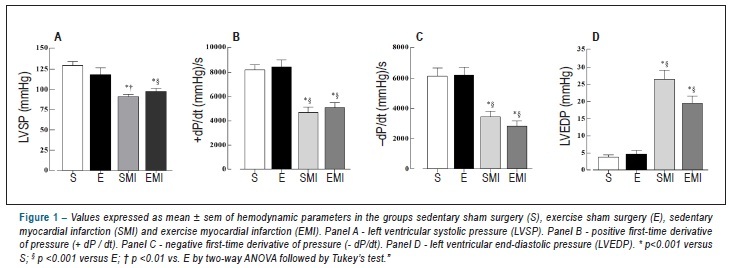
BACKGROUND: Few studies have analyzed the cardiac effects of exercise prior to coronary occlusion. OBJECTIVE: To evaluate the effects of myocardial infarction in rats undergoing physical exercise. METHODS: Female rats underwent swimming exercise or were kept sedentary for eight weeks and were randomized to coronary occlusion or sham surgery, in one of the following four groups: Sedentary (S), exercise (E), Sedentary myocardial infarction (SMI) and Exercise myocardial infarction (EMI). After six weeks, their biometrics, Doppler echocardiography, hemodynamics and myocardial mechanics were analyzed. RESULTS: No cardioprotection was observed in EMI animals and there was no difference in infarct size (%LV) between EMI (38.50 ± 4.60%) and SMI (36.58 ± 4.11%). Water content of the lung (%) of SMI (80 ± 0.59) and EMI (80 ± 0.57) was higher than that of S (78 ± 0.15) and E (78 ± 0.57) groups. Left ventricular systolic pressure (mmHg) (S: 130 ± 5, E: 118 ± 8; SMI: 91 ± 3; EMI: 98 ± 3) and the first positive time derivative (mmHg) positive pressure (S: 8216 ± 385; E: 8437 ± 572; SMI: 4674 ± 455; EMI: 5080 ± 412) of S and E were higher than those of SMI and EMI. The transverse fractional shortening (%) of SMI (27 ± 2) and EMI (25 ± 2) were similar and lower than that of E (65 ± 2) and S (69 ± 2). The E/A ratio was higher in SMI (5.14 ± 0.61) and EMI (4.73 ± 0.57) compared to S (2.96 ± 0.24) and E (2.83 ± 0 21). In studies of isolated papillary muscle, depression of the contractile capacity observed was similar to that of SMI and EMI, and there was no change in myocardial stiffness. CONCLUSION: Previous training by swimming did not attenuate cardiac implications due to myocardial infarction.

  • Animal
  • Myocardial Infarction
  • Physical Conditioning
  • Rats
  • Swimming
Read Full Article
Creative Commons Attribution (CC BY) Creative Commons license
11/12/2012 DOI: 10.1590/S0066-782X2012005000117
Swimming training attenuates contractile dysfunction in diabetic rat cardiomyocytes
ABC
Artigo Original

Swimming training attenuates contractile dysfunction in diabetic rat cardiomyocytes

Márcia Ferreira da Silva et al. Maria do Carmo Gouveia Pelúzio Paulo Roberto dos Santos Amorim Vitor Neiva Lavorato … Natália Pereira do Santos Luiz Henrique Marchesi Bozi Arlete Rita Penitente Daniel Luciano Falkoski Felipe Gomes Berfort Antonio Jose Natali

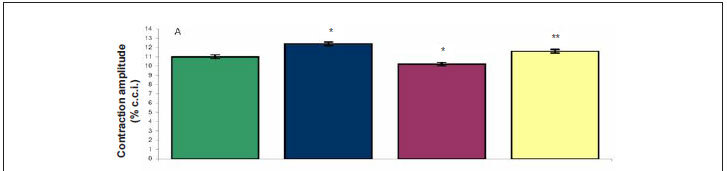
BACKGROUND: Experimental diabetes promotes contractile dysfunction in cardiomyocytes, but the effects of swimming in this disorder are not known. OBJECTIVE: To test the effects of a swimming training program (STP) on cardiomyocyte contractile dysfunction in rats with experimental diabetes. METHODS: Wistar rats (age: 30 days; mean body weight: 84.19 g) with diabetes induced by streptozotocin (60 mg/kg body weight; glucose > 300 mg/dl) were divided into sedentary diabetic rats (SD, n = 10) and exercised diabetic rats (ED, n = 13). Animals of same age and weight served as sedentary controls (SC, n = 10) and exercised controls (EC, n = 06). Animals and ED and EC underwent a STP (05 days/week, 90 min/day) for 08 weeks. Left ventricular (LV) myocytes were isolated and electrically stimulated at 3.0 Hz at room temperature (∼ 25º C). RESULTS: Diabetes reduced contractile function in cardiomyocytes of animals compared to controls (i.e., lower amplitude of contraction, longer duration of contraction and relaxation). The STP attenuated the reduced amplitude of contraction (SC, 11 ± 0.2% vs ED, 11.6 ± 0.2%), time to peak contraction (SC, 319 ± 5.8 ms vs ED, 333 ± 4.8 ms) and time to 50.0% of relaxation (SC, 619 ± 22.2 ms vs ED 698 ± 18.6 ms) of cardiomyocytes of diabetic rats. Diabetes reduced the size of cardiomyocytes, however, the STP minimized the reduction of cell volume and width, without changing length. CONCLUSION: The swimming training program attenuated the contractile dysfunction of the LV myocytes of rats with experimental diabetes.

  • Diabetes Mellitus
  • Myocytes, Cardiac
  • Physical Exertion
  • Rats
  • Swimming
Read Full Article
Creative Commons Attribution (CC BY) Creative Commons license
06/05/2011 DOI: 10.1590/S0066-782X2011005000055 Views 1

How to cite this article

EndNote RIS

Electronic Document Format (Vancouver)

Motta SB, Toledes VC, Franzoni L. Statin Associated With Physical Training: A Perfect Combination. Arquivos Brasileiros de Cardiologia 2021;117(2):279-80.

Electronic Document Format (ABNT)

Motta, Stephanie Bastos da; Toledes, Vanessa Caroline; Franzoni, Leandro. Statin Associated With Physical Training: A Perfect Combination. Arquivos Brasileiros de Cardiologia, v. 117, n. 2, p. 279-280, Sep. 2021.

Electronic Document Format (APA)

Motta, S. B. , Toledes, V. C., & Franzoni, L. (2021). Statin Associated With Physical Training: A Perfect Combination. Arquivos Brasileiros de Cardiologia, 117(2), 279-280.

Electronic Document Format (ISO)

Motta, Stephanie Bastos da and Toledes, Vanessa Caroline and Franzoni, Leandro. Statin Associated With Physical Training: A Perfect Combination. Arquivos Brasileiros de Cardiologia [online]. 2021, vol. 117, n. 2, [cited 2026-10-14], pp. 279-280. Available from: <https://journals.cardiol.br/en/article/statin-associated-with-physical-training-a-perfect-combination/>. ISSN 0066-782X

EndNote RIS

Electronic Document Format (Vancouver)

Veiga ECA, Portes LA, Bocalini DS, Antonio EL, Santos AA, Santos MH, Silva FA, et al. Cardiac implications after myocardial infarction in rats previously undergoing physical exercise. Arquivos Brasileiros de Cardiologia 2012;100(1):37-43.

Electronic Document Format (ABNT)

Veiga, Eduardo Carvalho de Arruda; Portes, Leslie Andrews; Bocalini, Danilo Sales; Antonio, Ednei Luiz; Santos, Alexandra Alberta dos; Santos, Marília Higuchi; Silva, Flavio André; Tucci, Paulo José Ferreira. Cardiac implications after myocardial infarction in rats previously undergoing physical exercise. Arquivos Brasileiros de Cardiologia, v. 100, n. 1, p. 37-43, Dec. 2012.

Electronic Document Format (APA)

Veiga, E. C. A., Portes, L. A., Bocalini, D. S., Antonio, E. L., Santos, A. A. , Santos, M. H., Silva, F. A., & Tucci, P. J. F. (2012). Cardiac implications after myocardial infarction in rats previously undergoing physical exercise. Arquivos Brasileiros de Cardiologia, 100(1), 37-43.

Electronic Document Format (ISO)

Veiga, Eduardo Carvalho de Arruda and Portes, Leslie Andrews and Bocalini, Danilo Sales and Antonio, Ednei Luiz and Santos, Alexandra Alberta dos and Santos, Marília Higuchi and Silva, Flavio André and Tucci, Paulo José Ferreira. Cardiac implications after myocardial infarction in rats previously undergoing physical exercise. Arquivos Brasileiros de Cardiologia [online]. 2012, vol. 100, n. 1, [cited 2026-10-14], pp. 37-43. Available from: <https://journals.cardiol.br/en/article/cardiac-implications-after-myocardial-infarction-in-rats-previously-undergoing-physical-exercise/>. ISSN 0066-782X

EndNote RIS

Electronic Document Format (Vancouver)

Silva MF, Pelúzio MCG, Amorim PRS, Lavorato VN, Santos NP, Bozi LHM, Penitente AR, et al. Swimming training attenuates contractile dysfunction in diabetic rat cardiomyocytes. Arquivos Brasileiros de Cardiologia 2011;97(1):33-9.

Electronic Document Format (ABNT)

Silva, Márcia Ferreira da; Pelúzio, Maria do Carmo Gouveia; Amorim, Paulo Roberto dos Santos; Lavorato, Vitor Neiva; Santos, Natália Pereira do; Bozi, Luiz Henrique Marchesi; Penitente, Arlete Rita; Falkoski, Daniel Luciano; Berfort, Felipe Gomes; Natali, Antonio Jose. Swimming training attenuates contractile dysfunction in diabetic rat cardiomyocytes. Arquivos Brasileiros de Cardiologia, v. 97, n. 1, p. 33-39, May. 2011.

Electronic Document Format (APA)

Silva, M. F. , Pelúzio, M. C. G., Amorim, P. R. S., Lavorato, V. N., Santos, N. P. , Bozi, L. H. M., Penitente, A. R., Falkoski, D. L., Berfort, F. G., & Natali, A. J. (2011). Swimming training attenuates contractile dysfunction in diabetic rat cardiomyocytes. Arquivos Brasileiros de Cardiologia, 97(1), 33-39.

Electronic Document Format (ISO)

Silva, Márcia Ferreira da and Pelúzio, Maria do Carmo Gouveia and Amorim, Paulo Roberto dos Santos and Lavorato, Vitor Neiva and Santos, Natália Pereira do and Bozi, Luiz Henrique Marchesi and Penitente, Arlete Rita and Falkoski, Daniel Luciano and Berfort, Felipe Gomes and Natali, Antonio Jose. Swimming training attenuates contractile dysfunction in diabetic rat cardiomyocytes. Arquivos Brasileiros de Cardiologia [online]. 2011, vol. 97, n. 1, [cited 2026-10-14], pp. 33-39. Available from: <https://journals.cardiol.br/en/article/swimming-training-attenuates-contractile-dysfunction-in-diabetic-rat-cardiomyocytes/>. ISSN 0066-782X

  • About ABC Family
  • Internal Regulation
  • Editorial Board
  • Brazilian Society of Cardiology (SBC)

Issues

SBC Guidelines

  • Videos
  • Podcasts
  • News