ABC Family Arquivos Brasileiros de Cardiologia International Journal of Cardiovascular Sciences ABC Heart Failure & Cardiomyopathy ABC Imagem Cardiovascular
Português English
ABC Family
Português English
  • About
    • About ABC Family
    • Internal Regulation
    • Editorial Board
    • Brazilian Society of Cardiology (SBC)
  • Issues
  • SBC Guidelines
  • Content
    • Videos
    • Podcasts
    • News
  • About
    • About ABC Family
    • Internal Regulation
    • Editorial Board
    • Brazilian Society of Cardiology (SBC)
  • Issues
  • SBC Guidelines
  • Content
    • Videos
    • Podcasts
    • News

ABC Family

  • ABC Family
  • Arquivos Brasileiros de Cardiologia
  • International Journal of Cardiovascular Sciences
  • ABC Heart Failure & Cardiomyopathy
  • ABC Imagem Cardiovascular
Search in

No content found.

Journals
Ordering
Article types
Others

  1. Home
  2. Keyword: Lipoprotein(a)
ABCIC
Editorial

Elevated Lipoprotein(a) in Patients Without Comorbidities: Which Imaging Tests Should be Ordered?

Eduardo Gomes Lima et al. Leticia Neves Solon Carvalho Tatiane Mascarenhas Santiago Emerich Eduardo Ferreira Amorim Fabiana Hanna Rached

The incorporation of lipoprotein(a) [Lp(a)] into contemporary cardiovascular risk assessment has introduced a practical question that is increasingly common in clinical practice: when faced with an elevated result, how should risk be reclassified and what management should be adopted, given that current guidelines recommend measuring Lp(a) at least once in adulthood and recognize it as a risk-modifying factor., However, the cardiovascular risk estimation proposed by these same guidelines — based on prognostic scores such as Predicting Risk of Cardiovascular Disease EVENTs – atherosclerotic cardiovascular disease (PREVENT-ASCVD), developed in 2023 by the American Heart Association — does not, a priori, account for the impact of elevated Lp(a) levels in its calculation. This creates a clinical scenario that is both concrete and challenging: the possibility that an asymptomatic patient, without traditional risk factors, may carry a biologically relevant risk factor that the score simply does not “see.” Thus arises the central question: what should be done when Lp(a) is elevated? In particular, should cardiovascular imaging be used to refine risk stratification?

A reasonable answer to these important questions requires an analysis of the biology and evidence that have propelled Lp(a) to its newly acquired prominence in the field of primary prevention in cardiology. Lp(a) is a particle similar to low-density lipoprotein (LDL), composed by an apolipoprotein B-100 molecule covalently bound to apolipoprotein(a), with levels predominantly determined by the LPA gene and relative stability throughout life., Its association with atherosclerotic cardiovascular disease is supported by epidemiological, genetic, and Mendelian randomization evidence, giving the particle a status stronger than that of a simple associative marker., Data from 450,000 patients demonstrate a strong linear correlation between elevated Lp(a) levels and atherosclerotic disease, with an approximate 11% increase in relative risk for every 50 nmol/L.

[…]
  • Atherosclerosis
  • Lipoprotein(a)
  • Primary Prevention
Read Full Article
Creative Commons Attribution (CC BY) Creative Commons license
31/07/2026 DOI: 10.36660/abcimg.20260053i Views 1
Systemic Inflammation, Fibrinogen, and Lipoprotein(a) as Composite Predictors of Peripheral Arterial Disease
IJCS
Original Article

Systemic Inflammation, Fibrinogen, and Lipoprotein(a) as Composite Predictors of Peripheral Arterial Disease

Alim Namitokov et al. Karina Karabakhtsieva Irina Gilevich

Abstract

Background:

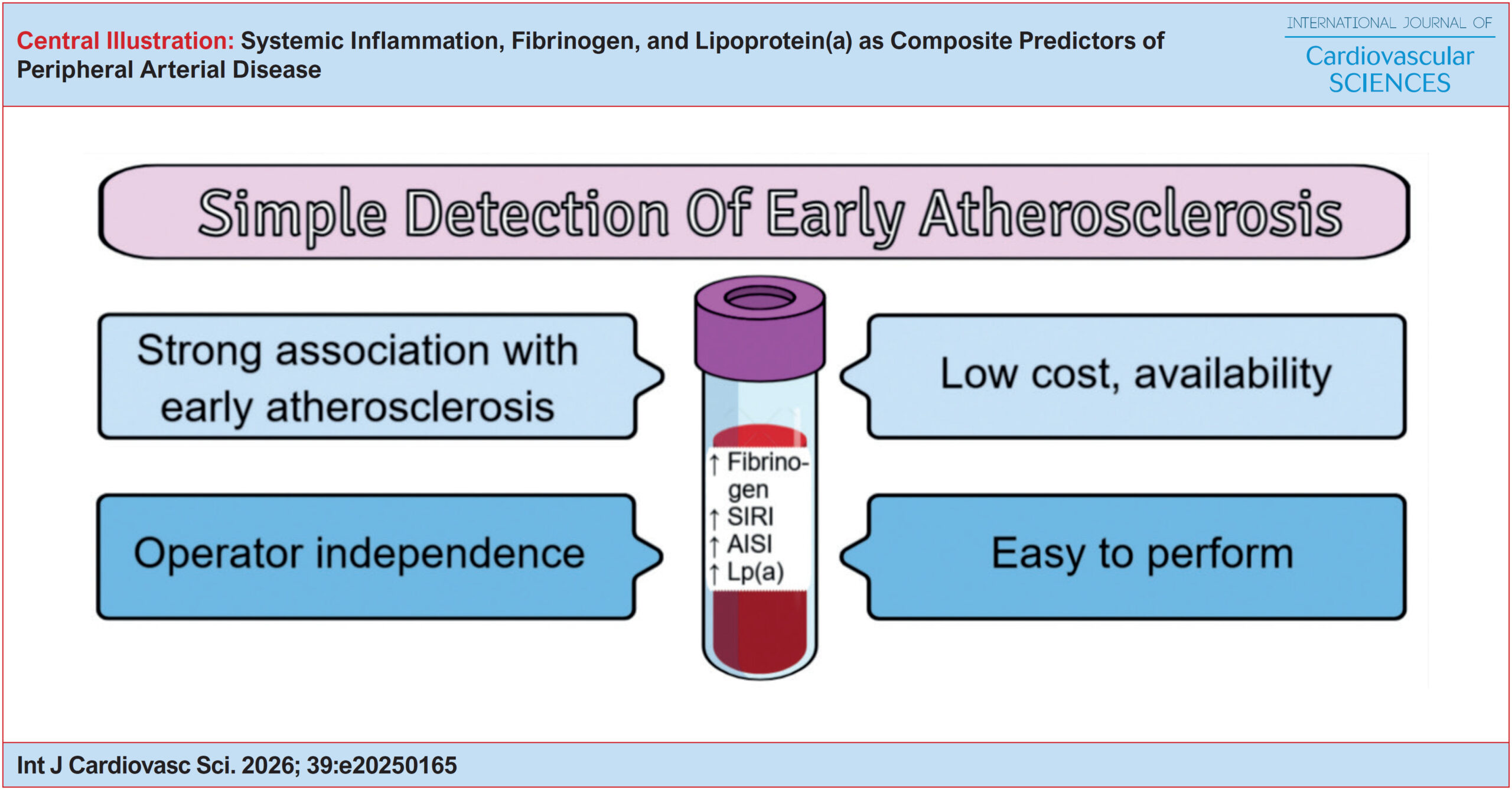
Early detection of peripheral atherosclerosis remains a clinical challenge, especially in asymptomatic individuals. This study aimed to evaluate the predictive value of systemic inflammatory indices and lipid-related biomarkers for early atherosclerosis.

Objectives:

To investigate the diagnostic value of systemic inflammation indices, fibrinogen, and lipoprotein(a) as individual biomarkers and as a combined predictive model for early peripheral arterial disease.

Methods:

A prospective case-control study was conducted in 54 individuals: 20 patients diagnosed with early peripheral atherosclerosis (<55 years) and 34 healthy controls. Laboratory data included complete blood count, lipid profile, fibrinogen, lipoprotein(a), angiopoietin-like protein 3 (ANGPTL3), and Lp-PLA2. Inflammatory indices, including NLR, PLR, SII, SIRI, AISI, and MLR, were calculated. Logistic regression and ROC analysis were performed. A two-sided p-value < 0.05 was considered statistically significant.

Results:

SIRI (1.70 vs. 0.93, p = 0.0039) and AISI (431.6 vs. 236.4, p = 0.0128) were significantly higher in the atherosclerosis group. Fibrinogen showed the most robust association (5.46 vs. 3.71 g/L, p < 0.00001). Lp(a) alone was not statistically different between groups but improved the multivariate model (AUC 0.85 vs. 0.82). The final model, including age, inflammatory indices, LDL, Lp (a), and fibrinogen, achieved an AUC of 0.91.

Conclusion:

Systemic inflammation and fibrinogen levels are strongly associated with early atherosclerosis. Their combination with lipoprotein(a) enhances diagnostic performance, offering a simple, cost-effective strategy for early vascular risk assessment.

  • Atherosclerosis
  • Biomarkers
  • Fibrinogen
  • Inflammation
  • Lipoprotein(a)
  • Peripheral Arterial Disease
Read Full Article
Creative Commons Attribution (CC BY) Creative Commons license
25/05/2026 DOI: 10.36660/ijcs.20250165 Views 2
The Relationship between Basal Serum Lipoprotein(a) Levels and the Pulmonary Artery to Ascending Aorta Ratio in COVID-19 Survivors
IJCS
Original Article

The Relationship between Basal Serum Lipoprotein(a) Levels and the Pulmonary Artery to Ascending Aorta Ratio in COVID-19 Survivors

Uğur Küçük et al. Bahadır Kırılmaz

Abstract

Background:

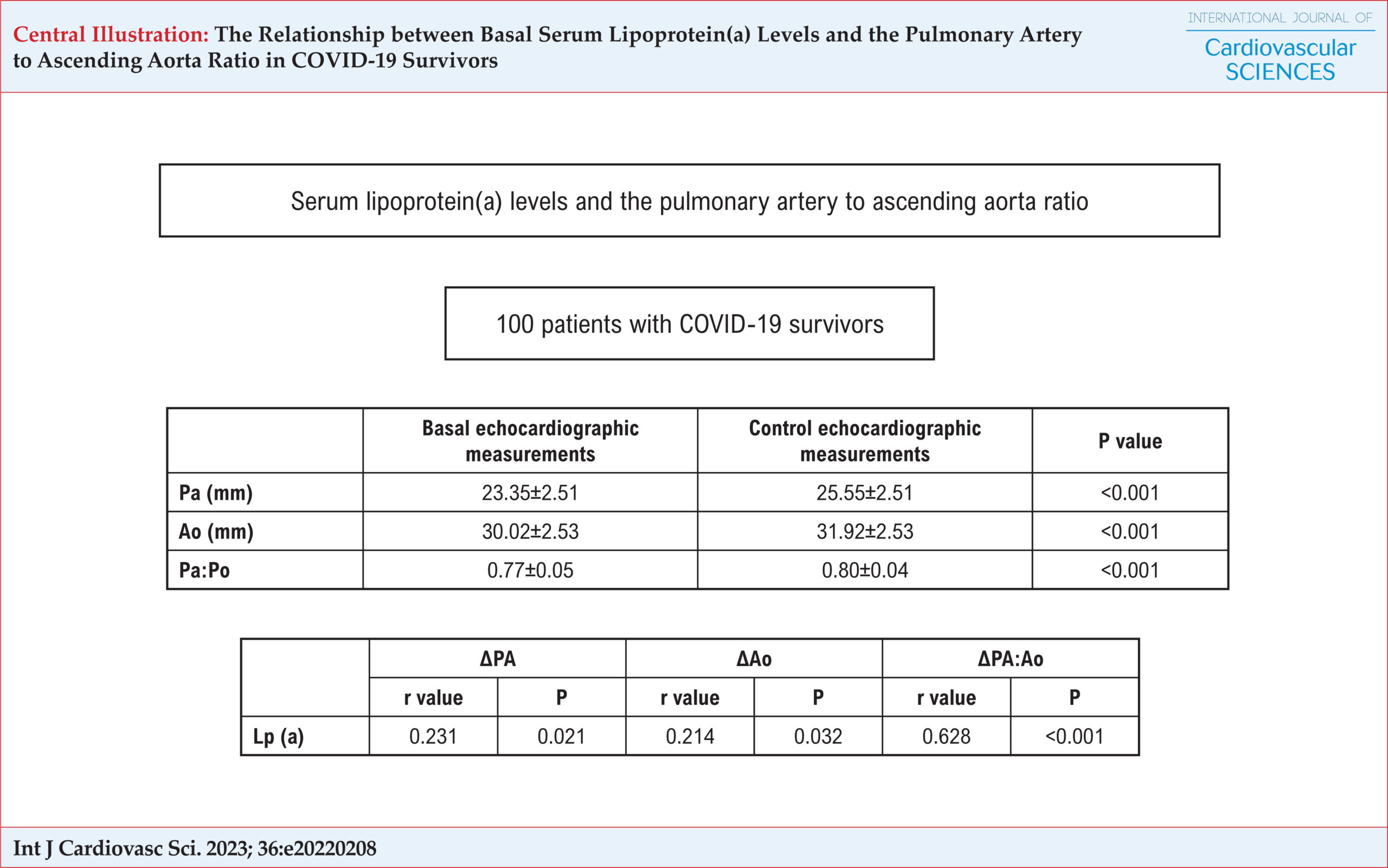
Coronavirus disease (COVID-19) can cause permanent damage to vascular structures by directly or indirectly affecting the cardiopulmonary system. Lipoprotein(a) [Lp(a)] is an important identified risk factor for vascular endothelial cell dysfunction.

Objective:

The aim of this study was to reveal the relationship between Lp(a) levels measured at the time of COVID-19 diagnosis and the pulmonary artery (PA) to the ascending aorta (Ao) ratio (PA:Ao ratio) in survivors evaluated by transthoracic echocardiography (TTE).

Methods:

The study sample consisted of 100 patients who recovered from COVID-19 in the past 3 to 6 months. The relationship between the change in the PA:Ao ratio (ΔPA:Ao) and the Lp(a) levels measured at the time of diagnosis was evaluated. Diameter measurements at baseline and follow-up were evaluated with TTE.

Results:

A significant increase was found in PA, Ao, and epicardial adipose tissue (EAT) thickness in TTE (p< 0.001 for all). There was a weak correlation between D-dimer and high-sensitivity cardiac troponin measured at the time of diagnosis and ΔPA:Ao and ΔEAT in survivors. However, a positive and strong correlation was observed between Lp(a) levels and ΔPa:Ao (r = 0.628, p< 0.001) and ΔEAT (r = 0.633, p< 0.001).

Conclusion:

There may be dysfunction in vascular structures due to COVID-19. For the first time in the literature, a strong correlation was shown between the Lp(a) levels measured at the time of diagnosis and ΔPA:Ao and ΔEAT values in patients with COVID-19.

  • Aorta, Thoracic
  • COVID-19
  • Echocardiography
  • Lipoprotein(a)
  • Pulmonary Artery
Read Full Article
Creative Commons Attribution (CC BY) Creative Commons license
15/09/2023 DOI: 10.36660/ijcs.20220208
IJCS
Editorial

Elevated Lipoprotein(A) in Children and Adolescents: Early Identification is Key for Successful Intervention

Sergio Emanuel Kaiser

Over the last decades, numerous studies have demonstrated that elevated lipoprotein (Lp)(a) is a powerful and independent risk factor for coronary heart disease,, ischemic stroke, and calcific aortic stenosis. Even in patients treated with statins who achieve LDL-cholesterol goals below 70 mg/dL, elevated Lp(a) levels remain independently related to an increased risk of atherosclerotic events.

The LDL particle has a unique molecular structure, as exemplified by its covalent bond with an apolipoprotein(a) that bears resemblance to plasminogen and may well represent an evolutionary deviation of this well-known plasmin precursor. Lp(a) is synthesized by the liver and the amount of circulating particles in the bloodstream is almost exclusively determined by inheritance, leaving very little space for environmental influence. The distribution of Lp(a) levels in the population is highly skewed with approximately 80% of people exhibiting plasma concentrations below 50 mg/dL, and the remaining 20% with a wide range of values above that limit.

[…]

  • Adolescents
  • Aortic Stenosis
  • Atherosclerosis
  • Child
  • Coronary Artery Diseases
  • Lipoprotein(a)
  • Statins/therapeutic, use
Read Full Article
Creative Commons Attribution (CC BY) Creative Commons license
01/02/2021 DOI: 10.36660/ijcs.20200303
Increased serum levels of lipoprotein(a) correlated with the severity of coronary artery disease in patients submitted to angiography
ABC
Artigo Original

Increased serum levels of lipoprotein(a) correlated with the severity of coronary artery disease in patients submitted to angiography

Luciana Moreira Lima et al. Maria das Graças Carvalho Andréia Assis Loures-Vale Ana Paula Fernandes … Ana Paula Lucas Mota Cirilo Pereira da Fonseca Neto José Carlos Faria Garcia Jamil Abdala Saad Marinez de Oliveira Souza

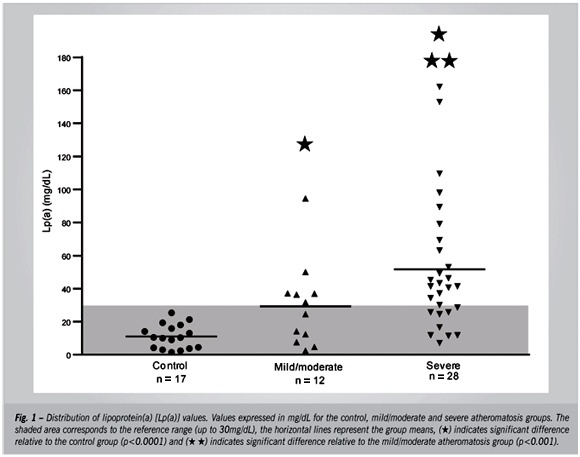
OBJECTIVE: To determine serum levels of lipoprotein(a) and lipid profile of a group of individuals submitted to coronary angiography, with the aim of establishing the possible correlation between these parameters and the severity of coronary artery disease. METHODS: Serum levels of total cholesterol, HDL C, LDL C, triglycerides, lipoprotein(a), apolipoproteins A-I and B were measured in blood samples of 17 subjects with absence of atheromatosis in the coronary arteries (control), 12 subjects presenting mild/moderate atheromatosis and 28 subjects presenting severe atheromatosis. RESULTS: No significant statistical differences were found between the means of the three groups for the parameters assessed, except for lipoprotein(a) serum levels which presented significant differences between the means of the control, mild/moderate atheromatosis and severe atheromatosis groups (p<0.001). CONCLUSION: The means obtained in the three groups for Lp(a) indicate a progressive increase in the serum levels of this parameter according to the severity of coronary atheromatosis. These findings suggest the need of additional studies in order to obtain enough evidence to support the introduction of routine assessment of Lp(a) levels in clinical laboratories in the monitoring of patients at risk for coronary artery disease (CAD).

  • Coronary Angiography
  • Coronary Artery Disease
  • Lipoprotein(a)
Read Full Article
Creative Commons Attribution (CC BY) Creative Commons license
16/10/2006 DOI: 10.1590/S0066-782X2006001600006 Views 2

How to cite this article

EndNote RIS

Electronic Document Format (Vancouver)

Lima EG, Carvalho LNS, Emerich TMS, Amorim EF, Rached FH. Elevated Lipoprotein(a) in Patients Without Comorbidities: Which Imaging Tests Should be Ordered?. ABC Imagem Cardiovascular 2026;39(2):e20260053.

Electronic Document Format (ABNT)

Lima, Eduardo Gomes; Carvalho, Leticia Neves Solon; Emerich, Tatiane Mascarenhas Santiago; Amorim, Eduardo Ferreira; Rached, Fabiana Hanna. Elevated Lipoprotein(a) in Patients Without Comorbidities: Which Imaging Tests Should be Ordered?. ABC Imagem Cardiovascular, v. 39, n. 2, e20260053, Jul. 2026.

Electronic Document Format (APA)

Lima, E. G., Carvalho, L. N. S., Emerich, T. M. S., Amorim, E. F., & Rached, F. H. (2026). Elevated Lipoprotein(a) in Patients Without Comorbidities: Which Imaging Tests Should be Ordered?. ABC Imagem Cardiovascular, 39(2), e20260053.

Electronic Document Format (ISO)

Lima, Eduardo Gomes and Carvalho, Leticia Neves Solon and Emerich, Tatiane Mascarenhas Santiago and Amorim, Eduardo Ferreira and Rached, Fabiana Hanna. Elevated Lipoprotein(a) in Patients Without Comorbidities: Which Imaging Tests Should be Ordered?. ABC Imagem Cardiovascular [online]. 2026, vol. 39, n. 2, [cited 2026-10-14], e20260053. Available from: <https://journals.cardiol.br/en/article/elevated-lipoproteina-in-patients-without-comorbidities-which-imaging-tests-should-be-ordered/>. ISSN 2318-8219

EndNote RIS

Electronic Document Format (Vancouver)

Namitokov A, Karabakhtsieva K, Gilevich I. Systemic Inflammation, Fibrinogen, and Lipoprotein(a) as Composite Predictors of Peripheral Arterial Disease. International Journal of Cardiovascular Sciences 2026;39:e20250165.

Electronic Document Format (ABNT)

Namitokov, Alim; Karabakhtsieva, Karina; Gilevich, Irina. Systemic Inflammation, Fibrinogen, and Lipoprotein(a) as Composite Predictors of Peripheral Arterial Disease. International Journal of Cardiovascular Sciences, v. 39, e20250165, May. 2026.

Electronic Document Format (APA)

Namitokov, A., Karabakhtsieva, K., & Gilevich, I. (2026). Systemic Inflammation, Fibrinogen, and Lipoprotein(a) as Composite Predictors of Peripheral Arterial Disease. International Journal of Cardiovascular Sciences, 39, e20250165.

Electronic Document Format (ISO)

Namitokov, Alim and Karabakhtsieva, Karina and Gilevich, Irina. Systemic Inflammation, Fibrinogen, and Lipoprotein(a) as Composite Predictors of Peripheral Arterial Disease. International Journal of Cardiovascular Sciences [online]. 2026, vol. 39, [cited 2026-10-14], e20250165. Available from: <https://journals.cardiol.br/en/article/systemic-inflammation-fibrinogen-and-lipoproteina-as-composite-predictors-of-peripheral-arterial-disease/>. ISSN 2359-4802

EndNote RIS

Electronic Document Format (Vancouver)

Küçük U, Kırılmaz B. The Relationship between Basal Serum Lipoprotein(a) Levels and the Pulmonary Artery to Ascending Aorta Ratio in COVID-19 Survivors. International Journal of Cardiovascular Sciences 2023;36:e20220208.

Electronic Document Format (ABNT)

Küçük, Uğur; Kırılmaz, Bahadır. The Relationship between Basal Serum Lipoprotein(a) Levels and the Pulmonary Artery to Ascending Aorta Ratio in COVID-19 Survivors. International Journal of Cardiovascular Sciences, v. 36, e20220208, Sep. 2023.

Electronic Document Format (APA)

Küçük, U., & Kırılmaz, B. (2023). The Relationship between Basal Serum Lipoprotein(a) Levels and the Pulmonary Artery to Ascending Aorta Ratio in COVID-19 Survivors. International Journal of Cardiovascular Sciences, 36, e20220208.

Electronic Document Format (ISO)

Küçük, Uğur and Kırılmaz, Bahadır. The Relationship between Basal Serum Lipoprotein(a) Levels and the Pulmonary Artery to Ascending Aorta Ratio in COVID-19 Survivors. International Journal of Cardiovascular Sciences [online]. 2023, vol. 36, [cited 2026-10-14], e20220208. Available from: <https://journals.cardiol.br/en/article/the-relationship-between-basal-serum-lipoproteina-levels-and-the-pulmonary-artery-to-ascending-aorta-ratio-in-covid-19-survivors/>. ISSN 2359-4802

EndNote RIS

Electronic Document Format (Vancouver)

Kaiser SE. Elevated Lipoprotein(A) in Children and Adolescents: Early Identification is Key for Successful Intervention. International Journal of Cardiovascular Sciences 2021;34(1):19-20.

Electronic Document Format (ABNT)

Kaiser, Sergio Emanuel. Elevated Lipoprotein(A) in Children and Adolescents: Early Identification is Key for Successful Intervention. International Journal of Cardiovascular Sciences, v. 34, n. 1, p. 19-20, Jan. 2021.

Electronic Document Format (APA)

Kaiser, S. E. (2021). Elevated Lipoprotein(A) in Children and Adolescents: Early Identification is Key for Successful Intervention. International Journal of Cardiovascular Sciences, 34(1), 19-20.

Electronic Document Format (ISO)

Kaiser, Sergio Emanuel. Elevated Lipoprotein(A) in Children and Adolescents: Early Identification is Key for Successful Intervention. International Journal of Cardiovascular Sciences [online]. 2021, vol. 34, n. 1, [cited 2026-10-14], pp. 19-20. Available from: <https://journals.cardiol.br/en/article/elevated-lipoproteina-in-children-and-adolescents-early-identification-is-key-for-successful-intervention/>. ISSN 2359-4802

EndNote RIS

Electronic Document Format (Vancouver)

Lima LM, Carvalho MG, Loures-Vale AA, Fernandes AP, Mota APL, Fonseca Neto CP, Garcia JCF, et al. Increased serum levels of lipoprotein(a) correlated with the severity of coronary artery disease in patients submitted to angiography. Arquivos Brasileiros de Cardiologia 2006;87(3):260-6.

Electronic Document Format (ABNT)

Lima, Luciana Moreira; Carvalho, Maria das Graças; Loures-Vale, Andréia Assis; Fernandes, Ana Paula; Mota, Ana Paula Lucas; Fonseca Neto, Cirilo Pereira da; Garcia, José Carlos Faria; Saad, Jamil Abdala; Souza, Marinez de Oliveira. Increased serum levels of lipoprotein(a) correlated with the severity of coronary artery disease in patients submitted to angiography. Arquivos Brasileiros de Cardiologia, v. 87, n. 3, p. 260-266, Oct. 2006.

Electronic Document Format (APA)

Lima, L. M., Carvalho, M. G., Loures-Vale, A. A., Fernandes, A. P., Mota, A. P. L., Fonseca Neto, C. P. , Garcia, J. C. F., Saad, J. A., & Souza, M. O. (2006). Increased serum levels of lipoprotein(a) correlated with the severity of coronary artery disease in patients submitted to angiography. Arquivos Brasileiros de Cardiologia, 87(3), 260-266.

Electronic Document Format (ISO)

Lima, Luciana Moreira and Carvalho, Maria das Graças and Loures-Vale, Andréia Assis and Fernandes, Ana Paula and Mota, Ana Paula Lucas and Fonseca Neto, Cirilo Pereira da and Garcia, José Carlos Faria and Saad, Jamil Abdala and Souza, Marinez de Oliveira. Increased serum levels of lipoprotein(a) correlated with the severity of coronary artery disease in patients submitted to angiography. Arquivos Brasileiros de Cardiologia [online]. 2006, vol. 87, n. 3, [cited 2026-10-14], pp. 260-266. Available from: <https://journals.cardiol.br/en/article/increased-serum-levels-of-lipoproteina-correlated-with-the-severity-of-coronary-artery-disease-in-patients-submitted-to-angiography/>. ISSN 0066-782X

  • About ABC Family
  • Internal Regulation
  • Editorial Board
  • Brazilian Society of Cardiology (SBC)

Issues

SBC Guidelines

  • Videos
  • Podcasts
  • News