ABC Family Arquivos Brasileiros de Cardiologia International Journal of Cardiovascular Sciences ABC Heart Failure & Cardiomyopathy ABC Imagem Cardiovascular
Português English
ABC Family
Português English
  • About
    • About ABC Family
    • Internal Regulation
    • Editorial Board
    • Brazilian Society of Cardiology (SBC)
  • Issues
  • SBC Guidelines
  • Content
    • Videos
    • Podcasts
    • News
  • About
    • About ABC Family
    • Internal Regulation
    • Editorial Board
    • Brazilian Society of Cardiology (SBC)
  • Issues
  • SBC Guidelines
  • Content
    • Videos
    • Podcasts
    • News

ABC Family

  • ABC Family
  • Arquivos Brasileiros de Cardiologia
  • International Journal of Cardiovascular Sciences
  • ABC Heart Failure & Cardiomyopathy
  • ABC Imagem Cardiovascular
Search in

No content found.

Journals
Ordering
Article types
Others

  1. Home
  2. Keyword: hormone replacement therapy
ABC
Editorial

Testosterone, SHBG Levels, and Heart Failure Risk: Does the Correlation Imply Causation?

Érique José Farias Peixoto de Miranda

The authors describe a meta-analysis of six observational studies with low risk of bias, which suggests a modest association between low testosterone levels, but not Sex Hormone-Binding Globulin (SHBG), and incidence of heart failure (HF) in men, but not in women. In short, for each reduction of one standard deviation of serum testosterone levels, the hazard ratio of HF increased 10% (HR 1.10, 95% CI: 1.03-1.17).

The polled data show that a total of 233,474 middle-aged participants were followed up for at least 7.7 years; the vast majority of them (90.2%) registered in one single cohort, 3,991 (1.71%) of them had events. In other words, we could observe a small absolute risk increase in comparison to the overall population. Among individuals aged ≥45 years, the incidence of HF is 6.0 per 1,000 person-years, increasing to 21.1 per 1,000 person-years among those aged 65 years or more.

[…]

  • Heart Failure
  • hormone replacement therapy
  • Testosterone
Read Full Article
Creative Commons Attribution (CC BY) Creative Commons license
15/12/2025 DOI: 10.36660/abc.20250593i Views 1
Figure 1
ABC
Original Article

Hormone therapy and Hypertension in Postmenopausal Women: Results from the Brazilian Longitudinal Study of Adult Health (ELSA-Brasil)

Luana Ferreira-Campos et al. Ligia Gabrielli Maria da Conceição Chagas Almeida Estela Maria Leão Aquino … Sheila Maria Alvim Matos Rosane Harter Griep Roque Aras

Abstract

Background

Hypertension is a major risk factor for cardiovascular morbidity and mortality in post-menopausal women. Although menopausal hormone therapy (MHT) is a very effective treatment for vasomotor symptoms during this period, the influence of this therapy on blood pressure is not yet clear.

Objective

To evaluate the relationship between the use of MHT and hypertension in participants of the ELSA-Brasil.

Methods

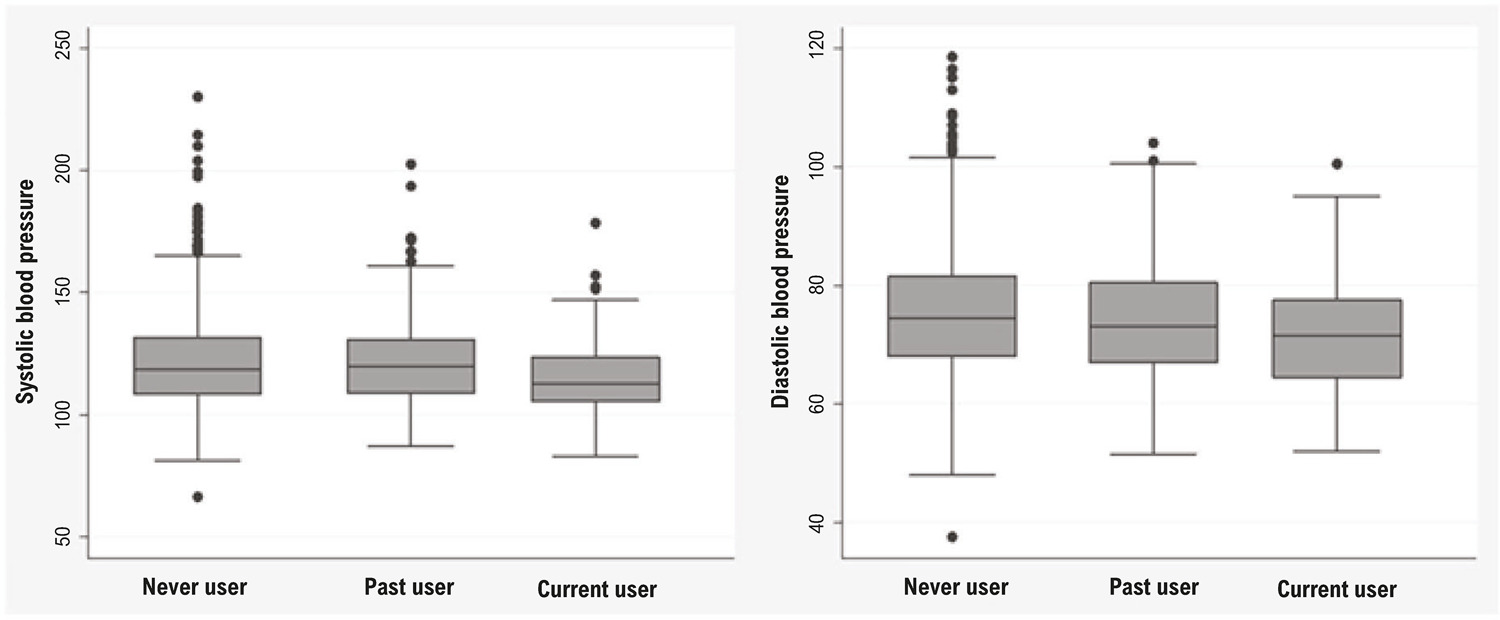
A cross-sectional study using the baseline ELSA-Brasil data in a cohort of 2,138 women who had experienced natural menopause. This study analyzed hypertension, defined as arterial pressure ≥140/90 mmHg or previous antihypertensive use, and use of MHT, with participants being classified into never, past, and current users. Associations were assessed using an adjusted logistic regression model, with statistical significance set at p<0.05.

Results

Overall, 1,492 women (69.8%) had never used MHT, 457 (21.4%) had used it in the past, and 189 (8.8%) were current users. The use of MHT was more common in women who had a body mass index (BMI) <25 kg/m2and triglyceride levels <150 mg/dl, and who were physically less inactive, non-smokers, and non-diabetics. Current MHT users were less likely to have hypertension (OR=0.59; 95% CI: 0.41-0.85) compared to those who had never used MHT. In most cases, MHT was started at or before 59 years of age, within 10 years of becoming menopausal, and its use lasted for up to five years.

Conclusion

Current MHT use was not related to hypertension, particularly in healthy women and in those under 60 years of age.

  • hormone replacement therapy
  • Postmenopause
Read Full Article
Creative Commons Attribution (CC BY) Creative Commons license
13/05/2022 DOI: 10.36660/abc.20210218 Views 3
Figure 1
ABC
Case Report

Dilated Cardiomyopathy Reversibility in Sheehan's Syndrome: A Case Report

Maria Luíza Barbosa Fernandes Dourado et al. Taís Paiva da Costa Márcia Sampaio de Carvalho Carlos Geraldo Guerreiro de Moura

Introduction

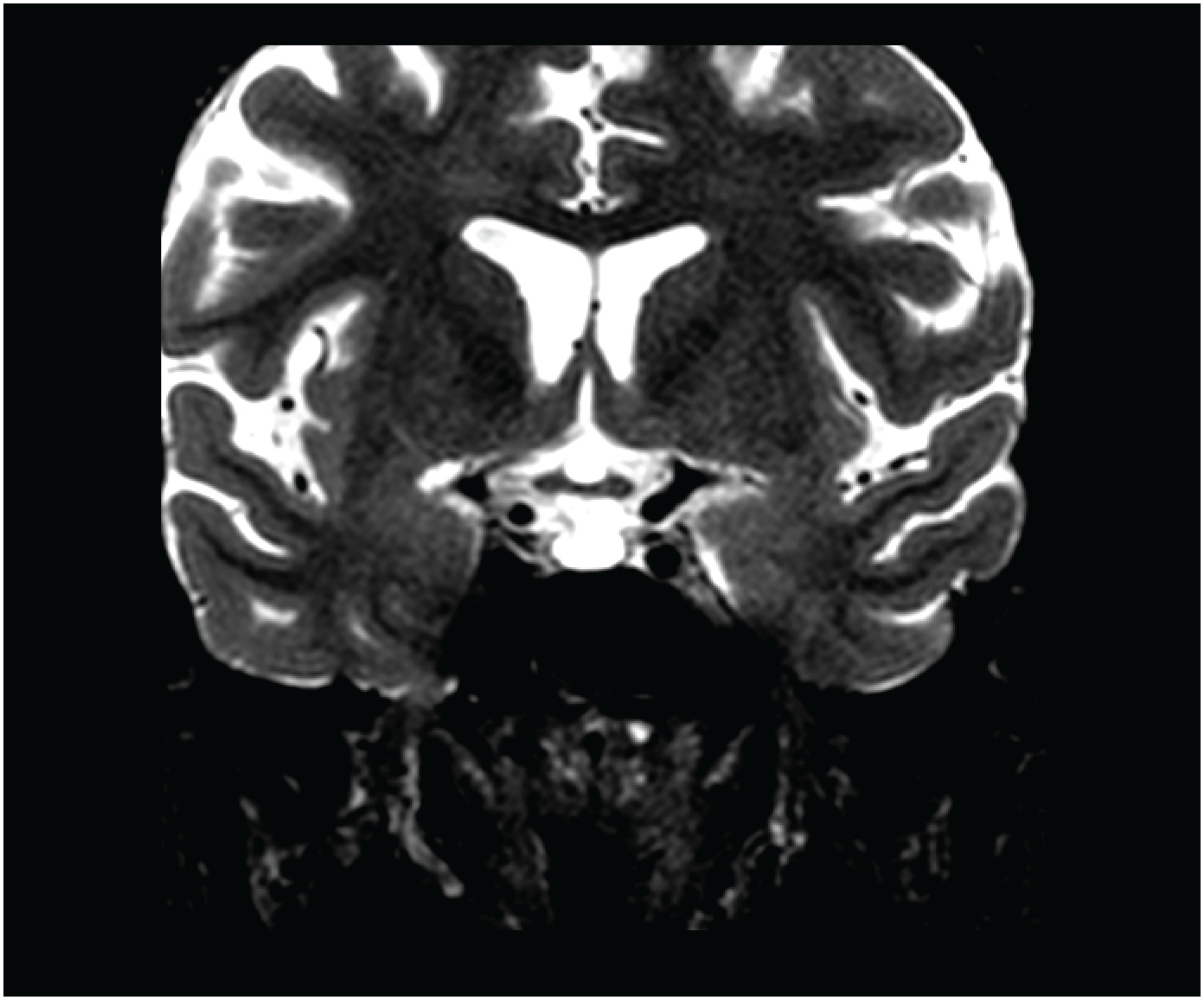
Sheehan’s syndrome, discovered in 1937 by Harold Leeming Sheehan is described as pan-hypopituitarism secondary to pituitary necrosis after post-partum hemorrhage. The clinical condition presentation depends on the hormonal shortfall presented, and may involve changes in serum cortisol levels, thyroid function, growth hormones, breastfeeding and sex hormones. Although poorly described in the literature, there are reports of dilated cardiomyopathy associated with Sheehan’s syndrome, some with reversibility of cardiopathy after hormone replacement therapy. This paper reports a clinical case of Sheehan’s syndrome associated to dilated cardiomyopathy that displayed cardiac function improvement after hormone replacement therapy.

[…]

  • Cardiomyopathy, Dilated
  • Diagnostic Imaging
  • hormone replacement therapy
  • Hypopituitaris
  • Sheehan's Syndrome
Read Full Article
Creative Commons Attribution (CC BY) Creative Commons license
05/02/2021 DOI: 10.36660/abc.20190547 Views 1
ABC
Editorial

Hormone Therapy to Treat Cardiac Remodeling: Is There Any Evidence?

Luís Alexandre F. Cicchetto et al. Bertha F. Polegato Leonardo A. M. Zornoff

Cardiac remodeling can be defined as a set of molecular, cellular and interstitial cardiac variations, which manifest clinically as changes in heart size, mass, geometry and function in response to certain aggressions. That process has bad prognosis, because it is associated with ventricular dysfunction progression and malignant arrhythmias. Different therapeutic strategies have been assessed to prevent, or at least attenuate, cardiac remodeling., Some treatments, such as those using angiotensin-convert-enzyme inhibitors, angiotensin II receptor blockers, beta-blockers, and aldosterone antagonists, have been well established. Other treatments, despite their pathophysiological potential, are still being studied. Of those, hormone therapy stands out, particularly with testosterone, thyroid hormone, and growth hormone (GH).

Testosterone has received great attention in recent years. From the pathophysiological viewpoint, in the presence of ventricular dysfunction, testosterone can modulate the cardiac remodeling process, strengthen skeletal musculature, enhance exercise capacity and reduce inflammatory activity., It is worth noting that a significant number of patients with heart failure have reduced testosterone levels. In addition, low testosterone levels in patients with heart failure are an independent risk factor for hospital readmission within 90 days and for mortality. Thus, testosterone supplementation seems an attractive strategy to manage heart failure.

[…]

  • Heart Failure
  • hormone replacement therapy
  • Testosterone
  • Thyroid Hormones
  • Ventricular Remodeling
Read Full Article
Creative Commons Attribution (CC BY) Creative Commons license
01/07/2016 DOI: 10.5935/abc.20160106
ABC
Letter to the Editor

Hormone replacement therapy: is it recommended by SBC guidelines or not?

Flávio Danni Fuchs

LETTER TO THE EDITOR

[…]

  • Guidelines
  • hormone replacement therapy
Read Full Article
Creative Commons Attribution (CC BY) Creative Commons license
13/04/2011 DOI: 10.1590/S0066-782X2010001500019 Views 2
ABC
Point of view

Prevention of cardiovascular diseases in perimenopausal women and the influence of hormone replacement therapy: an evidence-based guideline

Otavio C. E. Gebara et al. Cesar Fernandes Marcelo C. Bertolami

POINT OF VIEW

Prevention of cardiovascular diseases in perimenopausal women and the influence of hormone replacement therapy: an evidence-based guideline

[…]

  • Cardiovascular disease
  • climateric
  • Climaterio
  • Directriz
  • Enfermedades Cardiovasculares
  • Evidence-Based Medicine
  • guideline
  • hormone replacement therapy
  • Medicina Basada en Evidencias
  • Terapia de Reposición Hormonal
Read Full Article
Creative Commons Attribution (CC BY) Creative Commons license
11/01/2010 DOI: 10.1590/S0066-782X2009001100026 Views 1
Acute effects of the use of estrogens in association with progestogens on postprandial triglyceridemia and vascular reactivity
ABC
Artigo Original

Acute effects of the use of estrogens in association with progestogens on postprandial triglyceridemia and vascular reactivity

Silvio C.M. Santos et al. Jaime Augusto Canashiro Otavio C.E. Gebara José Mendes Aldrighi … Nubia Vieira Amit Nussbacher Humberto Pierri João Serro-Azul Maurício Wajngarten Giuseppe Rosano Jose A. F. Ramires

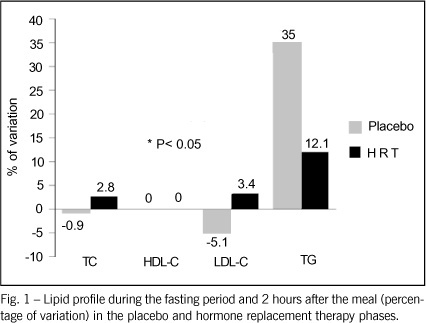
OBJECTIVE: To assess whether hormone replacement therapy with estrogens in association with progestogens in postmenopausal hypertensive women alters postprandial triglyceridemia and vascular reactivity. METHODS: A double-blind, placebo-controlled, crossover study was carried out with 15 postmenopausal women (age range: 50 to 70 years, mean = 61.6 ± 6 years) randomly assigned to 2 weeks of placebo or oral ingestion of 0.625 mg of equine conjugated estrogens and 2.5 mg of medroxyprogesterone, fed a high-fat diet (897 calories; 50.1% fat). Vascular reactivity (VR – % of vessel diameter variation in the fasting period and 2 hours after meals) was measured by using the automated ultrasound method. Lipid profile and glycemia during the fasting period and 2 hours after a high-fat meal were measured. RESULTS: With placebo, vascular reactivity (VR) decreased from 3.20 ± 17% during the fasting period to -2.1 ± 30% 2 hours after the meal (P=0.041). With the hormone replacement therapy, vascular reactivity decreased from 6.14 ± 27% during the fasting period to – 0.05 ± 18% 2 hours after the meal (P=NS). Postprandial triglyceridemia increased as follows: 35 ± 25% with placebo; and 12 ± 10% with hormone replacement therapy (P < 0.05). CONCLUSION: In postmenopausal hypertensive women, 2 weeks of hormone replacement with an association of estrogens and progestogens decreased hypertriglyceridemia after a high-fat meal, an effect that may reduce the endothelial dysfunction occurring in the postprandial period.

  • hormone replacement therapy
  • triglyceridemia
  • vascular endothelium
Read Full Article
Creative Commons Attribution (CC BY) Creative Commons license
11/11/2004 DOI: 10.1590/S0066-782X2004001700005 Views 1
Changes in the profile of lipoprotein subfractions associated with hormone replacement therapy
ABC
Original Article

Changes in the profile of lipoprotein subfractions associated with hormone replacement therapy

José Luiz da Costa Vieira et al. Marcos Emanuel W. Gomes Áurea Beltrão de Almeida Emílio H. Moriguchi

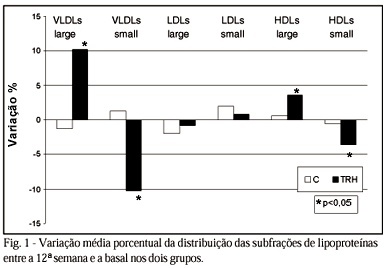
OBJECTIVE: To report the effects of 2 regimens of hormone replacement therapy during the postmenopausal period on the profile of the major lipoprotein subfractions (HDL, LDL, and VLDL). METHODS: We carried out a cohort study in 38 postmenopausal patients who were starting their hormone replacement therapy due to gynecological indications, for a period of 12 weeks. Analysis of lipoprotein subclasses was performed through nuclear magnetic resonance spectroscopy. RESULTS: Hormone replacement therapy cause an increase in the proportion of larger subfractions of VLDL and HDL (p=0.008 and 0.03, respectively) and in the proportion of larger particles of VLDL due to a 36% increase in the levels of larger particles (p=0.004), concomitantly with a 15% reduction in the levels of smaller particles (p=0.04). In regard to HDL, the increase occurred only a 17% increase in the levels of larger particles (p=0.002). No significant change occurred in the distribution pattern of LDL subfractions. CONCLUSION: The proportion of larger subfractions of VLDL and HDL increases after hormone replacement therapy. The increase in the proportion of larger particles of VLDL occurs due to an increase in the levels of the larger subclasses concomitantly with a reduction in the smaller particles. However, an increase in the proportion of larger particles of HDL occurs only due to an increase in the levels of the larger subfractions.

  • coronary heart disease
  • hormone replacement therapy
  • Lipoproteins
Read Full Article
Creative Commons Attribution (CC BY) Creative Commons license
08/01/2002 DOI: 10.1590/S0066-782X2001000300001 Views 1

How to cite this article

EndNote RIS

Electronic Document Format (Vancouver)

Miranda JFP. Testosterone, SHBG Levels, and Heart Failure Risk: Does the Correlation Imply Causation?. Arquivos Brasileiros de Cardiologia 2025;122(10):e20250593.

Electronic Document Format (ABNT)

Miranda, Érique José Farias Peixoto de. Testosterone, SHBG Levels, and Heart Failure Risk: Does the Correlation Imply Causation?. Arquivos Brasileiros de Cardiologia, v. 122, n. 10, e20250593, Dec. 2025.

Electronic Document Format (APA)

Miranda, J. F. P. (2025). Testosterone, SHBG Levels, and Heart Failure Risk: Does the Correlation Imply Causation?. Arquivos Brasileiros de Cardiologia, 122(10), e20250593.

Electronic Document Format (ISO)

Miranda, Érique José Farias Peixoto de. Testosterone, SHBG Levels, and Heart Failure Risk: Does the Correlation Imply Causation?. Arquivos Brasileiros de Cardiologia [online]. 2025, vol. 122, n. 10, [cited 2026-10-14], e20250593. Available from: <https://journals.cardiol.br/en/article/testosterone-shbg-levels-and-heart-failure-risk-does-the-correlation-imply-causation/>. ISSN 0066-782X

EndNote RIS

Electronic Document Format (Vancouver)

Ferreira-Campos L, Gabrielli L, Almeida MCC, Aquino EML, Matos SMA, Griep RH, Aras R, et al. Hormone therapy and Hypertension in Postmenopausal Women: Results from the Brazilian Longitudinal Study of Adult Health (ELSA-Brasil). Arquivos Brasileiros de Cardiologia 2022;118(5):905-13.

Electronic Document Format (ABNT)

Ferreira-Campos, Luana; Gabrielli, Ligia; Almeida, Maria da Conceição Chagas; Aquino, Estela Maria Leão; Matos, Sheila Maria Alvim; Griep, Rosane Harter; Aras, Roque. Hormone therapy and Hypertension in Postmenopausal Women: Results from the Brazilian Longitudinal Study of Adult Health (ELSA-Brasil). Arquivos Brasileiros de Cardiologia, v. 118, n. 5, p. 905-913, May. 2022.

Electronic Document Format (APA)

Ferreira-Campos, L., Gabrielli, L., Almeida, M. C. C., Aquino, E. M. L., Matos, S. M. A., Griep, R. H., & Aras, R. (2022). Hormone therapy and Hypertension in Postmenopausal Women: Results from the Brazilian Longitudinal Study of Adult Health (ELSA-Brasil). Arquivos Brasileiros de Cardiologia, 118(5), 905-913.

Electronic Document Format (ISO)

Ferreira-Campos, Luana and Gabrielli, Ligia and Almeida, Maria da Conceição Chagas and Aquino, Estela Maria Leão and Matos, Sheila Maria Alvim and Griep, Rosane Harter and Aras, Roque. Hormone therapy and Hypertension in Postmenopausal Women: Results from the Brazilian Longitudinal Study of Adult Health (ELSA-Brasil). Arquivos Brasileiros de Cardiologia [online]. 2022, vol. 118, n. 5, [cited 2026-10-14], pp. 905-913. Available from: <https://journals.cardiol.br/en/article/hormone-therapy-and-hypertension-in-postmenopausal-women-results-from-the-brazilian-longitudinal-study-of-adult-health-elsa-brasil/>. ISSN 0066-782X

EndNote RIS

Electronic Document Format (Vancouver)

Dourado MLBF, Costa TP, Carvalho MS, Moura CGG. Dilated Cardiomyopathy Reversibility in Sheehan’s Syndrome: A Case Report. Arquivos Brasileiros de Cardiologia 2021;116(2 suppl 1):17-20.

Electronic Document Format (ABNT)

Dourado, Maria Luíza Barbosa Fernandes; Costa, Taís Paiva da; Carvalho, Márcia Sampaio de; Moura, Carlos Geraldo Guerreiro de. Dilated Cardiomyopathy Reversibility in Sheehan’s Syndrome: A Case Report. Arquivos Brasileiros de Cardiologia, v. 116, n. 2 suppl 1, p. 17-20, Feb. 2021.

Electronic Document Format (APA)

Dourado, M. L. B. F., Costa, T. P. , Carvalho, M. S. , & Moura, C. G. G. (2021). Dilated Cardiomyopathy Reversibility in Sheehan’s Syndrome: A Case Report. Arquivos Brasileiros de Cardiologia, 116(2 suppl 1), 17-20.

Electronic Document Format (ISO)

Dourado, Maria Luíza Barbosa Fernandes and Costa, Taís Paiva da and Carvalho, Márcia Sampaio de and Moura, Carlos Geraldo Guerreiro de. Dilated Cardiomyopathy Reversibility in Sheehan’s Syndrome: A Case Report. Arquivos Brasileiros de Cardiologia [online]. 2021, vol. 116, n. 2 suppl 1, [cited 2026-10-14], pp. 17-20. Available from: <https://journals.cardiol.br/en/article/dilated-cardiomyopathy-reversibility-in-sheehans-syndrome-a-case-report/>. ISSN 0066-782X

EndNote RIS

Electronic Document Format (Vancouver)

Cicchetto LAF, Polegato BF, Zornoff LAM. Hormone Therapy to Treat Cardiac Remodeling: Is There Any Evidence?. Arquivos Brasileiros de Cardiologia 2016;107(1):2-3.

Electronic Document Format (ABNT)

Cicchetto, Luís Alexandre F.; Polegato, Bertha F.; Zornoff, Leonardo A. M.. Hormone Therapy to Treat Cardiac Remodeling: Is There Any Evidence?. Arquivos Brasileiros de Cardiologia, v. 107, n. 1, p. 2-3, Jun. 2016.

Electronic Document Format (APA)

Cicchetto, L. A. F., Polegato, B. F., & Zornoff, L. A. M. (2016). Hormone Therapy to Treat Cardiac Remodeling: Is There Any Evidence?. Arquivos Brasileiros de Cardiologia, 107(1), 2-3.

Electronic Document Format (ISO)

Cicchetto, Luís Alexandre F. and Polegato, Bertha F. and Zornoff, Leonardo A. M.. Hormone Therapy to Treat Cardiac Remodeling: Is There Any Evidence?. Arquivos Brasileiros de Cardiologia [online]. 2016, vol. 107, n. 1, [cited 2026-10-14], pp. 2-3. Available from: <https://journals.cardiol.br/en/article/hormone-therapy-to-treat-cardiac-remodeling-is-there-any-evidence/>. ISSN 0066-782X

EndNote RIS

Electronic Document Format (Vancouver)

Fuchs FD. Hormone replacement therapy: is it recommended by SBC guidelines or not?. Arquivos Brasileiros de Cardiologia 2011;95(5):674.

Electronic Document Format (ABNT)

Fuchs, Flávio Danni. Hormone replacement therapy: is it recommended by SBC guidelines or not?. Arquivos Brasileiros de Cardiologia, v. 95, n. 5, p. 674-674, Apr. 2011.

Electronic Document Format (APA)

Fuchs, F. D. (2011). Hormone replacement therapy: is it recommended by SBC guidelines or not?. Arquivos Brasileiros de Cardiologia, 95(5), 674-674.

Electronic Document Format (ISO)

Fuchs, Flávio Danni. Hormone replacement therapy: is it recommended by SBC guidelines or not?. Arquivos Brasileiros de Cardiologia [online]. 2011, vol. 95, n. 5, [cited 2026-10-14], pp. 674-674. Available from: <https://journals.cardiol.br/en/article/hormone-replacement-therapy-is-it-recommended-by-sbc-guidelines-or-not/>. ISSN 0066-782X

EndNote RIS

Electronic Document Format (Vancouver)

Gebara OCE, Fernandes C, Bertolami MC. Prevention of cardiovascular diseases in perimenopausal women and the influence of hormone replacement therapy: an evidence-based guideline. Arquivos Brasileiros de Cardiologia 2010;93(5):e86-8.

Electronic Document Format (ABNT)

Gebara, Otavio C. E.; Fernandes, Cesar; Bertolami, Marcelo C.. Prevention of cardiovascular diseases in perimenopausal women and the influence of hormone replacement therapy: an evidence-based guideline. Arquivos Brasileiros de Cardiologia, v. 93, n. 5, p. e86-e88, Jan. 2010.

Electronic Document Format (APA)

Gebara, O. C. E., Fernandes, C., & Bertolami, M. C. (2010). Prevention of cardiovascular diseases in perimenopausal women and the influence of hormone replacement therapy: an evidence-based guideline. Arquivos Brasileiros de Cardiologia, 93(5), e86-e88.

Electronic Document Format (ISO)

Gebara, Otavio C. E. and Fernandes, Cesar and Bertolami, Marcelo C.. Prevention of cardiovascular diseases in perimenopausal women and the influence of hormone replacement therapy: an evidence-based guideline. Arquivos Brasileiros de Cardiologia [online]. 2010, vol. 93, n. 5, [cited 2026-10-14], pp. e86-e88. Available from: <https://journals.cardiol.br/en/article/prevention-of-cardiovascular-diseases-in-perimenopausal-women-and-the-influence-of-hormone-replacement-therapy-an-evidence-based-guideline/>. ISSN 0066-782X

EndNote RIS

Electronic Document Format (Vancouver)

Santos SC, Canashiro JA, Gebara OC, Aldrighi JM, Vieira N, Nussbacher A, Pierri H, et al. Acute effects of the use of estrogens in association with progestogens on postprandial triglyceridemia and vascular reactivity. Arquivos Brasileiros de Cardiologia 2004;83(5):385-90.

Electronic Document Format (ABNT)

Santos, Silvio C.M.; Canashiro, Jaime Augusto; Gebara, Otavio C.E.; Aldrighi, José Mendes; Vieira, Nubia; Nussbacher, Amit; Pierri, Humberto; Serro-Azul, João; Wajngarten, Maurício; Rosano, Giuseppe; Ramires, Jose A. F.. Acute effects of the use of estrogens in association with progestogens on postprandial triglyceridemia and vascular reactivity. Arquivos Brasileiros de Cardiologia, v. 83, n. 5, p. 385-390, Nov. 2004.

Electronic Document Format (APA)

Santos, S. C., Canashiro, J. A., Gebara, O. C., Aldrighi, J. M., Vieira, N., Nussbacher, A., Pierri, H., Serro-Azul, J., Wajngarten, M., Rosano, G., & Ramires, J. A. F. (2004). Acute effects of the use of estrogens in association with progestogens on postprandial triglyceridemia and vascular reactivity. Arquivos Brasileiros de Cardiologia, 83(5), 385-390.

Electronic Document Format (ISO)

Santos, Silvio C.M. and Canashiro, Jaime Augusto and Gebara, Otavio C.E. and Aldrighi, José Mendes and Vieira, Nubia and Nussbacher, Amit and Pierri, Humberto and Serro-Azul, João and Wajngarten, Maurício and Rosano, Giuseppe and Ramires, Jose A. F.. Acute effects of the use of estrogens in association with progestogens on postprandial triglyceridemia and vascular reactivity. Arquivos Brasileiros de Cardiologia [online]. 2004, vol. 83, n. 5, [cited 2026-10-14], pp. 385-390. Available from: <https://journals.cardiol.br/en/article/acute-effects-of-the-use-of-estrogens-in-association-with-progestogens-on-postprandial-triglyceridemia-and-vascular-reactivity/>. ISSN 0066-782X

EndNote RIS

Electronic Document Format (Vancouver)

Vieira JLC, Gomes MEW, Almeida B, Moriguchi EH. Changes in the profile of lipoprotein subfractions associated with hormone replacement therapy. Arquivos Brasileiros de Cardiologia 2002;76(3):183-8.

Electronic Document Format (ABNT)

Vieira, José Luiz da Costa; Gomes, Marcos Emanuel W.; Almeida, Áurea Beltrão de; Moriguchi, Emílio H.. Changes in the profile of lipoprotein subfractions associated with hormone replacement therapy. Arquivos Brasileiros de Cardiologia, v. 76, n. 3, p. 183-188, Jan. 2002.

Electronic Document Format (APA)

Vieira, J. L. C., Gomes, M. E. W., Almeida, B. , & Moriguchi, E. H. (2002). Changes in the profile of lipoprotein subfractions associated with hormone replacement therapy. Arquivos Brasileiros de Cardiologia, 76(3), 183-188.

Electronic Document Format (ISO)

Vieira, José Luiz da Costa and Gomes, Marcos Emanuel W. and Almeida, Áurea Beltrão de and Moriguchi, Emílio H.. Changes in the profile of lipoprotein subfractions associated with hormone replacement therapy. Arquivos Brasileiros de Cardiologia [online]. 2002, vol. 76, n. 3, [cited 2026-10-14], pp. 183-188. Available from: <https://journals.cardiol.br/en/article/changes-in-the-profile-of-lipoprotein-subfractions-associated-with-hormone-replacement-therapy/>. ISSN 0066-782X

  • About ABC Family
  • Internal Regulation
  • Editorial Board
  • Brazilian Society of Cardiology (SBC)

Issues

SBC Guidelines

  • Videos
  • Podcasts
  • News