ABC Family Arquivos Brasileiros de Cardiologia International Journal of Cardiovascular Sciences ABC Heart Failure & Cardiomyopathy ABC Imagem Cardiovascular
Português English
ABC Family
Português English
  • About
    • About ABC Family
    • Internal Regulation
    • Editorial Board
    • Brazilian Society of Cardiology (SBC)
  • Issues
  • SBC Guidelines
  • Content
    • Videos
    • Podcasts
    • News
  • About
    • About ABC Family
    • Internal Regulation
    • Editorial Board
    • Brazilian Society of Cardiology (SBC)
  • Issues
  • SBC Guidelines
  • Content
    • Videos
    • Podcasts
    • News

ABC Family

  • ABC Family
  • Arquivos Brasileiros de Cardiologia
  • International Journal of Cardiovascular Sciences
  • ABC Heart Failure & Cardiomyopathy
  • ABC Imagem Cardiovascular
Search in

No content found.

Journals
Ordering
Article types
Others

  1. Home
  2. Keyword: albuminuria
ABC
Artigo Original

Cystatin C, CRP, log TG/HDLc and metabolic syndrome are associated with microalbuminuria in hypertension

Rafaela do Socorro Souza e Silva Moura et al. Daniel França Vasconcelos Eduardo Freitas Flavio José Dutra de Moura … Tânia Torres Rosa Joel Paulo Russomano Veiga

Background:

In patients with systemic hypertension, microalbuminuria is a marker of endothelial damage and is associated with an increased risk for cardiovascular disease.

Objective:

To determine the factors that may lead to the occurrence of microalbuminuria in hypertensive patients with serum creatinine lower than 1.5 mg/dL.

Methods:

This cross-sectional study included 133 Brazilians with essential hypertension followed up at a hypertension outpatient clinic. Those with serum creatinine higher than 1.5 mg/dL, as well as those with diabetes mellitus, were excluded. Systolic and diastolic blood pressures were measured, and body mass index (BMI) and GFR estimated by using the CKD-EPI formula were calculated. The serum levels of the following were assessed: CysC, creatinine, total cholesterol, HDL cholesterol, LDL cholesterol, triglycerides, C-reactive protein (CRP) and fasting glucose. Microalbuminuria was determined in 24-hour urine. Hypertensive patients were classified according to the presence of one or more criteria for metabolic syndrome.

Results:

In a multiple regression analysis, the serum levels of CysC and CRP, the atherogenic index log TG/HDLc and the presence of three or more criteria for metabolic syndrome were positively correlated with microalbuminuria (r2: 0.277, p < 0.05).

Conclusion:

CysC, CRP, log TG/HDLc, and the presence of three or more criteria for metabolic syndrome, regardless of serum creatinine, were associated with microalbuminuria, an early marker of kidney damage and cardiovascular risk in patients with essential hypertension.
  • albuminuria
  • Hypertension
  • Kidney, Diseases
  • Metabolic Syndrome X
Read Full Article
Creative Commons Attribution (CC BY) Creative Commons license
25/10/2013 DOI: 10.5935/abc.20130210
Microalbuminuria is an independent prognostic marker in patients with chronic heart failure
ABC
Artigo Original

Microalbuminuria is an independent prognostic marker in patients with chronic heart failure

Humberto Villacorta et al. Paula de Vilhena Ferradaes Evandro Tinoco Mesquita Antônio Cláudio Lucas da Nóbrega

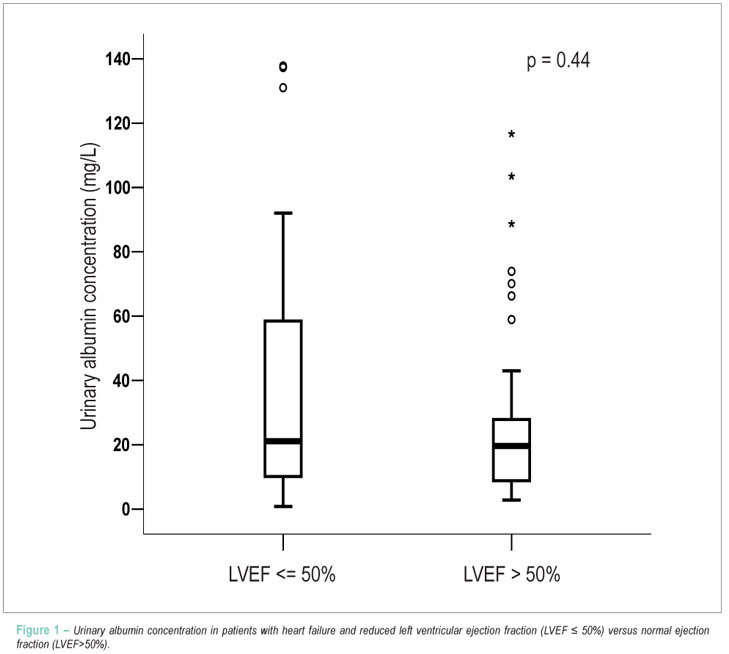
BACKGROUND: Microalbuminuria has been described as a risk factor for progressive cardiovascular and renal diseases. Little is known about its prognostic value in patients (pts) with established heart failure (HF). OBJECTIVE: To assess the role of microalbuminuria as a prognostic marker in patients with chronic HF receiving standard medication. METHODS: From January 2008 through September 2009, 92 pts with chronic HF, were prospectively included. Mean age was 63.7±12.2 and 37 (40.7%) were male. Mean left ventricular ejection fraction (LVEF) was 52.5±17.5%. Pts under dialysis were excluded. Urinary albumin concentration (UAC) was determined in first morning spot sample of urine. Time to first event (HF hospitalization, emergency department visit for HF or cardiovascular death) was defined as endpoint. Mean follow-up was 11±6.1 months. RESULTS: At the time of inclusion in the study, 38 (41.3%) pts had microalbuminuria and no patient had overt albuminuria. Pts with microalbuminuria had lower left ventricular ejection fraction than the rest of the individuals (47.9±18.5 vs 54.5±17.7%, p=0.08). UAC was higher in patients with events (median 59.8 vs 18 mg/L, p=0.0005). Event-free survival was lower in pts with microalbuminuria as compared with normoalbuminuria (p<0.0001). Independent variables related to cardiac events were UAC (p<0.0001, hazard ratio=1.02, 95% CI=1.01 to 1.03 per 1-U increase of UAC), and previous myocardial infarction (p=0.025, HR=3.11, 95% CI=1.15 to 8.41). CONCLUSION: Microalbuminuria is an independent prognostic marker in pts with chronic HF. Pts with microalbuminuria had a trend for lower LVEF.

  • albuminuria
  • Heart Failure
  • Kidney, Diseases
  • Prognosis
Read Full Article
Creative Commons Attribution (CC BY) Creative Commons license
13/12/2011 DOI: 10.1590/S0066-782X2011005000120
Lipid transfer to HDL in type-2 diabetic patients: associations with microalbuminuria, statin, and insulin
ABC
Artigo Original

Lipid transfer to HDL in type-2 diabetic patients: associations with microalbuminuria, statin, and insulin

Gilson Soares Feitosa-Filho et al. Talita de Mattos Seydell Alina Coutinho Rodrigues Feitosa Raul Cavalcante Maranhão José Antônio Franchini Ramires

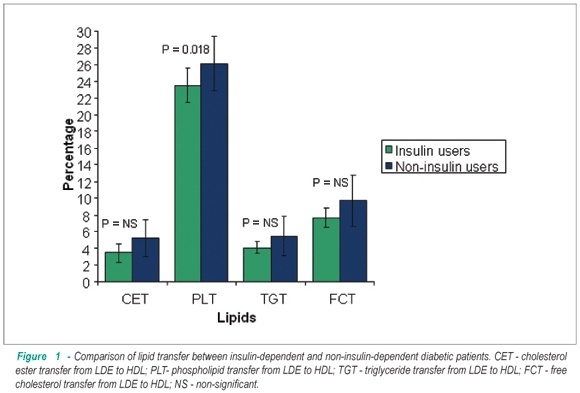
BACKGROUND: Type-2 diabetes mellitus (T2DM) is an isolated risk factor for coronary artery disease, especially when associated with microalbuminuria (MA). Structural and functional changes in lipoproteins have not yet been fully elucidated in this context. OBJECTIVE: To assess lipid transfer (T) to HDL in type-2 diabetic patients and its association with microalbuminuria and treatment with statins or insulin. METHODS: Thirty-three patients with type-2 diabetes mellitus and 34 age-matched control subjects were studied. A synthetic cholesterol-rich nanoemulsion radiolabeled with ³H- triglycerides (TG) and 14C-free cholesterol (FC) or ³H- cholesteryl ester (CE) and 14C-phospholipids (PL) was incubated with plasma. Both the nanoemulsion and lipoproteins were precipitated, except for HDL, which was counted for radioactivity. RESULTS: PLT (%) was higher in the T2DM group than in the control group (25.2 ± 3.2 and 19.7 ± 3.2 respectively; p < 0.001), as was free cholesterol (% FC): 9.1 ± 2.7 and 6.3 ± 1.5 respectively; p < 0.001. The diagnosis of microalbuminuria (MA) was not associated with changes in lipid transfers. Insulin therapy was associated with lower PLT rates: 23.5 ± 2.1 versus 26.1 ± 3.3; p = 0.018. Statin therapy, in turn, was associated with a drop in all lipid transfers – CET 3.5 ± 0.9; PLT: 23.8 ± 2.0; TGT: 3.9 ± 0.8; FCT: 7.4 ± 1.3 – as compared to the group that was not on statin therapy (CET: 5.9 ± 2.4; PLT: 26.9 ± 3.6; TGT: 6.4 ± 2.2; FCT: 11.1 ± 2.6). CONCLUSION:Type-2 diabetes mellitus increased lipid transfer to HDL particles, whereas statin therapy decreased all lipid transfers. The presence of MA was not associated with changes in lipid transfer.

  • albuminuria
  • Cholesterol, HDL
  • Diabetes Mellitus, Type 2
  • diabetic nephropathies
  • Hydroxymethylglutaryl-CoA Reductase Inhibitors
  • Insulin
  • Lipoproteins
Read Full Article
Creative Commons Attribution (CC BY) Creative Commons license
06/04/2009 DOI: 10.1590/S0066-782X2009000200005
Determination of microalbuminuria in hypertensive patients and in patients with coronary artery disease
ABC
Artigo Original

Determination of microalbuminuria in hypertensive patients and in patients with coronary artery disease

Ricardo Pereira Silva et al. Karinne Cisne Jerusa Mara de Oliveira Marcos Kubrusly … Carlos Roberto Martins Rodrigues Sobrinho Pedro José Negreiros de Andrade

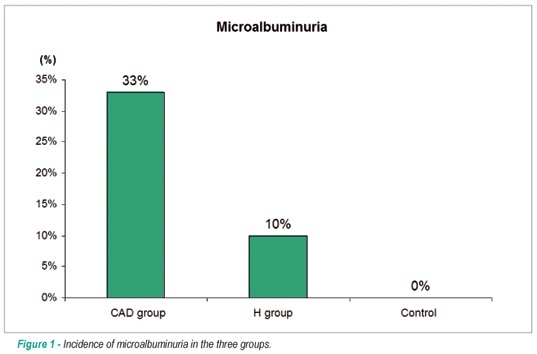
BACKGROUND: The normal 24-hour albumin excretion rate is of 20 mg. A persistent rate of 30 to 300 mg/day is called microalbuminuria and is related to a higher prevalence of cardiovascular disease. OBJECTIVE: 1) To determine the prevalence of microalbuminuria in a group of hypertensive patients and in a group of patients with coronary artery disease; 2) To determine the relationship between the presence of microalbuminuria and hypertension, diabetes mellitus, dyslipidemia, smoking and obesity. METHODS: The presence of microalbuminuria in a group of hypertensive patients (73 individuals) and in a group of patients with coronary artery disease (39 individuals) was determined and compared with a control group (43 individuals). Microalbuminuria was defined as an albumin/creatinine ratio higher than 30 and lower than 300 in a spot morning urine sample. The chi-square test and the Fisher’s exact test were used in the statistical analysis. RESULTS: Microalbuminuria was present in 9.5% of the hypertensive individuals and in 33% of the patients with coronary artery disease, and was absent in individuals of the control group. When the occurrence of microalbuminuria was analyzed according to the different clinical parameters, regardless of the group involved, a statistically significant correlation was found with age, diabetes and dyslipidemia. CONCLUSION: 1) The prevalence of microalbuminuria in hypertensive individuals is high, and is even higher in patients with coronary artery disease; 2) There is a correlation of the presence of microalbuminuria with age, diabetes and dyslipidemia.

  • albuminuria
  • Coronary Disease
  • Hypertension
Read Full Article
Creative Commons Attribution (CC BY) Creative Commons license
28/04/2008 DOI: 10.1590/S0066-782X2008000200006 Views 1
ABC
Artigo Original

Systemic hypertension and microalbuminuria

Ana Maria Nunes de Faria Stamm et al. Gisele Meinerz Jacqueline Consuelo da Silva

OBJECTIVE: To identify the prevalence of microalbuminuria and target organ lesions and their association in a hypertensive population undergoing treatment. METHODS: This observational, descriptive and cross-sectional study was conducted between April and August 2006, and included 153 hypertensive patients undergoing treatment at the Internal Medicine and Cardiology Outpatient Clinics at a University Hospital in the Southern Region of Brazil. RESULTS: The prevalence of microalbuminuria was 13.7% (21/153). The clinical and demographic characteristics of groups with and without microalbuminuria were similar. The prevalence of target organ lesions was 48.4%, of which most were cardiac lesions. Target organ lesions were found more often in the microalbuminuria group [76.2% (16/21) versus 43.9% (58/132)] with a significant statistical difference (p=0.006). This was also observed in the cardiac lesions, for both the total population (p=0.003) and the geriatric group (p=0.006). CONCLUSION: The prevalence of microalbuminuria in the study population was 13.7% and that of target organ lesions was 48.4%; a statistically significant association was found. Microalbuminuria is also associated with cardiac lesions, including in the geriatric population.

  • albuminuria
  • Hypertension
  • Risk Factors
  • target organs
Read Full Article
Creative Commons Attribution (CC BY) Creative Commons license
18/04/2008 DOI: 10.1590/S0066-782X2007001800011

How to cite this article

EndNote RIS

Electronic Document Format (Vancouver)

Moura RSSS, Vasconcelos DF, Freitas E, Moura FJD, Rosa TT, Veiga JPR. Cystatin C, CRP, log TG/HDLc and metabolic syndrome are associated with microalbuminuria in hypertension. Arquivos Brasileiros de Cardiologia 2013;102(1):54-9.

Electronic Document Format (ABNT)

Moura, Rafaela do Socorro Souza e Silva; Vasconcelos, Daniel França; Freitas, Eduardo; Moura, Flavio José Dutra de; Rosa, Tânia Torres; Veiga, Joel Paulo Russomano. Cystatin C, CRP, log TG/HDLc and metabolic syndrome are associated with microalbuminuria in hypertension. Arquivos Brasileiros de Cardiologia, v. 102, n. 1, p. 54-59, Oct. 2013.

Electronic Document Format (APA)

Moura, R. S. S. S., Vasconcelos, D. F., Freitas, E., Moura, F. J. D. , Rosa, T. T., & Veiga, J. P. R. (2013). Cystatin C, CRP, log TG/HDLc and metabolic syndrome are associated with microalbuminuria in hypertension. Arquivos Brasileiros de Cardiologia, 102(1), 54-59.

Electronic Document Format (ISO)

Moura, Rafaela do Socorro Souza e Silva and Vasconcelos, Daniel França and Freitas, Eduardo and Moura, Flavio José Dutra de and Rosa, Tânia Torres and Veiga, Joel Paulo Russomano. Cystatin C, CRP, log TG/HDLc and metabolic syndrome are associated with microalbuminuria in hypertension. Arquivos Brasileiros de Cardiologia [online]. 2013, vol. 102, n. 1, [cited 2026-10-14], pp. 54-59. Available from: <https://journals.cardiol.br/en/article/cystatin-c-crp-log-tg-hdlc-and-metabolic-syndrome-are-associated-with-microalbuminuria-in-hypertension/>. ISSN 0066-782X

EndNote RIS

Electronic Document Format (Vancouver)

Villacorta H, Ferradaes PV, Mesquita ET, Nóbrega ACL. Microalbuminuria is an independent prognostic marker in patients with chronic heart failure. Arquivos Brasileiros de Cardiologia 2011;98(1):62-9.

Electronic Document Format (ABNT)

Villacorta, Humberto; Ferradaes, Paula de Vilhena; Mesquita, Evandro Tinoco; Nóbrega, Antônio Cláudio Lucas da. Microalbuminuria is an independent prognostic marker in patients with chronic heart failure. Arquivos Brasileiros de Cardiologia, v. 98, n. 1, p. 62-69, Dec. 2011.

Electronic Document Format (APA)

Villacorta, H., Ferradaes, P. V., Mesquita, E. T., & Nóbrega, A. C. L. (2011). Microalbuminuria is an independent prognostic marker in patients with chronic heart failure. Arquivos Brasileiros de Cardiologia, 98(1), 62-69.

Electronic Document Format (ISO)

Villacorta, Humberto and Ferradaes, Paula de Vilhena and Mesquita, Evandro Tinoco and Nóbrega, Antônio Cláudio Lucas da. Microalbuminuria is an independent prognostic marker in patients with chronic heart failure. Arquivos Brasileiros de Cardiologia [online]. 2011, vol. 98, n. 1, [cited 2026-10-14], pp. 62-69. Available from: <https://journals.cardiol.br/en/article/microalbuminuria-is-an-independent-prognostic-marker-in-patients-with-chronic-heart-failure/>. ISSN 0066-782X

EndNote RIS

Electronic Document Format (Vancouver)

Feitosa-Filho GS, Seydell TM, Feitosa ACR, Maranhão RC, Ramires JAF. Lipid transfer to HDL in type-2 diabetic patients: associations with microalbuminuria, statin, and insulin. Arquivos Brasileiros de Cardiologia 2009;92(2):100-6.

Electronic Document Format (ABNT)

Feitosa-Filho, Gilson Soares; Seydell, Talita de Mattos; Feitosa, Alina Coutinho Rodrigues; Maranhão, Raul Cavalcante; Ramires, José Antônio Franchini. Lipid transfer to HDL in type-2 diabetic patients: associations with microalbuminuria, statin, and insulin. Arquivos Brasileiros de Cardiologia, v. 92, n. 2, p. 100-106, Apr. 2009.

Electronic Document Format (APA)

Feitosa-Filho, G. S., Seydell, T. M., Feitosa, A. C. R., Maranhão, R. C., & Ramires, J. A. F. (2009). Lipid transfer to HDL in type-2 diabetic patients: associations with microalbuminuria, statin, and insulin. Arquivos Brasileiros de Cardiologia, 92(2), 100-106.

Electronic Document Format (ISO)

Feitosa-Filho, Gilson Soares and Seydell, Talita de Mattos and Feitosa, Alina Coutinho Rodrigues and Maranhão, Raul Cavalcante and Ramires, José Antônio Franchini. Lipid transfer to HDL in type-2 diabetic patients: associations with microalbuminuria, statin, and insulin. Arquivos Brasileiros de Cardiologia [online]. 2009, vol. 92, n. 2, [cited 2026-10-14], pp. 100-106. Available from: <https://journals.cardiol.br/en/article/lipid-transfer-to-hdl-in-type-2-diabetic-patients-associations-with-microalbuminuria-statin-and-insulin/>. ISSN 0066-782X

EndNote RIS

Electronic Document Format (Vancouver)

Silva RP, Cisne K, Oliveira JM, Kubrusly M, Sobrinho CRMR, Andrade PJN. Determination of microalbuminuria in hypertensive patients and in patients with coronary artery disease. Arquivos Brasileiros de Cardiologia 2008;90(2):108-13.

Electronic Document Format (ABNT)

Silva, Ricardo Pereira; Cisne, Karinne; Oliveira, Jerusa Mara de; Kubrusly, Marcos; Sobrinho, Carlos Roberto Martins Rodrigues; Andrade, Pedro José Negreiros de. Determination of microalbuminuria in hypertensive patients and in patients with coronary artery disease. Arquivos Brasileiros de Cardiologia, v. 90, n. 2, p. 108-113, Apr. 2008.

Electronic Document Format (APA)

Silva, R. P., Cisne, K., Oliveira, J. M. , Kubrusly, M., Sobrinho, C. R. M. R., & Andrade, P. J. N. (2008). Determination of microalbuminuria in hypertensive patients and in patients with coronary artery disease. Arquivos Brasileiros de Cardiologia, 90(2), 108-113.

Electronic Document Format (ISO)

Silva, Ricardo Pereira and Cisne, Karinne and Oliveira, Jerusa Mara de and Kubrusly, Marcos and Sobrinho, Carlos Roberto Martins Rodrigues and Andrade, Pedro José Negreiros de. Determination of microalbuminuria in hypertensive patients and in patients with coronary artery disease. Arquivos Brasileiros de Cardiologia [online]. 2008, vol. 90, n. 2, [cited 2026-10-14], pp. 108-113. Available from: <https://journals.cardiol.br/en/article/determination-of-microalbuminuria-in-hypertensive-patients-and-in-patients-with-coronary-artery-disease/>. ISSN 0066-782X

EndNote RIS

Electronic Document Format (Vancouver)

Stamm AMNF, Meinerz G, Silva JC. Systemic hypertension and microalbuminuria. Arquivos Brasileiros de Cardiologia 2008;89(6):415-20.

Electronic Document Format (ABNT)

Stamm, Ana Maria Nunes de Faria; Meinerz, Gisele; Silva, Jacqueline Consuelo da. Systemic hypertension and microalbuminuria. Arquivos Brasileiros de Cardiologia, v. 89, n. 6, p. 415-420, Apr. 2008.

Electronic Document Format (APA)

Stamm, A. M. N. F., Meinerz, G., & Silva, J. C. (2008). Systemic hypertension and microalbuminuria. Arquivos Brasileiros de Cardiologia, 89(6), 415-420.

Electronic Document Format (ISO)

Stamm, Ana Maria Nunes de Faria and Meinerz, Gisele and Silva, Jacqueline Consuelo da. Systemic hypertension and microalbuminuria. Arquivos Brasileiros de Cardiologia [online]. 2008, vol. 89, n. 6, [cited 2026-10-14], pp. 415-420. Available from: <https://journals.cardiol.br/en/article/systemic-hypertension-and-microalbuminuria/>. ISSN 0066-782X

  • About ABC Family
  • Internal Regulation
  • Editorial Board
  • Brazilian Society of Cardiology (SBC)

Issues

SBC Guidelines

  • Videos
  • Podcasts
  • News