ABC Family Arquivos Brasileiros de Cardiologia International Journal of Cardiovascular Sciences ABC Heart Failure & Cardiomyopathy ABC Imagem Cardiovascular
Português English
ABC Family
Português English
  • About
    • About ABC Family
    • Internal Regulation
    • Editorial Board
    • Brazilian Society of Cardiology (SBC)
  • Issues
  • SBC Guidelines
  • Content
    • Videos
    • Podcasts
    • News
  • About
    • About ABC Family
    • Internal Regulation
    • Editorial Board
    • Brazilian Society of Cardiology (SBC)
  • Issues
  • SBC Guidelines
  • Content
    • Videos
    • Podcasts
    • News

ABC Family

  • ABC Family
  • Arquivos Brasileiros de Cardiologia
  • International Journal of Cardiovascular Sciences
  • ABC Heart Failure & Cardiomyopathy
  • ABC Imagem Cardiovascular
Search in

No content found.

Journals
Ordering
Article types
Others

  1. Home
  2. Keyword: Lipoproteins, HDL
ABC
Editorial

Antiinflammatory and Cardioprotective Effects of HDL-C: Association With Autoantibodies Against Oxidized LDL?

Estêvão Lanna Figueiredo et al. Ricardo Wang

The accumulation of lipoproteins containing apolipoprotein B (ApoB), mainly low-density lipoprotein (LDL), in the arterial intima has been attributed to one of the initial steps of atherogenesis. In other studies, oxidized LDL and macrophages are the main pathogenic factors for the development of atherosclerosis., In turn, there is increasing evidence of the protective role of autoantibodies against oxidized LDL (oxLDL-AboxLDL-Ab in atherogenesis, a fact that can be potentiated by high-density lipoprotein (HDL).,

In this volume of Arquivos Brasileiros de Cardiologia, Nunez et al. evaluated the hypothesis that individuals with higher levels of HDL-C would have elevated levels of oxLDL-Ab. This is a cross-sectional study that included 193 consecutive healthy individuals aged ≥ 18 years and excluded patients with coronary artery disease (CAD), stroke, secondary causes of HDL elevation or reduction, use of lipid-lowering drugs, alcoholism, and smoking. The subjects underwent a detailed physical examination, blood pressure measurements and carotid ultrasound, in addition to biochemical analyzes of peripheral blood. Participants were divided into tertiles, according to HDL-C levels: low (80 mg/dL: n=63).

[…]

  • Atherosclerosis
  • Cholesterol, HDL
  • Lipoproteins, HDL
Read Full Article
Creative Commons Attribution (CC BY) Creative Commons license
25/11/2022 DOI: 10.36660/abc.20220703
Figure 1
ABC
Original Article

Discordance of Low-Density Lipoprotein Cholestrol and Non-High-Density Lipoprotein Cholestrol and Coronary Artery Disease Severity

Ozge Kurmus et al. Aycan Fahri Erkan Berkay Ekici Turgay Aslan Murat Eren

Abstract

Background:

A sizeable proportion of patients have discordant low-density lipoprotein cholesterol (LDL-C) and non-high-density lipoprotein cholesterol (non-HDL-C).

Objectives:

We assessed the relationship between discordance of LDL-C and non-HDL-C and coronary artery disease (CAD) severity.

Methods:

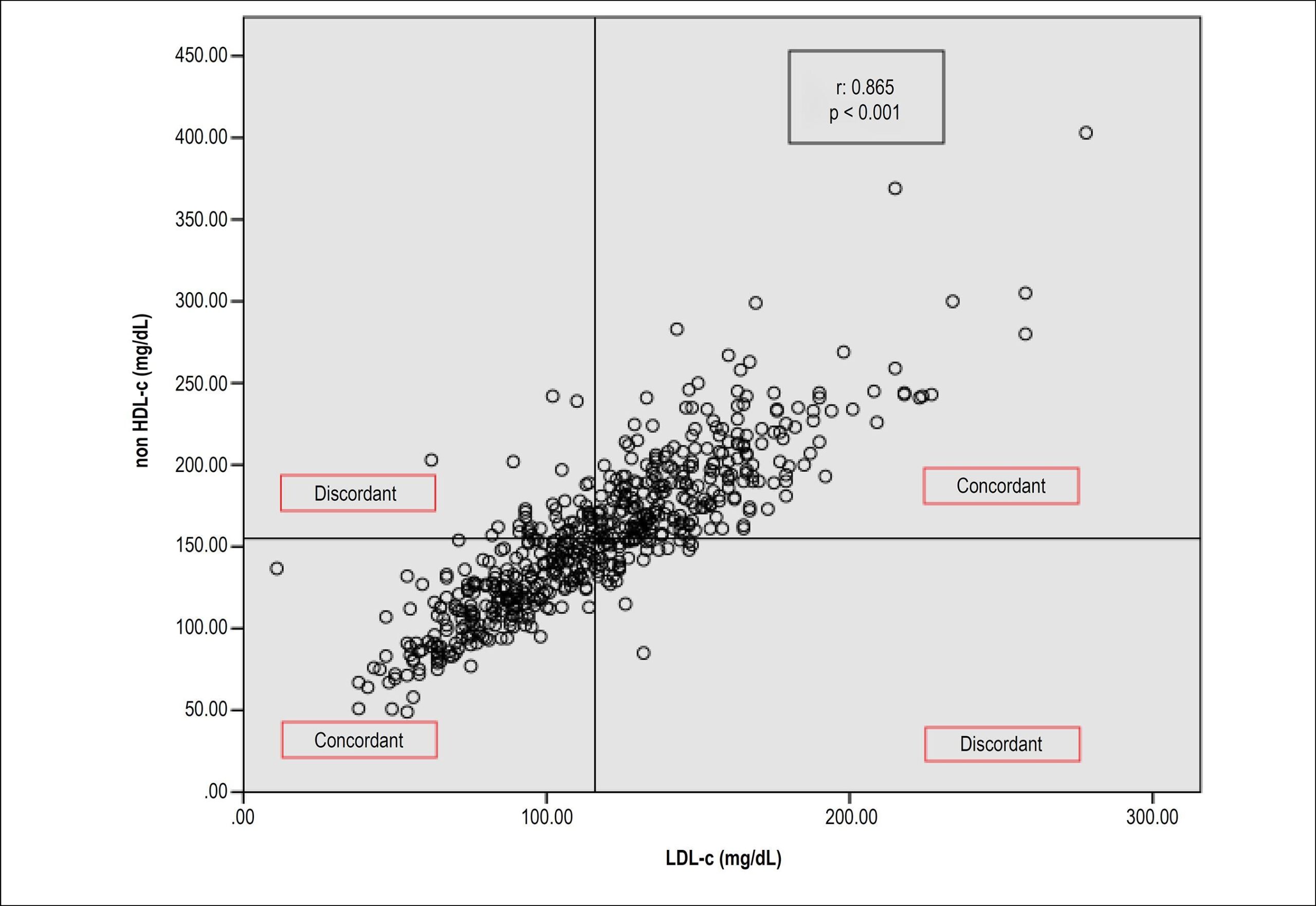
We retrospectively evaluated the data of 574 consecutive patients who underwent coronary angiography. Fasting serum lipid profiles were recorded, SYNTAX and Gensini scores were calculated to establish CAD complexity and severity. We determined the medians for LDL-C and non-HDL-C to examine the discordance between LDL-C and non-HDL-C. Discordance was defined as LDL-C greater than or equal to the median and non-HDL-C less than median; or LDL-C less than median and non-HDL-C greater than or equal to median. A p value < 0.05 was accepted as statistically significant.

Results:

LDL-C levels were strongly and positively correlated with non-HDL-C levels (r = 0.865, p 22 were not different from group to group (p = 0.635, p = 0.733, p = 0.799, p = 0.891, respectively). Also, there was no statistically significant correlation between LDL-C and Gensini or SYNTAX scores in any of the discordant or concordant groups. Additionally, no correlation was found between non-HDL-C and Gensini or SYNTAX score.

Conclusions:

While there was discordance between LDL-C and non-HDL-C (15% of patients), there is no difference regarding CAD severity and complexity between discordant and concordant groups.

  • Atherosclerosis
  • Coronary Artery Disease/physiopathology
  • Discordance
  • Lipoproteins, HDL
  • Lipoproteins, LDL
Read Full Article
Creative Commons Attribution (CC BY) Creative Commons license
07/02/2020 DOI: 10.36660/abc.20190091 Views 1
ABC
Editorial

A New Marker of Myocardial Bridge?

Paolo Blanco Villela et al. Gláucia Maria Moraes de Oliveira

Myocardial bridges (MBs) have been associated with an increased incidence of cardiovascular events. Even though the pathophysiology of this association is still elusive, it seems to be related to the development of atherosclerosis. This hypothesis is based on changes in blood flow resulting from systolic compression of coronary arteries and leading to changes in arterial wall shear stress, which could act as a proatherogenic event affecting the endothelium of the arterial segment proximal to the MB.

Recently, Akishima-Fukasawa et al. assessed 150 autopsies of individuals without cardiovascular heart disease to verify the influence of MBs on the development of atherosclerosis. The authors found the occurrence of MBs in 93 hearts, and using computer-assisted histomorphometry, observed a higher frequency of luminal stenosis in segments proximal to the MB. Using a multiple comparison test, the authors showed a relation between the presence of risk factors like hypertension, diabetes, and dyslipidemia to a higher rate of stenosis affecting segments located 2.5 cm proximally to the MB. Despite the absence of MB flow evaluation, the authors documented an anatomical association between significant atherosclerotic lesions and the presence of MBs. We could speculate that this may be one of the explanations for the increased incidence of cardiovascular events in patients with MB.

[…]

  • Atherosclerosis
  • Inflammation
  • Lipoproteins, HDL
  • Monocytes
  • Myocardial Bridging/physiopathology
  • Risk Factors
Read Full Article
Creative Commons Attribution (CC BY) Creative Commons license
01/01/2019 DOI: 10.5935/abc.20180264
Figure 1
ABC
Original Article

Is Lipid Accumulation Product Associated with an Atherogenic Lipoprotein Profile in Brazilian Subjects?

Flavia De Conti Cartolano et al. Caroline Pappiani Maria Camila Prupper de Freitas Antonio M. Figueiredo Neto … Antônio Augusto Ferreira Carioca Nágila Raquel Teixeira Damasceno

Abstract

Background:

Lipid accumulation product (LAP), a simple and low-cost tool, is a novel biomarker of central lipid accumulation and represents a potential surrogate marker for atherogenic lipoprotein profile. However, its association with lipoprotein subfractions has not been described in the literature.

Objective:

To determine whether LAP index could be used as a marker of low- and high-density lipoprotein (LDL and HDL) size in Brazilian individuals.

Methods:

This cross-sectional study included patients (n = 351) of both sexes and age between 30-74 years. Clinical and sociodemographic data and family history of diseases were evaluated. Lipoprotein size, and levels of total cholesterol (TC), lipoproteins, apolipoprotein AI and B (APO AI/APO B), glucose, insulin, insulin resistance index (HOMA-IR) and non-esterified fatty acids (NEFA) were assessed in blood samples. LAP was calculated by the formulas [(waist circumference[cm]-58) × (triglycerides[mmol/L]) for women and (waist circumference [cm]-65) × (triglycerides [mmol/L]) for men]. The association between LAP and metabolic parameters were tested by linear trend (general linear model, GLM test) before and after multiple adjustments for potential confounders (sex, age, smoking, statin, fibrate, and hypoglycemic drugs) at significant level p < 0.05.

Results:

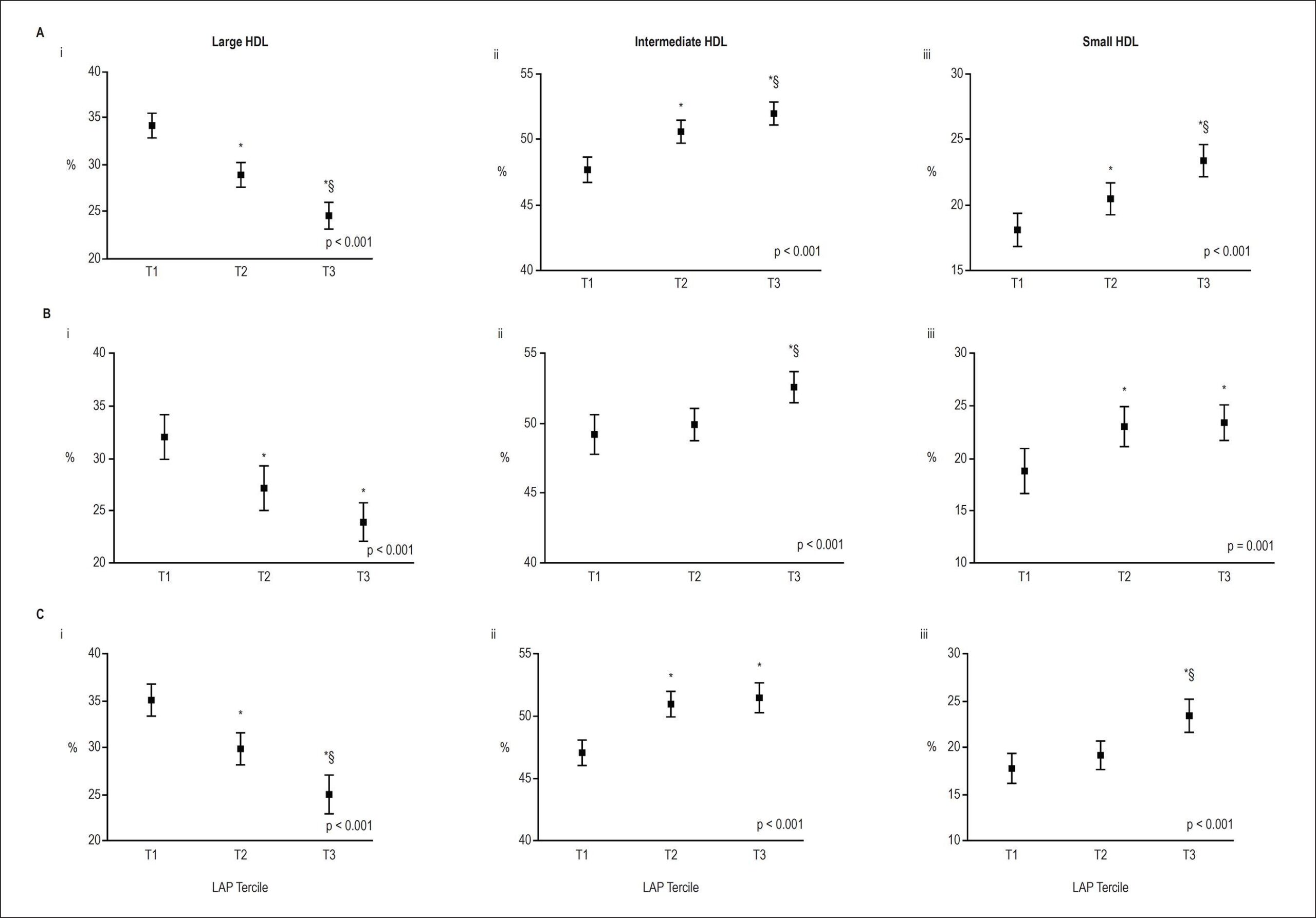
LAP was positively associated with TC, APO B, NEFA, glucose, insulin and HOMA-IR values, and negatively associated with HDL-C. Higher central lipid accumulation was corelated with higher percentage of intermediate HDL and of small LDL and HDL and less amount of large HDL. LDL size was also reduced in greater LAP index values. The negative impact of LAP was maintained after adjustment for multiple variables.

Conclusion:

LAP was robustly associated with atherogenic profile of lipoprotein subfractions, independently of multiple confounders.

  • Adults
  • Cardiovascular Diseases
  • Dyslipidemias
  • Insulin Resistance
  • Lipoproteins, HDL
  • Lipoproteins, LDL
  • Risk Factors
Read Full Article
Creative Commons Attribution (CC BY) Creative Commons license
01/04/2018 DOI: 10.5935/abc.20180054
ABC
Original Article

p.Q192R SNP of PON1 seems not to be Associated with Carotid Atherosclerosis Risk Factors in an Asymptomatic and Normolipidemic Brazilian Population Sample

Daniel Zanetti Scherrer et al. Vanessa Helena de Souza Zago Isabela Calanca Vieira Eliane Soler Parra … Natália Baratella Panzoldo Fernanda Alexandre Rodrigo Secolin Jamal Baracat Eder Carlos Rocha Quintão Eliana Cotta de Faria

Background:

Evidences suggest that paraoxonase 1 (PON1) confers important antioxidant and anti-inflammatory properties when associated with high-density lipoprotein (HDL).

Objective:

To investigate the relationships between p.Q192R SNP ofPON1, biochemical parameters and carotid atherosclerosis in an asymptomatic, normolipidemic Brazilian population sample.

Methods:

We studied 584 volunteers (females n = 326, males n = 258; 19-75 years of age). Total genomic DNA was extracted and SNP was detected in the TaqMan® SNP OpenArray® genotyping platform (Applied Biosystems, Foster City, CA). Plasma lipoproteins and apolipoproteins were determined and PON1 activity was measured using paraoxon as a substrate. High-resolution β-mode ultrasonography was used to measure cIMT and the presence of carotid atherosclerotic plaques in a subgroup of individuals (n = 317).

Results:

The presence of p.192Q was associated with a significant increase in PON1 activity (RR = 12.30 (11.38); RQ = 46.96 (22.35); QQ = 85.35 (24.83) μmol/min; p < 0.0001), HDL-C (RR= 45 (37); RQ = 62 (39); QQ = 69 (29) mg/dL; p < 0.001) and apo A-I (RR = 140.76 ± 36.39; RQ = 147.62 ± 36.92; QQ = 147.49 ± 36.65 mg/dL; p = 0.019). Stepwise regression analysis revealed that heterozygous and p.192Q carriers influenced by 58% PON1 activity towards paraoxon. The univariate linear regression analysis demonstrated that p.Q192R SNP was not associated with mean cIMT; as a result, in the multiple regression analysis, no variables were selected with 5% significance. In logistic regression analysis, the studied parameters were not associated with the presence of carotid plaques.

Conclusion:

In low-risk individuals, the presence of the p.192Q variant ofPON1 is associated with a beneficial plasma lipid profile but not with carotid atherosclerosis.

  • Carotid Artery Diseases / physiopathology
  • Lipoproteins, HDL
  • Paraoxonase-1 / genetics
  • Polymorphism, Genetic
Read Full Article
Creative Commons Attribution (CC BY) Creative Commons license
29/05/2015 DOI: 10.5935/abc.20150053 Views 2

How to cite this article

EndNote RIS

Electronic Document Format (Vancouver)

Figueiredo EL, Wang R. Antiinflammatory and Cardioprotective Effects of HDL-C: Association With Autoantibodies Against Oxidized LDL?. Arquivos Brasileiros de Cardiologia 2022;119(5):722-3.

Electronic Document Format (ABNT)

Figueiredo, Estêvão Lanna; Wang, Ricardo. Antiinflammatory and Cardioprotective Effects of HDL-C: Association With Autoantibodies Against Oxidized LDL?. Arquivos Brasileiros de Cardiologia, v. 119, n. 5, p. 722-723, Nov. 2022.

Electronic Document Format (APA)

Figueiredo, E. L., & Wang, R. (2022). Antiinflammatory and Cardioprotective Effects of HDL-C: Association With Autoantibodies Against Oxidized LDL?. Arquivos Brasileiros de Cardiologia, 119(5), 722-723.

Electronic Document Format (ISO)

Figueiredo, Estêvão Lanna and Wang, Ricardo. Antiinflammatory and Cardioprotective Effects of HDL-C: Association With Autoantibodies Against Oxidized LDL?. Arquivos Brasileiros de Cardiologia [online]. 2022, vol. 119, n. 5, [cited 2026-10-14], pp. 722-723. Available from: <https://journals.cardiol.br/en/article/antiinflammatory-and-cardioprotective-effects-of-hdl-c-association-with-autoantibodies-against-oxidized-ldl/>. ISSN 0066-782X

EndNote RIS

Electronic Document Format (Vancouver)

Kurmus O, Erkan AF, Ekici B, Aslan T, Eren M. Discordance of Low-Density Lipoprotein Cholestrol and Non-High-Density Lipoprotein Cholestrol and Coronary Artery Disease Severity. Arquivos Brasileiros de Cardiologia 2020;114(3):469-75.

Electronic Document Format (ABNT)

Kurmus, Ozge; Erkan, Aycan Fahri; Ekici, Berkay; Aslan, Turgay; Eren, Murat. Discordance of Low-Density Lipoprotein Cholestrol and Non-High-Density Lipoprotein Cholestrol and Coronary Artery Disease Severity. Arquivos Brasileiros de Cardiologia, v. 114, n. 3, p. 469-475, Feb. 2020.

Electronic Document Format (APA)

Kurmus, O., Erkan, A. F., Ekici, B., Aslan, T., & Eren, M. (2020). Discordance of Low-Density Lipoprotein Cholestrol and Non-High-Density Lipoprotein Cholestrol and Coronary Artery Disease Severity. Arquivos Brasileiros de Cardiologia, 114(3), 469-475.

Electronic Document Format (ISO)

Kurmus, Ozge and Erkan, Aycan Fahri and Ekici, Berkay and Aslan, Turgay and Eren, Murat. Discordance of Low-Density Lipoprotein Cholestrol and Non-High-Density Lipoprotein Cholestrol and Coronary Artery Disease Severity. Arquivos Brasileiros de Cardiologia [online]. 2020, vol. 114, n. 3, [cited 2026-10-14], pp. 469-475. Available from: <https://journals.cardiol.br/en/article/discordance-of-low-density-lipoprotein-cholestrol-and-non-high-density-lipoprotein-cholestrol-and-coronary-artery-disease-severity/>. ISSN 0066-782X

EndNote RIS

Electronic Document Format (Vancouver)

Villela PB, Oliveira GMM. A New Marker of Myocardial Bridge?. Arquivos Brasileiros de Cardiologia 2019;112(1):18-9.

Electronic Document Format (ABNT)

Villela, Paolo Blanco; Oliveira, Gláucia Maria Moraes de. A New Marker of Myocardial Bridge?. Arquivos Brasileiros de Cardiologia, v. 112, n. 1, p. 18-19, Dec. 2018.

Electronic Document Format (APA)

Villela, P. B., & Oliveira, G. M. M. (2019). A New Marker of Myocardial Bridge?. Arquivos Brasileiros de Cardiologia, 112(1), 18-19.

Electronic Document Format (ISO)

Villela, Paolo Blanco and Oliveira, Gláucia Maria Moraes de. A New Marker of Myocardial Bridge?. Arquivos Brasileiros de Cardiologia [online]. 2019, vol. 112, n. 1, [cited 2026-10-14], pp. 18-19. Available from: <https://journals.cardiol.br/en/article/a-new-marker-of-myocardial-bridge/>. ISSN 0066-782X

EndNote RIS

Electronic Document Format (Vancouver)

Cartolano FDC, Pappiani C, Freitas MCP, Figueiredo Neto AM, Carioca AAF, Damasceno NRT. Is Lipid Accumulation Product Associated with an Atherogenic Lipoprotein Profile in Brazilian Subjects?. Arquivos Brasileiros de Cardiologia 2018;110(4):339-47.

Electronic Document Format (ABNT)

Cartolano, Flavia De Conti; Pappiani, Caroline; Freitas, Maria Camila Prupper de; Figueiredo Neto, Antonio M.; Carioca, Antônio Augusto Ferreira; Damasceno, Nágila Raquel Teixeira. Is Lipid Accumulation Product Associated with an Atherogenic Lipoprotein Profile in Brazilian Subjects?. Arquivos Brasileiros de Cardiologia, v. 110, n. 4, p. 339-347, Mar. 2018.

Electronic Document Format (APA)

Cartolano, F. D. C., Pappiani, C., Freitas, M. C. P. , Figueiredo Neto, A. M., Carioca, A. A. F., & Damasceno, N. R. T. (2018). Is Lipid Accumulation Product Associated with an Atherogenic Lipoprotein Profile in Brazilian Subjects?. Arquivos Brasileiros de Cardiologia, 110(4), 339-347.

Electronic Document Format (ISO)

Cartolano, Flavia De Conti and Pappiani, Caroline and Freitas, Maria Camila Prupper de and Figueiredo Neto, Antonio M. and Carioca, Antônio Augusto Ferreira and Damasceno, Nágila Raquel Teixeira. Is Lipid Accumulation Product Associated with an Atherogenic Lipoprotein Profile in Brazilian Subjects?. Arquivos Brasileiros de Cardiologia [online]. 2018, vol. 110, n. 4, [cited 2026-10-14], pp. 339-347. Available from: <https://journals.cardiol.br/en/article/is-lipid-accumulation-product-associated-with-an-atherogenic-lipoprotein-profile-in-brazilian-subjects/>. ISSN 0066-782X

EndNote RIS

Electronic Document Format (Vancouver)

Scherrer DZ, Zago VHS, Vieira IC, Parra ES, Panzoldo NB, Alexandre F, Secolin R, et al. p.Q192R SNP of PON1 seems not to be Associated with Carotid Atherosclerosis Risk Factors in an Asymptomatic and Normolipidemic Brazilian Population Sample. Arquivos Brasileiros de Cardiologia 2015;105(1):45-52.

Electronic Document Format (ABNT)

Scherrer, Daniel Zanetti; Zago, Vanessa Helena de Souza; Vieira, Isabela Calanca; Parra, Eliane Soler; Panzoldo, Natália Baratella; Alexandre, Fernanda; Secolin, Rodrigo; Baracat, Jamal; Quintão, Eder Carlos Rocha; Faria, Eliana Cotta de. p.Q192R SNP of PON1 seems not to be Associated with Carotid Atherosclerosis Risk Factors in an Asymptomatic and Normolipidemic Brazilian Population Sample. Arquivos Brasileiros de Cardiologia, v. 105, n. 1, p. 45-52, May. 2015.

Electronic Document Format (APA)

Scherrer, D. Z., Zago, V. H. S., Vieira, I. C., Parra, E. S., Panzoldo, N. B., Alexandre, F., Secolin, R., Baracat, J., Quintão, E. C. R., & Faria, E. C. (2015). p.Q192R SNP of PON1 seems not to be Associated with Carotid Atherosclerosis Risk Factors in an Asymptomatic and Normolipidemic Brazilian Population Sample. Arquivos Brasileiros de Cardiologia, 105(1), 45-52.

Electronic Document Format (ISO)

Scherrer, Daniel Zanetti and Zago, Vanessa Helena de Souza and Vieira, Isabela Calanca and Parra, Eliane Soler and Panzoldo, Natália Baratella and Alexandre, Fernanda and Secolin, Rodrigo and Baracat, Jamal and Quintão, Eder Carlos Rocha and Faria, Eliana Cotta de. p.Q192R SNP of PON1 seems not to be Associated with Carotid Atherosclerosis Risk Factors in an Asymptomatic and Normolipidemic Brazilian Population Sample. Arquivos Brasileiros de Cardiologia [online]. 2015, vol. 105, n. 1, [cited 2026-10-14], pp. 45-52. Available from: <https://journals.cardiol.br/en/article/p-q192r-snp-of-pon1-seems-not-to-be-associated-with-carotid-atherosclerosis-risk-factors-in-an-asymptomatic-and-normolipidemic-brazilian-population-sample/>. ISSN 0066-782X

  • About ABC Family
  • Internal Regulation
  • Editorial Board
  • Brazilian Society of Cardiology (SBC)

Issues

SBC Guidelines

  • Videos
  • Podcasts
  • News