ABC Family Arquivos Brasileiros de Cardiologia International Journal of Cardiovascular Sciences ABC Heart Failure & Cardiomyopathy ABC Imagem Cardiovascular
Português English
ABC Family
Português English
  • About
    • About ABC Family
    • Internal Regulation
    • Editorial Board
    • Brazilian Society of Cardiology (SBC)
  • Issues
  • SBC Guidelines
  • Content
    • Videos
    • Podcasts
    • News
  • About
    • About ABC Family
    • Internal Regulation
    • Editorial Board
    • Brazilian Society of Cardiology (SBC)
  • Issues
  • SBC Guidelines
  • Content
    • Videos
    • Podcasts
    • News

ABC Family

  • ABC Family
  • Arquivos Brasileiros de Cardiologia
  • International Journal of Cardiovascular Sciences
  • ABC Heart Failure & Cardiomyopathy
  • ABC Imagem Cardiovascular
Search in

No content found.

Journals
Ordering
Article types
Others

  1. Home
  2. Keyword: Reference Standards
ABC
Editorial

Reference Values in Cardiovascular Magnetic Resonance Imaging: Between Local Validation and Global Harmonization

Miguel Correia

Cardiovascular magnetic resonance imaging (CMR) has become established in recent decades as the gold standard method for cardiac morphofunctional assessment, allowing for the precise quantification of ventricular volumes, ejection fraction, and myocardial mass, as well as the tissue characterization of multiple heart diseases.– The high reproducibility of its measurements is one of its main advantages over other imaging modalities, making CMR an essential tool in both clinical practice and cardiovascular research.,

However, the proper interpretation of parameters obtained by CMR depends on the existence of robust reference values applicable to the studied population. In this context, the article “Normal Reference Values for Cardiovascular Magnetic Resonance: An Analytical–Comparative Review with Emphasis on the Brazilian Population”, published in this issue of the Arquivos Brasileiros de Cardiologia, addresses a question that is particularly relevant to Brazilian cardiology: the applicability of international normative values to the national reality.

[…]

  • Magnetic Resonance Imaging
  • Reference Standards
  • Reference Values
Read Full Article
Creative Commons Attribution (CC BY) Creative Commons license
10/08/2026 DOI: 10.36660/abc.2026458i Views 2
ABC
Research Letter

What are the Optimal Reference Values for Home Blood Pressure Monitoring?

Audes D. M. Feitosa et al. Marco A. Mota-Gomes Fernando Nobre Decio Mion Jr. … Annelise M.G. Paiva Fábio Argenta Weimar K.S. Barroso Roberto D. Miranda Eduardo C. D. Barbosa Andréa A. Brandão Thiago S.V. Jardim Paulo C.B.V. Jardim Wilson Nadruz

Introduction

The diagnosis of hypertension usually relies on office blood pressure (BP) measures. However, this approach might underestimate or overestimate the true prevalence of hypertension due to the presence of alternative BP phenotypes, such as masked hypertension and white-coat hypertension. In this regard, current hypertension guidelines have recommended the evaluation of out-of-office BP by ambulatory BP monitoring (ABPM) or home blood pressure monitoring (HBPM), when these techniques are available, to confirm the diagnosis and to provide a more adequate management of hypertension.–

HBPM reference values used to define hypertension have been more consistently suggested since the end of 1990s. In 1998, results of a meta-analysis including data from 17 studies and 5,422 untreated participants suggested that elevated HBPM values should be ≥ 137/89 mmHg or ≥ 135/86 mmHg based on analysis of means + 2 standard deviations or ninety-fifth percentiles, respectively. In 1999, the analysis of the ninety-fifth percentiles of HBPM values from 2,401 normotensive individuals at the office estimated that elevated HBPM values were ≥ 137/85 mmHg. Furthermore, the evaluation of 1,913 individuals (69% not treated with antihypertensive medications) from the Ohasama Study showed that HBPM values ≥ 137/84 mmHg were associated with greater risk of death after 5 years of follow-up. Subsequent hypertension guidelines rounded the reference values suggested by these latter studies and recommended that abnormal HBPM measures should be considered when ≥ 135/85 mmHg., HBPM thresholds of 135/85 mmHg were then incorporated into clinical practice, and they have been used to define abnormal HBPM values by hypertension guidelines from various societies,, including the Seventh Brazilian Hypertension Guidelines published in 2016 and the Sixth Brazilian Guidelines of ABPM and Fourth Brazilian Guidelines of HBPM published in 2018.

[…]

  • Blood Pressure
  • Blood Pressure Self-Monitoring
  • Hypertension
  • Reference Standards
  • Reference Values
Read Full Article
Creative Commons Attribution (CC BY) Creative Commons license
23/04/2021 DOI: 10.36660/abc.20201109 Views 1
IJCS
Editorial

Simplicity and Complexity of the Six-Minute Walk Test

José Antônio Caldas Teixeira

The cardiopulmonary exercise testing (CPET) is known to be the gold standard method for the assessment of functional capacity. However, the method is expensive, often not well tolerated by the patients, and may not be a good strategy to evaluate activities of daily living (ADL). Functional tests are indirect method to assess functional status or functional capacity of an individual to perform ADL and meet their metabolic demands. These tests are considered objective measures that can monitor the clinical course of several diseases as well as responses to interventional therapies.

Walking and running tests were originally developed to evaluate and estimate aerobic physical fitness of healthy individuals and correlate it with maximal aerobic power (peak VO2). Balke, in the sixties, followed by Cooper and his 12-minute test, used to evaluate physical performance in healthy subjects, motivated, according to them, by the need of field tests for screening of large populations. These methods showed good correlation with laboratory measurements of aerobic capacity (peak VO2 and anaerobic threshold).

[…]

  • Bronchitis, Chronic
  • Health Status Indicators
  • Heart Failure
  • Reference Standards
  • Running
  • Walk Test
Read Full Article
Creative Commons Attribution (CC BY) Creative Commons license
01/01/2019 DOI: 10.5935/2359-4802.20190012 Views 1
IJCS
Original Article

Determinants of the Distance Covered During a Six-Minute Walk Test in Patients with Chronic Heart Failure

Elizabeth Rodrigues de Morais et al. Salvador Rassi

Abstract

Background:

The evaluation of the functional capacity of patients with chronic heart failure (HF) by means of the distance covered in the six-minute walk test (6MWT) has assumed great importance, since the 6MWD is a predictor of mortality and hospitalization in this population, however the determinants of better distance traveled in patients with HF are little explored, especially in the Brazilian population.

Objective:

To evaluate the determinants of 6MWD in patients with chronic HF.

Methods:

A cross-sectional study was performed with 81 HF patients in outpatient treatment. 6MWD was used as the outcome variable and sociodemographic, clinical, physical-functional and emotional data were submitted to multiple regression analysis using the stepwise method with a significance level of 5%.

Results:

Mean age of participants was 56.71 years; the 6MWD showed a bivariate correlation with age (r = -0.27, p = 0.01), maximal inspiratory pressure (r = 0.42, p < 0.01), maximal expiratory pressure (r = 0.36, p < 0.01), handgrip strength (r = 0.38, p < 0.01), Borg scale (-0.22, p = 0.04), Charlson index (r = -0.25, p = 0.02) and modified Medical Research Council (mMRC) dyspnea scale (r = -0.42, p < 0.01). In the multivariate analysis, the variables gender (p = 0.001), age (0.004), forced vital capacity (FVC) (p = 0.016) and mMRC (p = 0.001) simultaneously explained 37% of variance in the 6MWD.

Conclusion:

Higher levels of dyspnea on daily life activities, female sex, older age and lower forced vital capacity are determinants of a shorter 6MWD in patients with chronic HF.

  • Health Status Indicators
  • Heart Failure / diagnosis
  • Heart Failure/physiopathology
  • Reference Standards
  • Walk Test/methods
Read Full Article
Creative Commons Attribution (CC BY) Creative Commons license
01/11/2018 DOI: 10.5935/2359-4802.20180088 Views 1
IJCS
Editorial

New Cholesterol Targets of SBC Guidelines on Dyslipidemia

Maria Eliane Campos Magalhães

Evidence from clinical trials and meta-analysis have demonstrated that the most effective LDL (low-density lipoprotein) cholesterol-lowering treatment is associated with unequivocal benefits for reducing atherosclerotic cardiovascular disease (ASCVD) events. More recently, clinical trials concluded that the addition of ezetimibe and of a new class of drugs, inhibitors of proprotein convertase subtilisin/kexine type 9 (iPCSK9), to statins, were able to reduce LDL-C to levels not previously achieved with the available therapy so far.–

Is this context, the results of the IMPROVE-IT study – Improved Reduction of Outcomes: Vytorin Efficacy International Trial, with statins plus ezetimibe compared to statin monotherapy, achieved strict lipid control (LDL-c of 53.7 vs. 69.5 mg/dL, respectively) in patients with acute coronary syndrome, that is, individuals at high cardiovascular risk. In this study, patients achieving LDL-cholesterol levels less than 50 mg/dL had a significantly lower risk of major cardiovascular events compared to patients with LDL cholesterol levels above this value. The risk category was proportionally lower as the level of LDL-C decreased. Although at modest levels, there was an incremental cardiovascular event risk reduction, except mortality.

[…]

  • Atherosclerosis
  • Cholesterol / standards
  • Dyslipidemias
  • Reference Standards
  • Risk Factor
Read Full Article
Creative Commons Attribution (CC BY) Creative Commons license
01/01/2017 DOI: 10.5935/2359-4802.20170090
The importance of a normal ECG in non-ST elevation acute coronary syndromes
ABC
Artigo Original

The importance of a normal ECG in non-ST elevation acute coronary syndromes

Rogério Teixeira et al. Carolina Lourenço Natália António Sílvia Monteiro … Rui Baptista Elisabete Jorge Maria João Ferreira Pedro Monteiro Mário Freitas Luís A Providência

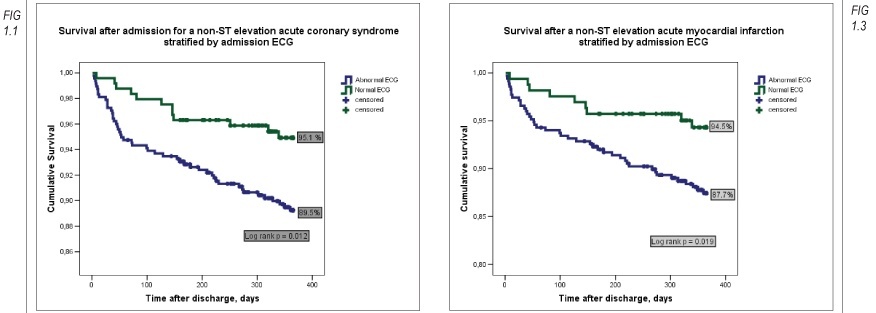
BACKGROUND: Admission ECG has a major impact on the diagnosis and management of non-ST elevation acute coronary syndromes (ACS). OBJECTIVE: To assess the impact of the admission ECG on prognosis over non-ST ACS. Population: prospective, continuous, observational study of 802 non-ST ACS patients from a single center. METHODS: Patients were divided in 2 groups: A (n=538) – Abnormal ECG and B (n=264) – Normal ECG. Normal ECG was synonymous of sinus rhythm and no acute ischemic changes. A one-year clinical follow up was performed targeting all causes of mortality and the MACE rate. RESULTS: Group A patients were older (68.7±11.7 vs. 63.4±12.7Y, p<0.001), had higher Killip classes and peak myocardial necrosis biomarkers. Furthermore, they had lower left ventricular ejection fraction (LVEF) (52.01±10.55 vs. 55.34± 9.51%, p<0.001), glomerular filtration rate, initial hemoglobin, and total cholesterol levels. Group B patients were more frequently submitted to invasive strategy (63.6 vs. 46.5%, p<0.001) and treated with aspirin, clopidogrel, beta blockers and statins. They also more often presented normal coronary anatomy (26.2 vs. 18.0%, p=0.45). There was a trend to higher in-hospital mortality in group A (4.6 vs. 1.9%, p=0.054). Kaplan-Meyer analysis showed that at one month and one year (95.1 vs. 89.5%, p=0.012) survival was higher in group B and the result remained significant on a Cox regression model (normal ECG HR 0.45 (0.21 – 0.97). There were no differences regarding the MACE rate. CONCLUSION: In our non-ST elevation ACS population, a normal ECG was an early marker for good prognosis.

  • diagnostic
  • Electrocardiography
  • Prognosis
  • Reference Standards
Read Full Article
Creative Commons Attribution (CC BY) Creative Commons license
22/09/2010 DOI: 10.1590/S0066-782X2010000100006

How to cite this article

EndNote RIS

Electronic Document Format (Vancouver)

Correia M. Reference Values in Cardiovascular Magnetic Resonance Imaging: Between Local Validation and Global Harmonization. Arquivos Brasileiros de Cardiologia 2026;123(6):e20260458.

Electronic Document Format (ABNT)

Correia, Miguel. Reference Values in Cardiovascular Magnetic Resonance Imaging: Between Local Validation and Global Harmonization. Arquivos Brasileiros de Cardiologia, v. 123, n. 6, e20260458, Aug. 2026.

Electronic Document Format (APA)

Correia, M. (2026). Reference Values in Cardiovascular Magnetic Resonance Imaging: Between Local Validation and Global Harmonization. Arquivos Brasileiros de Cardiologia, 123(6), e20260458.

Electronic Document Format (ISO)

Correia, Miguel. Reference Values in Cardiovascular Magnetic Resonance Imaging: Between Local Validation and Global Harmonization. Arquivos Brasileiros de Cardiologia [online]. 2026, vol. 123, n. 6, [cited 2026-10-14], e20260458. Available from: <https://journals.cardiol.br/en/article/reference-values-in-cardiovascular-magnetic-resonance-imaging-between-local-validation-and-global-harmonization/>. ISSN 0066-782X

EndNote RIS

Electronic Document Format (Vancouver)

Feitosa ADM, Mota-Gomes MA, Nobre F, Mion Jr. D, Paiva AM, Argenta F, Barroso WK, et al. What are the Optimal Reference Values for Home Blood Pressure Monitoring?. Arquivos Brasileiros de Cardiologia 2021;116(3):501-3.

Electronic Document Format (ABNT)

Feitosa, Audes D. M.; Mota-Gomes, Marco A.; Nobre, Fernando; Mion Jr., Decio; Paiva, Annelise M.G.; Argenta, Fábio; Barroso, Weimar K.S.; Miranda, Roberto D.; Barbosa, Eduardo C. D.; Brandão, Andréa A.; Jardim, Thiago S.V.; Jardim, Paulo C.B.V.; Nadruz, Wilson. What are the Optimal Reference Values for Home Blood Pressure Monitoring?. Arquivos Brasileiros de Cardiologia, v. 116, n. 3, p. 501-503, Apr. 2021.

Electronic Document Format (APA)

Feitosa, A. D. M., Mota-Gomes, M. A., Nobre, F., Mion Jr., D., Paiva, A. M., Argenta, F., Barroso, W. K., Miranda, R. D., Barbosa, E. C. D., Brandão, A. A., Jardim, T. S., Jardim, P. C., & Nadruz, W. (2021). What are the Optimal Reference Values for Home Blood Pressure Monitoring?. Arquivos Brasileiros de Cardiologia, 116(3), 501-503.

Electronic Document Format (ISO)

Feitosa, Audes D. M. and Mota-Gomes, Marco A. and Nobre, Fernando and Mion Jr., Decio and Paiva, Annelise M.G. and Argenta, Fábio and Barroso, Weimar K.S. and Miranda, Roberto D. and Barbosa, Eduardo C. D. and Brandão, Andréa A. and Jardim, Thiago S.V. and Jardim, Paulo C.B.V. and Nadruz, Wilson. What are the Optimal Reference Values for Home Blood Pressure Monitoring?. Arquivos Brasileiros de Cardiologia [online]. 2021, vol. 116, n. 3, [cited 2026-10-14], pp. 501-503. Available from: <https://journals.cardiol.br/article/what-are-the-optimal-reference-values-for-home-blood-pressure-monitoring/>. ISSN 0066-782X

EndNote RIS

Electronic Document Format (Vancouver)

Teixeira JAC. Simplicity and Complexity of the Six-Minute Walk Test. International Journal of Cardiovascular Sciences 2019;32(2):98-9.

Electronic Document Format (ABNT)

Teixeira, José Antônio Caldas. Simplicity and Complexity of the Six-Minute Walk Test. International Journal of Cardiovascular Sciences, v. 32, n. 2, p. 98-99, Dec. 2018.

Electronic Document Format (APA)

Teixeira, J. A. C. (2019). Simplicity and Complexity of the Six-Minute Walk Test. International Journal of Cardiovascular Sciences, 32(2), 98-99.

Electronic Document Format (ISO)

Teixeira, José Antônio Caldas. Simplicity and Complexity of the Six-Minute Walk Test. International Journal of Cardiovascular Sciences [online]. 2019, vol. 32, n. 2, [cited 2026-10-14], pp. 98-99. Available from: <https://journals.cardiol.br/en/article/simplicity-and-complexity-of-the-six-minute-walk-test/>. ISSN 2359-4802

EndNote RIS

Electronic Document Format (Vancouver)

Morais ER, Rassi S. Determinants of the Distance Covered During a Six-Minute Walk Test in Patients with Chronic Heart Failure. International Journal of Cardiovascular Sciences 2018;32(2):134-42.

Electronic Document Format (ABNT)

Morais, Elizabeth Rodrigues de; Rassi, Salvador. Determinants of the Distance Covered During a Six-Minute Walk Test in Patients with Chronic Heart Failure. International Journal of Cardiovascular Sciences, v. 32, n. 2, p. 134-142, Oct. 2018.

Electronic Document Format (APA)

Morais, E. R. , & Rassi, S. (2018). Determinants of the Distance Covered During a Six-Minute Walk Test in Patients with Chronic Heart Failure. International Journal of Cardiovascular Sciences, 32(2), 134-142.

Electronic Document Format (ISO)

Morais, Elizabeth Rodrigues de and Rassi, Salvador. Determinants of the Distance Covered During a Six-Minute Walk Test in Patients with Chronic Heart Failure. International Journal of Cardiovascular Sciences [online]. 2018, vol. 32, n. 2, [cited 2026-10-14], pp. 134-142. Available from: <https://journals.cardiol.br/en/article/determinants-of-the-distance-covered-during-a-six-minute-walk-test-in-patients-with-chronic-heart-failure/>. ISSN 2359-4802

EndNote RIS

Electronic Document Format (Vancouver)

Magalhães MEC. New Cholesterol Targets of SBC Guidelines on Dyslipidemia. International Journal of Cardiovascular Sciences 2017;30(6):466-8.

Electronic Document Format (ABNT)

Magalhães, Maria Eliane Campos. New Cholesterol Targets of SBC Guidelines on Dyslipidemia. International Journal of Cardiovascular Sciences, v. 30, n. 6, p. 466-468, Dec. 2016.

Electronic Document Format (APA)

Magalhães, M. E. C. (2017). New Cholesterol Targets of SBC Guidelines on Dyslipidemia. International Journal of Cardiovascular Sciences, 30(6), 466-468.

Electronic Document Format (ISO)

Magalhães, Maria Eliane Campos. New Cholesterol Targets of SBC Guidelines on Dyslipidemia. International Journal of Cardiovascular Sciences [online]. 2017, vol. 30, n. 6, [cited 2026-10-14], pp. 466-468. Available from: <https://journals.cardiol.br/en/article/new-cholesterol-targets-of-sbc-guidelines-on-dyslipidemia/>. ISSN 2359-4802

EndNote RIS

Electronic Document Format (Vancouver)

Teixeira R, Lourenço C, António N, Monteiro S, Baptista R, Jorge E, Ferreira MJ, et al. The importance of a normal ECG in non-ST elevation acute coronary syndromes. Arquivos Brasileiros de Cardiologia 2010;94(1):25-33.

Electronic Document Format (ABNT)

Teixeira, Rogério; Lourenço, Carolina; António, Natália; Monteiro, Sílvia; Baptista, Rui; Jorge, Elisabete; Ferreira, Maria João; Monteiro, Pedro; Freitas, Mário; Providência, Luís A. The importance of a normal ECG in non-ST elevation acute coronary syndromes. Arquivos Brasileiros de Cardiologia, v. 94, n. 1, p. 25-33, Sep. 2010.

Electronic Document Format (APA)

Teixeira, R., Lourenço, C., António, N., Monteiro, S., Baptista, R., Jorge, E., Ferreira, M. J., Monteiro, P., Freitas, M., & Providência, L. A. (2010). The importance of a normal ECG in non-ST elevation acute coronary syndromes. Arquivos Brasileiros de Cardiologia, 94(1), 25-33.

Electronic Document Format (ISO)

Teixeira, Rogério and Lourenço, Carolina and António, Natália and Monteiro, Sílvia and Baptista, Rui and Jorge, Elisabete and Ferreira, Maria João and Monteiro, Pedro and Freitas, Mário and Providência, Luís A. The importance of a normal ECG in non-ST elevation acute coronary syndromes. Arquivos Brasileiros de Cardiologia [online]. 2010, vol. 94, n. 1, [cited 2026-10-14], pp. 25-33. Available from: <https://journals.cardiol.br/en/article/the-importance-of-a-normal-ecg-in-non-st-elevation-acute-coronary-syndromes/>. ISSN 0066-782X

  • About ABC Family
  • Internal Regulation
  • Editorial Board
  • Brazilian Society of Cardiology (SBC)

Issues

SBC Guidelines

  • Videos
  • Podcasts
  • News