ABC Family Arquivos Brasileiros de Cardiologia International Journal of Cardiovascular Sciences ABC Heart Failure & Cardiomyopathy ABC Imagem Cardiovascular
Português English
ABC Family
Português English
  • About
    • About ABC Family
    • Internal Regulation
    • Editorial Board
    • Brazilian Society of Cardiology (SBC)
  • Issues
  • SBC Guidelines
  • Content
    • Videos
    • Podcasts
    • News
  • About
    • About ABC Family
    • Internal Regulation
    • Editorial Board
    • Brazilian Society of Cardiology (SBC)
  • Issues
  • SBC Guidelines
  • Content
    • Videos
    • Podcasts
    • News

ABC Family

  • ABC Family
  • Arquivos Brasileiros de Cardiologia
  • International Journal of Cardiovascular Sciences
  • ABC Heart Failure & Cardiomyopathy
  • ABC Imagem Cardiovascular
Search in

No content found.

Journals
Ordering
Article types
Others

  1. Home
  2. Keyword: Heart Failure / diagnosis
Figura 1
ABC
Review Article

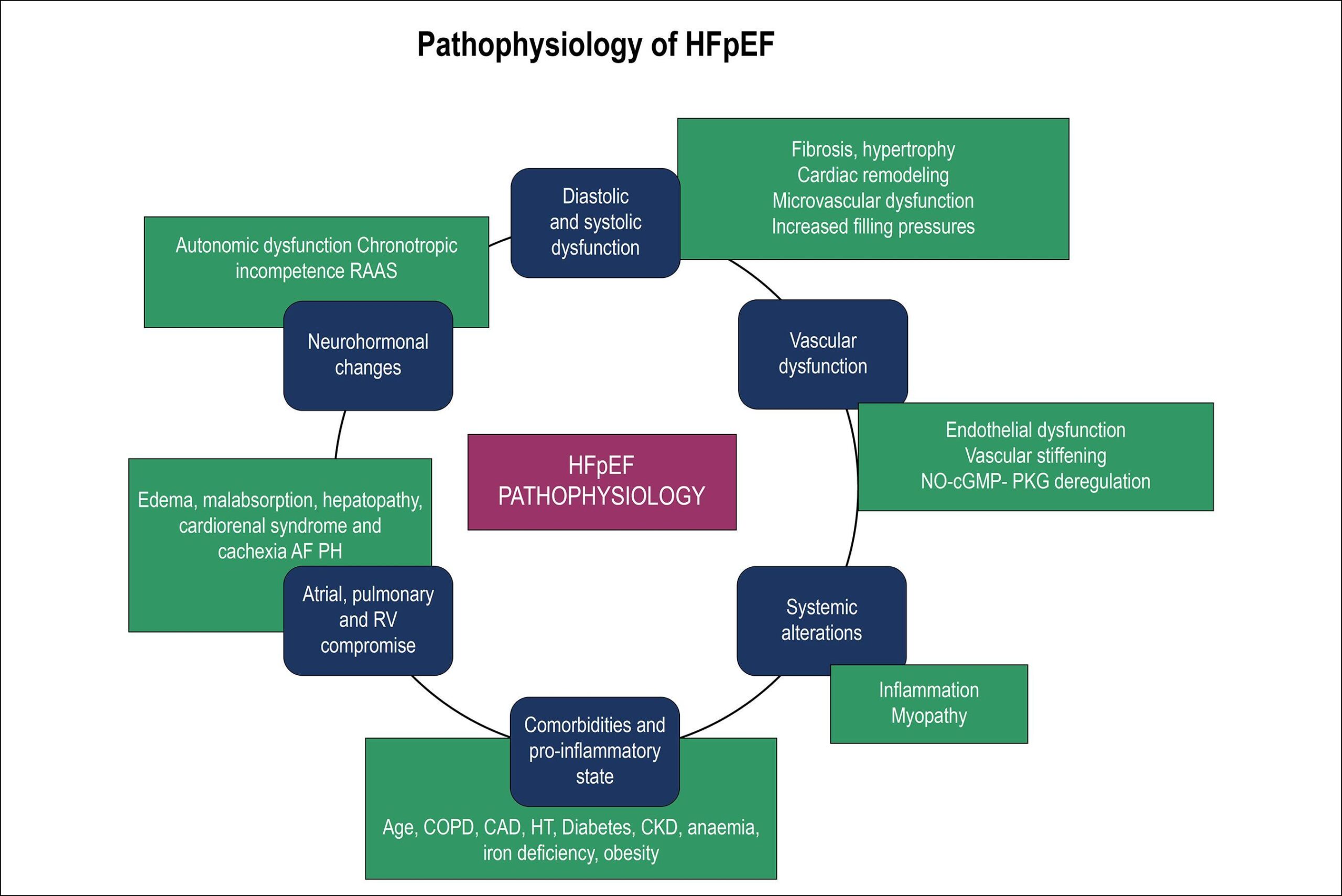
Pathophysiology and Treatment of Heart Failure with Preserved Ejection Fraction: State of the Art and Prospects for the Future

Sara Lopes Fernandes et al. Rita Ribeiro Carvalho Luís Graça Santos Fernando Montenegro Sá … Catarina Ruivo Sofia Lázaro Mendes Hélia Martins João Araujo Morais

Introduction

Heart failure (HF) is extremely prevalent and has a considerable impact on mortality and quality of life. It affects nearly 1-3% of the adult population in developed countries, exponentially increasing with age and affecting more than 10% of the population over 70 years. Given the increase in the average life expectancy, better diagnostic methods and increased comorbidities, a greater prevalence of heart failure is expected.

It is a clinical syndrome characterized by classic symptoms (such as fatigue, dyspnea) that may be accompanied by clinical signs (elevated jugular pressure, pulmonary crackles and peripheral edema). It is caused by structural and/or functional cardiac abnormalities, resulting in reduced cardiac output and/or elevated intracardiac pressures at rest or during stress.

[…]
  • Heart Failure / diagnosis
  • Heart Failure/complications
  • Heart Failure/drug therapy
  • Heart Failure/physiopathology
  • Systolic Volume
Read Full Article
Creative Commons Attribution (CC BY) Creative Commons license
14/11/2019 DOI: 10.36660/abc.20190111
IJCS
Original Article

Determinants of the Distance Covered During a Six-Minute Walk Test in Patients with Chronic Heart Failure

Elizabeth Rodrigues de Morais et al. Salvador Rassi

Abstract

Background:

The evaluation of the functional capacity of patients with chronic heart failure (HF) by means of the distance covered in the six-minute walk test (6MWT) has assumed great importance, since the 6MWD is a predictor of mortality and hospitalization in this population, however the determinants of better distance traveled in patients with HF are little explored, especially in the Brazilian population.

Objective:

To evaluate the determinants of 6MWD in patients with chronic HF.

Methods:

A cross-sectional study was performed with 81 HF patients in outpatient treatment. 6MWD was used as the outcome variable and sociodemographic, clinical, physical-functional and emotional data were submitted to multiple regression analysis using the stepwise method with a significance level of 5%.

Results:

Mean age of participants was 56.71 years; the 6MWD showed a bivariate correlation with age (r = -0.27, p = 0.01), maximal inspiratory pressure (r = 0.42, p < 0.01), maximal expiratory pressure (r = 0.36, p < 0.01), handgrip strength (r = 0.38, p < 0.01), Borg scale (-0.22, p = 0.04), Charlson index (r = -0.25, p = 0.02) and modified Medical Research Council (mMRC) dyspnea scale (r = -0.42, p < 0.01). In the multivariate analysis, the variables gender (p = 0.001), age (0.004), forced vital capacity (FVC) (p = 0.016) and mMRC (p = 0.001) simultaneously explained 37% of variance in the 6MWD.

Conclusion:

Higher levels of dyspnea on daily life activities, female sex, older age and lower forced vital capacity are determinants of a shorter 6MWD in patients with chronic HF.

  • Health Status Indicators
  • Heart Failure / diagnosis
  • Heart Failure/physiopathology
  • Reference Standards
  • Walk Test/methods
Read Full Article
Creative Commons Attribution (CC BY) Creative Commons license
01/11/2018 DOI: 10.5935/2359-4802.20180088 Views 1
Figure 1
ABC
Original Article

Neutrophil-to-Lymphocyte Ratio and Platelet-to-Lymphocyte Ratio are Predictors of Heart Failure

Erdal Durmus et al. Tarik Kivrak Fethullah Gerin Murat Sunbul … Ibrahim Sari Okan Erdogan

Abstract

Background:

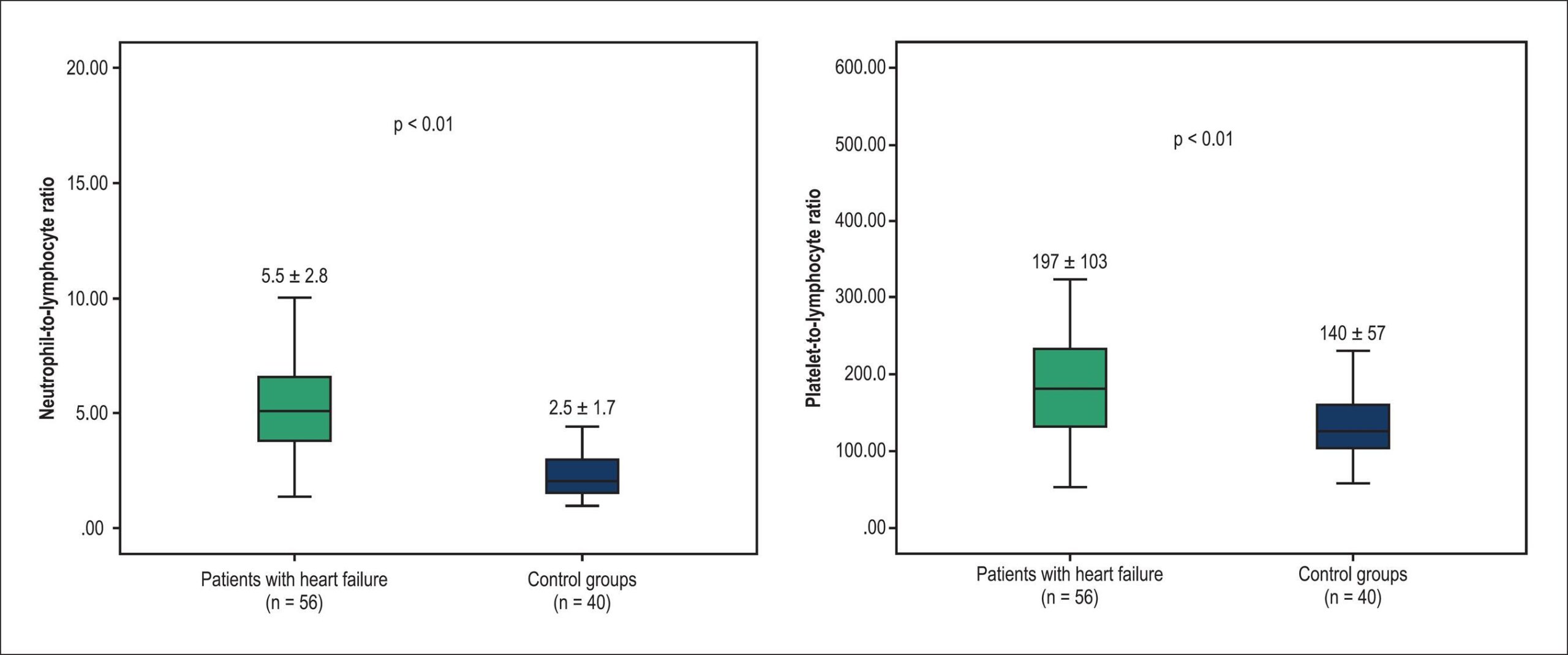
Neutrophil-to-lymphocyte ratio (NLR) and platelet-to-lymphocyte ratio (PLR) are inflammatory markers used as prognostic factors in various diseases. The aims of this study were to compare the PLR and the NLR of heart failure (HF) patients with those of age-sex matched controls, to evaluate the predictive value of those markers in detecting HF, and to demonstrate the effect of NLR and PLR on mortality in HF patients during follow-up.

Methods:

This study included 56 HF patients and 40 controls without HF. All subjects underwent transthoracic echocardiography to evaluate cardiac functions. The NLR and the PLR were calculated as the ratio of neutrophil count to lymphocyte count and as the ratio of platelet count to lymphocyte count, respectively. All HF patients were followed after their discharge from the hospital to evaluate mortality, cerebrovascular events, and re-hospitalization.

Results:

The NLR and the PLR of HF patients were significantly higher compared to those of the controls (p < 0.01). There was an inverse correlation between the NLR and the left ventricular ejection fraction of the study population (r: -0.409, p < 0.001). The best cut-off value of NLR to predict HF was 3.0, with 86.3% sensitivity and 77.5% specificity, and the best cut-off value of PLR to predict HF was 137.3, with 70% sensitivity and 60% specificity. Only NLR was an independent predictor of mortality in HF patients. A cut-off value of 5.1 for NLR can predict death in HF patients with 75% sensitivity and 62% specificity during a 12.8-month follow-up period on average.

Conclusion:

NLR and PLR were higher in HF patients than in age-sex matched controls. However, NLR and PLR were not sufficient to establish a diagnosis of HF. NLR can be used to predict mortality during the follow-up of HF patients.

  • Heart Failure / blood
  • Heart Failure / diagnosis
  • Leukocyte Count
  • Lymphocyte Count
  • multivariate analysis
  • Neutrophils / cytology
Read Full Article
Creative Commons Attribution (CC BY) Creative Commons license
03/11/2015 DOI: 10.5935/abc.20150126 Views 1

How to cite this article

EndNote RIS

Electronic Document Format (Vancouver)

Fernandes SL, Carvalho RR, Santos LG, Sá FM, Ruivo C, Mendes SL, Martins H, et al. Pathophysiology and Treatment of Heart Failure with Preserved Ejection Fraction: State of the Art and Prospects for the Future. Arquivos Brasileiros de Cardiologia 2019;114(1):120-9.

Electronic Document Format (ABNT)

Fernandes, Sara Lopes; Carvalho, Rita Ribeiro; Santos, Luís Graça; Sá, Fernando Montenegro; Ruivo, Catarina; Mendes, Sofia Lázaro; Martins, Hélia; Morais, João Araujo. Pathophysiology and Treatment of Heart Failure with Preserved Ejection Fraction: State of the Art and Prospects for the Future. Arquivos Brasileiros de Cardiologia, v. 114, n. 1, p. 120-129, Nov. 2019.

Electronic Document Format (APA)

Fernandes, S. L., Carvalho, R. R., Santos, L. G., Sá, F. M., Ruivo, C., Mendes, S. L., Martins, H., & Morais, J. A. (2019). Pathophysiology and Treatment of Heart Failure with Preserved Ejection Fraction: State of the Art and Prospects for the Future. Arquivos Brasileiros de Cardiologia, 114(1), 120-129.

Electronic Document Format (ISO)

Fernandes, Sara Lopes and Carvalho, Rita Ribeiro and Santos, Luís Graça and Sá, Fernando Montenegro and Ruivo, Catarina and Mendes, Sofia Lázaro and Martins, Hélia and Morais, João Araujo. Pathophysiology and Treatment of Heart Failure with Preserved Ejection Fraction: State of the Art and Prospects for the Future. Arquivos Brasileiros de Cardiologia [online]. 2019, vol. 114, n. 1, [cited 2026-10-14], pp. 120-129. Available from: <https://journals.cardiol.br/en/article/pathophysiology-and-treatment-of-heart-failure-with-preserved-ejection-fraction-state-of-the-art-and-prospects-for-the-future/>. ISSN 0066-782X

EndNote RIS

Electronic Document Format (Vancouver)

Morais ER, Rassi S. Determinants of the Distance Covered During a Six-Minute Walk Test in Patients with Chronic Heart Failure. International Journal of Cardiovascular Sciences 2018;32(2):134-42.

Electronic Document Format (ABNT)

Morais, Elizabeth Rodrigues de; Rassi, Salvador. Determinants of the Distance Covered During a Six-Minute Walk Test in Patients with Chronic Heart Failure. International Journal of Cardiovascular Sciences, v. 32, n. 2, p. 134-142, Oct. 2018.

Electronic Document Format (APA)

Morais, E. R. , & Rassi, S. (2018). Determinants of the Distance Covered During a Six-Minute Walk Test in Patients with Chronic Heart Failure. International Journal of Cardiovascular Sciences, 32(2), 134-142.

Electronic Document Format (ISO)

Morais, Elizabeth Rodrigues de and Rassi, Salvador. Determinants of the Distance Covered During a Six-Minute Walk Test in Patients with Chronic Heart Failure. International Journal of Cardiovascular Sciences [online]. 2018, vol. 32, n. 2, [cited 2026-10-14], pp. 134-142. Available from: <https://journals.cardiol.br/en/article/determinants-of-the-distance-covered-during-a-six-minute-walk-test-in-patients-with-chronic-heart-failure/>. ISSN 2359-4802

EndNote RIS

Electronic Document Format (Vancouver)

Durmus E, Kivrak T, Gerin F, Sunbul M, Sari I, Erdogan O. Neutrophil-to-Lymphocyte Ratio and Platelet-to-Lymphocyte Ratio are Predictors of Heart Failure. Arquivos Brasileiros de Cardiologia 2015;105(6):606-13.

Electronic Document Format (ABNT)

Durmus, Erdal; Kivrak, Tarik; Gerin, Fethullah; Sunbul, Murat; Sari, Ibrahim; Erdogan, Okan. Neutrophil-to-Lymphocyte Ratio and Platelet-to-Lymphocyte Ratio are Predictors of Heart Failure. Arquivos Brasileiros de Cardiologia, v. 105, n. 6, p. 606-613, Nov. 2015.

Electronic Document Format (APA)

Durmus, E., Kivrak, T., Gerin, F., Sunbul, M., Sari, I., & Erdogan, O. (2015). Neutrophil-to-Lymphocyte Ratio and Platelet-to-Lymphocyte Ratio are Predictors of Heart Failure. Arquivos Brasileiros de Cardiologia, 105(6), 606-613.

Electronic Document Format (ISO)

Durmus, Erdal and Kivrak, Tarik and Gerin, Fethullah and Sunbul, Murat and Sari, Ibrahim and Erdogan, Okan. Neutrophil-to-Lymphocyte Ratio and Platelet-to-Lymphocyte Ratio are Predictors of Heart Failure. Arquivos Brasileiros de Cardiologia [online]. 2015, vol. 105, n. 6, [cited 2026-10-14], pp. 606-613. Available from: <https://journals.cardiol.br/en/article/neutrophil-to-lymphocyte-ratio-and-platelet-to-lymphocyte-ratio-are-predictors-of-heart-failure/>. ISSN 0066-782X

  • About ABC Family
  • Internal Regulation
  • Editorial Board
  • Brazilian Society of Cardiology (SBC)

Issues

SBC Guidelines

  • Videos
  • Podcasts
  • News