ABC Family Arquivos Brasileiros de Cardiologia International Journal of Cardiovascular Sciences ABC Heart Failure & Cardiomyopathy ABC Imagem Cardiovascular
Português English
ABC Family
Português English
  • About
    • About ABC Family
    • Internal Regulation
    • Editorial Board
    • Brazilian Society of Cardiology (SBC)
  • Issues
  • SBC Guidelines
  • Content
    • Videos
    • Podcasts
    • News
  • About
    • About ABC Family
    • Internal Regulation
    • Editorial Board
    • Brazilian Society of Cardiology (SBC)
  • Issues
  • SBC Guidelines
  • Content
    • Videos
    • Podcasts
    • News

ABC Family

  • ABC Family
  • Arquivos Brasileiros de Cardiologia
  • International Journal of Cardiovascular Sciences
  • ABC Heart Failure & Cardiomyopathy
  • ABC Imagem Cardiovascular
Search in

No content found.

Journals
Ordering
Article types
Others

  1. Home
  2. Keyword: Natriuretic Peptide, B-Type
Figure 1
ABC
Original Article

Prognostic Value of Troponin-T and B-Type Natriuretic Peptide in Patients Hospitalized for COVID-19

Gustavo Luiz Gouvêa de Almeida Junior et al. Fabricio Braga José Kezen Jorge Gustavo Freitas Nobre … Marcelo Kalichsztein Paula de Medeiros Pache de Faria Bruno Bussade Guilherme Loures Penna Vitor Oliveira Alves Marcella Alecrim Pereira Paula de Castro Gorgulho Milena Rego dos Santos Espelta de Faria Luis Eduardo Drumond Fabrini Batista Soares Carpinete Ana Carolina Lessa Brandão Neno Augusto César de Araújo Neno

Abstract

Background:

COVID-19 causes severe pulmonary involvement, but the cardiovascular system can also be affected by myocarditis, heart failure and shock. The increase in cardiac biomarkers has been associated with a worse prognosis.

Objectives:

To evaluate the prognostic value of Troponin-T (TNT) and natriuretic peptide (BNP) in patients hospitalized for Covid-19.

Methods:

This was a convenience sample of patients hospitalized for COVID-19. Data were collected from medical records to assess the association of TnT and BNP measured in the first 24 hours of hospital admission with the combined outcome (CO) of death or need for mechanical ventilation. Univariate analysis was used to compare the groups with and without the CO. Cox’s multivariate model was used to determine independent predictors of the CO.

Results:

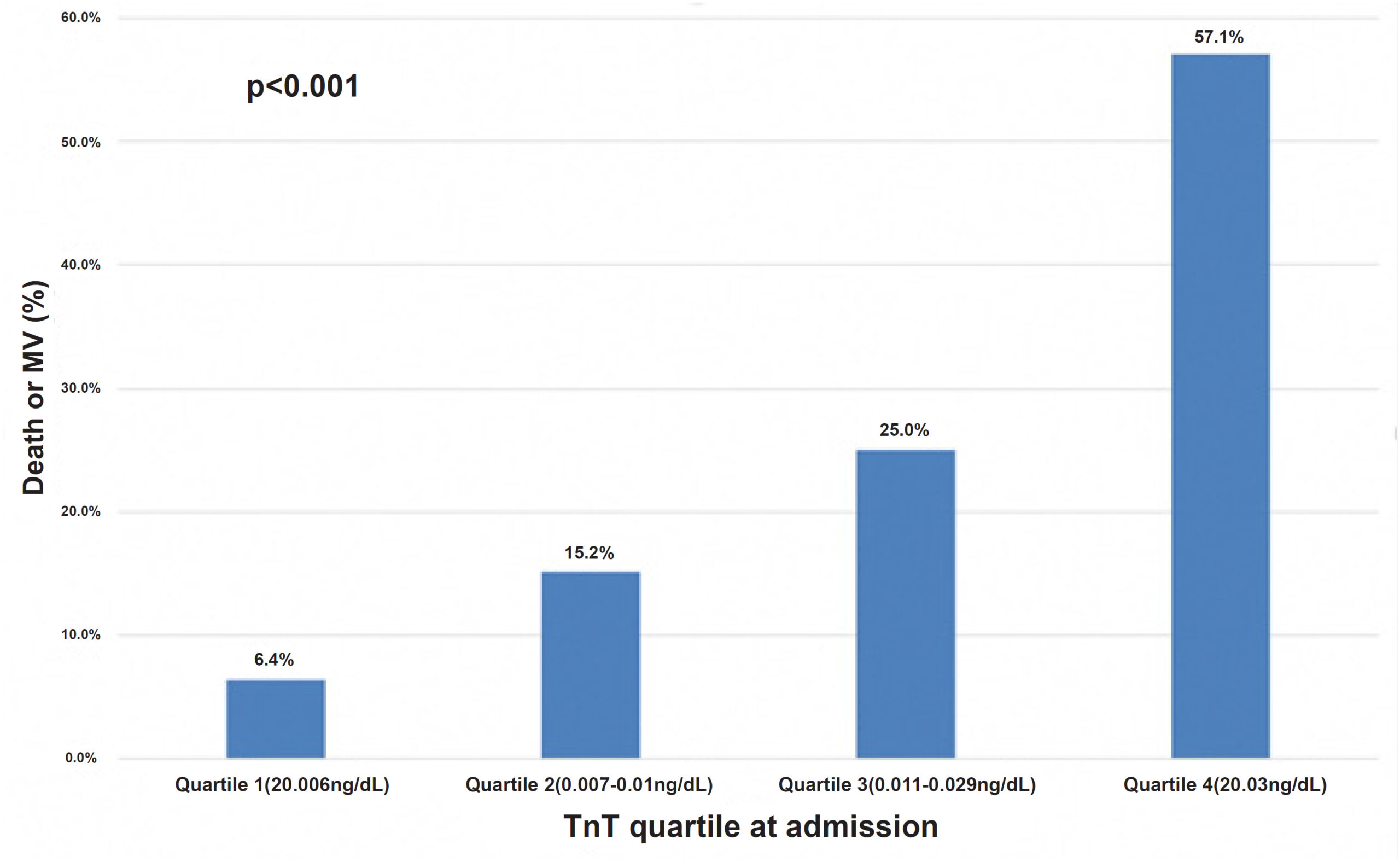
We evaluated 183 patients (age = 66.8±17 years, 65.6% of which were males). The time of follow-up was 7 days (range 1 to 39 days). The CO occurred in 24% of the patients. The median troponin-T and BNP levels were 0.011 and 0.041ng/dL (p <0.001); 64 and 198 pg/dL (p <0.001), respectively, for the groups without and with the CO. In the univariate analysis, in addition to TnT and BNP, age, presence of coronary disease, oxygen saturation, lymphocytes, D-dimer, t-CRP and creatinine, were different between groups with and without outcomes. In the bootstrap multivariate analysis, only TnT (1.12 [95% CI 1.03-1.47]) and t-CRP (1.04 [95% CI 1.00-1.10]) were independent predictors of the CO.

Conclusion:

In the first 24h of admission, TnT, but not BNP, was an independent marker of mortality or need for invasive mechanical ventilation. This finding further reinforces the clinical importance of cardiac involvement in COVID-19. (Arq Bras Cardiol. 2020; 115(4):660-666)
  • Betacoronavirus
  • Biomarkers
  • Cardiovascular Diseases/complications
  • Inpatients
  • Natriuretic Peptide, B-Type
  • Pandemics
  • SARS-CoV-2
  • Troponin T
Read Full Article
Creative Commons Attribution (CC BY) Creative Commons license
23/10/2020 DOI: 10.36660/abc.20200385
ABC
Letter to the Editor

How to Approach Elevated NT-pro BNP Level on Admission to Prevent Left Ventricular Aneurysm Following Acute ST-Segment Elevation Myocardial Infarction

Teruhiko Imamura

I have read with great interest the article written by Celebi and colleagues, demonstrating that elevated plasma N-terminal pro-B-type natriuretic peptide (NT-pro BNP) level on admission is a significant predictive biomarker of development of left ventricular aneurysm following acute ST-segment elevation myocardial infarction (STEMI) in the current era.

Their findings are straightforward and would lead us the next concerns. The first concern is reversibility of NT-pro BNP and its impact on post-STEMI outcomes. Is the reduction of NT-pro BNP following STEMI associated with a lower rate of left ventricular aneurysm formation?

[…]

  • Coronary Aneurysm/complications
  • Heart Failure/physiopathology
  • Indicators of Morbidity and Mortality
  • Natriuretic Peptide, B-Type
  • ST Elevation Myocardial Infarction
  • Stroke Volume
Read Full Article
Creative Commons Attribution (CC BY) Creative Commons license
20/03/2020 DOI: 10.36660/abc.20190773 Views 1
B-type natriuretic peptide is predictive of postoperative events in orthopedic surgery
ABC
Artigo Original

B-type natriuretic peptide is predictive of postoperative events in orthopedic surgery

Humberto Villacorta Junior et al. Isabela Simões de Castro Marise Godinho Camila Mattos … Rogério Visconti Maurício Saud Mônica Novais Cláudia Murad Fernanda Nogueira

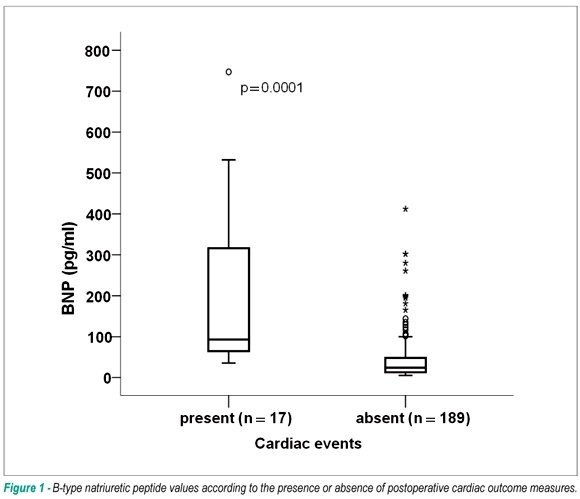
BACKGROND: Clinical assessment is not always sufficient to predict postoperative (PO) cardiac complications. B-type natriuretic peptide (BNP) has an important prognostic value in patients with heart failure. Its value as a predictor of events in orthopedic surgeries has not yet been tested. OBJECTIVE: To assess the value of BNP in predicting cardiac complications in the PO period of orthopedic surgeries. METHODS: A total of 208 patients undergoing surgical treatment of femur fracture and hip or knee arthroplasty were prospectively evaluated. Of these, 149 (71.6%) were women and the mean age was 72.6 ± 8.8 years. In the preoperative period, the patients underwent conventional clinical assessment and their surgical risk was estimated according to the American Society of Anesthesiologists’ (ASA) classification. BNP was determined in the preoperative period, and its ability to predict PO cardiac events (death; acute myocardial infarction; unstable angina; atrial fibrillation; ventricular tachycardia; or heart failure) was analyzed using multivariate logistic regression analysis. RESULTS: Seventeen patients (8.0%) experienced cardiac events. Median BNP was significantly higher in these patients in comparison to those without cardiac events (93 [interquartile range 73-424] vs 26.6 [13.2-53.1], p = 0.0001). BNP was the main independent predictor of events (p = 0.01). The ASA classification was not an independent predictor. Analysis of the ROC curve demonstrated that for a cut-off point of 60pg/mL, BNP showed sensitivity of 76.0% and specificity of 79.0% in the prediction of events, with an area under the curve of 83.0%. CONCLUSION: BNP is an independent predictor of PO cardiac events in orthopedic surgeries.

  • Natriuretic Peptide, B-Type
  • orthopedic procedures
  • Orthopedics
  • Postoperative Care
Read Full Article
Creative Commons Attribution (CC BY) Creative Commons license
24/09/2010 DOI: 10.1590/S0066-782X2010005000131 Views 1
B-type natriuretic peptide assessment in the diagnosis of rejection after pediatric heart transplant
ABC
Artigo Original

B-type natriuretic peptide assessment in the diagnosis of rejection after pediatric heart transplant

Cristina de Sylos et al. Estela Azeka Luis Kajita Luis Benvenutti … Célia Cassaro Strunz Klébia Castello Branco Arlindo Almeida Riso Carla Tanamati Marcelo Jatene Miguel Barbero-Marcial

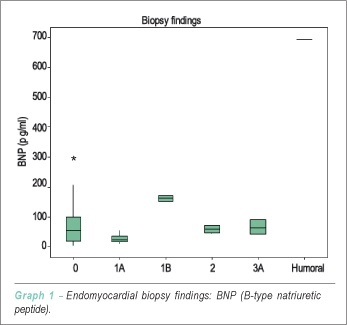
BACKGROUND: Rejection is one of the major causes of mortality following pediatric heart transplant. B-type natriuretic peptide (BNP) has been studied as a method for the diagnosis of acute rejection, especially in adult patients undergoing heart transplant. OBJECTIVE: To correlate serum BNP levels with acute rejection as diagnosed by endomyocardial biopsy in patients of the pediatric heart transplant group. METHODS: A total of 50 BNP samples were collected from 33 children in the postoperative period of heart transplant, and data on age, gender, skin color, blood group, immune panel, follow-up time after transplant, functional class, immunosuppressive regimen used and number of rejections were analyzed. RESULTS: Thirty three children with median age of 10.13 years were analyzed; of these, 54% were females and 78% were Caucasians. BNP levels were determined at a mean time from transplant of 4.25 years. Nine episodes of rejection were diagnosed in eight patients (27%) by means of endomyocardial biopsy; of these, three were grade 3A, five were grade 2, and one had humoral rejection. At the moment of biopsy, most patients were asymptomatic. The mean serum BNP level was 77.18 pg/ml, with 144.22 pg/ml in the group with rejection and 62.46 pg/ml in the group without rejection, with p = 0.02. CONCLUSION: Asymptomatic children can present acute rejection in the postoperative period of heart transplant. Serum BNP levels show a statistically significant difference in the group with rejection and thus can be an additional method in the diagnosis of cardiac rejection.

  • Biopsy
  • Children
  • Graft Rejection
  • Heart Transplantation
  • Natriuretic Peptide, B-Type
Read Full Article
Creative Commons Attribution (CC BY) Creative Commons license
17/04/2009 DOI: 10.1590/S0066-782X2009000300011 Views 1
ABC
Artigo Original

Positive end-expiratory pressure and renal function influence B-type natriuretic peptide in patients with severe sepsis and septic shock

Victor Sarli Issa et al. Leandro Utino Taniguchi Marcelo Park Luiz Monteiro Cruz … Edimar Alcides Bocchi Irineu Tadeu Velasco Francisco Soriano

BACKGROUND: Myocardial dysfunction is a complication associated with a poor prognosis in septic patients. A biomarker of cardiac function providing prognostic information is of paramount interest. OBJECTIVE: We sought to determine the value of B-type natriuretic peptide in patients with severe sepsis/septic shock. METHODS: We performed a prospective study in patients with severe sepsis/septic shock in a medical intensive care unit. B-type natriuretic peptide level was determined within 24 hours after the diagnosis of severe sepsis/septic shock. We also analyzed mortality, and presence of association between B-type natriuretic peptide and clinical, hemodynamic and respiratory variables. RESULTS: 23 (9 women; 14 men) patients with ages ranging from 20-79 (mean 51.3±18.6) years old and APACHE score of 22.6±11.8 were included; 15 (65.2%) patients received pulmonary artery catheters, and 20 (87%) were mechanically ventilated. Multivariate analysis disclosed inverse association between B-type natriuretic peptide values with positive end-expiratory pressure values, and direct association with creatinine (beta 0.548 and 0.377, p 0.02 and 0.002, respectively), but not with mortality, clinical and hemodynamic parameters. CONCLUSION: This is the first report on an inverse association between positive end-expiratory pressure and BNP levels in patients with severe sepsis and septic shock. BNP and creatinine levels should be taken into consideration when analyzing B-type natriuretic peptide levels in this setting.

  • cardiac output, low
  • Natriuretic Peptide, B-Type
  • positive pressure respiration
  • Sepsis
  • Shock
Read Full Article
Creative Commons Attribution (CC BY) Creative Commons license
11/08/2008 DOI: 10.1590/S0066-782X2008001400008 Views 1

How to cite this article

EndNote RIS

Electronic Document Format (Vancouver)

Almeida Junior GLG, Braga F, Jorge JK, Nobre GF, Kalichsztein M, Faria PMP, Bussade B, et al. Prognostic Value of Troponin-T and B-Type Natriuretic Peptide in Patients Hospitalized for COVID-19. Arquivos Brasileiros de Cardiologia 2020;115(4):660-6.

Electronic Document Format (ABNT)

Almeida Junior, Gustavo Luiz Gouvêa de; Braga, Fabricio; Jorge, José Kezen; Nobre, Gustavo Freitas; Kalichsztein, Marcelo; Faria, Paula de Medeiros Pache de; Bussade, Bruno; Penna, Guilherme Loures; Alves, Vitor Oliveira; Pereira, Marcella Alecrim; Gorgulho, Paula de Castro; Faria, Milena Rego dos Santos Espelta de; Drumond, Luis Eduardo; Carpinete, Fabrini Batista Soares; Neno, Ana Carolina Lessa Brandão; Neno, Augusto César de Araújo. Prognostic Value of Troponin-T and B-Type Natriuretic Peptide in Patients Hospitalized for COVID-19. Arquivos Brasileiros de Cardiologia, v. 115, n. 4, p. 660-666, Oct. 2020.

Electronic Document Format (APA)

Almeida Junior, G. L. G. , Braga, F., Jorge, J. K., Nobre, G. F., Kalichsztein, M., Faria, P. M. P. , Bussade, B., Penna, G. L., Alves, V. O., Pereira, M. A., Gorgulho, P. C., Faria, M. R. S. E. , Drumond, L. E., Carpinete, F. B. S., Neno, A. C. L. B., & Neno, A. C. A. (2020). Prognostic Value of Troponin-T and B-Type Natriuretic Peptide in Patients Hospitalized for COVID-19. Arquivos Brasileiros de Cardiologia, 115(4), 660-666.

Electronic Document Format (ISO)

Almeida Junior, Gustavo Luiz Gouvêa de and Braga, Fabricio and Jorge, José Kezen and Nobre, Gustavo Freitas and Kalichsztein, Marcelo and Faria, Paula de Medeiros Pache de and Bussade, Bruno and Penna, Guilherme Loures and Alves, Vitor Oliveira and Pereira, Marcella Alecrim and Gorgulho, Paula de Castro and Faria, Milena Rego dos Santos Espelta de and Drumond, Luis Eduardo and Carpinete, Fabrini Batista Soares and Neno, Ana Carolina Lessa Brandão and Neno, Augusto César de Araújo. Prognostic Value of Troponin-T and B-Type Natriuretic Peptide in Patients Hospitalized for COVID-19. Arquivos Brasileiros de Cardiologia [online]. 2020, vol. 115, n. 4, [cited 2026-10-14], pp. 660-666. Available from: <https://journals.cardiol.br/en/article/prognostic-value-of-troponin-t-and-b-type-natriuretic-peptide-in-patients-hospitalized-for-covid-19/>. ISSN 0066-782X

EndNote RIS

Electronic Document Format (Vancouver)

Imamura T. How to Approach Elevated NT-pro BNP Level on Admission to Prevent Left Ventricular Aneurysm Following Acute ST-Segment Elevation Myocardial Infarction. Arquivos Brasileiros de Cardiologia 2020;114(2):323-4.

Electronic Document Format (ABNT)

Imamura, Teruhiko. How to Approach Elevated NT-pro BNP Level on Admission to Prevent Left Ventricular Aneurysm Following Acute ST-Segment Elevation Myocardial Infarction. Arquivos Brasileiros de Cardiologia, v. 114, n. 2, p. 323-324, Mar. 2020.

Electronic Document Format (APA)

Imamura, T. (2020). How to Approach Elevated NT-pro BNP Level on Admission to Prevent Left Ventricular Aneurysm Following Acute ST-Segment Elevation Myocardial Infarction. Arquivos Brasileiros de Cardiologia, 114(2), 323-324.

Electronic Document Format (ISO)

Imamura, Teruhiko. How to Approach Elevated NT-pro BNP Level on Admission to Prevent Left Ventricular Aneurysm Following Acute ST-Segment Elevation Myocardial Infarction. Arquivos Brasileiros de Cardiologia [online]. 2020, vol. 114, n. 2, [cited 2026-10-14], pp. 323-324. Available from: <https://journals.cardiol.br/en/article/how-to-approach-elevated-nt-pro-bnp-level-on-admission-to-prevent-left-ventricular-aneurysm-following-acute-st-segment-elevation-myocardial-infarction/>. ISSN 0066-782X

EndNote RIS

Electronic Document Format (Vancouver)

Villacorta Junior H, Castro IS, Godinho M, Mattos C, Visconti R, Saud M, Novais M, et al. B-type natriuretic peptide is predictive of postoperative events in orthopedic surgery. Arquivos Brasileiros de Cardiologia 2010;95(6):743-8.

Electronic Document Format (ABNT)

Villacorta Junior, Humberto; Castro, Isabela Simões de; Godinho, Marise; Mattos, Camila; Visconti, Rogério; Saud, Maurício; Novais, Mônica; Murad, Cláudia; Nogueira, Fernanda. B-type natriuretic peptide is predictive of postoperative events in orthopedic surgery. Arquivos Brasileiros de Cardiologia, v. 95, n. 6, p. 743-748, Sep. 2010.

Electronic Document Format (APA)

Villacorta Junior, H., Castro, I. S. , Godinho, M., Mattos, C., Visconti, R., Saud, M., Novais, M., Murad, C., & Nogueira, F. (2010). B-type natriuretic peptide is predictive of postoperative events in orthopedic surgery. Arquivos Brasileiros de Cardiologia, 95(6), 743-748.

Electronic Document Format (ISO)

Villacorta Junior, Humberto and Castro, Isabela Simões de and Godinho, Marise and Mattos, Camila and Visconti, Rogério and Saud, Maurício and Novais, Mônica and Murad, Cláudia and Nogueira, Fernanda. B-type natriuretic peptide is predictive of postoperative events in orthopedic surgery. Arquivos Brasileiros de Cardiologia [online]. 2010, vol. 95, n. 6, [cited 2026-10-14], pp. 743-748. Available from: <https://journals.cardiol.br/en/article/b-type-natriuretic-peptide-is-predictive-of-postoperative-events-in-orthopedic-surgery/>. ISSN 0066-782X

EndNote RIS

Electronic Document Format (Vancouver)

Sylos C, Azeka E, Kajita L, Benvenutti L, Strunz CC, Branco KC, Riso AA, et al. B-type natriuretic peptide assessment in the diagnosis of rejection after pediatric heart transplant. Arquivos Brasileiros de Cardiologia 2009;92(3):227-32.

Electronic Document Format (ABNT)

Sylos, Cristina de; Azeka, Estela; Kajita, Luis; Benvenutti, Luis; Strunz, Célia Cassaro; Branco, Klébia Castello; Riso, Arlindo Almeida; Tanamati, Carla; Jatene, Marcelo; Barbero-Marcial, Miguel. B-type natriuretic peptide assessment in the diagnosis of rejection after pediatric heart transplant. Arquivos Brasileiros de Cardiologia, v. 92, n. 3, p. 227-232, Apr. 2009.

Electronic Document Format (APA)

Sylos, C. , Azeka, E., Kajita, L., Benvenutti, L., Strunz, C. C., Branco, K. C., Riso, A. A., Tanamati, C., Jatene, M., & Barbero-Marcial, M. (2009). B-type natriuretic peptide assessment in the diagnosis of rejection after pediatric heart transplant. Arquivos Brasileiros de Cardiologia, 92(3), 227-232.

Electronic Document Format (ISO)

Sylos, Cristina de and Azeka, Estela and Kajita, Luis and Benvenutti, Luis and Strunz, Célia Cassaro and Branco, Klébia Castello and Riso, Arlindo Almeida and Tanamati, Carla and Jatene, Marcelo and Barbero-Marcial, Miguel. B-type natriuretic peptide assessment in the diagnosis of rejection after pediatric heart transplant. Arquivos Brasileiros de Cardiologia [online]. 2009, vol. 92, n. 3, [cited 2026-10-14], pp. 227-232. Available from: <https://journals.cardiol.br/en/article/b-type-natriuretic-peptide-assessment-in-the-diagnosis-of-rejection-after-pediatric-heart-transplant/>. ISSN 0066-782X

EndNote RIS

Electronic Document Format (Vancouver)

Issa VS, Taniguchi LU, Park M, Cruz LM, Bocchi EA, Velasco IT, Soriano F, et al. Positive end-expiratory pressure and renal function influence B-type natriuretic peptide in patients with severe sepsis and septic shock. Arquivos Brasileiros de Cardiologia 2008;91(2):119-25.

Electronic Document Format (ABNT)

Issa, Victor Sarli; Taniguchi, Leandro Utino; Park, Marcelo; Cruz, Luiz Monteiro; Bocchi, Edimar Alcides; Velasco, Irineu Tadeu; Soriano, Francisco. Positive end-expiratory pressure and renal function influence B-type natriuretic peptide in patients with severe sepsis and septic shock. Arquivos Brasileiros de Cardiologia, v. 91, n. 2, p. 119-125, Aug. 2008.

Electronic Document Format (APA)

Issa, V. S., Taniguchi, L. U., Park, M., Cruz, L. M., Bocchi, E. A., Velasco, I. T., & Soriano, F. (2008). Positive end-expiratory pressure and renal function influence B-type natriuretic peptide in patients with severe sepsis and septic shock. Arquivos Brasileiros de Cardiologia, 91(2), 119-125.

Electronic Document Format (ISO)

Issa, Victor Sarli and Taniguchi, Leandro Utino and Park, Marcelo and Cruz, Luiz Monteiro and Bocchi, Edimar Alcides and Velasco, Irineu Tadeu and Soriano, Francisco. Positive end-expiratory pressure and renal function influence B-type natriuretic peptide in patients with severe sepsis and septic shock. Arquivos Brasileiros de Cardiologia [online]. 2008, vol. 91, n. 2, [cited 2026-10-14], pp. 119-125. Available from: <https://journals.cardiol.br/en/article/positive-end-expiratory-pressure-and-renal-function-influence-b-type-natriuretic-peptide-in-patients-with-severe-sepsis-and-septic-shock/>. ISSN 0066-782X

  • About ABC Family
  • Internal Regulation
  • Editorial Board
  • Brazilian Society of Cardiology (SBC)

Issues

SBC Guidelines

  • Videos
  • Podcasts
  • News