ABC Family Arquivos Brasileiros de Cardiologia International Journal of Cardiovascular Sciences ABC Heart Failure & Cardiomyopathy ABC Imagem Cardiovascular
Português English
ABC Family
Português English
  • About
    • About ABC Family
    • Internal Regulation
    • Editorial Board
    • Brazilian Society of Cardiology (SBC)
  • Issues
  • SBC Guidelines
  • Content
    • Videos
    • Podcasts
    • News
  • About
    • About ABC Family
    • Internal Regulation
    • Editorial Board
    • Brazilian Society of Cardiology (SBC)
  • Issues
  • SBC Guidelines
  • Content
    • Videos
    • Podcasts
    • News

ABC Family

  • ABC Family
  • Arquivos Brasileiros de Cardiologia
  • International Journal of Cardiovascular Sciences
  • ABC Heart Failure & Cardiomyopathy
  • ABC Imagem Cardiovascular
Search in

No content found.

Journals
Ordering
Article types
Others

  1. Home
  2. Keyword: positive pressure respiration
ABC
Artigo Original

Expiratory positive airway pressure in postoperative cardiac hemodynamics

Ana Claudia Borges dos Santos Sena et al. Sérgio Pinto Ribeiro Robledo Leal Condessa Sílvia Regina Rios Vieira

BACKGROND: Expiratory positive airway pressure (EPAP) is used in after cardiac surgeries. However, its hemodynamic effects have not been clearly studied. OBJECTIVE: To evaluate the hemodynamic changes caused by EPAP in patients after cardiac surgery monitored by Swan-Ganz. METHODS: Patients at the first or second cardiac surgery postoperative period hemodynamically stable with a Swan-Ganz catheter were included in the study. They were assessed at rest and after using 10 cmH2O EPAP at random. The variables studied were: oxygen saturation, heart rate and respiratory rate, mean artery pressures and pulmonary artery mean pressures (MAP and PAMP), central venous pressure (CVP) and pulmonary capillary wedge pressure (PAOP), cardiac output and index, and systemic and pulmonary vascular resistances. Patients were divided into subgroups (with ejection fraction 50%) and data were compared by t test and ANOVA. RESULTS: Twenty-eight patients were studied (22 men, aged 68 ± 11 years). Comparing the period of rest versus EPAP, the changes observed were: PAOP (11.9 ± 3.8 to 17.1 ± 4.9 mmHg, p < 0.001), PVC (8.7 ± 4.1 to 10.9 ± 4.3 mmHg, p = 0.014), PAMP (21.5 ± 4.2 to 26.5 ± 5.8 mmHg, p < 0.001), MAP (76 ± 10 for 80 ± 10 mmHg, p = 0.035). The other variables showed no significant differences. CONCLUSION: EPAP was well tolerated by patients and the hemodynamic changes found showed an increase in pressure measurements of right and left ventricular filling, as well as mean arterial pressure.
  • Cardiac Output
  • facial masks
  • Hypertension
  • positive pressure respiration
  • Thoracic Surgery
Read Full Article
Creative Commons Attribution (CC BY) Creative Commons license
24/09/2010 DOI: 10.1590/S0066-782X2010005000128 Views 1
ABC
Artigo Original

Positive end-expiratory pressure and renal function influence B-type natriuretic peptide in patients with severe sepsis and septic shock

Victor Sarli Issa et al. Leandro Utino Taniguchi Marcelo Park Luiz Monteiro Cruz … Edimar Alcides Bocchi Irineu Tadeu Velasco Francisco Soriano

BACKGROUND: Myocardial dysfunction is a complication associated with a poor prognosis in septic patients. A biomarker of cardiac function providing prognostic information is of paramount interest. OBJECTIVE: We sought to determine the value of B-type natriuretic peptide in patients with severe sepsis/septic shock. METHODS: We performed a prospective study in patients with severe sepsis/septic shock in a medical intensive care unit. B-type natriuretic peptide level was determined within 24 hours after the diagnosis of severe sepsis/septic shock. We also analyzed mortality, and presence of association between B-type natriuretic peptide and clinical, hemodynamic and respiratory variables. RESULTS: 23 (9 women; 14 men) patients with ages ranging from 20-79 (mean 51.3±18.6) years old and APACHE score of 22.6±11.8 were included; 15 (65.2%) patients received pulmonary artery catheters, and 20 (87%) were mechanically ventilated. Multivariate analysis disclosed inverse association between B-type natriuretic peptide values with positive end-expiratory pressure values, and direct association with creatinine (beta 0.548 and 0.377, p 0.02 and 0.002, respectively), but not with mortality, clinical and hemodynamic parameters. CONCLUSION: This is the first report on an inverse association between positive end-expiratory pressure and BNP levels in patients with severe sepsis and septic shock. BNP and creatinine levels should be taken into consideration when analyzing B-type natriuretic peptide levels in this setting.

  • cardiac output, low
  • Natriuretic Peptide, B-Type
  • positive pressure respiration
  • Sepsis
  • Shock
Read Full Article
Creative Commons Attribution (CC BY) Creative Commons license
11/08/2008 DOI: 10.1590/S0066-782X2008001400008 Views 1
Analysis of ventilation and hemodynamic changes resulting from noninvasive bilevel pressure mechanical ventilation applied to patients with congestive heart failure
ABC
Artigo Original

Analysis of ventilation and hemodynamic changes resulting from noninvasive bilevel pressure mechanical ventilation applied to patients with congestive heart failure

Ariadne Fernandes de Barros et al. Luciana Costa de Barros Márcia Cristina Sangean Joaquim Minuzo Vega

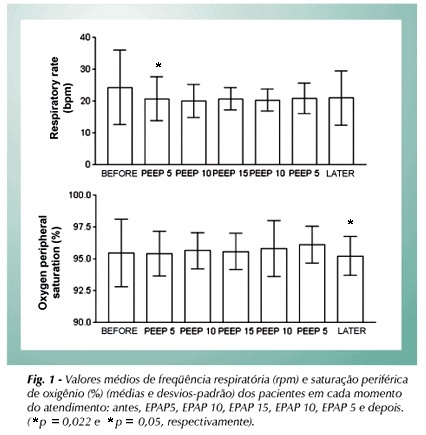
OBJECTIVE: To observe in practice how noninvasive bilevel positive pressure, applied at different levels, may interfere with systolic arterial pressure (SAP), diastolic arterial pressure (DAP), mean arterial pressure (MAP), heart rate (HR), respiratory rate (RR), and peripheral oxygen saturation (SpO2), in patients with congestive heart failure (CHF). METHODS: Fourteen CHF patients (mean age 62.85 years) were treated with noninvasive bilevel mechanical ventilation. Patients were consecutively treated with an expiratory positive airway pressure (EPAP) of 5 cmH2O, 10 cmH2O, 15 cmH2O, 10 cmH2O, and 5 cmH2O, maintaining a variation in pressure (deltaP) of 5 cmH2O between the inspiratory pressure (IPAP) and the expiratory pressure (EPAP). Ventilation and hemodynamic data were collected at these time points, as well as 5 minutes before the beginning of the protocol and 5 minutes after its completion. RESULTS: A statistically significant difference was observed in the respiratory rate between the moment just before the beginning of the protocol and 5 minutes after positive pressure mask placement (p=0.022), and in oxygen saturation, between the final minute of EPAP at 5 cmH2O and after the removal of the mask (p=0.05). CONCLUSION: Noninvasive bilevel mechanical ventilation improves oxygenation and reduces respiratory work, thus being beneficial for patients with congestive heart failure. It was not possible to observe statistically significant changes in the hemodynamic data due to the small number of patients and to other associated heart diseases.

  • Artificial Respiration
  • congestive heart failure
  • Failure heart
  • positive pressure respiration
Read Full Article
Creative Commons Attribution (CC BY) Creative Commons license
07/03/2007 DOI: 10.1590/S0066-782X2007000100016

How to cite this article

EndNote RIS

Electronic Document Format (Vancouver)

Sena ACBS, Ribeiro SP, Condessa RL, Vieira SRR. Expiratory positive airway pressure in postoperative cardiac hemodynamics. Arquivos Brasileiros de Cardiologia 2010;95(5):594-9.

Electronic Document Format (ABNT)

Sena, Ana Claudia Borges dos Santos; Ribeiro, Sérgio Pinto; Condessa, Robledo Leal; Vieira, Sílvia Regina Rios. Expiratory positive airway pressure in postoperative cardiac hemodynamics. Arquivos Brasileiros de Cardiologia, v. 95, n. 5, p. 594-599, Sep. 2010.

Electronic Document Format (APA)

Sena, A. C. B. S., Ribeiro, S. P., Condessa, R. L., & Vieira, S. R. R. (2010). Expiratory positive airway pressure in postoperative cardiac hemodynamics. Arquivos Brasileiros de Cardiologia, 95(5), 594-599.

Electronic Document Format (ISO)

Sena, Ana Claudia Borges dos Santos and Ribeiro, Sérgio Pinto and Condessa, Robledo Leal and Vieira, Sílvia Regina Rios. Expiratory positive airway pressure in postoperative cardiac hemodynamics. Arquivos Brasileiros de Cardiologia [online]. 2010, vol. 95, n. 5, [cited 2026-10-14], pp. 594-599. Available from: <https://journals.cardiol.br/en/article/expiratory-positive-airway-pressure-in-postoperative-cardiac-hemodynamics/>. ISSN 0066-782X

EndNote RIS

Electronic Document Format (Vancouver)

Issa VS, Taniguchi LU, Park M, Cruz LM, Bocchi EA, Velasco IT, Soriano F, et al. Positive end-expiratory pressure and renal function influence B-type natriuretic peptide in patients with severe sepsis and septic shock. Arquivos Brasileiros de Cardiologia 2008;91(2):119-25.

Electronic Document Format (ABNT)

Issa, Victor Sarli; Taniguchi, Leandro Utino; Park, Marcelo; Cruz, Luiz Monteiro; Bocchi, Edimar Alcides; Velasco, Irineu Tadeu; Soriano, Francisco. Positive end-expiratory pressure and renal function influence B-type natriuretic peptide in patients with severe sepsis and septic shock. Arquivos Brasileiros de Cardiologia, v. 91, n. 2, p. 119-125, Aug. 2008.

Electronic Document Format (APA)

Issa, V. S., Taniguchi, L. U., Park, M., Cruz, L. M., Bocchi, E. A., Velasco, I. T., & Soriano, F. (2008). Positive end-expiratory pressure and renal function influence B-type natriuretic peptide in patients with severe sepsis and septic shock. Arquivos Brasileiros de Cardiologia, 91(2), 119-125.

Electronic Document Format (ISO)

Issa, Victor Sarli and Taniguchi, Leandro Utino and Park, Marcelo and Cruz, Luiz Monteiro and Bocchi, Edimar Alcides and Velasco, Irineu Tadeu and Soriano, Francisco. Positive end-expiratory pressure and renal function influence B-type natriuretic peptide in patients with severe sepsis and septic shock. Arquivos Brasileiros de Cardiologia [online]. 2008, vol. 91, n. 2, [cited 2026-10-14], pp. 119-125. Available from: <https://journals.cardiol.br/en/article/positive-end-expiratory-pressure-and-renal-function-influence-b-type-natriuretic-peptide-in-patients-with-severe-sepsis-and-septic-shock/>. ISSN 0066-782X

EndNote RIS

Electronic Document Format (Vancouver)

Barros AF, Barros LC, Sangean MC, Vega JM. Analysis of ventilation and hemodynamic changes resulting from noninvasive bilevel pressure mechanical ventilation applied to patients with congestive heart failure. Arquivos Brasileiros de Cardiologia 2007;88(1):96-103.

Electronic Document Format (ABNT)

Barros, Ariadne Fernandes de; Barros, Luciana Costa de; Sangean, Márcia Cristina; Vega, Joaquim Minuzo. Analysis of ventilation and hemodynamic changes resulting from noninvasive bilevel pressure mechanical ventilation applied to patients with congestive heart failure. Arquivos Brasileiros de Cardiologia, v. 88, n. 1, p. 96-103, Mar. 2007.

Electronic Document Format (APA)

Barros, A. F. , Barros, L. C. , Sangean, M. C., & Vega, J. M. (2007). Analysis of ventilation and hemodynamic changes resulting from noninvasive bilevel pressure mechanical ventilation applied to patients with congestive heart failure. Arquivos Brasileiros de Cardiologia, 88(1), 96-103.

Electronic Document Format (ISO)

Barros, Ariadne Fernandes de and Barros, Luciana Costa de and Sangean, Márcia Cristina and Vega, Joaquim Minuzo. Analysis of ventilation and hemodynamic changes resulting from noninvasive bilevel pressure mechanical ventilation applied to patients with congestive heart failure. Arquivos Brasileiros de Cardiologia [online]. 2007, vol. 88, n. 1, [cited 2026-10-14], pp. 96-103. Available from: <https://journals.cardiol.br/en/article/analysis-of-ventilation-and-hemodynamic-changes-resulting-from-noninvasive-bilevel-pressure-mechanical-ventilation-applied-to-patients-with-congestive-heart-failure/>. ISSN 0066-782X

  • About ABC Family
  • Internal Regulation
  • Editorial Board
  • Brazilian Society of Cardiology (SBC)

Issues

SBC Guidelines

  • Videos
  • Podcasts
  • News