ABC Family Arquivos Brasileiros de Cardiologia International Journal of Cardiovascular Sciences ABC Heart Failure & Cardiomyopathy ABC Imagem Cardiovascular
Português English
ABC Family
Português English
  • About
    • About ABC Family
    • Internal Regulation
    • Editorial Board
    • Brazilian Society of Cardiology (SBC)
  • Issues
  • SBC Guidelines
  • Content
    • Videos
    • Podcasts
    • News
  • About
    • About ABC Family
    • Internal Regulation
    • Editorial Board
    • Brazilian Society of Cardiology (SBC)
  • Issues
  • SBC Guidelines
  • Content
    • Videos
    • Podcasts
    • News

ABC Family

  • ABC Family
  • Arquivos Brasileiros de Cardiologia
  • International Journal of Cardiovascular Sciences
  • ABC Heart Failure & Cardiomyopathy
  • ABC Imagem Cardiovascular
Search in

No content found.

Journals
Ordering
Article types
Others

  1. Home
  2. Keyword: Flavonoids
Comparison of the Effects of Alcoholic and Non-Alcoholic Red Wine on Flow-Mediated Dilation and Brachial Artery Vasodilation
IJCS
Original Article

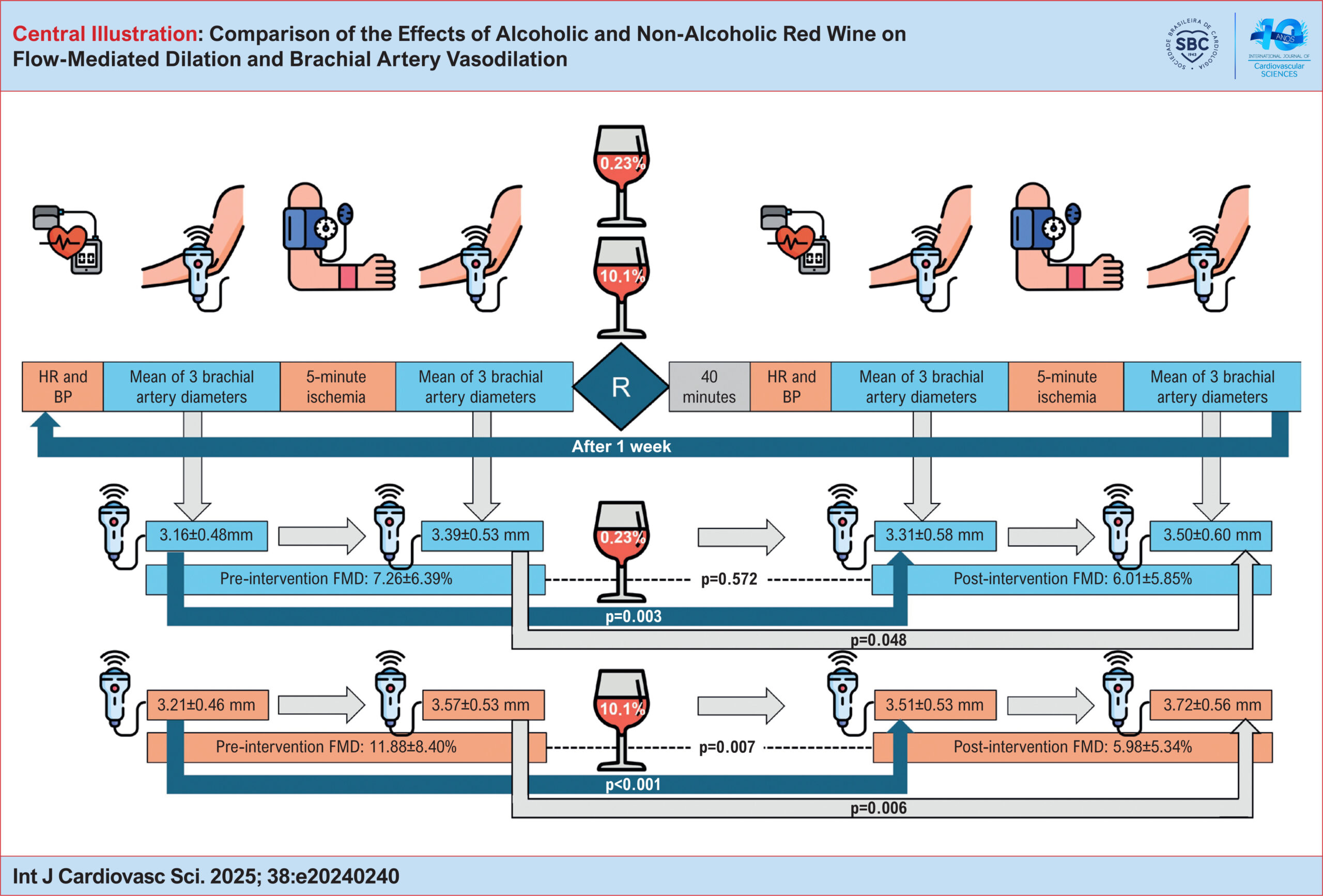
Comparison of the Effects of Alcoholic and Non-Alcoholic Red Wine on Flow-Mediated Dilation and Brachial Artery Vasodilation

Daniel Medeiros Moreira et al. Luiza Frassetto Martins Lucca Antonini Savas Rafael Cegielka

Abstract

Background:

Cardiovascular diseases are the leading cause of mortality worldwide. Wine consumption has been associated with cardiovascular benefits, which are attributed to the presence of flavonoids.

Objectives:

To assess the effects of alcoholic and non-alcoholic red wine on endothelial function by measuring variations in brachial artery flow-mediated dilation (FMD) and analyzing changes in arterial diameter, heart rate, and blood pressure.

Methods:

A randomized, parallel, controlled clinical trial was conducted with 22 participants assessed at 2 distinct time points. Participants consumed 200 mL of red wine and, after a 7-day washout period, received 200 mL of non-alcoholic wine. Data were analyzed using Student’s t test. P values < 0.05 were considered statistically significant.

Results:

Pre-ischemia brachial artery diameter increased after both interventions: with alcoholic wine (3.21 ± 0.46 mm before versus 3.51 ± 0.53 mm after; p < 0.001) and non-alcoholic wine (3.16 ± 0.48 mm before versus 3.31 ± 0.58 mm after; p = 0.003). FMD showed a decrease after consumption of alcoholic wine (11.88% ± 8.40% before versus 5.98% ± 5.34% after; p = 0.007), whereas consumption of non-alcoholic wine did not result in significant changes (7.26% ± 6.39% before versus 6.01% ± 5.85% after; p = 0.572). Other parameters, such as heart rate and blood pressure, did not show any significant differences.

Conclusion:

Consumption of red wine, with and without alcohol, increased brachial artery diameter. However, alcoholic red wine was associated with reduced FMD, suggesting that ethanol may negatively affect endothelial function.

  • Cardiovascular Diseases
  • Endothelium
  • Flavonoids
  • Resveratrol
  • Vasodilation
  • Wine
Read Full Article
Creative Commons Attribution (CC BY) Creative Commons license
15/08/2025 DOI: 10.36660/ijcs.20240240 Views 1
ABC
Editorial

Naringin, Trimetazidine and Baroreflex in Renal Ischemia-Reperfusion Injury

Luis Cuadrado Martin

The paper “Naringin and trimetazidine improve baroreflex sensitivity and electrical activity of solitary tract nucleus in renal ischemia-reperfusion injury,” published in this journal, found improvement in baroreflex sensitivity in an acute ischemia/reperfusion kidney injury model in rats treated by naringin and/or trimetazidine.

Trimetazidine and naringin are substances capable of reducing oxidative stress, documented in many situations. Trimetazidine is a drug with anti-ischemic properties, which acts directly on mitochondria and is able to decrease oxidative stress. Naringin is a polyphenol with antioxidant properties present in several citrus fruits.

[…]

  • Flavanones
  • Flavonoids
  • Heart Failure
  • Hypertension
  • Oxidative Stress
  • Renal Reperfusion
  • Trimetazidine
  • Vasodilatador Agents
Read Full Article
Creative Commons Attribution (CC BY) Creative Commons license
06/09/2021 DOI: 10.36660/abc.20210453 Views 1
ABC
Editorial

Short Editorial: Quercetin Ameliorates Lipid and Apolipoprotein Profile in High-Dose Glucocorticoid Treated Rats

Bruna Paola Murino Rafacho

Short Editorial related to the article: Quercetin Ameliorates Lipid and Apolipoprotein Profile in High-Dose Glucocorticoid Treated Rats

Flavonoids, such as anthocyanins, flavonols, flavanols, flavanones, flavones, and isoflavones are the most abundant polyphenols in the human diet. The flavonol quercetin is one of the most studied among these compounds. – Quercetin is a secondary plant metabolite of the flavonol subclass of flavonoids present in many fruits and vegetables, e.g. apples, grapes, onions and peppers. ,

[…]

  • Anti-Inflamatórios Agents
  • Antioxidants
  • Flavonoids
  • Glucocorticoids
  • Quercetin
  • Rats
Read Full Article
Creative Commons Attribution (CC BY) Creative Commons license
07/08/2020 DOI: 10.36660/abc.20200461 Views 1
IJCS
Editorial

Chocolate Consumption: Benefits in Cardiovascular Disease

Milena Barcza Stockler-Pinto

The major risk factors for cardiovascular diseases (CVDs) are directly related to endothelial dysfunction, reduced bioavailability of nitric oxide, vasoconstriction, oxidative stress, and inflammation. Several studies have been stimulating the use of non-pharmacological strategies to reduce these risk factors. In this sense, some nutrients and bioactive compounds in foods have demonstrated beneficial effects. Chocolate, for example, has gained attention for its content of cocoa, a polyphenols-rich food, and flavanols.

In the paper entitled “Association between chocolate consumption and severity of first infarction”, Duarte et al., found that patients with the first acute myocardial infarction (AMI) who consumed chocolate, showed a low Syntax index, indicating low complexity of coronary lesions. The authors also demonstrated a negative correlation between Syntax and the amount of chocolate consumed, and an association between chocolate consumption and absence of systemic arterial hypertension and diabetes. The cardioprotective effects of polyphenols present in chocolate have been studied, and a series of results supported the protective effects of cocoa and chocolate intake on CVDs. These protective effects are associated with vasodilation, improvement of endothelial function, platelet aggregation, increase in HDL and reduction in LDL levels.

[…]

  • Cardiovascular Diseases, mortality
  • Chocolate
  • Flavonoids
  • Myocardial Infarction/physiopathology
  • Polyphenols
Read Full Article
Creative Commons Attribution (CC BY) Creative Commons license
24/10/2019 DOI: 10.5935/2359-4802.20190091 Views 1
IJCS
Original Article

Association Between Chocolate Consumption and Severity of First Infarction

Heloyse Martins Duarte et al. Milena Christy Rocha de Oliveira Ramona Jung Roberto Léo da Silva … Tammuz Fatah Daniel Medeiros Moreira

Abstract

Background:

Cardiovascular diseases, such as acute myocardial infarction, are the main causes of death in the world. The flavonoids present in chocolate can have benefits for people who have risk factors to the development of cardiovascular diseases and have a coadjuvant effect on known therapies.

Objective:

To analyze the association between chocolate consumption, severity of coronary lesions, risk factors and severity of the first infarction in patients attended at the Cardiology Institute of Santa Catarina and other hospitals in the State of Santa Catarina.

Methods:

Subanalysis of the Catarina Heart Study cohort, evaluated 350 patients with first myocardial infarction. We evaluated clinical, echocardiographic, hemodynamic laboratorial variables. We used chi square test to evaluate qualitative variables, t student test in the case of parametric variables and U Mann Whitney test in non-parametric variables. We considered significant p < 0,05.

Results:

Lower prevalence of hypertension (43.2% % vs. 62.3% p = 0.003), diabetes mellitus (13.5% vs. 25.7%, p = 0.027) and smoking (24.3% vs. 37.7%, p = 0.032) among those who consume chocolate. Higher use of alcohol (40.5% vs. 26.4%, p = 0.018) and drugs (9.5% vs. 3.3%, p = 0.023) among those who consumed chocolate. Among the patients who consumed chocolate, there was a negative correlation between amount consumed and Syntax (r = -0.296, p = 0.019).

Conclusion:

There was association between chocolate consumption and lower prevalence of hypertension, diabetes and smoking. There was no association between amount of chocolate consumed and post-infarction ventricular function and TIMI frame count. Higher prevalence of alcohol and drug use among those who consume chocolate. Negative correlation between Syntax and the amount of chocolate consumed.

  • Cacao
  • Cardiovascular Diseases, mortality
  • Flavonoids
  • Myocardial Infarction/physiopathology
  • Polyphenols
Read Full Article
Creative Commons Attribution (CC BY) Creative Commons license
06/05/2019 DOI: 10.5935/2359-4802.20190039 Views 2

How to cite this article

EndNote RIS

Electronic Document Format (Vancouver)

Moreira DM, Martins LF, Savas LA, Cegielka R. Comparison of the Effects of Alcoholic and Non-Alcoholic Red Wine on Flow-Mediated Dilation and Brachial Artery Vasodilation. International Journal of Cardiovascular Sciences 2025;38:e20240240.

Electronic Document Format (ABNT)

Moreira, Daniel Medeiros; Martins, Luiza Frassetto; Savas, Lucca Antonini; Cegielka, Rafael. Comparison of the Effects of Alcoholic and Non-Alcoholic Red Wine on Flow-Mediated Dilation and Brachial Artery Vasodilation. International Journal of Cardiovascular Sciences, v. 38, e20240240, Aug. 2025.

Electronic Document Format (APA)

Moreira, D. M., Martins, L. F., Savas, L. A., & Cegielka, R. (2025). Comparison of the Effects of Alcoholic and Non-Alcoholic Red Wine on Flow-Mediated Dilation and Brachial Artery Vasodilation. International Journal of Cardiovascular Sciences, 38, e20240240.

Electronic Document Format (ISO)

Moreira, Daniel Medeiros and Martins, Luiza Frassetto and Savas, Lucca Antonini and Cegielka, Rafael. Comparison of the Effects of Alcoholic and Non-Alcoholic Red Wine on Flow-Mediated Dilation and Brachial Artery Vasodilation. International Journal of Cardiovascular Sciences [online]. 2025, vol. 38, [cited 2026-10-14], e20240240. Available from: <https://journals.cardiol.br/en/article/comparison-of-the-effects-of-alcoholic-and-non-alcoholic-red-wine-on-flow-mediated-dilation-and-brachial-artery-vasodilation/>. ISSN 2359-4802

EndNote RIS

Electronic Document Format (Vancouver)

Martin LC. Naringin, Trimetazidine and Baroreflex in Renal Ischemia-Reperfusion Injury. Arquivos Brasileiros de Cardiologia 2021;117(2):298-9.

Electronic Document Format (ABNT)

Martin, Luis Cuadrado. Naringin, Trimetazidine and Baroreflex in Renal Ischemia-Reperfusion Injury. Arquivos Brasileiros de Cardiologia, v. 117, n. 2, p. 298-299, Sep. 2021.

Electronic Document Format (APA)

Martin, L. C. (2021). Naringin, Trimetazidine and Baroreflex in Renal Ischemia-Reperfusion Injury. Arquivos Brasileiros de Cardiologia, 117(2), 298-299.

Electronic Document Format (ISO)

Martin, Luis Cuadrado. Naringin, Trimetazidine and Baroreflex in Renal Ischemia-Reperfusion Injury. Arquivos Brasileiros de Cardiologia [online]. 2021, vol. 117, n. 2, [cited 2026-10-14], pp. 298-299. Available from: <https://journals.cardiol.br/en/article/naringin-trimetazidine-and-baroreflex-in-renal-ischemia-reperfusion-injury/>. ISSN 0066-782X

EndNote RIS

Electronic Document Format (Vancouver)

Rafacho BPM. Short Editorial: Quercetin Ameliorates Lipid and Apolipoprotein Profile in High-Dose Glucocorticoid Treated Rats. Arquivos Brasileiros de Cardiologia 2020;115(1):109-10.

Electronic Document Format (ABNT)

Rafacho, Bruna Paola Murino. Short Editorial: Quercetin Ameliorates Lipid and Apolipoprotein Profile in High-Dose Glucocorticoid Treated Rats. Arquivos Brasileiros de Cardiologia, v. 115, n. 1, p. 109-110, Aug. 2020.

Electronic Document Format (APA)

Rafacho, B. P. M. (2020). Short Editorial: Quercetin Ameliorates Lipid and Apolipoprotein Profile in High-Dose Glucocorticoid Treated Rats. Arquivos Brasileiros de Cardiologia, 115(1), 109-110.

Electronic Document Format (ISO)

Rafacho, Bruna Paola Murino. Short Editorial: Quercetin Ameliorates Lipid and Apolipoprotein Profile in High-Dose Glucocorticoid Treated Rats. Arquivos Brasileiros de Cardiologia [online]. 2020, vol. 115, n. 1, [cited 2026-10-14], pp. 109-110. Available from: <https://journals.cardiol.br/en/article/short-editorial-quercetin-ameliorates-lipid-and-apolipoprotein-profile-in-high-dose-glucocorticoid-treated-rats/>. ISSN 0066-782X

EndNote RIS

Electronic Document Format (Vancouver)

Stockler-Pinto MB. Chocolate Consumption: Benefits in Cardiovascular Disease. International Journal of Cardiovascular Sciences 2019;32(6):583-4.

Electronic Document Format (ABNT)

Stockler-Pinto, Milena Barcza. Chocolate Consumption: Benefits in Cardiovascular Disease. International Journal of Cardiovascular Sciences, v. 32, n. 6, p. 583-584, Oct. 2019.

Electronic Document Format (APA)

Stockler-Pinto, M. B. (2019). Chocolate Consumption: Benefits in Cardiovascular Disease. International Journal of Cardiovascular Sciences, 32(6), 583-584.

Electronic Document Format (ISO)

Stockler-Pinto, Milena Barcza. Chocolate Consumption: Benefits in Cardiovascular Disease. International Journal of Cardiovascular Sciences [online]. 2019, vol. 32, n. 6, [cited 2026-10-14], pp. 583-584. Available from: <https://journals.cardiol.br/en/article/chocolate-consumption-benefits-in-cardiovascular-disease/>. ISSN 2359-4802

EndNote RIS

Electronic Document Format (Vancouver)

Duarte HM, Oliveira MCR, Jung R, Silva RL, Fatah T, Moreira DM. Association Between Chocolate Consumption and Severity of First Infarction. International Journal of Cardiovascular Sciences 2019;32(6):576-82.

Electronic Document Format (ABNT)

Duarte, Heloyse Martins; Oliveira, Milena Christy Rocha de; Jung, Ramona; Silva, Roberto Léo da; Fatah, Tammuz; Moreira, Daniel Medeiros. Association Between Chocolate Consumption and Severity of First Infarction. International Journal of Cardiovascular Sciences, v. 32, n. 6, p. 576-582, May. 2019.

Electronic Document Format (APA)

Duarte, H. M., Oliveira, M. C. R. , Jung, R., Silva, R. L. , Fatah, T., & Moreira, D. M. (2019). Association Between Chocolate Consumption and Severity of First Infarction. International Journal of Cardiovascular Sciences, 32(6), 576-582.

Electronic Document Format (ISO)

Duarte, Heloyse Martins and Oliveira, Milena Christy Rocha de and Jung, Ramona and Silva, Roberto Léo da and Fatah, Tammuz and Moreira, Daniel Medeiros. Association Between Chocolate Consumption and Severity of First Infarction. International Journal of Cardiovascular Sciences [online]. 2019, vol. 32, n. 6, [cited 2026-10-14], pp. 576-582. Available from: <https://journals.cardiol.br/en/article/association-between-chocolate-consumption-and-severity-of-first-infarction/>. ISSN 2359-4802

  • About ABC Family
  • Internal Regulation
  • Editorial Board
  • Brazilian Society of Cardiology (SBC)

Issues

SBC Guidelines

  • Videos
  • Podcasts
  • News