ABC Family Arquivos Brasileiros de Cardiologia International Journal of Cardiovascular Sciences ABC Heart Failure & Cardiomyopathy ABC Imagem Cardiovascular
Português English
ABC Family
Português English
  • About
    • About ABC Family
    • Internal Regulation
    • Editorial Board
    • Brazilian Society of Cardiology (SBC)
  • Issues
  • SBC Guidelines
  • Content
    • Videos
    • Podcasts
    • News
  • About
    • About ABC Family
    • Internal Regulation
    • Editorial Board
    • Brazilian Society of Cardiology (SBC)
  • Issues
  • SBC Guidelines
  • Content
    • Videos
    • Podcasts
    • News

ABC Family

  • ABC Family
  • Arquivos Brasileiros de Cardiologia
  • International Journal of Cardiovascular Sciences
  • ABC Heart Failure & Cardiomyopathy
  • ABC Imagem Cardiovascular
Search in

No content found.

Journals
Ordering
Article types
Others

  1. Home
  2. Keyword: Resveratrol
Comparison of the Effects of Alcoholic and Non-Alcoholic Red Wine on Flow-Mediated Dilation and Brachial Artery Vasodilation
IJCS
Original Article

Comparison of the Effects of Alcoholic and Non-Alcoholic Red Wine on Flow-Mediated Dilation and Brachial Artery Vasodilation

Daniel Medeiros Moreira et al. Luiza Frassetto Martins Lucca Antonini Savas Rafael Cegielka

Abstract

Background:

Cardiovascular diseases are the leading cause of mortality worldwide. Wine consumption has been associated with cardiovascular benefits, which are attributed to the presence of flavonoids.

Objectives:

To assess the effects of alcoholic and non-alcoholic red wine on endothelial function by measuring variations in brachial artery flow-mediated dilation (FMD) and analyzing changes in arterial diameter, heart rate, and blood pressure.

Methods:

A randomized, parallel, controlled clinical trial was conducted with 22 participants assessed at 2 distinct time points. Participants consumed 200 mL of red wine and, after a 7-day washout period, received 200 mL of non-alcoholic wine. Data were analyzed using Student’s t test. P values < 0.05 were considered statistically significant.

Results:

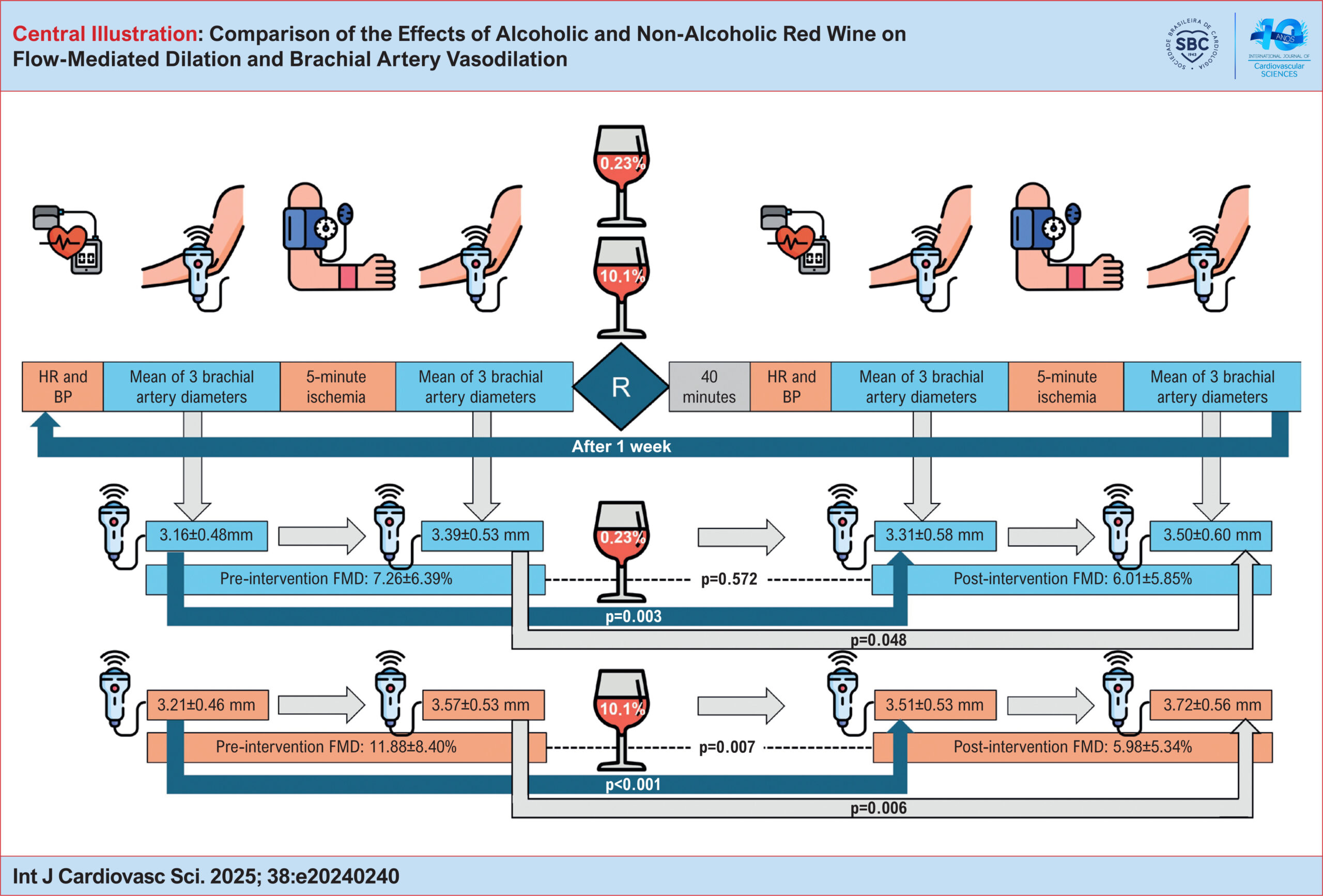
Pre-ischemia brachial artery diameter increased after both interventions: with alcoholic wine (3.21 ± 0.46 mm before versus 3.51 ± 0.53 mm after; p < 0.001) and non-alcoholic wine (3.16 ± 0.48 mm before versus 3.31 ± 0.58 mm after; p = 0.003). FMD showed a decrease after consumption of alcoholic wine (11.88% ± 8.40% before versus 5.98% ± 5.34% after; p = 0.007), whereas consumption of non-alcoholic wine did not result in significant changes (7.26% ± 6.39% before versus 6.01% ± 5.85% after; p = 0.572). Other parameters, such as heart rate and blood pressure, did not show any significant differences.

Conclusion:

Consumption of red wine, with and without alcohol, increased brachial artery diameter. However, alcoholic red wine was associated with reduced FMD, suggesting that ethanol may negatively affect endothelial function.
  • Cardiovascular Diseases
  • Endothelium
  • Flavonoids
  • Resveratrol
  • Vasodilation
  • Wine
Read Full Article
Creative Commons Attribution (CC BY) Creative Commons license
15/08/2025 DOI: 10.36660/ijcs.20240240 Views 1
ABC
Editorial

Cardioprotection during Chemotherapy: Prospects of Antioxidant Strategies

Thiago Gomes Heck

The concept of oxidative stress, well defined as a situation in which cells, tissues, or the whole body present an imbalance between reactive oxygen species (ROS) and antioxidant defenses in favor of ROS levels, is found in several acute and chronic diseases, including cancer. The equilibrium between ROS production and the ability of cells to avoid oxidative damage is a natural challenge for mammalian species since the energy production by oxidative pathways in mitochondria allows the continuous production of free radical and oxidative molecules. Pharmacological agents may generally use the modulation of oxidative balance to treat some diseases, or oxidative imbalance may represent a side effect of the drugs. Also, we need to keep in mind that oxidative stress caused by environmental (e.g., air pollution) and metabolic (e.g., obesity and diabetes) conditions is also associated with an increased risk of a variety of cancers.

Hyperproliferation of tumor cells is accompanied by high ROS production, but it is well known that cell stress response, antioxidant defenses, and resistance against the cytotoxic effects of chemotherapy is quite different in tumor compared to immune cells and other tissues. Thus, the tumor is able to adapt to conditions of oxidative burden while other cells may not present sufficient self-defense against oxidative damage. The mechanism of tumor self-protection involves increasing the levels of the major non-enzymatic antioxidant defense, glutathione (GSH). As a “hungry” cell, considering the common high-energy demand mainly by glucose uptake, tumors activate glucose-6-phosphate dehydrogenase (G6PD) and reroute glucose metabolism from glycolysis through the oxidative arm of the pentose phosphate pathway (PPP) toward nucleotide synthesis. In turn, the increase in nicotinamide adenine dinucleotide phosphate (NADPH) allows the increase in GSH and other antioxidant systems. Also, at a molecular level, the tumor evocates many transcription factors, including activator protein 1 (AP-1), heat shock factor 1 (HSF1), nuclear factor κB (NF-κB), nuclear factor-erythroid 2 p45-related factor 2 (NRF2), and tumor protein p53, representing a proliferative strategy accompanied by a robust cell stress defense.,

[…]

  • Antioxidants
  • Cardioprotection
  • Drug Therapy
  • Oxidative Stress
  • Resveratrol
Read Full Article
Creative Commons Attribution (CC BY) Creative Commons license
03/12/2021 DOI: 10.36660/abc.20210914 Views 1
Figure 1
ABC
Original Article

Cardioprotective Effect of Maternal Supplementation with Resveratrol on Toxicity Induced by Doxorubicin in Offspring Cardiomyocytes

Verônica Bidinotto Brito et al. Leopoldo Vinicius Martins Nascimento Dinara Jaqueline Moura Jenifer Saffi

Abstract

Background

Doxorubicin (DOX) is frequently used to treat many types of cancers, despite its dose-dependent cardiotoxicity. Alternatively, resveratrol is a polyphenol that has shown useful cardioprotective effects in many heart dysfunction models.

Objective

This study investigated whether resveratrol treatment in pregnant rats protects against doxorubicin-induced toxicity in offspring cardiomyocytes.

Methods

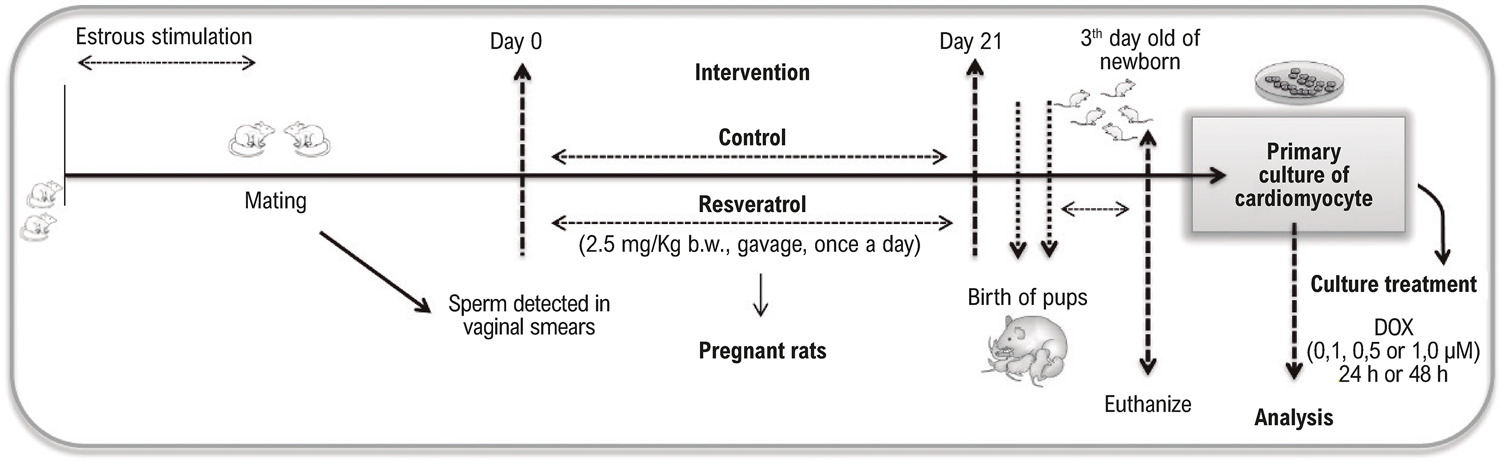
Wistar rats (n=8) were supplemented with dietary resveratrol during pregnancy. Upon the offspring’s birth, hearts (9-11) were used to obtain the primary culture of cardiomyocytes. DOX-induced cardiotoxicity and the effects of resveratrol supplementation were evaluated by oxidative stress markers, such as dichlorofluorescein diacetate oxidation, decrease in the activity of antioxidant enzymes, and oxidation of total sulfhydryl content, in addition to cell viability evaluation, DNA damage generation, and DNA damage repair response. A value of p<0.05 was considered statistically significant.

Results

Neonatal cardiomyocytes from resveratrol supplemented rats exhibiting an increase (p<0.01) in cell viability and lower (p<0.0001) apoptotic/necrotic cells after DOX treatment, which correlates with the activities of antioxidant enzymes and dichlorofluorescein production. Moreover, resveratrol protected cardiomyocytes from DOX-induced DNA damage, showing a decrease (p<0.05) in DNA breaks induced by oxidative stress, evaluated by the activity of DNA-repair enzymes endonuclease III and formamidopyrimidine glycosylase. Supplementation with resveratrol increased (p<0.05) the expression of the repair protein Sirt6 in the cardiomyocytes of the pups.

Conclusion

This research indicates that supplementation with resveratrol during the gestational period has a notable cardioprotective effect on the offspring’s heart against DOX-induced toxicity, which may well be due to its antioxidant function, and the increase in the DNA damage repair response.

  • cardiomyocytes
  • DNA Repair Enzymes
  • Doxorubicin
  • Rats
  • Resveratrol
Read Full Article
Creative Commons Attribution (CC BY) Creative Commons license
08/10/2021 DOI: 10.36660/abc.20200752 Views 2
Figure 1
ABC
Original Article

Resveratrol Treatment Normalizes the Endothelial Function and Blood Pressure in Ovariectomized Rats

Victor Fabricio et al. Jorge Camargo Oishi Bruna Gabriele Biffe Leandro Dias Gonçalves Ruffoni … Karina Ana da Silva Keico Okino Nonaka Gerson Jhonatan Rodrigues

Abstract

Background:

Despite knowing that resveratrol has effects on blood vessels, blood pressure and that phytostrogens can also improve the endothelium-dependent relaxation/vasodilation, there are no reports of reveratrol’s direct effect on the endothelial function and blood pressure of animals with estrogen deficit (mimicking post-menopausal increased blood pressure).

Objective:

To verify the effect of two different periods of preventive treatment with resveratrol on blood pressure and endothelial function in ovariectomized young adult rats.

Methods:

3-month old female Wistar rats were used and distributed in 6 groups: intact groups with 60 or 90 days, ovariectomized groups with 60 or 90 days, and ovariectomized treated with resveratrol (10 mg/kg of body weight per day) for 60 or 90 days. The number of days in each group corresponds to the duration of the experimental period. Vascular reactivity study was performed in abdominal aortic rings, systolic blood pressure was measured and serum nitric oxide (NO) concentration was quantified.

Results:

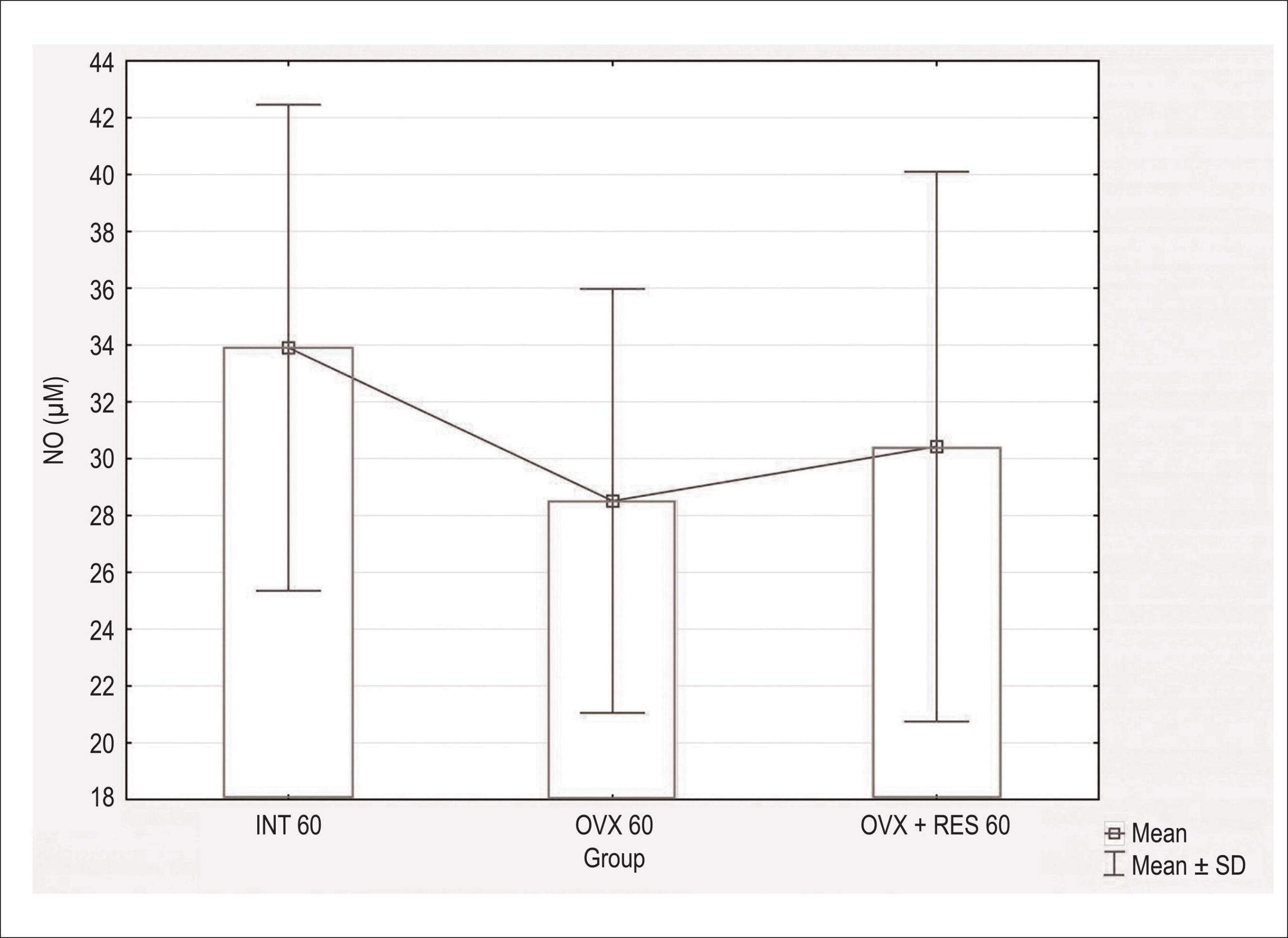
Ovariectomy induced blood pressure increase 60 and 90 days after surgery, whereas the endothelial function decreased only 90 days after surgery, with no difference in NO concentration among the groups. Only longer treatment (90 days) with resveratrol was able to improve the endothelial function and normalize blood pressure.

Conclusion:

Our results suggest that 90 days of treatment with resveratrol is able to improve the endothelial function and decrease blood pressure in ovariectomized rats.

  • Blood Pressure
  • Endothelium, Vascular
  • Ovariectomy
  • Phytoestrogens
  • Rats Wistar
  • Resveratrol
Read Full Article
Creative Commons Attribution (CC BY) Creative Commons license
01/02/2017 DOI: 10.5935/abc.20170012 Views 1

How to cite this article

EndNote RIS

Electronic Document Format (Vancouver)

Moreira DM, Martins LF, Savas LA, Cegielka R. Comparison of the Effects of Alcoholic and Non-Alcoholic Red Wine on Flow-Mediated Dilation and Brachial Artery Vasodilation. International Journal of Cardiovascular Sciences 2025;38:e20240240.

Electronic Document Format (ABNT)

Moreira, Daniel Medeiros; Martins, Luiza Frassetto; Savas, Lucca Antonini; Cegielka, Rafael. Comparison of the Effects of Alcoholic and Non-Alcoholic Red Wine on Flow-Mediated Dilation and Brachial Artery Vasodilation. International Journal of Cardiovascular Sciences, v. 38, e20240240, Aug. 2025.

Electronic Document Format (APA)

Moreira, D. M., Martins, L. F., Savas, L. A., & Cegielka, R. (2025). Comparison of the Effects of Alcoholic and Non-Alcoholic Red Wine on Flow-Mediated Dilation and Brachial Artery Vasodilation. International Journal of Cardiovascular Sciences, 38, e20240240.

Electronic Document Format (ISO)

Moreira, Daniel Medeiros and Martins, Luiza Frassetto and Savas, Lucca Antonini and Cegielka, Rafael. Comparison of the Effects of Alcoholic and Non-Alcoholic Red Wine on Flow-Mediated Dilation and Brachial Artery Vasodilation. International Journal of Cardiovascular Sciences [online]. 2025, vol. 38, [cited 2026-10-14], e20240240. Available from: <https://journals.cardiol.br/en/article/comparison-of-the-effects-of-alcoholic-and-non-alcoholic-red-wine-on-flow-mediated-dilation-and-brachial-artery-vasodilation/>. ISSN 2359-4802

EndNote RIS

Electronic Document Format (Vancouver)

Heck TG. Cardioprotection during Chemotherapy: Prospects of Antioxidant Strategies. Arquivos Brasileiros de Cardiologia 2021;117(6):1159-60.

Electronic Document Format (ABNT)

Heck, Thiago Gomes. Cardioprotection during Chemotherapy: Prospects of Antioxidant Strategies. Arquivos Brasileiros de Cardiologia, v. 117, n. 6, p. 1159-1160, Dec. 2021.

Electronic Document Format (APA)

Heck, T. G. (2021). Cardioprotection during Chemotherapy: Prospects of Antioxidant Strategies. Arquivos Brasileiros de Cardiologia, 117(6), 1159-1160.

Electronic Document Format (ISO)

Heck, Thiago Gomes. Cardioprotection during Chemotherapy: Prospects of Antioxidant Strategies. Arquivos Brasileiros de Cardiologia [online]. 2021, vol. 117, n. 6, [cited 2026-10-14], pp. 1159-1160. Available from: <https://journals.cardiol.br/en/article/cardioprotection-during-chemotherapy-prospects-of-antioxidant-strategies/>. ISSN 0066-782X

EndNote RIS

Electronic Document Format (Vancouver)

Brito VB, Nascimento LVM, Moura DJ, Saffi J. Cardioprotective Effect of Maternal Supplementation with Resveratrol on Toxicity Induced by Doxorubicin in Offspring Cardiomyocytes. Arquivos Brasileiros de Cardiologia 2021;117(6):1147-58.

Electronic Document Format (ABNT)

Brito, Verônica Bidinotto; Nascimento, Leopoldo Vinicius Martins; Moura, Dinara Jaqueline; Saffi, Jenifer. Cardioprotective Effect of Maternal Supplementation with Resveratrol on Toxicity Induced by Doxorubicin in Offspring Cardiomyocytes. Arquivos Brasileiros de Cardiologia, v. 117, n. 6, p. 1147-1158, Oct. 2021.

Electronic Document Format (APA)

Brito, V. B., Nascimento, L. V. M., Moura, D. J., & Saffi, J. (2021). Cardioprotective Effect of Maternal Supplementation with Resveratrol on Toxicity Induced by Doxorubicin in Offspring Cardiomyocytes. Arquivos Brasileiros de Cardiologia, 117(6), 1147-1158.

Electronic Document Format (ISO)

Brito, Verônica Bidinotto and Nascimento, Leopoldo Vinicius Martins and Moura, Dinara Jaqueline and Saffi, Jenifer. Cardioprotective Effect of Maternal Supplementation with Resveratrol on Toxicity Induced by Doxorubicin in Offspring Cardiomyocytes. Arquivos Brasileiros de Cardiologia [online]. 2021, vol. 117, n. 6, [cited 2026-10-14], pp. 1147-1158. Available from: <https://journals.cardiol.br/en/article/cardioprotective-effect-of-maternal-supplementation-with-resveratrol-on-toxicity-induced-by-doxorubicin-in-offspring-cardiomyocytes/>. ISSN 0066-782X

EndNote RIS

Electronic Document Format (Vancouver)

Fabricio V, Oishi JC, Biffe BG, Ruffoni LDG, Silva KA, Nonaka KO, Rodrigues GJ, et al. Resveratrol Treatment Normalizes the Endothelial Function and Blood Pressure in Ovariectomized Rats. Arquivos Brasileiros de Cardiologia 2017;108(2):116-21.

Electronic Document Format (ABNT)

Fabricio, Victor; Oishi, Jorge Camargo; Biffe, Bruna Gabriele; Ruffoni, Leandro Dias Gonçalves; Silva, Karina Ana da; Nonaka, Keico Okino; Rodrigues, Gerson Jhonatan. Resveratrol Treatment Normalizes the Endothelial Function and Blood Pressure in Ovariectomized Rats. Arquivos Brasileiros de Cardiologia, v. 108, n. 2, p. 116-121, Jan. 2017.

Electronic Document Format (APA)

Fabricio, V., Oishi, J. C., Biffe, B. G., Ruffoni, L. D. G., Silva, K. A. , Nonaka, K. O., & Rodrigues, G. J. (2017). Resveratrol Treatment Normalizes the Endothelial Function and Blood Pressure in Ovariectomized Rats. Arquivos Brasileiros de Cardiologia, 108(2), 116-121.

Electronic Document Format (ISO)

Fabricio, Victor and Oishi, Jorge Camargo and Biffe, Bruna Gabriele and Ruffoni, Leandro Dias Gonçalves and Silva, Karina Ana da and Nonaka, Keico Okino and Rodrigues, Gerson Jhonatan. Resveratrol Treatment Normalizes the Endothelial Function and Blood Pressure in Ovariectomized Rats. Arquivos Brasileiros de Cardiologia [online]. 2017, vol. 108, n. 2, [cited 2026-10-14], pp. 116-121. Available from: <https://journals.cardiol.br/en/article/resveratrol-treatment-normalizes-the-endothelial-function-and-blood-pressure-in-ovariectomized-rats/>. ISSN 0066-782X

  • About ABC Family
  • Internal Regulation
  • Editorial Board
  • Brazilian Society of Cardiology (SBC)

Issues

SBC Guidelines

  • Videos
  • Podcasts
  • News