ABC Family Arquivos Brasileiros de Cardiologia International Journal of Cardiovascular Sciences ABC Heart Failure & Cardiomyopathy ABC Imagem Cardiovascular
Português English
ABC Family
Português English
  • About
    • About ABC Family
    • Internal Regulation
    • Editorial Board
    • Brazilian Society of Cardiology (SBC)
  • Issues
  • SBC Guidelines
  • Content
    • Videos
    • Podcasts
    • News
  • About
    • About ABC Family
    • Internal Regulation
    • Editorial Board
    • Brazilian Society of Cardiology (SBC)
  • Issues
  • SBC Guidelines
  • Content
    • Videos
    • Podcasts
    • News

ABC Family

  • ABC Family
  • Arquivos Brasileiros de Cardiologia
  • International Journal of Cardiovascular Sciences
  • ABC Heart Failure & Cardiomyopathy
  • ABC Imagem Cardiovascular
Search in

No content found.

Journals
Ordering
Article types
Others

  1. Home
  2. Keyword: Polyphenols
Figure 1
ABC
Original Article

Influence of Consumption of Orange Juice (Citrus Sinensis) on Cardiac Remodeling of Rats Submitted to Myocardial Infarction

Bruna C. Oliveira et al. Priscila P. Santos Amanda M. Figueiredo Bruna P. M. Rafacho … Larissa Ishikawa Silméia G. Zanati Ana A. H. Fernandes Paula S. Azevedo Bertha F. Polegato Leonardo A. M. Zornoff Marcos F. Minicucci Sergio A. R. Paiva

Abstract

Background

Orange juice (OJ) is rich in polyphenols with anti-inflammatory and antioxidant properties. After myocardial infarction (MI), complex changes occur in cardiac structure and function, which is known as cardiac remodeling (CR). Oxidative stress and inflammation can modulate this process. We hypothesized that the consumption of OJ attenuates the CR after MI.

Objectives

To evaluate the influence of OJ on CR after MI by analysis of functional, morphological, oxidative stress, inflammation, and energy metabolism variables.

Methods

A total of 242 male rats weighing 200-250 g were submitted to a surgical procedure (coronary artery ligation or simulated surgery). Seven days after surgery, survivors were assigned to one of the four groups 1) SM, sham animals with water and maltodextrin (n= 20); 2) SOJ, sham animals with OJ (n= 20); 3) IM, infarcted animals with water and maltodextrin (n= 40); and 4) IOJ, infarcted animals with OJ (n = 40). Statistical analysis was performed by the two-way ANOVA supplemented by Holm-Sidak. Results are presented as mean ± standard deviation, the level of significance adopted was 5%.

Results

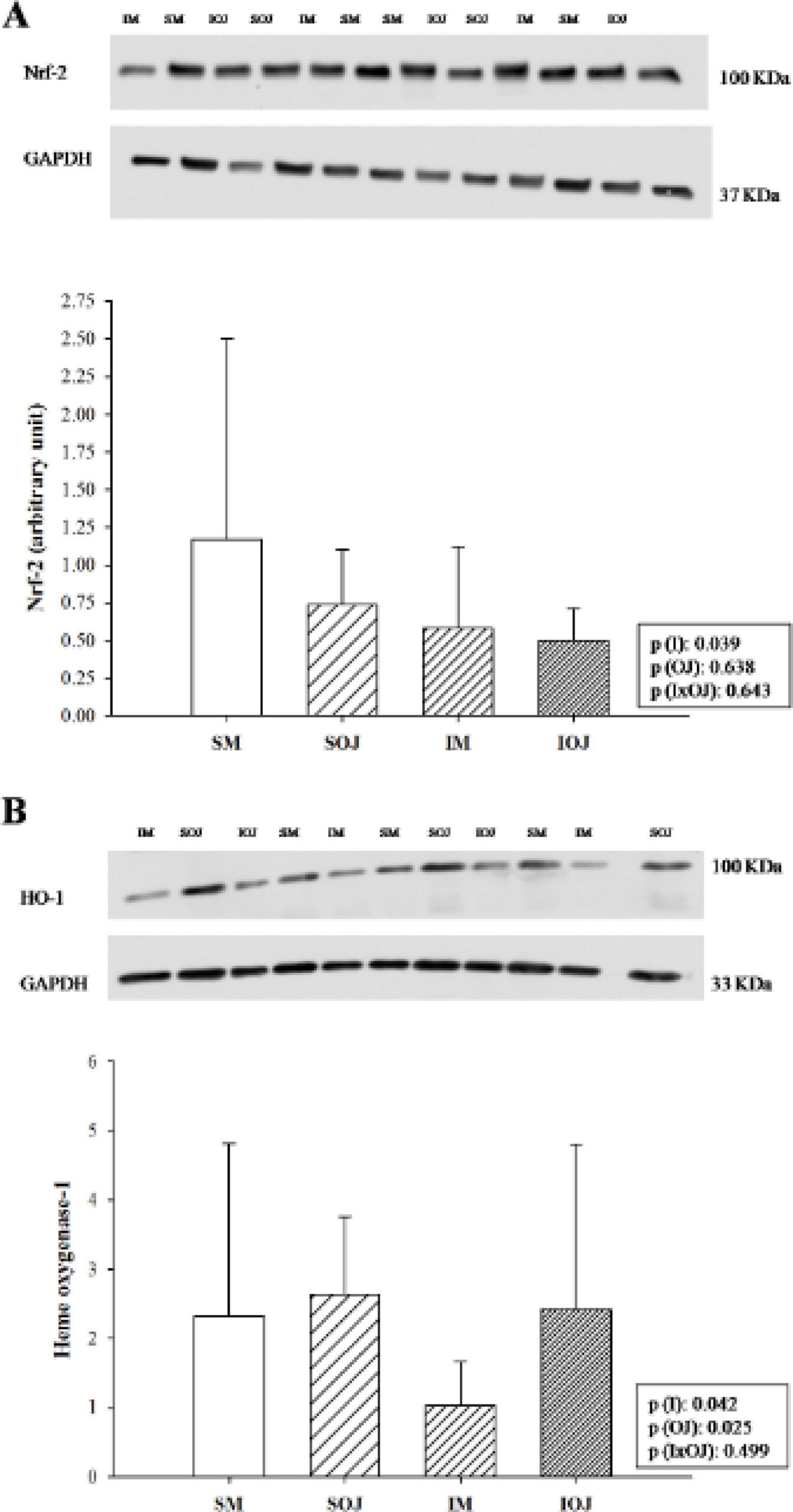
After 3 months, MI led to left ventricular (LV) hypertrophy, with systolic and diastolic dysfunction, and increased oxidative stress and inflammatory mediators. OJ intake reduced LV cavity and improved systolic and diastolic function. The OJ animals presented lower activity of glutathione peroxidase and higher expression of heme-oxygenase-1 (HO-1).

Conclusion

OJ attenuated CR in infarcted rats and HO-1 may be play an important role in this process.
  • Anti-Inflammatory Agents
  • Antioxidants
  • Fruits Juices (orange)
  • Myocardial Infarction
  • Polyphenols
  • Ventricular Remodeling
Read Full Article
Creative Commons Attribution (CC BY) Creative Commons license
14/06/2021 DOI: 10.36660/abc.20190397 Views 2
IJCS
Editorial

Chocolate Consumption: Benefits in Cardiovascular Disease

Milena Barcza Stockler-Pinto

The major risk factors for cardiovascular diseases (CVDs) are directly related to endothelial dysfunction, reduced bioavailability of nitric oxide, vasoconstriction, oxidative stress, and inflammation. Several studies have been stimulating the use of non-pharmacological strategies to reduce these risk factors. In this sense, some nutrients and bioactive compounds in foods have demonstrated beneficial effects. Chocolate, for example, has gained attention for its content of cocoa, a polyphenols-rich food, and flavanols.

In the paper entitled “Association between chocolate consumption and severity of first infarction”, Duarte et al., found that patients with the first acute myocardial infarction (AMI) who consumed chocolate, showed a low Syntax index, indicating low complexity of coronary lesions. The authors also demonstrated a negative correlation between Syntax and the amount of chocolate consumed, and an association between chocolate consumption and absence of systemic arterial hypertension and diabetes. The cardioprotective effects of polyphenols present in chocolate have been studied, and a series of results supported the protective effects of cocoa and chocolate intake on CVDs. These protective effects are associated with vasodilation, improvement of endothelial function, platelet aggregation, increase in HDL and reduction in LDL levels.

[…]

  • Cardiovascular Diseases, mortality
  • Chocolate
  • Flavonoids
  • Myocardial Infarction/physiopathology
  • Polyphenols
Read Full Article
Creative Commons Attribution (CC BY) Creative Commons license
24/10/2019 DOI: 10.5935/2359-4802.20190091 Views 1
IJCS
Original Article

Association Between Chocolate Consumption and Severity of First Infarction

Heloyse Martins Duarte et al. Milena Christy Rocha de Oliveira Ramona Jung Roberto Léo da Silva … Tammuz Fatah Daniel Medeiros Moreira

Abstract

Background:

Cardiovascular diseases, such as acute myocardial infarction, are the main causes of death in the world. The flavonoids present in chocolate can have benefits for people who have risk factors to the development of cardiovascular diseases and have a coadjuvant effect on known therapies.

Objective:

To analyze the association between chocolate consumption, severity of coronary lesions, risk factors and severity of the first infarction in patients attended at the Cardiology Institute of Santa Catarina and other hospitals in the State of Santa Catarina.

Methods:

Subanalysis of the Catarina Heart Study cohort, evaluated 350 patients with first myocardial infarction. We evaluated clinical, echocardiographic, hemodynamic laboratorial variables. We used chi square test to evaluate qualitative variables, t student test in the case of parametric variables and U Mann Whitney test in non-parametric variables. We considered significant p < 0,05.

Results:

Lower prevalence of hypertension (43.2% % vs. 62.3% p = 0.003), diabetes mellitus (13.5% vs. 25.7%, p = 0.027) and smoking (24.3% vs. 37.7%, p = 0.032) among those who consume chocolate. Higher use of alcohol (40.5% vs. 26.4%, p = 0.018) and drugs (9.5% vs. 3.3%, p = 0.023) among those who consumed chocolate. Among the patients who consumed chocolate, there was a negative correlation between amount consumed and Syntax (r = -0.296, p = 0.019).

Conclusion:

There was association between chocolate consumption and lower prevalence of hypertension, diabetes and smoking. There was no association between amount of chocolate consumed and post-infarction ventricular function and TIMI frame count. Higher prevalence of alcohol and drug use among those who consume chocolate. Negative correlation between Syntax and the amount of chocolate consumed.

  • Cacao
  • Cardiovascular Diseases, mortality
  • Flavonoids
  • Myocardial Infarction/physiopathology
  • Polyphenols
Read Full Article
Creative Commons Attribution (CC BY) Creative Commons license
06/05/2019 DOI: 10.5935/2359-4802.20190039 Views 2
ABC
Editorial

Nutrition and Cardiology: An Interface not to be Ignored

Paula S. Azevedo et al. Sergio A. R. Paiva Leonardo A. M. Zornoff

Food and nutrition constitute a field of knowledge with inherent characteristics. In the first half of the twentieth century, the major objectives of the nutritional sciences consisted in discovering essential nutrients, characterizing their physiological and biochemical roles, and describing the consequences of their defficiencies. Very frequently, the fundamental model of the study was animal growth.

However, in the past 50 years, the spread of knowledge expanded the objectives related to food and nutrition, which were inserted in an organizational complexity focused on cells, organs, organisms and communities, ranging, therefore, from molecules to populations. The challenges to understand the physiopathological mechanisms involved and to prevent and occasionally solve consequent clinical problems constitute a decisive stimulus to the development of new fields of knowledge within that of food and nutrition. Of those, the relationship between food, obesity and diseases frequently associated with obesity, the so-called chronic diseases, such as arterial hypertension, coronary artery disease, diabetes mellitus, dyslipidemias, and cancer, is noteworthy.

[…]

  • Cardiovascular Diseases
  • Carotenoids
  • Food
  • Polyphenols
Read Full Article
Creative Commons Attribution (CC BY) Creative Commons license
01/08/2014 DOI: 10.5935/abc.20140121 Views 1
Maternal restriction of polyphenols and fetal ductal dynamics in normal pregnancy: an open clinical trial
ABC
Artigo Original

Maternal restriction of polyphenols and fetal ductal dynamics in normal pregnancy: an open clinical trial

Paulo Zielinsky et al. Antônio Luiz Piccoli Jr. Izabele Vian Ana Maria Zílio … Alexandre Antônio Naujorks Luiz Henrique Nicoloso Carolina Weiss Barbisan Stefano Busato Mauro Lopes Caroline Klein

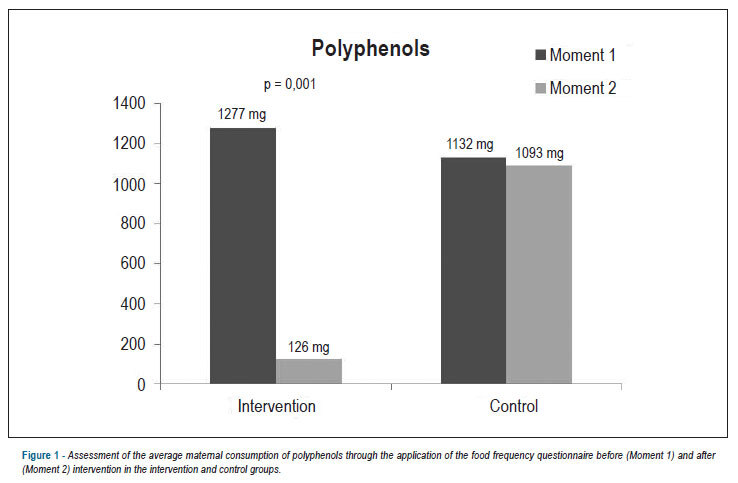
BACKGROUND:We have recently demonstrated reversal of fetal ductal constriction after dietary maternal restriction of polyphenol-rich foods (PRF), due to its inhibitory action on prostaglandin synthesis. OBJECTIVE: To test the hyphotesis that normal third trimester fetuses also improve ductus arteriosus dynamics after maternal restriction of polyphenols. METHODS: Open clinical trial with 46 fetuses with gestational age (GA) > 28 weeks submitted to 2 Doppler echocardiographic studies with an interval of at least 2 weeks, being the examiners blinded to maternal dietary habits. A validated food frequency questionnaire was applied and a diet based on polyphenol-poor foods (<30mg/100mg) was recommended. A control group of 26 third trimester fetuses was submitted to the same protocol. Statistics used t test for independent samples. RESULTS: Mean GA was 33±2 weeks. Mean daily maternal estimated polyphenol intake (DMPI) was 1277mg, decreasing to 126mg after dietary orientation (p=0.0001). Significant decreases in systolic (SDV) and diastolic (DDV) ductal velocities, and RV/LV diameters ratio, as well as increase in ductal PI were observed [DSV=1.2±0.4m/s (0.7-1.6) to 0.9±0.3m/s (0.6-1.3) (p=0.018); DDV=0.21±0.09m/s (0.15-0.32) to 0.18±0.06m/s (0.11-0.25) (p=0.016); RV/LV ratio =1.3±0.2 (0.9-1.4) to 1.1±0.2 (0.8-1.3) (p=0.004); ductal PI=2.2±0.03 (2.0-2.7) to 2.4±0.4(2.2-2.9) (p=0.04)]. In the control group, with GA of 32±4 weeks, there were no significant differences in DMPI, mean SDV, DDV, PI and RV/LV ratio. CONCLUSION: The oriented restriction of third trimester maternal ingestion of polyphenol-rich foods for a period of 2 weeks or more improve fetal ductus arteriosus flow dynamics and right ventricular dimensions.

  • Anti-Inflammatory Agents
  • Constriction
  • Ductus Arteriosus
  • fetal heart
  • Polyphenols
  • Pregnancy
  • Prostaglandins
Read Full Article
Creative Commons Attribution (CC BY) Creative Commons license
14/08/2013 DOI: 10.5935/abc.20130166 Views 3

How to cite this article

EndNote RIS

Electronic Document Format (Vancouver)

Oliveira BC, Santos PP, Figueiredo AM, Rafacho BPM, Ishikawa L, Zanati SG, Fernandes AAH, et al. Influence of Consumption of Orange Juice (Citrus Sinensis) on Cardiac Remodeling of Rats Submitted to Myocardial Infarction. Arquivos Brasileiros de Cardiologia 2021;116(6):1127-36.

Electronic Document Format (ABNT)

Oliveira, Bruna C.; Santos, Priscila P.; Figueiredo, Amanda M.; Rafacho, Bruna P. M.; Ishikawa, Larissa; Zanati, Silméia G.; Fernandes, Ana A. H.; Azevedo, Paula S.; Polegato, Bertha F.; Zornoff, Leonardo A. M.; Minicucci, Marcos F.; Paiva, Sergio A. R.. Influence of Consumption of Orange Juice (Citrus Sinensis) on Cardiac Remodeling of Rats Submitted to Myocardial Infarction. Arquivos Brasileiros de Cardiologia, v. 116, n. 6, p. 1127-1136, Jun. 2021.

Electronic Document Format (APA)

Oliveira, B. C., Santos, P. P., Figueiredo, A. M., Rafacho, B. P. M., Ishikawa, L., Zanati, S. G., Fernandes, A. A. H., Azevedo, P. S., Polegato, B. F., Zornoff, L. A. M., Minicucci, M. F., & Paiva, S. A. R. (2021). Influence of Consumption of Orange Juice (Citrus Sinensis) on Cardiac Remodeling of Rats Submitted to Myocardial Infarction. Arquivos Brasileiros de Cardiologia, 116(6), 1127-1136.

Electronic Document Format (ISO)

Oliveira, Bruna C. and Santos, Priscila P. and Figueiredo, Amanda M. and Rafacho, Bruna P. M. and Ishikawa, Larissa and Zanati, Silméia G. and Fernandes, Ana A. H. and Azevedo, Paula S. and Polegato, Bertha F. and Zornoff, Leonardo A. M. and Minicucci, Marcos F. and Paiva, Sergio A. R.. Influence of Consumption of Orange Juice (Citrus Sinensis) on Cardiac Remodeling of Rats Submitted to Myocardial Infarction. Arquivos Brasileiros de Cardiologia [online]. 2021, vol. 116, n. 6, [cited 2026-10-14], pp. 1127-1136. Available from: <https://journals.cardiol.br/en/article/influence-of-consumption-of-orange-juice-citrus-sinensis-on-cardiac-remodeling-of-rats-submitted-to-myocardial-infarction/>. ISSN 0066-782X

EndNote RIS

Electronic Document Format (Vancouver)

Stockler-Pinto MB. Chocolate Consumption: Benefits in Cardiovascular Disease. International Journal of Cardiovascular Sciences 2019;32(6):583-4.

Electronic Document Format (ABNT)

Stockler-Pinto, Milena Barcza. Chocolate Consumption: Benefits in Cardiovascular Disease. International Journal of Cardiovascular Sciences, v. 32, n. 6, p. 583-584, Oct. 2019.

Electronic Document Format (APA)

Stockler-Pinto, M. B. (2019). Chocolate Consumption: Benefits in Cardiovascular Disease. International Journal of Cardiovascular Sciences, 32(6), 583-584.

Electronic Document Format (ISO)

Stockler-Pinto, Milena Barcza. Chocolate Consumption: Benefits in Cardiovascular Disease. International Journal of Cardiovascular Sciences [online]. 2019, vol. 32, n. 6, [cited 2026-10-14], pp. 583-584. Available from: <https://journals.cardiol.br/en/article/chocolate-consumption-benefits-in-cardiovascular-disease/>. ISSN 2359-4802

EndNote RIS

Electronic Document Format (Vancouver)

Duarte HM, Oliveira MCR, Jung R, Silva RL, Fatah T, Moreira DM. Association Between Chocolate Consumption and Severity of First Infarction. International Journal of Cardiovascular Sciences 2019;32(6):576-82.

Electronic Document Format (ABNT)

Duarte, Heloyse Martins; Oliveira, Milena Christy Rocha de; Jung, Ramona; Silva, Roberto Léo da; Fatah, Tammuz; Moreira, Daniel Medeiros. Association Between Chocolate Consumption and Severity of First Infarction. International Journal of Cardiovascular Sciences, v. 32, n. 6, p. 576-582, May. 2019.

Electronic Document Format (APA)

Duarte, H. M., Oliveira, M. C. R. , Jung, R., Silva, R. L. , Fatah, T., & Moreira, D. M. (2019). Association Between Chocolate Consumption and Severity of First Infarction. International Journal of Cardiovascular Sciences, 32(6), 576-582.

Electronic Document Format (ISO)

Duarte, Heloyse Martins and Oliveira, Milena Christy Rocha de and Jung, Ramona and Silva, Roberto Léo da and Fatah, Tammuz and Moreira, Daniel Medeiros. Association Between Chocolate Consumption and Severity of First Infarction. International Journal of Cardiovascular Sciences [online]. 2019, vol. 32, n. 6, [cited 2026-10-14], pp. 576-582. Available from: <https://journals.cardiol.br/en/article/association-between-chocolate-consumption-and-severity-of-first-infarction/>. ISSN 2359-4802

EndNote RIS

Electronic Document Format (Vancouver)

Azevedo PS, Paiva SAR, Zornoff LAM. Nutrition and Cardiology: An Interface not to be Ignored. Arquivos Brasileiros de Cardiologia 2014;103(2):87-8.

Electronic Document Format (ABNT)

Azevedo, Paula S.; Paiva, Sergio A. R.; Zornoff, Leonardo A. M.. Nutrition and Cardiology: An Interface not to be Ignored. Arquivos Brasileiros de Cardiologia, v. 103, n. 2, p. 87-88, Jul. 2014.

Electronic Document Format (APA)

Azevedo, P. S., Paiva, S. A. R., & Zornoff, L. A. M. (2014). Nutrition and Cardiology: An Interface not to be Ignored. Arquivos Brasileiros de Cardiologia, 103(2), 87-88.

Electronic Document Format (ISO)

Azevedo, Paula S. and Paiva, Sergio A. R. and Zornoff, Leonardo A. M.. Nutrition and Cardiology: An Interface not to be Ignored. Arquivos Brasileiros de Cardiologia [online]. 2014, vol. 103, n. 2, [cited 2026-10-14], pp. 87-88. Available from: <https://journals.cardiol.br/en/article/nutrition-and-cardiology-an-interface-not-to-be-ignored/>. ISSN 0066-782X

EndNote RIS

Electronic Document Format (Vancouver)

Zielinsky P, Piccoli Jr. AL, Vian I, Zílio AM, Naujorks AA, Nicoloso LH, Barbisan CW, et al. Maternal restriction of polyphenols and fetal ductal dynamics in normal pregnancy: an open clinical trial. Arquivos Brasileiros de Cardiologia 2013;101(3):217-25.

Electronic Document Format (ABNT)

Zielinsky, Paulo; Piccoli Jr., Antônio Luiz; Vian, Izabele; Zílio, Ana Maria; Naujorks, Alexandre Antônio; Nicoloso, Luiz Henrique; Barbisan, Carolina Weiss; Busato, Stefano; Lopes, Mauro; Klein, Caroline. Maternal restriction of polyphenols and fetal ductal dynamics in normal pregnancy: an open clinical trial. Arquivos Brasileiros de Cardiologia, v. 101, n. 3, p. 217-225, Aug. 2013.

Electronic Document Format (APA)

Zielinsky, P., Piccoli Jr., A. L., Vian, I., Zílio, A. M., Naujorks, A. A., Nicoloso, L. H., Barbisan, C. W., Busato, S., Lopes, M., & Klein, C. (2013). Maternal restriction of polyphenols and fetal ductal dynamics in normal pregnancy: an open clinical trial. Arquivos Brasileiros de Cardiologia, 101(3), 217-225.

Electronic Document Format (ISO)

Zielinsky, Paulo and Piccoli Jr., Antônio Luiz and Vian, Izabele and Zílio, Ana Maria and Naujorks, Alexandre Antônio and Nicoloso, Luiz Henrique and Barbisan, Carolina Weiss and Busato, Stefano and Lopes, Mauro and Klein, Caroline. Maternal restriction of polyphenols and fetal ductal dynamics in normal pregnancy: an open clinical trial. Arquivos Brasileiros de Cardiologia [online]. 2013, vol. 101, n. 3, [cited 2026-10-14], pp. 217-225. Available from: <https://journals.cardiol.br/en/article/maternal-restriction-of-polyphenols-and-fetal-ductal-dynamics-in-normal-pregnancy-an-open-clinical-trial/>. ISSN 0066-782X

  • About ABC Family
  • Internal Regulation
  • Editorial Board
  • Brazilian Society of Cardiology (SBC)

Issues

SBC Guidelines

  • Videos
  • Podcasts
  • News