ABC Family Arquivos Brasileiros de Cardiologia International Journal of Cardiovascular Sciences ABC Heart Failure & Cardiomyopathy ABC Imagem Cardiovascular
Português English
ABC Family
Português English
  • About
    • About ABC Family
    • Internal Regulation
    • Editorial Board
    • Brazilian Society of Cardiology (SBC)
  • Issues
  • SBC Guidelines
  • Content
    • Videos
    • Podcasts
    • News
  • About
    • About ABC Family
    • Internal Regulation
    • Editorial Board
    • Brazilian Society of Cardiology (SBC)
  • Issues
  • SBC Guidelines
  • Content
    • Videos
    • Podcasts
    • News

ABC Family

  • ABC Family
  • Arquivos Brasileiros de Cardiologia
  • International Journal of Cardiovascular Sciences
  • ABC Heart Failure & Cardiomyopathy
  • ABC Imagem Cardiovascular
Search in

No content found.

Journals
Ordering
Article types
Others

  1. Home
  2. Keyword: Vasodilation
Comparison of the Effects of Alcoholic and Non-Alcoholic Red Wine on Flow-Mediated Dilation and Brachial Artery Vasodilation
IJCS
Original Article

Comparison of the Effects of Alcoholic and Non-Alcoholic Red Wine on Flow-Mediated Dilation and Brachial Artery Vasodilation

Daniel Medeiros Moreira et al. Luiza Frassetto Martins Lucca Antonini Savas Rafael Cegielka

Abstract

Background:

Cardiovascular diseases are the leading cause of mortality worldwide. Wine consumption has been associated with cardiovascular benefits, which are attributed to the presence of flavonoids.

Objectives:

To assess the effects of alcoholic and non-alcoholic red wine on endothelial function by measuring variations in brachial artery flow-mediated dilation (FMD) and analyzing changes in arterial diameter, heart rate, and blood pressure.

Methods:

A randomized, parallel, controlled clinical trial was conducted with 22 participants assessed at 2 distinct time points. Participants consumed 200 mL of red wine and, after a 7-day washout period, received 200 mL of non-alcoholic wine. Data were analyzed using Student’s t test. P values < 0.05 were considered statistically significant.

Results:

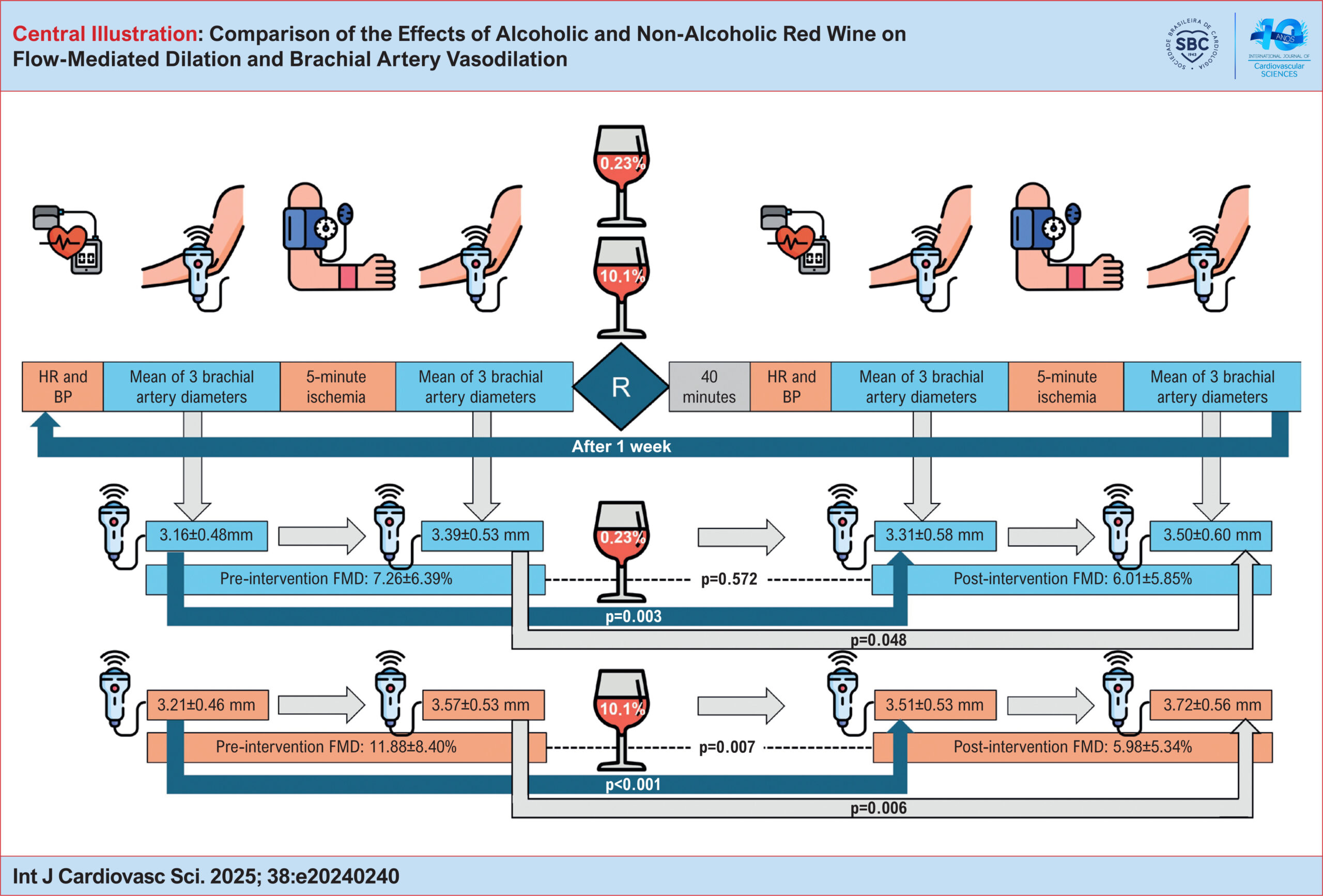
Pre-ischemia brachial artery diameter increased after both interventions: with alcoholic wine (3.21 ± 0.46 mm before versus 3.51 ± 0.53 mm after; p < 0.001) and non-alcoholic wine (3.16 ± 0.48 mm before versus 3.31 ± 0.58 mm after; p = 0.003). FMD showed a decrease after consumption of alcoholic wine (11.88% ± 8.40% before versus 5.98% ± 5.34% after; p = 0.007), whereas consumption of non-alcoholic wine did not result in significant changes (7.26% ± 6.39% before versus 6.01% ± 5.85% after; p = 0.572). Other parameters, such as heart rate and blood pressure, did not show any significant differences.

Conclusion:

Consumption of red wine, with and without alcohol, increased brachial artery diameter. However, alcoholic red wine was associated with reduced FMD, suggesting that ethanol may negatively affect endothelial function.
  • Cardiovascular Diseases
  • Endothelium
  • Flavonoids
  • Resveratrol
  • Vasodilation
  • Wine
Read Full Article
Creative Commons Attribution (CC BY) Creative Commons license
15/08/2025 DOI: 10.36660/ijcs.20240240 Views 1
ABC
Editorial

Endothelial Function and Arterial Hypertension

Rui Póvoa

A few years ago, it was believed that the endothelium was simply the inner lining of blood vessels, representing a simple mechanical barrier. Today, there is profound evidence of the importance of this thin layer of cells in the regulation of vascular tone and in several other functions, mainly in cell growth, interaction between leukocytes, tissue inflammation, and synthesis of vasoregulatory substances. The regulation of vascular tone involves the nitric oxide (NO) signaling pathway, which has strong vasodilatory, anti-inflammatory, and antioxidant properties.

A healthy endothelium is important for good vascular homeostasis since endothelial dysfunction plays a significant role in the pathogenesis of many diseases, such as arterial and pulmonary hypertension, cardiomyopathies, vasculitis, and, quite objectively, in the formation of atherosclerosis., The bioavailability of NO is considered one of the critical factors in hypertensive patients, including in the early stages of the disease and not only in the final event of the dysfunction, which is atherosclerosis.

[…]

  • Endothelium
  • Hypertension
  • Vasodilation
Read Full Article
Creative Commons Attribution (CC BY) Creative Commons license
02/06/2025 DOI: 10.36660/abc.20250179i Views 2
Antihypertensive Effect of New Agonist of Adenosine Receptor in Spontaneously Hypertensive Rats
ABC
Original Article

Antihypertensive Effect of New Agonist of Adenosine Receptor in Spontaneously Hypertensive Rats

Bruna de Souza Rocha et al. Jaqueline Soares da Silva Júlia Galvez Bulhões Pedreira Tadeu Lima Montagnoli … Eliezer Jesus Barreiro Gisele Zapata-Sudo

Abstract

Background

Systemic arterial hypertension is a risk factor for cardiac, renal, and metabolic dysfunction. The search for new strategies to prevent and treat cardiovascular diseases led to the synthesis of new N-acylhydrazones to produce antihypertensive effect. Adenosine receptors are an alternative target to reduce blood pressure because of their vasodilatory action and antioxidant properties, which may reduce oxidative stress characteristic of systemic arterial hypertension.

Objective

To evaluate the antihypertensive profile of novel selenium-containing compounds designed to improve their interaction with adenosine receptors.

Methods

Vascular reactivity was evaluated by recording the isometric tension of pre-contracted thoracic aorta of male Wistar rats after exposure to increasing concentrations of each derivative (0.1 to 100 μM). To investigate the antihypertensive effect in spontaneously hypertensive rats, systolic, diastolic, and mean arterial pressure and heart rate were determined after intravenous administration of 10 and 30 μmol/kg of the selected compound LASSBio-2062.

Results

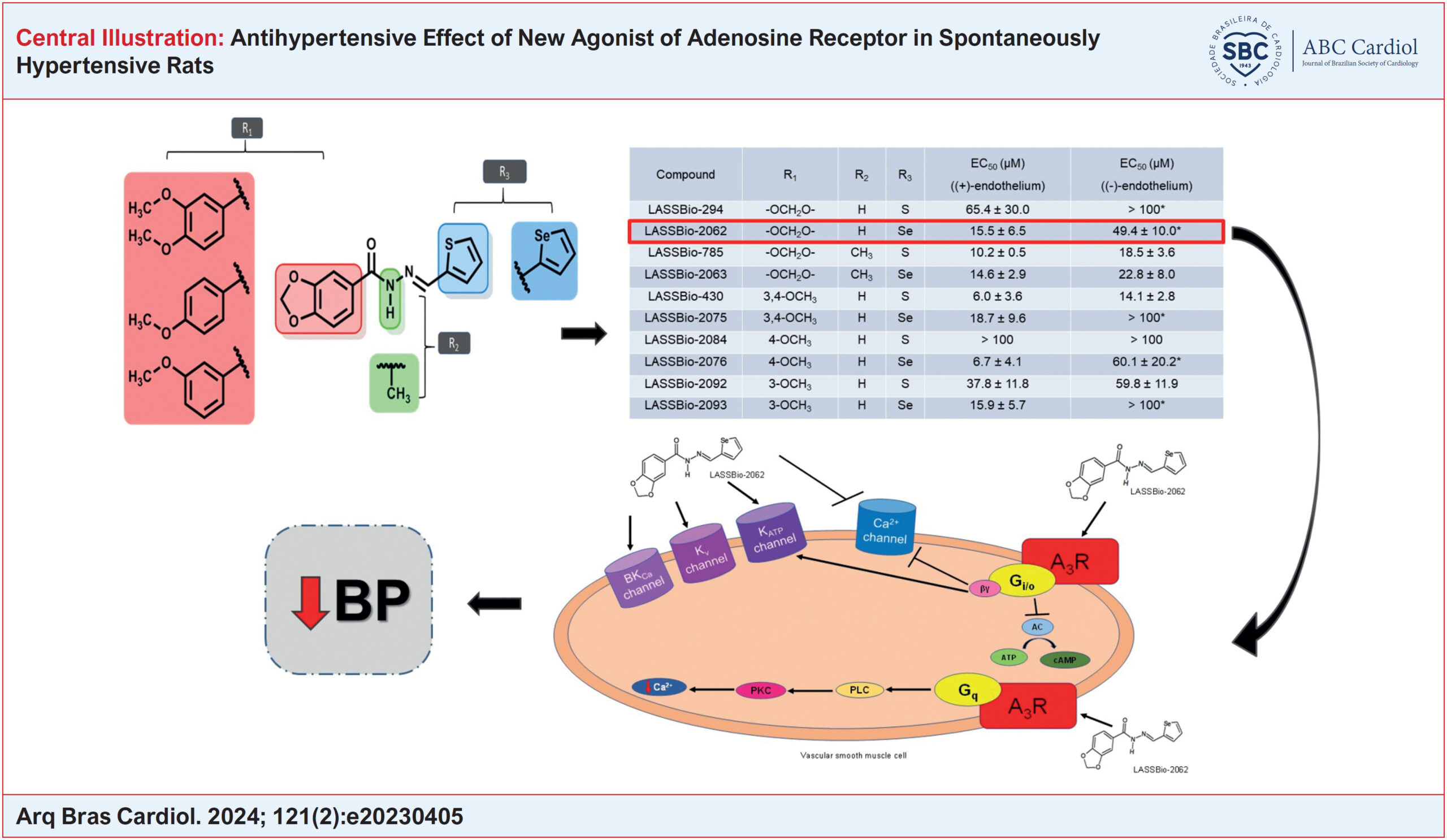
Compounds named LASSBio-2062, LASSBio-2063, LASSBio-2075, LASSBio-2076, LASSBio-2084, LASSBio-430, LASSBio-2092, and LASSBio-2093 promoted vasodilation with mean effective concentrations of 15.5 ± 6.5; 14.6 ± 2.9; 18.7 ± 9.6; 6.7 ± 4.1; > 100; 6.0 ± 3.6; 37.8 ± 11.8; and 15.9 ± 5.7 μM, respectively. LASSBio-2062 (30 μmol/kg) reduced mean arterial pressure in spontaneously hypertensive rats from 124.6 ± 8.6 to 72.0 ± 12.3 mmHg (p < 0.05). Activation of adenosine receptor subtype A3 and potassium channels seem to be involved in the antihypertensive effect of LASSBio-2062.

Conclusions

The new agonist of adenosine receptor and activator of potassium channels is a potential therapeutic agent to treat systemic arterial hypertension.

  • Calcium Channels
  • Hypertension
  • Purinergic P1 Receptors
  • Vasodilation
Read Full Article
Creative Commons Attribution (CC BY) Creative Commons license
05/04/2024 DOI: 10.36660/abc.20230405 Views 1

How to cite this article

EndNote RIS

Electronic Document Format (Vancouver)

Moreira DM, Martins LF, Savas LA, Cegielka R. Comparison of the Effects of Alcoholic and Non-Alcoholic Red Wine on Flow-Mediated Dilation and Brachial Artery Vasodilation. International Journal of Cardiovascular Sciences 2025;38:e20240240.

Electronic Document Format (ABNT)

Moreira, Daniel Medeiros; Martins, Luiza Frassetto; Savas, Lucca Antonini; Cegielka, Rafael. Comparison of the Effects of Alcoholic and Non-Alcoholic Red Wine on Flow-Mediated Dilation and Brachial Artery Vasodilation. International Journal of Cardiovascular Sciences, v. 38, e20240240, Aug. 2025.

Electronic Document Format (APA)

Moreira, D. M., Martins, L. F., Savas, L. A., & Cegielka, R. (2025). Comparison of the Effects of Alcoholic and Non-Alcoholic Red Wine on Flow-Mediated Dilation and Brachial Artery Vasodilation. International Journal of Cardiovascular Sciences, 38, e20240240.

Electronic Document Format (ISO)

Moreira, Daniel Medeiros and Martins, Luiza Frassetto and Savas, Lucca Antonini and Cegielka, Rafael. Comparison of the Effects of Alcoholic and Non-Alcoholic Red Wine on Flow-Mediated Dilation and Brachial Artery Vasodilation. International Journal of Cardiovascular Sciences [online]. 2025, vol. 38, [cited 2026-10-15], e20240240. Available from: <https://journals.cardiol.br/en/article/comparison-of-the-effects-of-alcoholic-and-non-alcoholic-red-wine-on-flow-mediated-dilation-and-brachial-artery-vasodilation/>. ISSN 2359-4802

EndNote RIS

Electronic Document Format (Vancouver)

Póvoa R. Endothelial Function and Arterial Hypertension. Arquivos Brasileiros de Cardiologia 2025;122(5):e20250179.

Electronic Document Format (ABNT)

Póvoa, Rui. Endothelial Function and Arterial Hypertension. Arquivos Brasileiros de Cardiologia, v. 122, n. 5, e20250179, Jun. 2025.

Electronic Document Format (APA)

Póvoa, R. (2025). Endothelial Function and Arterial Hypertension. Arquivos Brasileiros de Cardiologia, 122(5), e20250179.

Electronic Document Format (ISO)

Póvoa, Rui. Endothelial Function and Arterial Hypertension. Arquivos Brasileiros de Cardiologia [online]. 2025, vol. 122, n. 5, [cited 2026-10-15], e20250179. Available from: <https://journals.cardiol.br/en/article/endothelial-function-and-arterial-hypertension/>. ISSN 0066-782X

EndNote RIS

Electronic Document Format (Vancouver)

Rocha BS, Silva JS, Pedreira JGB, Montagnoli TL, Barreiro EJ, Zapata-Sudo G. Antihypertensive Effect of New Agonist of Adenosine Receptor in Spontaneously Hypertensive Rats. Arquivos Brasileiros de Cardiologia 2024;121(2):e20230405.

Electronic Document Format (ABNT)

Rocha, Bruna de Souza; Silva, Jaqueline Soares da; Pedreira, Júlia Galvez Bulhões; Montagnoli, Tadeu Lima; Barreiro, Eliezer Jesus; Zapata-Sudo, Gisele. Antihypertensive Effect of New Agonist of Adenosine Receptor in Spontaneously Hypertensive Rats. Arquivos Brasileiros de Cardiologia, v. 121, n. 2, e20230405, Apr. 2024.

Electronic Document Format (APA)

Rocha, B. S., Silva, J. S. , Pedreira, J. G. B., Montagnoli, T. L., Barreiro, E. J., & Zapata-Sudo, G. (2024). Antihypertensive Effect of New Agonist of Adenosine Receptor in Spontaneously Hypertensive Rats. Arquivos Brasileiros de Cardiologia, 121(2), e20230405.

Electronic Document Format (ISO)

Rocha, Bruna de Souza and Silva, Jaqueline Soares da and Pedreira, Júlia Galvez Bulhões and Montagnoli, Tadeu Lima and Barreiro, Eliezer Jesus and Zapata-Sudo, Gisele. Antihypertensive Effect of New Agonist of Adenosine Receptor in Spontaneously Hypertensive Rats. Arquivos Brasileiros de Cardiologia [online]. 2024, vol. 121, n. 2, [cited 2026-10-15], e20230405. Available from: <https://journals.cardiol.br/en/article/antihypertensive-effect-of-new-agonist-of-adenosine-receptor-in-spontaneously-hypertensive-rats/>. ISSN 0066-782X

  • About ABC Family
  • Internal Regulation
  • Editorial Board
  • Brazilian Society of Cardiology (SBC)

Issues

SBC Guidelines

  • Videos
  • Podcasts
  • News