ABC Family Arquivos Brasileiros de Cardiologia International Journal of Cardiovascular Sciences ABC Heart Failure & Cardiomyopathy ABC Imagem Cardiovascular
Português English
ABC Family
Português English
  • About
    • About ABC Family
    • Internal Regulation
    • Editorial Board
    • Brazilian Society of Cardiology (SBC)
  • Issues
  • SBC Guidelines
  • Content
    • Videos
    • Podcasts
    • News
  • About
    • About ABC Family
    • Internal Regulation
    • Editorial Board
    • Brazilian Society of Cardiology (SBC)
  • Issues
  • SBC Guidelines
  • Content
    • Videos
    • Podcasts
    • News

ABC Family

  • ABC Family
  • Arquivos Brasileiros de Cardiologia
  • International Journal of Cardiovascular Sciences
  • ABC Heart Failure & Cardiomyopathy
  • ABC Imagem Cardiovascular
Search in

No content found.

Journals
Ordering
Article types
Others

  1. Home
  2. Keyword: Endothelium/function
ABC
Editorial

Do Microvascular Reactivity Studies Contribute to Clinical Practice?

Claudio Leinig Pereira da Cunha

We appraise in this publication the article “Microvascular Reactivity in Hypertensive Patients with High Body Adiposity”, by D’El-Rei et al. This is a complex investigation, assessing patients with Arterial Hypertension undergoing treatment, with the inclusion of several models for obesity assessment and several hemodynamic and circulatory parameters, which are studied in this scenario. Microvascular reactivity was evaluated using the Laser Speckle Contrast Image method in combination with Post-occlusive Reactive Hyperemia, therefore studying the endothelial function in this patient population.

Endothelial cells constitute an organ that is distributed throughout the body, comprising a dynamic interface with all other organs. The endothelium mediates vasomotor tone, regulates cell and nutrient traffic, maintains body fluidity, contributes to the balance between pro- and anti-inflammatory mediators, modulates procoagulant and anticoagulant activity, participates in the formation of new blood vessels, orchestrates organ development, participates in immunity, interacts with circulating blood cells and undergoes programmed cell death.

[…]

  • Adiposity
  • Biomarkers
  • Cardiovascular Diseases
  • Endothelium/function
  • Hypertension
  • Obesity
  • Oxidative Stress
Read Full Article
Creative Commons Attribution (CC BY) Creative Commons license
07/12/2020 DOI: 10.36660/abc.20200574 Views 1
Figure 1
ABC
Original Article

Family History of Hypertension Impairs the Autonomic Balance, but not the Endothelial Function, in Young Soccer Players

Walter Vargas et al. Katya Rigatto

Abstract

Background

The family history of hypertension (FHH) imposes consistent risk for diverse chronic diseases that are accompanied by hypertension. Furthermore, the heart rate variability (HRV) and flow-mediated dilation (FMD) are both related to maximal oxygen uptake (VO2max), and are usually impaired during hypertension

Objective

To compare the autonomic modulation, the endothelial function (EF) and maximum oxygen uptake (VO2max) of young athletes, separated according to their parents’ blood pressure (BP) history, in order to study the influence of their genetic background on those parameters.

Methods

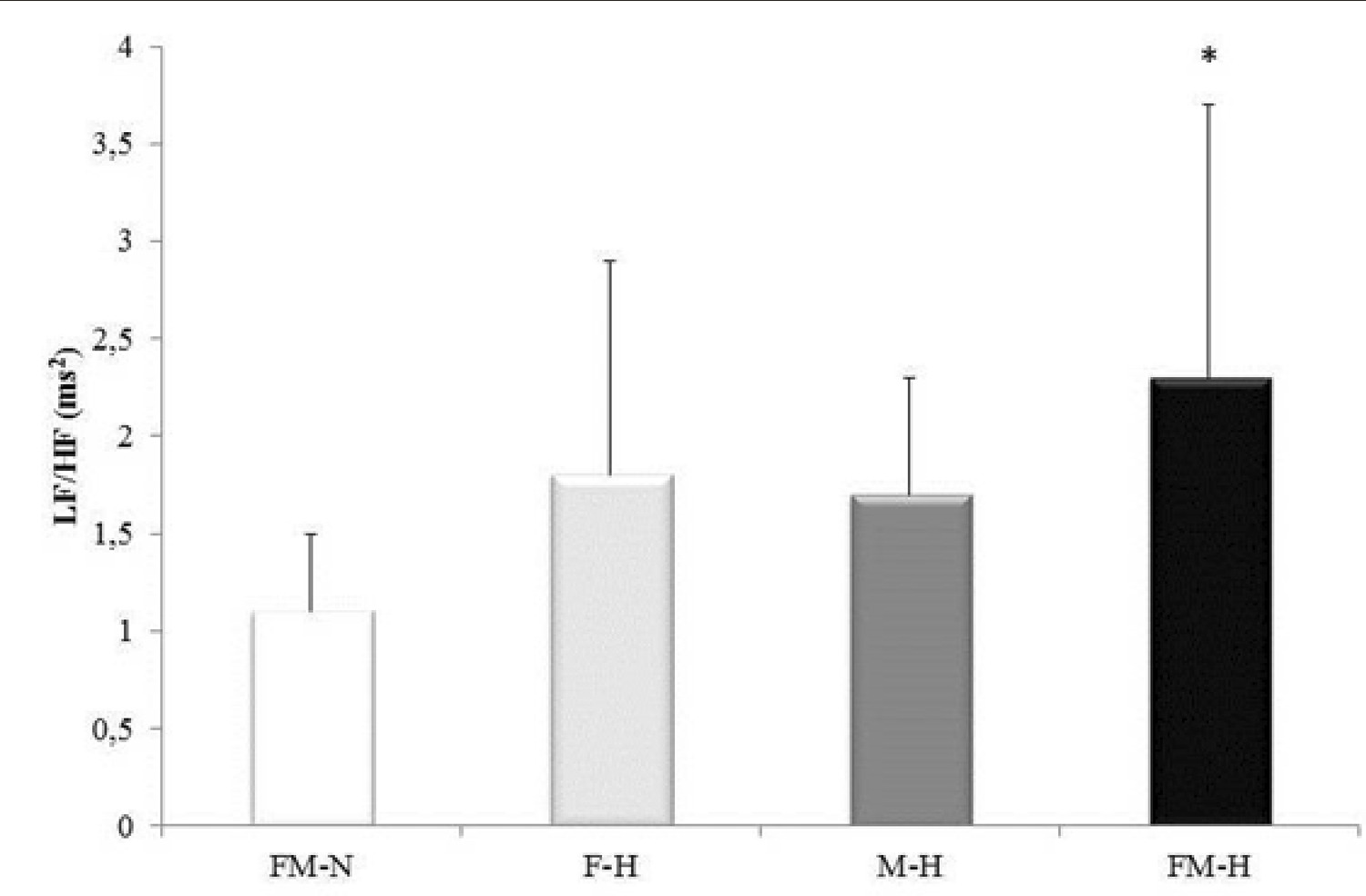
A total of 46 young male soccer players (18±2 years of age) were divided into four groups: 1-normotensive father and mother (FM-N); 2-only father was hypertensive (F-H); 3-only mother was hypertensive (M-H); 4-father and mother were hypertensive (FM-H). Measurements of BP, FMD, HRV and VO2maxwere performed. The significance level adopted in the statistical analysis was 5%.

Results

The standard deviation of normal RR intervals (SDNN; FM-N=314±185; FM-H=182.4± 57.8), the square root of the mean squared differences in successive RR intervals (RMSSD; FM-N=248±134; FM-H=87±51), the number of interval differences of successive NN intervals greater than 50ms (NN50; FM-N=367±83.4; FM-H=229±55), the ratio derived by dividing NN50 by the total number of NN intervals (pNN50; FM-N=32.4±6.2; FM-H=21.1±5.3) and the high (HF; FM-N=49±8.9; FM-H=35.3±12) and low-frequency (LF; FM-N=50.9±8.9; FM-H=64.6±12) components, in normalized units (%), were significantly lower in the FM-H group than in the FM-N group (p<0.05). On the other hand, the LF/HF ratio (ms2) was significantly higher (p<0.05). We found no significant difference between the groups in VO2maxand FMD (p<0.05).

Conclusions

In young male soccer players, the FHH plays a potentially role in autonomic balance impairment, especially when both parents are hypertensive, but present no changes in VO2maxand FMD. In this case, there is a decrease in the sympathetic-vagal control, which seems to precede the endothelial damage (Arq Bras Cardiol. 2020; 115(1):52-58)

  • Athletes
  • Blood Pressure
  • Endothelium/function
  • Heredity/genetics
  • Hypertension
  • Soccer
  • Youth Sports
Read Full Article
Creative Commons Attribution (CC BY) Creative Commons license
07/08/2020 DOI: 10.36660/abc.20180441 Views 2
Figure 1
ABC
Original Article

Vasodilation and Reduction of Systolic Blood Pressure after One Session of High-Intensity Interval Training in Patients With Heart Failure with Preserved Ejection Fraction

Juliana Beust de Lima et al. Anderson Donelli da Silveira Marco Aurélio Lumertz Saffi Márcio Garcia Menezes … Diogo Silva Piardi Leila Denise Cardoso Ramos Ramm Maurice Zanini Rosane Maria Nery, Ricardo Stein

Abstract

Background:

Heart failure with preserved ejection fraction (HFpEF) is a multifactorial syndrome characterized by a limited exercising capacity. High-intensity interval training (HIIT) is an emerging strategy for exercise rehabilitation in different settings. In patients with HFpEF, HIIT subacute effects on endothelial function and blood pressure are still unknown.

Objective:

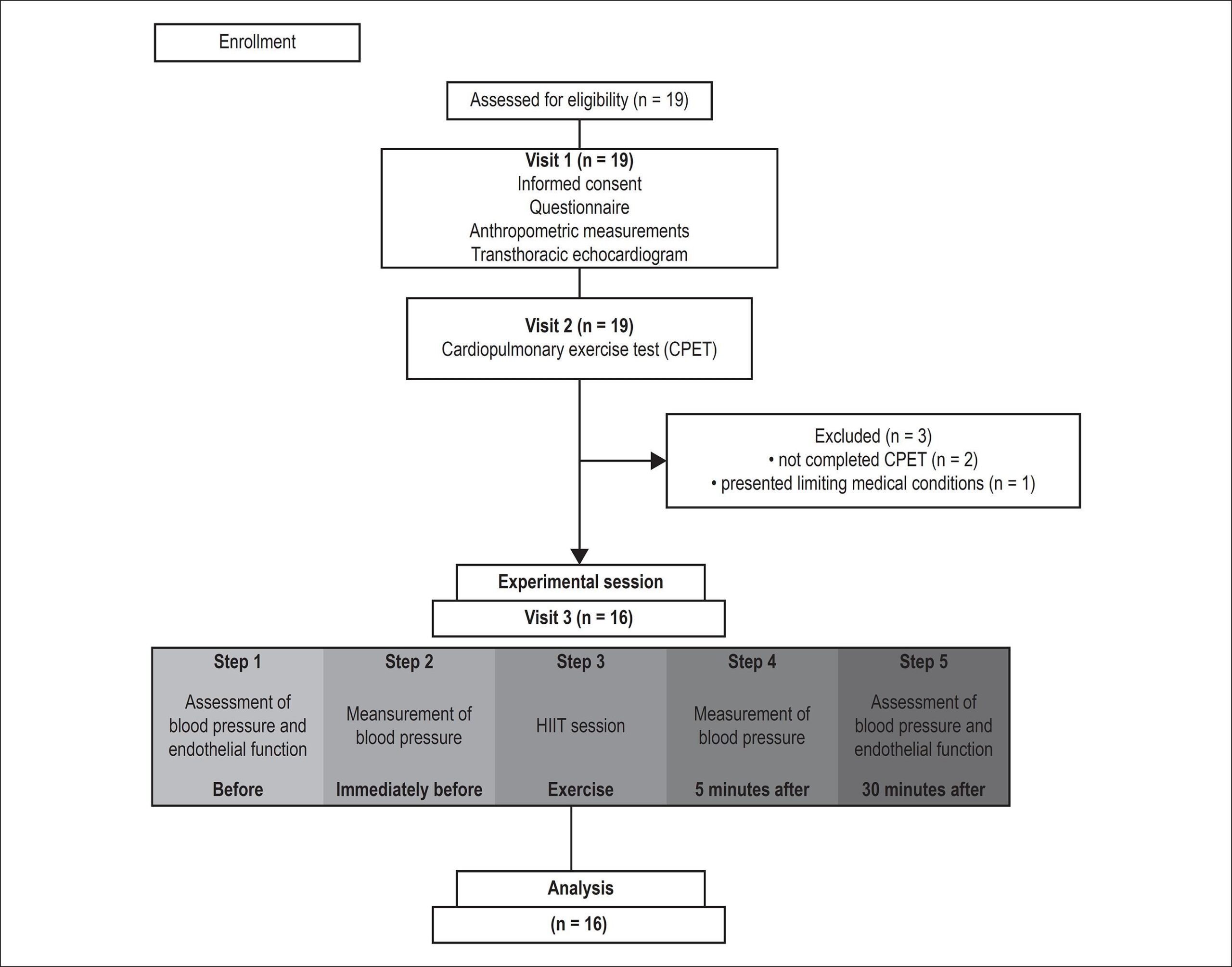
To evaluate the subacute effect of one HIIT session on endothelial function and blood pressure in patients with HFpEF.

Methods:

Sixteen patients with HFpEF underwent a 36-minute session of HIIT on a treadmill, alternating four minutes of high-intensity intervals with three minutes of active recovery. Brachial artery diameter, flow-mediated dilation, and blood pressure were assessed immediately before and 30 minutes after the HIIT session. In all analyses, p <0.05 was considered statistically significant.

Results:

There was an increase in brachial artery diameter (pre-exercise: 3.96 ± 0.57 mm; post-exercise: 4.33 ± 0.69 mm; p < 0.01) and a decrease in systolic blood pressure (pre-exercise: 138 ± 21 mmHg; post-exercise: 125 ± 20 mmHg; p < 0.01). Flow-mediated dilation (pre-exercise: 5.91 ± 5.20%; post-exercise: 3.55 ± 6.59%; p = 0.162) and diastolic blood pressure (pre-exercise: 81 ± 11 mmHg; post-exercise: 77 ± 8 mmHg; p = 1.000) did not change significantly. There were no adverse events throughout the experiment.

Conclusions:

One single HIIT session promoted an increase in brachial artery diameter and reduction in systolic blood pressure, but it did not change flow-mediated dilation and diastolic blood pressure.

  • Arterial Pressure
  • Brachial Artery
  • Endothelium/function
  • Exercise
  • Heart Failure
  • Vasodilatation
Read Full Article
Creative Commons Attribution (CC BY) Creative Commons license
18/10/2018 DOI: 10.5935/abc.20180202 Views 1

How to cite this article

EndNote RIS

Electronic Document Format (Vancouver)

Cunha CLP. Do Microvascular Reactivity Studies Contribute to Clinical Practice?. Arquivos Brasileiros de Cardiologia 2020;115(5):905-6.

Electronic Document Format (ABNT)

Cunha, Claudio Leinig Pereira da. Do Microvascular Reactivity Studies Contribute to Clinical Practice?. Arquivos Brasileiros de Cardiologia, v. 115, n. 5, p. 905-906, Dec. 2020.

Electronic Document Format (APA)

Cunha, C. L. P. (2020). Do Microvascular Reactivity Studies Contribute to Clinical Practice?. Arquivos Brasileiros de Cardiologia, 115(5), 905-906.

Electronic Document Format (ISO)

Cunha, Claudio Leinig Pereira da. Do Microvascular Reactivity Studies Contribute to Clinical Practice?. Arquivos Brasileiros de Cardiologia [online]. 2020, vol. 115, n. 5, [cited 2026-10-14], pp. 905-906. Available from: <https://journals.cardiol.br/en/article/do-microvascular-reactivity-studies-contribute-to-clinical-practice/>. ISSN 0066-782X

EndNote RIS

Electronic Document Format (Vancouver)

Vargas W, Rigatto K. Family History of Hypertension Impairs the Autonomic Balance, but not the Endothelial Function, in Young Soccer Players. Arquivos Brasileiros de Cardiologia 2020;115(1):52-8.

Electronic Document Format (ABNT)

Vargas, Walter; Rigatto, Katya. Family History of Hypertension Impairs the Autonomic Balance, but not the Endothelial Function, in Young Soccer Players. Arquivos Brasileiros de Cardiologia, v. 115, n. 1, p. 52-58, Aug. 2020.

Electronic Document Format (APA)

Vargas, W., & Rigatto, K. (2020). Family History of Hypertension Impairs the Autonomic Balance, but not the Endothelial Function, in Young Soccer Players. Arquivos Brasileiros de Cardiologia, 115(1), 52-58.

Electronic Document Format (ISO)

Vargas, Walter and Rigatto, Katya. Family History of Hypertension Impairs the Autonomic Balance, but not the Endothelial Function, in Young Soccer Players. Arquivos Brasileiros de Cardiologia [online]. 2020, vol. 115, n. 1, [cited 2026-10-14], pp. 52-58. Available from: <https://journals.cardiol.br/en/article/family-history-of-hypertension-impairs-the-autonomic-balance-but-not-the-endothelial-function-in-young-soccer-players/>. ISSN 0066-782X

EndNote RIS

Electronic Document Format (Vancouver)

Lima JB, Silveira AD, Saffi MAL, Menezes MG, Piardi DS, Ramm LDCR, Zanini M, et al. Vasodilation and Reduction of Systolic Blood Pressure after One Session of High-Intensity Interval Training in Patients With Heart Failure with Preserved Ejection Fraction. Arquivos Brasileiros de Cardiologia 2018;111(5):699-707.

Electronic Document Format (ABNT)

Lima, Juliana Beust de; Silveira, Anderson Donelli da; Saffi, Marco Aurélio Lumertz; Menezes, Márcio Garcia; Piardi, Diogo Silva; Ramm, Leila Denise Cardoso Ramos; Zanini, Maurice; Nery, Rosane Maria; Stein, Ricardo. Vasodilation and Reduction of Systolic Blood Pressure after One Session of High-Intensity Interval Training in Patients With Heart Failure with Preserved Ejection Fraction. Arquivos Brasileiros de Cardiologia, v. 111, n. 5, p. 699-707, Oct. 2018.

Electronic Document Format (APA)

Lima, J. B. , Silveira, A. D. , Saffi, M. A. L., Menezes, M. G., Piardi, D. S., Ramm, L. D. C. R., Zanini, M., Nery, R. M., & Stein, R. (2018). Vasodilation and Reduction of Systolic Blood Pressure after One Session of High-Intensity Interval Training in Patients With Heart Failure with Preserved Ejection Fraction. Arquivos Brasileiros de Cardiologia, 111(5), 699-707.

Electronic Document Format (ISO)

Lima, Juliana Beust de and Silveira, Anderson Donelli da and Saffi, Marco Aurélio Lumertz and Menezes, Márcio Garcia and Piardi, Diogo Silva and Ramm, Leila Denise Cardoso Ramos and Zanini, Maurice and Nery, Rosane Maria and Stein, Ricardo. Vasodilation and Reduction of Systolic Blood Pressure after One Session of High-Intensity Interval Training in Patients With Heart Failure with Preserved Ejection Fraction. Arquivos Brasileiros de Cardiologia [online]. 2018, vol. 111, n. 5, [cited 2026-10-14], pp. 699-707. Available from: <https://journals.cardiol.br/en/article/vasodilation-and-reduction-of-systolic-blood-pressure-after-one-session-of-high-intensity-interval-training-in-patients-with-heart-failure-with-preserved-ejection-fraction/>. ISSN 0066-782X

  • About ABC Family
  • Internal Regulation
  • Editorial Board
  • Brazilian Society of Cardiology (SBC)

Issues

SBC Guidelines

  • Videos
  • Podcasts
  • News