ABC Family Arquivos Brasileiros de Cardiologia International Journal of Cardiovascular Sciences ABC Heart Failure & Cardiomyopathy ABC Imagem Cardiovascular
Português English
ABC Family
Português English
  • About
    • About ABC Family
    • Internal Regulation
    • Editorial Board
    • Brazilian Society of Cardiology (SBC)
  • Issues
  • SBC Guidelines
  • Content
    • Videos
    • Podcasts
    • News
  • About
    • About ABC Family
    • Internal Regulation
    • Editorial Board
    • Brazilian Society of Cardiology (SBC)
  • Issues
  • SBC Guidelines
  • Content
    • Videos
    • Podcasts
    • News

ABC Family

  • ABC Family
  • Arquivos Brasileiros de Cardiologia
  • International Journal of Cardiovascular Sciences
  • ABC Heart Failure & Cardiomyopathy
  • ABC Imagem Cardiovascular
Search in

No content found.

Journals
Ordering
Article types
Others

  1. Home
  2. Keyword: Heredity/genetics
IJCS
Original Article

Family History of Hypertension: Impact on Blood Pressure, Anthropometric Measurements and Physical Activity Level in Schoolchildren

Tatiana Affornali Tozo et al. Beatriz Oliveira Pereira Francisco José de Menezes Junior Cristianne Morgado Montenegro … Carla Marisa Maia Moreira Neiva Leite

Abstract

Background:

A family history of arterial hypertension (AH), combined with environmental risk factors, is directly related to the development of AH.

Objectives:

To evaluate the frequency of AH, anthropometric indicators and level of physical activity and their association with a family history (FH) of AH in school children.

Methods:

Cross-sectional study with 118 students, aged between 11 and 17 years, of both sexes. Waist circumference (WC), weight, height, level of physical activity and FH of HA were collected. Body mass index z score (BMI-z) and waist-to-height ratio (WHtR) were calculated. Binary logistic regression model was used to verify the chance risk, with significance p <0.05.

Results:

Of the 118 parents who answered the questionnaire, 34.7% had a positive FH of AH. Girls with a positive FH had higher means of WC (p= 0,004), BMI (p=0,020), and systolic blood pressure (SBP) (p=0,006) than boys, and a higher risk of being overweight (OR=4,48; 95%CI:1,55–12,94), and having elevated WHtR (OR=5.98; 95%CI:1.66– 21.47) and SBP (OR=3,07; 95%CI:1,03–9,13) than girls without a FH, but they practice more vigorours moderate physical activity (MVPA) (p=0,039). On the other hand, no differences in these parameters were observed between boys with and without a FM of AH.

Conclusion:

Overweight and a FH of hypertension were associated with an increased risk for AH in girls. This was not observed among boys, perhaps due to more active lifestyle.
  • Anthropometry
  • Blood Pressure
  • Heredity/genetics
  • Hypertension/genetics
  • Obesity
  • Physical activity
  • Schoolchildren
Read Full Article
Creative Commons Attribution (CC BY) Creative Commons license
25/02/2022 DOI: 10.36660/ijcs.20200346 Views 1
Figure 1
ABC
Original Article

Family History of Hypertension Impairs the Autonomic Balance, but not the Endothelial Function, in Young Soccer Players

Walter Vargas et al. Katya Rigatto

Abstract

Background

The family history of hypertension (FHH) imposes consistent risk for diverse chronic diseases that are accompanied by hypertension. Furthermore, the heart rate variability (HRV) and flow-mediated dilation (FMD) are both related to maximal oxygen uptake (VO2max), and are usually impaired during hypertension

Objective

To compare the autonomic modulation, the endothelial function (EF) and maximum oxygen uptake (VO2max) of young athletes, separated according to their parents’ blood pressure (BP) history, in order to study the influence of their genetic background on those parameters.

Methods

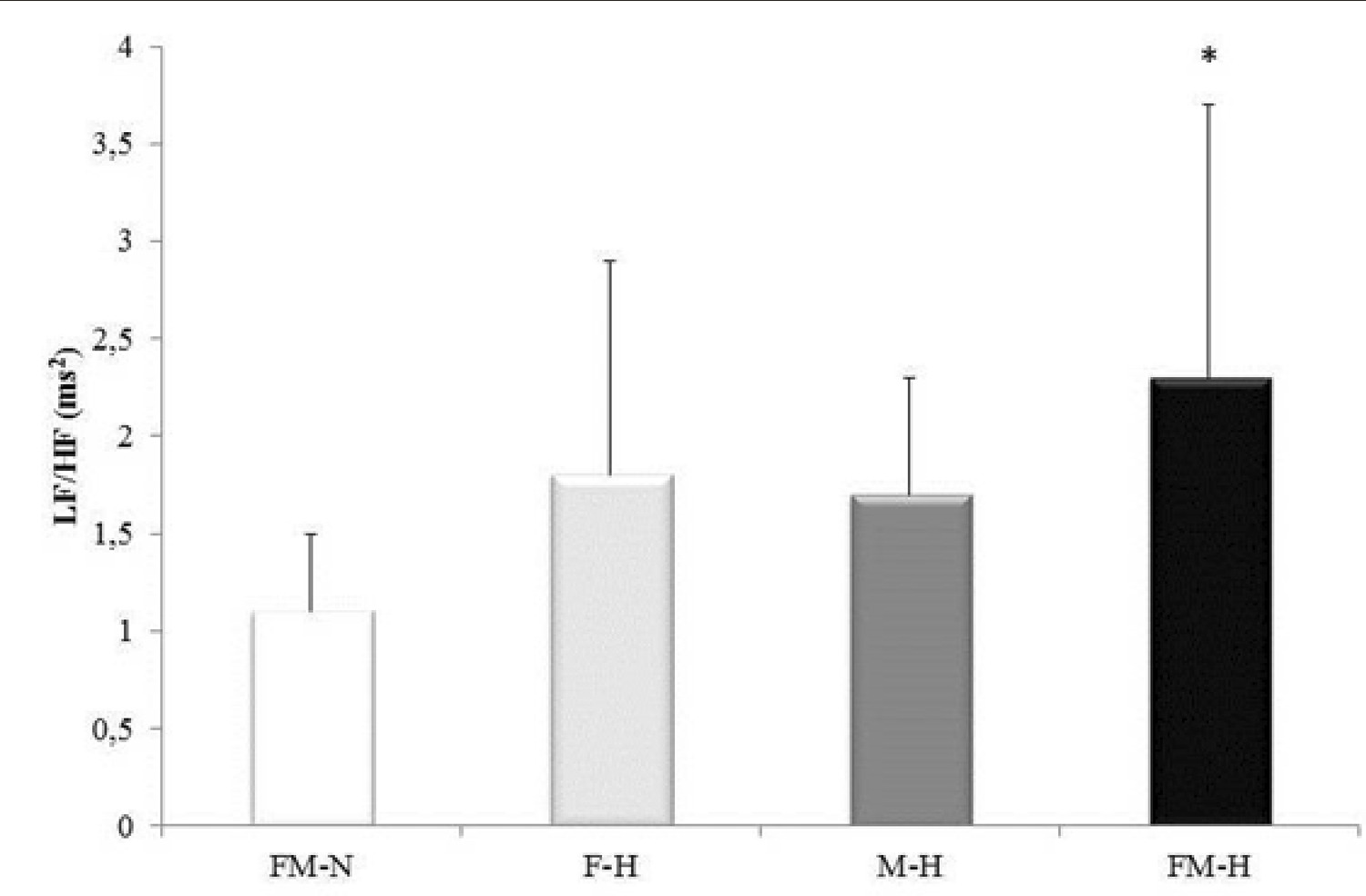
A total of 46 young male soccer players (18±2 years of age) were divided into four groups: 1-normotensive father and mother (FM-N); 2-only father was hypertensive (F-H); 3-only mother was hypertensive (M-H); 4-father and mother were hypertensive (FM-H). Measurements of BP, FMD, HRV and VO2maxwere performed. The significance level adopted in the statistical analysis was 5%.

Results

The standard deviation of normal RR intervals (SDNN; FM-N=314±185; FM-H=182.4± 57.8), the square root of the mean squared differences in successive RR intervals (RMSSD; FM-N=248±134; FM-H=87±51), the number of interval differences of successive NN intervals greater than 50ms (NN50; FM-N=367±83.4; FM-H=229±55), the ratio derived by dividing NN50 by the total number of NN intervals (pNN50; FM-N=32.4±6.2; FM-H=21.1±5.3) and the high (HF; FM-N=49±8.9; FM-H=35.3±12) and low-frequency (LF; FM-N=50.9±8.9; FM-H=64.6±12) components, in normalized units (%), were significantly lower in the FM-H group than in the FM-N group (p<0.05). On the other hand, the LF/HF ratio (ms2) was significantly higher (p<0.05). We found no significant difference between the groups in VO2maxand FMD (p<0.05).

Conclusions

In young male soccer players, the FHH plays a potentially role in autonomic balance impairment, especially when both parents are hypertensive, but present no changes in VO2maxand FMD. In this case, there is a decrease in the sympathetic-vagal control, which seems to precede the endothelial damage (Arq Bras Cardiol. 2020; 115(1):52-58)

  • Athletes
  • Blood Pressure
  • Endothelium/function
  • Heredity/genetics
  • Hypertension
  • Soccer
  • Youth Sports
Read Full Article
Creative Commons Attribution (CC BY) Creative Commons license
07/08/2020 DOI: 10.36660/abc.20180441 Views 2
ABC
Editorial

Heart Rate Variability as an Indicator of Cardiovascular Risk in Young Individuals

Breno Quintella Farah

The autonomic nervous system, which consists of the sympathetic and parasympathetic systems, plays an important role in regulating the functions of several systems in the human body, such as the cardiovascular system. Neural control of the heart is directly related to changes in heart rate and baroreceptor reflex activity, of which oscillation results from environmental stimuli. , These stimuli can lead to heart rate reduction through the parasympathetic nervous system, by decreasing the frequency of sinus node depolarization through the effect of acetylcholine on the cardiac neuroeffector junction. In turn, the sympathetic nervous system promotes an increase in heart rate through the norepinephrine release, which acts through the connection with β-adrenergic receptors, increasing the depolarization rate of the sinus pacemaker. ,

Healthy individuals or athletes, with an intact autonomic nervous system, show a predominance of parasympathetic modulation to the detriment of sympathetic modulation to the heart. On the other hand, in individuals with cardiovascular diseases, such as arterial hypertension, this pattern is reversed, with greater sympathetic modulation and less parasympathetic modulation being observed, which characterizes a picture of cardiac autonomic dysfunction. – This is particularly important, considering that changes in cardiac autonomic modulation and, consequently, in heart rate, can have a direct impact on cardiac output, which can result in BP changes.

[…]

  • Athletes
  • Blood Pressure
  • Endothelial function
  • Heredity/genetics
  • Hypertension
  • Soccer
  • Youth Sports
Read Full Article
Creative Commons Attribution (CC BY) Creative Commons license
07/08/2020 DOI: 10.36660/abc.20200444

How to cite this article

EndNote RIS

Electronic Document Format (Vancouver)

Tozo TA, Pereira BO, Menezes Junior FJ, Montenegro CM, Moreira CMM, Leite N. Family History of Hypertension: Impact on Blood Pressure, Anthropometric Measurements and Physical Activity Level in Schoolchildren. International Journal of Cardiovascular Sciences 2022;35(3):382-90.

Electronic Document Format (ABNT)

Tozo, Tatiana Affornali; Pereira, Beatriz Oliveira; Menezes Junior, Francisco José de; Montenegro, Cristianne Morgado; Moreira, Carla Marisa Maia; Leite, Neiva. Family History of Hypertension: Impact on Blood Pressure, Anthropometric Measurements and Physical Activity Level in Schoolchildren. International Journal of Cardiovascular Sciences, v. 35, n. 3, p. 382-390, Feb. 2022.

Electronic Document Format (APA)

Tozo, T. A., Pereira, B. O., Menezes Junior, F. J. , Montenegro, C. M., Moreira, C. M. M., & Leite, N. (2022). Family History of Hypertension: Impact on Blood Pressure, Anthropometric Measurements and Physical Activity Level in Schoolchildren. International Journal of Cardiovascular Sciences, 35(3), 382-390.

Electronic Document Format (ISO)

Tozo, Tatiana Affornali and Pereira, Beatriz Oliveira and Menezes Junior, Francisco José de and Montenegro, Cristianne Morgado and Moreira, Carla Marisa Maia and Leite, Neiva. Family History of Hypertension: Impact on Blood Pressure, Anthropometric Measurements and Physical Activity Level in Schoolchildren. International Journal of Cardiovascular Sciences [online]. 2022, vol. 35, n. 3, [cited 2026-10-14], pp. 382-390. Available from: <https://journals.cardiol.br/en/article/family-history-of-hypertension-impact-on-blood-pressure-anthropometric-measurements-and-physical-activity-level-in-schoolchildren/>. ISSN 2359-4802

EndNote RIS

Electronic Document Format (Vancouver)

Vargas W, Rigatto K. Family History of Hypertension Impairs the Autonomic Balance, but not the Endothelial Function, in Young Soccer Players. Arquivos Brasileiros de Cardiologia 2020;115(1):52-8.

Electronic Document Format (ABNT)

Vargas, Walter; Rigatto, Katya. Family History of Hypertension Impairs the Autonomic Balance, but not the Endothelial Function, in Young Soccer Players. Arquivos Brasileiros de Cardiologia, v. 115, n. 1, p. 52-58, Aug. 2020.

Electronic Document Format (APA)

Vargas, W., & Rigatto, K. (2020). Family History of Hypertension Impairs the Autonomic Balance, but not the Endothelial Function, in Young Soccer Players. Arquivos Brasileiros de Cardiologia, 115(1), 52-58.

Electronic Document Format (ISO)

Vargas, Walter and Rigatto, Katya. Family History of Hypertension Impairs the Autonomic Balance, but not the Endothelial Function, in Young Soccer Players. Arquivos Brasileiros de Cardiologia [online]. 2020, vol. 115, n. 1, [cited 2026-10-14], pp. 52-58. Available from: <https://journals.cardiol.br/en/article/family-history-of-hypertension-impairs-the-autonomic-balance-but-not-the-endothelial-function-in-young-soccer-players/>. ISSN 0066-782X

EndNote RIS

Electronic Document Format (Vancouver)

Farah BQ. Heart Rate Variability as an Indicator of Cardiovascular Risk in Young Individuals. Arquivos Brasileiros de Cardiologia 2020;115(1):59-60.

Electronic Document Format (ABNT)

Farah, Breno Quintella. Heart Rate Variability as an Indicator of Cardiovascular Risk in Young Individuals. Arquivos Brasileiros de Cardiologia, v. 115, n. 1, p. 59-60, Aug. 2020.

Electronic Document Format (APA)

Farah, B. Q. (2020). Heart Rate Variability as an Indicator of Cardiovascular Risk in Young Individuals. Arquivos Brasileiros de Cardiologia, 115(1), 59-60.

Electronic Document Format (ISO)

Farah, Breno Quintella. Heart Rate Variability as an Indicator of Cardiovascular Risk in Young Individuals. Arquivos Brasileiros de Cardiologia [online]. 2020, vol. 115, n. 1, [cited 2026-10-14], pp. 59-60. Available from: <https://journals.cardiol.br/en/article/heart-rate-variability-as-an-indicator-of-cardiovascular-risk-in-young-individuals/>. ISSN 0066-782X

  • About ABC Family
  • Internal Regulation
  • Editorial Board
  • Brazilian Society of Cardiology (SBC)

Issues

SBC Guidelines

  • Videos
  • Podcasts
  • News