ABC Family Arquivos Brasileiros de Cardiologia International Journal of Cardiovascular Sciences ABC Heart Failure & Cardiomyopathy ABC Imagem Cardiovascular
Português English
ABC Family
Português English
  • About
    • About ABC Family
    • Internal Regulation
    • Editorial Board
    • Brazilian Society of Cardiology (SBC)
  • Issues
  • SBC Guidelines
  • Content
    • Videos
    • Podcasts
    • News
  • About
    • About ABC Family
    • Internal Regulation
    • Editorial Board
    • Brazilian Society of Cardiology (SBC)
  • Issues
  • SBC Guidelines
  • Content
    • Videos
    • Podcasts
    • News

ABC Family

  • ABC Family
  • Arquivos Brasileiros de Cardiologia
  • International Journal of Cardiovascular Sciences
  • ABC Heart Failure & Cardiomyopathy
  • ABC Imagem Cardiovascular
Search in

No content found.

Journals
Ordering
Article types
Others

  1. Home
  2. Keyword: Endothelial function
ABC
Editorial

Endothelial Progenitor Cells and Exercise: Working Together to Target Endothelial Dysfunction in Metabolic Syndrome

Christina Grüne de Souza e Silva

Our understanding of the crucial role played by the endothelium in cardiovascular biology has evolved over the past couple of decades, with the recognition that it is a dynamically-regulated organ, essential in maintaining vascular homeostasis. A healthy endothelium is able to adequately respond to physical and chemical signals and, through the release of a wide range of mediators, regulate, among others, vascular tone and growth, cellular adhesion, thrombogenicity, and inflammation.

Furthermore, it has been acknowledged that when the endothelium loses its physiological properties due to an imbalance between its injury and its appropriate recovery, a tendency towards vasoconstriction, pro-thrombotic, and pro-inflammatory states are shown. This condition, termed endothelial dysfunction, has been shown to precede the development of pro-atherosclerotic changes, leading to atherosclerotic plaque formation and its later clinical complications.

[…]

  • Cardiovascular disease
  • Endothelial function
  • Metabolic Syndrome
  • Nitric Oxide
  • Physical activity
Read Full Article
Creative Commons Attribution (CC BY) Creative Commons license
26/07/2021 DOI: 10.36660/abc.20210399 Views 1
ABC
Editorial

Heart Rate Variability as an Indicator of Cardiovascular Risk in Young Individuals

Breno Quintella Farah

The autonomic nervous system, which consists of the sympathetic and parasympathetic systems, plays an important role in regulating the functions of several systems in the human body, such as the cardiovascular system. Neural control of the heart is directly related to changes in heart rate and baroreceptor reflex activity, of which oscillation results from environmental stimuli. , These stimuli can lead to heart rate reduction through the parasympathetic nervous system, by decreasing the frequency of sinus node depolarization through the effect of acetylcholine on the cardiac neuroeffector junction. In turn, the sympathetic nervous system promotes an increase in heart rate through the norepinephrine release, which acts through the connection with β-adrenergic receptors, increasing the depolarization rate of the sinus pacemaker. ,

Healthy individuals or athletes, with an intact autonomic nervous system, show a predominance of parasympathetic modulation to the detriment of sympathetic modulation to the heart. On the other hand, in individuals with cardiovascular diseases, such as arterial hypertension, this pattern is reversed, with greater sympathetic modulation and less parasympathetic modulation being observed, which characterizes a picture of cardiac autonomic dysfunction. – This is particularly important, considering that changes in cardiac autonomic modulation and, consequently, in heart rate, can have a direct impact on cardiac output, which can result in BP changes.

[…]

  • Athletes
  • Blood Pressure
  • Endothelial function
  • Heredity/genetics
  • Hypertension
  • Soccer
  • Youth Sports
Read Full Article
Creative Commons Attribution (CC BY) Creative Commons license
07/08/2020 DOI: 10.36660/abc.20200444
Prognostic value of endothelial function in patients with atherosclerosis: systematic review
ABC
Artigo Original

Prognostic value of endothelial function in patients with atherosclerosis: systematic review

Maristela Magnavita Oliveira Garcia et al. Paulo Roberto Passos Lima Luis Claudio Lemos Correia

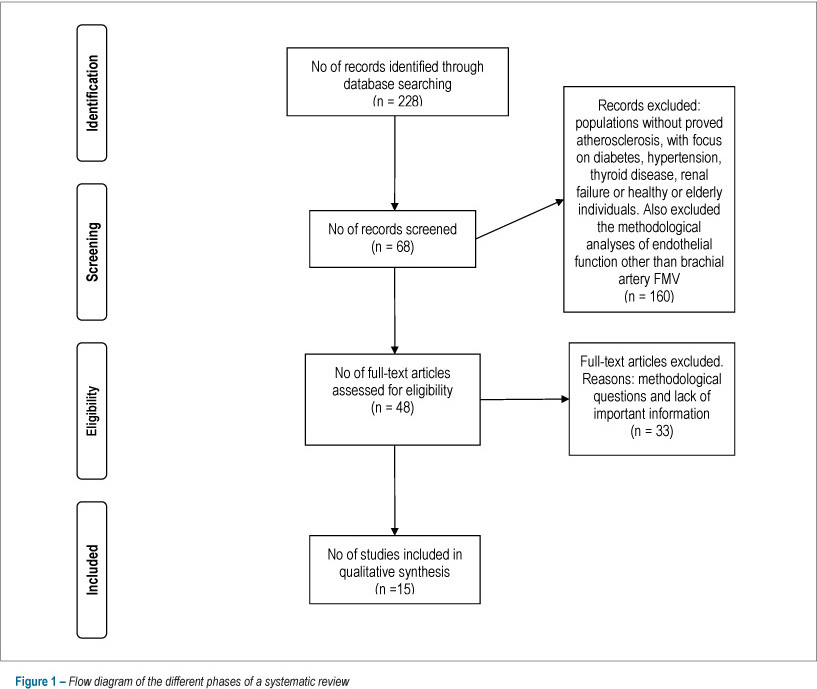
Analysis of flow-mediated vasodilation (FMV) of the brachial artery by use of ultrasound allows assessing endothelial function, and provides pathophysiological, diagnostic and prognostic information. This systematic review was aimed at assessing the literature level of evidence of the predictive capacity of endothelial function, measured through brachial artery FMV by use of ultrasound, regarding cardiovascular events in individuals with atherosclerosis. The MEDLINE, SCIELO and LILACS databases were searched, and prospective cohort studies on human beings about the prognostic value of endothelial function, measured by use of brachial artery FMV in individuals with peripheral or coronary atherosclerosis, were selected. Studies with clear methodological biases were excluded. The final selection consisted of 15 studies. Of the 13 studies that on univariate analysis showed statistical significance of the FMV method to predict cardiovascular events, 12 showed independent predictive capacity on multivariate analysis. None of the studies reviewed described the incremental predictive value of FMV to the traditional predictive models, such as the Framingham score. Results of three studies have suggested that the method adds prognostic value to isolated markers such as ankle-brachial index (ABI), diabetes, and high-sensitivity C-reactive protein (hsCRP). In conclusion, brachial artery FMV predicts cardiovascular risk, but its incremental predictive value to clinical prognostic models has not been established. In addition, solid evidence supporting its use in routine clinical practice to predict cardiovascular risk still lacks.

  • Atherosclerosis
  • Brachial Artery
  • Endothelial function
  • flow-mediated vasodilation
  • Prognosis
Read Full Article
Creative Commons Attribution (CC BY) Creative Commons license
30/08/2012 DOI: 10.1590/S0066-782X2012005000078
Reliability of brachial artery flow-mediated dilatation measurement using ultrasound
ABC
Artigo Original

Reliability of brachial artery flow-mediated dilatation measurement using ultrasound

Cláudia de Mello Meirelles et al. Sandra Pereira Leite Carlos Antonio Barbosa Montenegro Paulo Sergio Chagas Gomes

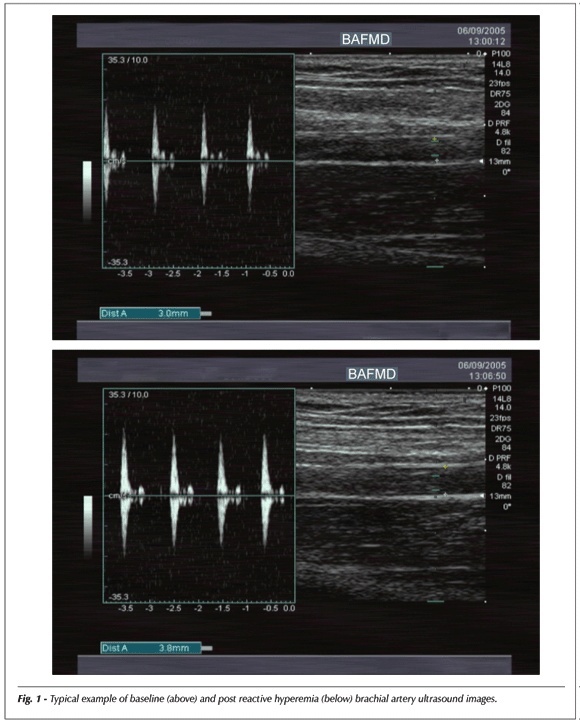
OBJECTIVE: To determine the reliability of the baseline (BBAB) and post occlusion (POBAD) brachial artery diameters, brachial artery flow-mediated dilatations (BAFMD) measurements, and to quantify the typical error of the measurements (TEM). METHODS: Internal consistency (2 measurements on the same day) was determined in 10 volunteers, whereas stability (2 measurements on separate days) was determined in 13 volunteers. All the volunteers looked healthy and were nonsmokers. The brachial artery images were obtained using a two dimensional Doppler ultrasound instrument: a 14 MHz transducer was used. The distances between the intima-lumen interfaces were measured before and after the blood flow had been stopped by means of a cuff on the arm for five minutes. BAFMD was considered as the percentile increase of POBAD in relation to BBAD. RESULTS: ANOVA did not identify any significant differences between the measurements taken on the same and separate days. For BAFMD, the intraclass correlation coefficients between the measurements taken on the same and separate days were: R = 0.7001 and R = 0.8420, respectively (p < 0.05). The variation coefficients were 5.8% and 12.4% and the relative SMEs were 13.8% and 14.9%, respectively, for the measurements taken on the same and separate days. Analysis of the Bland-Altman graphs indicated that the variables did not present heteroscedastic errors. CONCLUSION: The BBAD, POBAD and BAFMD measurements using the manual ultrasound technique were highly reliable for both the same and separate day measurements and therefore can be used to diagnose and monitor endothelial function.

  • Endothelial function
  • Internal consistency
  • stability
  • typical error of measurement
  • vascular reactivity
Read Full Article
Creative Commons Attribution (CC BY) Creative Commons license
25/09/2007 DOI: 10.1590/S0066-782X2007001500006 Views 1
Carotid intimal-medial thickening and endothelial function in coronary artery disease
ABC
Artigo Original

Carotid intimal-medial thickening and endothelial function in coronary artery disease

Graziela Chequer et al. Bruno Ramos Nascimento Túlio Pinho Navarro Eduardo Belisário Falqueto … Maria Clara N. Alencar Márcio Cristiano R. de Miranda Ari Mandil Jamil Abdalla Saad Cirilo Fonseca Antônio Luiz Pinho Ribeiro

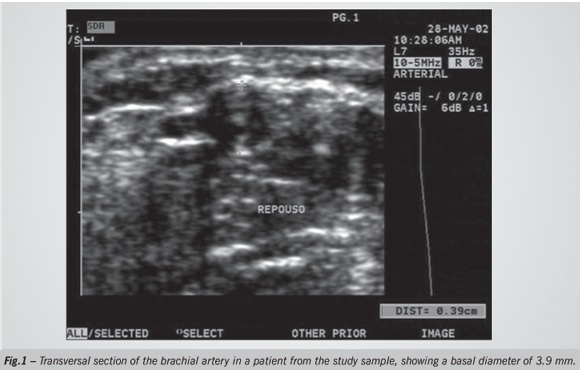
OBJECTIVE: To investigate the correlation between the endothelial function and the carotid intimal-medial thickening (IMT) in a population of patients with coronary artery disease, as well as that between the endothelial function and carotid IMT with the severity of the coronary lesions. METHODS: Forty-three patients aged 60.5±9.2 years, (67.4% males) with coronary artery disease at the coronariography were studied. Endothelial function was assessed using the brachial artery reactivity test (BART), which measured the percentage of flow-mediated dilatation (%FMD). The carotid IMT was evaluated through vascular ultrasound. RESULTS: The mean %FDM was 4.7 ± 3.6 and the mean carotid IMT was 1.08 ± 0.23 mm. The carotid MIT and %FMD measurements showed a statistically significant correlation, with Spearman’s coefficient of 0.315, p= 0.042, demonstrating that lower %FMD values corresponded to an increased carotid IMT (r = -0.315, p = 0.042). There was no correlation between %FMD or IMT and the severity of coronary lesions. CONCLUSIONS: The presence of a correlation between carotid IMT and %FMD demonstrates a concomitance of anatomical and functional vascular alterations in coronary artery disease, regardless of the severity of the atherosclerotic lesions.

  • Atherosclerosis
  • carotid
  • Coronary Disease
  • Endothelial function
Read Full Article
Creative Commons Attribution (CC BY) Creative Commons license
28/09/2006 DOI: 10.1590/S0066-782X2006001500004 Views 1

How to cite this article

EndNote RIS

Electronic Document Format (Vancouver)

Silva CGS. Endothelial Progenitor Cells and Exercise: Working Together to Target Endothelial Dysfunction in Metabolic Syndrome. Arquivos Brasileiros de Cardiologia 2021;117(1):118-9.

Electronic Document Format (ABNT)

Silva, Christina Grüne de Souza e. Endothelial Progenitor Cells and Exercise: Working Together to Target Endothelial Dysfunction in Metabolic Syndrome. Arquivos Brasileiros de Cardiologia, v. 117, n. 1, p. 118-119, Jul. 2021.

Electronic Document Format (APA)

Silva, C. G. S. (2021). Endothelial Progenitor Cells and Exercise: Working Together to Target Endothelial Dysfunction in Metabolic Syndrome. Arquivos Brasileiros de Cardiologia, 117(1), 118-119.

Electronic Document Format (ISO)

Silva, Christina Grüne de Souza e. Endothelial Progenitor Cells and Exercise: Working Together to Target Endothelial Dysfunction in Metabolic Syndrome. Arquivos Brasileiros de Cardiologia [online]. 2021, vol. 117, n. 1, [cited 2026-10-14], pp. 118-119. Available from: <https://journals.cardiol.br/en/article/endothelial-progenitor-cells-and-exercise-working-together-to-target-endothelial-dysfunction-in-metabolic-syndrome/>. ISSN 0066-782X

EndNote RIS

Electronic Document Format (Vancouver)

Farah BQ. Heart Rate Variability as an Indicator of Cardiovascular Risk in Young Individuals. Arquivos Brasileiros de Cardiologia 2020;115(1):59-60.

Electronic Document Format (ABNT)

Farah, Breno Quintella. Heart Rate Variability as an Indicator of Cardiovascular Risk in Young Individuals. Arquivos Brasileiros de Cardiologia, v. 115, n. 1, p. 59-60, Aug. 2020.

Electronic Document Format (APA)

Farah, B. Q. (2020). Heart Rate Variability as an Indicator of Cardiovascular Risk in Young Individuals. Arquivos Brasileiros de Cardiologia, 115(1), 59-60.

Electronic Document Format (ISO)

Farah, Breno Quintella. Heart Rate Variability as an Indicator of Cardiovascular Risk in Young Individuals. Arquivos Brasileiros de Cardiologia [online]. 2020, vol. 115, n. 1, [cited 2026-10-14], pp. 59-60. Available from: <https://journals.cardiol.br/en/article/heart-rate-variability-as-an-indicator-of-cardiovascular-risk-in-young-individuals/>. ISSN 0066-782X

EndNote RIS

Electronic Document Format (Vancouver)

Garcia MMO, Lima PRP, Correia LCL. Prognostic value of endothelial function in patients with atherosclerosis: systematic review. Arquivos Brasileiros de Cardiologia 2012;99(3):857-65.

Electronic Document Format (ABNT)

Garcia, Maristela Magnavita Oliveira; Lima, Paulo Roberto Passos; Correia, Luis Claudio Lemos. Prognostic value of endothelial function in patients with atherosclerosis: systematic review. Arquivos Brasileiros de Cardiologia, v. 99, n. 3, p. 857-865, Aug. 2012.

Electronic Document Format (APA)

Garcia, M. M. O., Lima, P. R. P., & Correia, L. C. L. (2012). Prognostic value of endothelial function in patients with atherosclerosis: systematic review. Arquivos Brasileiros de Cardiologia, 99(3), 857-865.

Electronic Document Format (ISO)

Garcia, Maristela Magnavita Oliveira and Lima, Paulo Roberto Passos and Correia, Luis Claudio Lemos. Prognostic value of endothelial function in patients with atherosclerosis: systematic review. Arquivos Brasileiros de Cardiologia [online]. 2012, vol. 99, n. 3, [cited 2026-10-14], pp. 857-865. Available from: <https://journals.cardiol.br/en/article/prognostic-value-of-endothelial-function-in-patients-with-atherosclerosis-systematic-review/>. ISSN 0066-782X

EndNote RIS

Electronic Document Format (Vancouver)

Meirelles CM, Leite SP, Montenegro CAB, Gomes PSC. Reliability of brachial artery flow-mediated dilatation measurement using ultrasound. Arquivos Brasileiros de Cardiologia 2007;89(3):176-83.

Electronic Document Format (ABNT)

Meirelles, Cláudia de Mello; Leite, Sandra Pereira; Montenegro, Carlos Antonio Barbosa; Gomes, Paulo Sergio Chagas. Reliability of brachial artery flow-mediated dilatation measurement using ultrasound. Arquivos Brasileiros de Cardiologia, v. 89, n. 3, p. 176-183, Sep. 2007.

Electronic Document Format (APA)

Meirelles, C. M., Leite, S. P., Montenegro, C. A. B., & Gomes, P. S. C. (2007). Reliability of brachial artery flow-mediated dilatation measurement using ultrasound. Arquivos Brasileiros de Cardiologia, 89(3), 176-183.

Electronic Document Format (ISO)

Meirelles, Cláudia de Mello and Leite, Sandra Pereira and Montenegro, Carlos Antonio Barbosa and Gomes, Paulo Sergio Chagas. Reliability of brachial artery flow-mediated dilatation measurement using ultrasound. Arquivos Brasileiros de Cardiologia [online]. 2007, vol. 89, n. 3, [cited 2026-10-14], pp. 176-183. Available from: <https://journals.cardiol.br/en/article/reliability-of-brachial-artery-flow-mediated-dilatation-measurement-using-ultrasound/>. ISSN 0066-782X

EndNote RIS

Electronic Document Format (Vancouver)

Chequer G, Nascimento BR, Navarro TP, Falqueto EB, Alencar MCN, Miranda MCR, Mandil A, et al. Carotid intimal-medial thickening and endothelial function in coronary artery disease. Arquivos Brasileiros de Cardiologia 2006;87(2):84-90.

Electronic Document Format (ABNT)

Chequer, Graziela; Nascimento, Bruno Ramos; Navarro, Túlio Pinho; Falqueto, Eduardo Belisário; Alencar, Maria Clara N.; Miranda, Márcio Cristiano R. de; Mandil, Ari; Saad, Jamil Abdalla; Fonseca, Cirilo; Ribeiro, Antônio Luiz Pinho. Carotid intimal-medial thickening and endothelial function in coronary artery disease. Arquivos Brasileiros de Cardiologia, v. 87, n. 2, p. 84-90, Sep. 2006.

Electronic Document Format (APA)

Chequer, G., Nascimento, B. R., Navarro, T. P., Falqueto, E. B., Alencar, M. C. N., Miranda, M. C. R. , Mandil, A., Saad, J. A., Fonseca, C., & Ribeiro, A. L. P. (2006). Carotid intimal-medial thickening and endothelial function in coronary artery disease. Arquivos Brasileiros de Cardiologia, 87(2), 84-90.

Electronic Document Format (ISO)

Chequer, Graziela and Nascimento, Bruno Ramos and Navarro, Túlio Pinho and Falqueto, Eduardo Belisário and Alencar, Maria Clara N. and Miranda, Márcio Cristiano R. de and Mandil, Ari and Saad, Jamil Abdalla and Fonseca, Cirilo and Ribeiro, Antônio Luiz Pinho. Carotid intimal-medial thickening and endothelial function in coronary artery disease. Arquivos Brasileiros de Cardiologia [online]. 2006, vol. 87, n. 2, [cited 2026-10-14], pp. 84-90. Available from: <https://journals.cardiol.br/en/article/carotid-intimal-medial-thickening-and-endothelial-function-in-coronary-artery-disease/>. ISSN 0066-782X

  • About ABC Family
  • Internal Regulation
  • Editorial Board
  • Brazilian Society of Cardiology (SBC)

Issues

SBC Guidelines

  • Videos
  • Podcasts
  • News