Carotid intimal-medial thickening and endothelial function in coronary artery disease
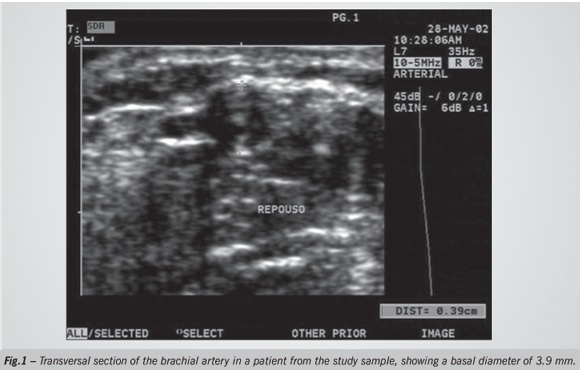
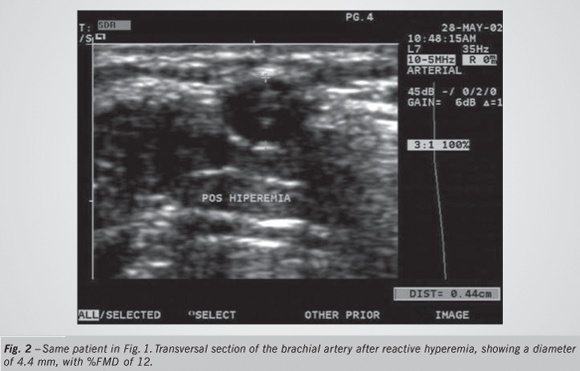
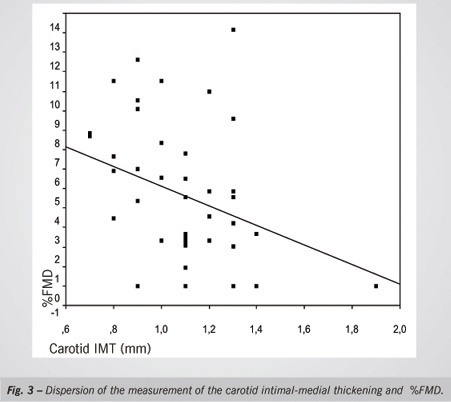
OBJECTIVE: To investigate the correlation between the endothelial function and the carotid intimal-medial thickening (IMT) in a population of patients with coronary artery disease, as well as that between the endothelial function and carotid IMT with the severity of the coronary lesions. METHODS: Forty-three patients aged 60.5±9.2 years, (67.4% males) with coronary artery disease at the coronariography were studied. Endothelial function was assessed using the brachial artery reactivity test (BART), which measured the percentage of flow-mediated dilatation (%FMD). The carotid IMT was evaluated through vascular ultrasound. RESULTS: The mean %FDM was 4.7 ± 3.6 and the mean carotid IMT was 1.08 ± 0.23 mm. The carotid MIT and %FMD measurements showed a statistically significant correlation, with Spearman’s coefficient of 0.315, p= 0.042, demonstrating that lower %FMD values corresponded to an increased carotid IMT (r = -0.315, p = 0.042). There was no correlation between %FMD or IMT and the severity of coronary lesions. CONCLUSIONS: The presence of a correlation between carotid IMT and %FMD demonstrates a concomitance of anatomical and functional vascular alterations in coronary artery disease, regardless of the severity of the atherosclerotic lesions.
Images
Image gallery fullscreen viewer
Comments are moderated by the editorial team before publication. Discussions should be evidence-based and use scientific language. Conflicts of interest should be declared.