ABC Family Arquivos Brasileiros de Cardiologia International Journal of Cardiovascular Sciences ABC Heart Failure & Cardiomyopathy ABC Imagem Cardiovascular
Português English
ABC Family
Português English
  • About
    • About ABC Family
    • Internal Regulation
    • Editorial Board
    • Brazilian Society of Cardiology (SBC)
  • Issues
  • SBC Guidelines
  • Content
    • Videos
    • Podcasts
    • News
  • About
    • About ABC Family
    • Internal Regulation
    • Editorial Board
    • Brazilian Society of Cardiology (SBC)
  • Issues
  • SBC Guidelines
  • Content
    • Videos
    • Podcasts
    • News

ABC Family

  • ABC Family
  • Arquivos Brasileiros de Cardiologia
  • International Journal of Cardiovascular Sciences
  • ABC Heart Failure & Cardiomyopathy
  • ABC Imagem Cardiovascular
Search in

No content found.

Journals
Ordering
Article types
Others

  1. Home
  2. Keyword: Death, Sudden, Cardiac/prevention & control
ABC
Editorial

Myocardial Fibrosis in Hypertrophic Cardiomyopathy: What Remains to be Proven?

Leonardo Sara

Hypertrophic cardiomyopathy (HCM) is a complex and well-characterized disease. Its prevalence in the general population is 1 in 500 individuals, with some data suggesting an even higher prevalence when using associated genetic criteria. This means that, based on a conservative estimate, cities such as Goiânia-GO or Recife-PE have approximately more than 3,000 individuals with the disease, a figure that can be as high as 25,000 individuals in a large city such as São Paulo.

Although HCM is perceived as a rare and usually very severe disease, related to dramatic episodes of sudden death (SD) in young individuals and athletes, it is a disease with low mortality. Due to advances in the diagnosis, treatment and prevention of SD, current estimates indicate a mortality rate of 0.5% a year, similar to that found in the general population, with most patients with the disease being asymptomatic or minimally symptomatic. In this scenario, the correct identification of subgroups of individuals with a higher risk of unfavorable outcome and, therefore, a greater chance of benefit when submitted to specific therapeutic strategies, such as the use of implantable cardioverter defibrillators (ICD), is of utmost importance.

[…]

  • Cardiomyopathy, Hypertrophic
  • Death, Sudden, Cardiac/prevention & control
  • Heart Failure
  • Magnetic Resonance Spectroscopy/ methods
  • Prevalence
Read Full Article
Creative Commons Attribution (CC BY) Creative Commons license
01/03/2019 DOI: 10.5935/abc.20190043
ABC
Editorial

Programmed Ventricular Stimulation in the Management of Brugada Syndrome Patients

Mauricio Ibrahim Scanavacca et al. Denise Tessariol Hachul

Since 1980, the American College of Cardiology (ACC) and the American Heart Association (AHA), by means of a systematic methodology, have incorporated and adapted scientific evidence into practical recommendations aiming to improve preventive and therapeutic measures for cardiovascular diseases. These guidelines have become the current reference for cardiology practices and been adopted by many societies, which adapt them according to local realities.

In 2006, the AHA/ACC, together with the Heart Rhythm Society (HRS), published the first guidelines for the management of patients with ventricular arrhythmias and prevention of sudden death (SD). In 2017, this first document was updated by the same societies and published in October 2018.,

[…]

  • Brugada Syndrome
  • Death, Sudden, Cardiac/prevention & control
  • Defibrilators, Implantable/utilization
  • Risk Factors
  • Tachycardia, Ventricular
  • Ventricular Fibrillation
Read Full Article
Creative Commons Attribution (CC BY) Creative Commons license
01/03/2019 DOI: 10.5935/abc.20190047 Views 1
Figure 1
ABC
Original Article

Prevention of Sudden Cardiac Death in Hypertrophic Cardiomyopathy: What has Changed in The Guidelines?

Liliana Reis et al. Rogerio Teixeira Andreia Fernandes Inês Almeida … Marta Madeira Joana Silva Ana Botelho João Pais José Nascimento Lino Gonçalves

Abstract

Background:

The new European Society of Cardiology guidelines for hypertrophic cardiomyopathy (HCM) define the estimation of sudden cardiac death (SCD) risk as an integral part of clinical management. An implantable cardioverter defibrillator (ICD) is recommended (class IIa) when the risk is ≥ 6%.

Objectives:

To compare the SCD risk stratification according to the 2011 and 2014 recommendations for ICD implantation in patients with HCM.

Methods:

Retrospective study including 105 patients diagnosed with HCM. The indication for ICD was assessed using the 2011 and 2014 guidelines. Statistical analysis was performed using SPSS software version 19.0.0.2®. The tests performed were bilateral, considering the significance level of 5% (p < 0.05).

Results:

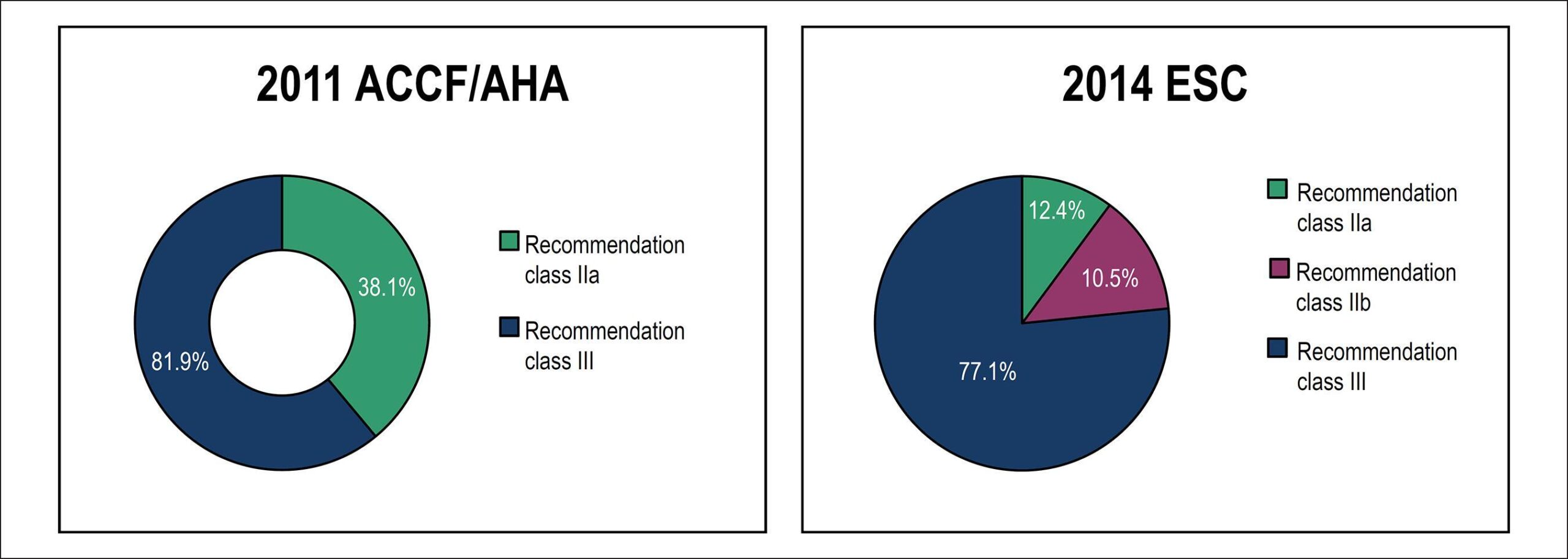
Regarding primary prevention, according to the 2011 ACCF/AHA recommendations, 39.0% of the patients had indication for ICD implantation (level of evidence IIa). Using the 2014 guidelines, only 12.4% of the patients had an indication for ICD implantation. Comparing the two risk stratification models for patients with HCM, we detected a significant reduction in the number of indications for ICD implantation (p < 0.001). Of the 41 patients classified as IIa according to the 2011 recommendations, 68.3% received a different classification according to the 2014 guidelines.

Conclusion:

Significant differences were found when comparing the SCD risk stratification for ICD implantation in the two guidelines. The current SCD risk score seems to identify many low-risk patients who are not candidates for ICD implantation. The use of this new score results in a significant reduction in the number of ICD implanted.

  • Cardiomyopathy, Hypertrophic / complications
  • Death, Sudden, Cardiac/prevention & control
  • Defibrillators, Implantable / trends
  • Diagnostic Imaging
  • Syncope
Read Full Article
Creative Commons Attribution (CC BY) Creative Commons license
01/06/2018 DOI: 10.5935/abc.20180099 Views 1
ABC
Editorial

Prevention of Sudden Death in Hypertrophic Cardiomyopathy

Edmundo Arteaga-Fernández et al. Murillo de Oliveira Antunes

Hypertrophic cardiomyopathy (HCM) is the most common congenital disease, and sudden death (SD), its most feared complication, was already mentioned by Donald Teare in the first description of the disease, being observed in 7 out of 8 patients. SD occurs during daily activities, after exercises and even during sleep; it may affect young athletes, which has a great impact on the media. This has required considerable effort by researchers in defining clinical factors and complementary tests that could be used in the screening of individuals at higher risk that could benefit from implantable cardioverter defibrillator (ICD) and also to prevent SD, since it is caused by tachycardia and ventricular fibrillation. HCM favors the occurrence of ventricular arrythmias – hypertrophy causes repolarization dispersion; myocyte disarray and increased fibrosis create areas of conduction block and predispose to reentry arrhythmias; and abnormalities in ion fluxes, such as calcium, during repolarization may also trigger arrhythmias. In addition, this complex arrhythmogenic substrate may be modulated by impaired autonomic response, myocardial ischemia and left ventricular outflow tract obstruction.– If we consider deaths from cardiovascular causes, in patients with HCM, they account for 0.5%-1.5% deaths a year, which is near to that of the general population. In HCM patients considered as high risk, SD may reach 2.5% of deaths a year. However, the accurate identification of these patients for preventive therapy with ICD may be challenging.

Before the guidelines were published, it was known that manifestations of HCM in children younger than 10 years old with diastolic or systolic dysfunction, SD in first-degree relatives younger than 50 years, nonsustained ventricular tachycardia, syncope and myocardial hypertrophy > 30 mm were factors associated with SD, and the last four fully considered as indications for ICD in the first guideline (2011).

[…]

  • Cardiomyopathy, Hypertrophic
  • Death, Sudden, Cardiac/prevention & control
  • Heart Defects, Congenital
Read Full Article
Creative Commons Attribution (CC BY) Creative Commons license
01/06/2018 DOI: 10.5935/abc.20180101
Figure 1
ABC
Artigo Original

A New Tissue Doppler Index to Predict Cardiac Death in Patients with Heart Failure

Cristian Mornos et al. Lucian Petrescu Dragos Cozma Adina Ionac

Background:

It has been shown that a new tissue Doppler index, E/(E’×S’), including the ratio between early diastolic transmitral and mitral annular velocity (E/E’), and the systolic mitral annular velocity (S’), has a good accuracy to predict left ventricular filling pressure.

Objectives:

We investigated the value of E/(E’×S’) to predict cardiac death in patients with heart failure.

Methods:

Echocardiography was performed in 339 consecutive hospitalized patients with heart failure, in sinus rhythm, after appropriate medical treatment, at discharge and after one month. Worsening of E/(E’×S’) was defined as any increase of baseline value. The end point was cardiac death.

Results:

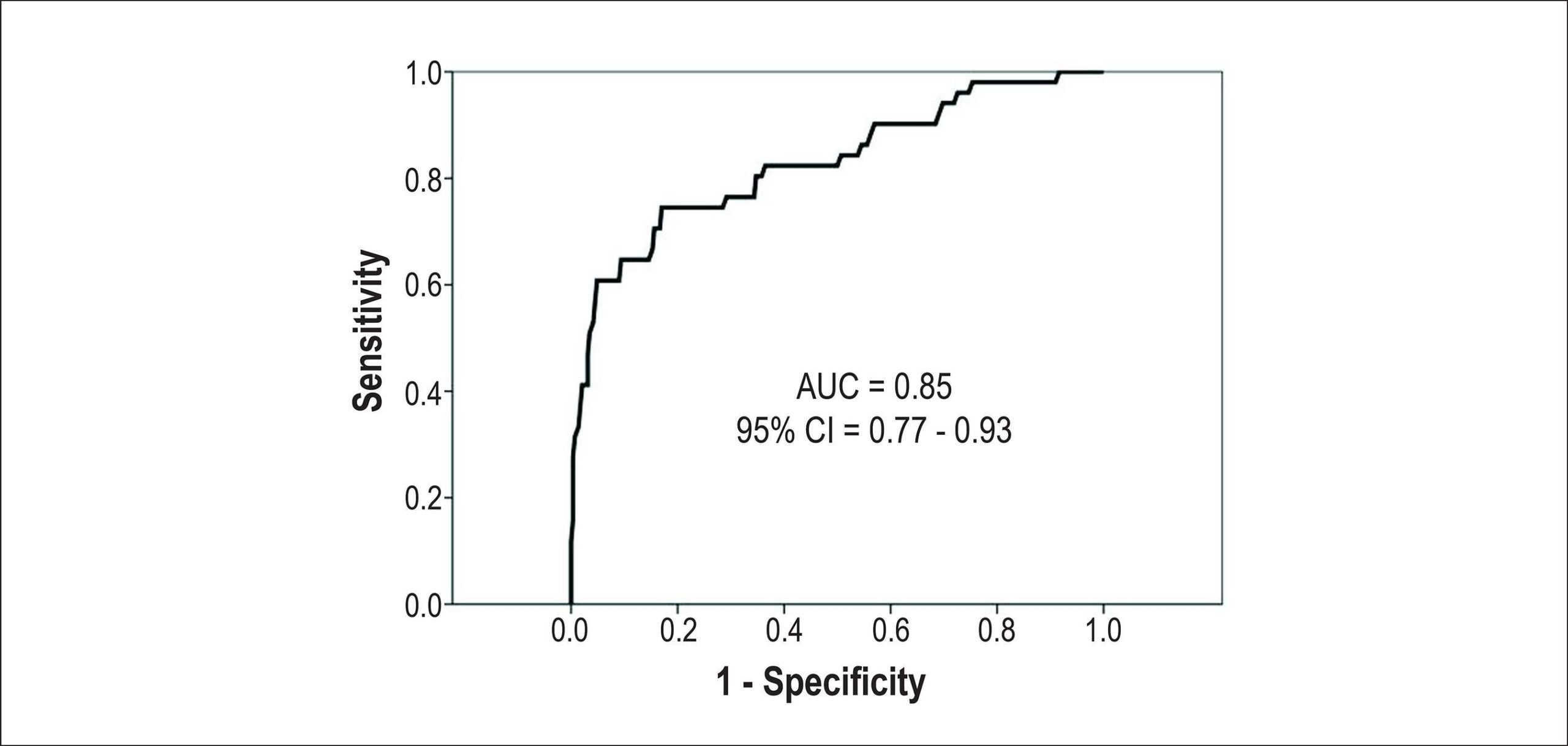
During the follow-up period (35.2 ± 8.8 months), cardiac death occurred in 51 patients (15%). The optimal cut-off value for the initial E/(E’×S’) to predict cardiac death was 2.83 (76% sensitivity, 85% specificity). At discharge, 252 patients (74.3%) presented E/(E’×S’) ≤ 2.83 (group I) and 87 (25.7%) presented E/(E’×S’) > 2.83 (group II), respectively. Cardiac death was significantly higher in group II than in group I (38 deaths, 43.7% vs 13 deaths, 5.15%, p 2.83 at discharge and its worsening after one month presented the worst prognosis (all p < 0.05).

Conclusions:

In patients with heart failure, the E/(E’×S’) ratio is a powerful predictor of cardiac death, particularly if it is associated with its worsening.

  • Death, Sudden, Cardiac/prevention & control
  • Echocardiography, Doppler
  • Heart Failure / mortality
Read Full Article
Creative Commons Attribution (CC BY) Creative Commons license
12/11/2013 DOI: 10.5935/abc.20130222

How to cite this article

EndNote RIS

Electronic Document Format (Vancouver)

Sara L. Myocardial Fibrosis in Hypertrophic Cardiomyopathy: What Remains to be Proven?. Arquivos Brasileiros de Cardiologia 2019;112(3):290-1.

Electronic Document Format (ABNT)

Sara, Leonardo. Myocardial Fibrosis in Hypertrophic Cardiomyopathy: What Remains to be Proven?. Arquivos Brasileiros de Cardiologia, v. 112, n. 3, p. 290-291, Feb. 2019.

Electronic Document Format (APA)

Sara, L. (2019). Myocardial Fibrosis in Hypertrophic Cardiomyopathy: What Remains to be Proven?. Arquivos Brasileiros de Cardiologia, 112(3), 290-291.

Electronic Document Format (ISO)

Sara, Leonardo. Myocardial Fibrosis in Hypertrophic Cardiomyopathy: What Remains to be Proven?. Arquivos Brasileiros de Cardiologia [online]. 2019, vol. 112, n. 3, [cited 2026-10-14], pp. 290-291. Available from: <https://journals.cardiol.br/en/article/myocardial-fibrosis-in-hypertrophic-cardiomyopathy-what-remains-to-be-proven/>. ISSN 0066-782X

EndNote RIS

Electronic Document Format (Vancouver)

Scanavacca MI, Hachul DT. Programmed Ventricular Stimulation in the Management of Brugada Syndrome Patients. Arquivos Brasileiros de Cardiologia 2019;112(3):217-9.

Electronic Document Format (ABNT)

Scanavacca, Mauricio Ibrahim; Hachul, Denise Tessariol. Programmed Ventricular Stimulation in the Management of Brugada Syndrome Patients. Arquivos Brasileiros de Cardiologia, v. 112, n. 3, p. 217-219, Feb. 2019.

Electronic Document Format (APA)

Scanavacca, M. I., & Hachul, D. T. (2019). Programmed Ventricular Stimulation in the Management of Brugada Syndrome Patients. Arquivos Brasileiros de Cardiologia, 112(3), 217-219.

Electronic Document Format (ISO)

Scanavacca, Mauricio Ibrahim and Hachul, Denise Tessariol. Programmed Ventricular Stimulation in the Management of Brugada Syndrome Patients. Arquivos Brasileiros de Cardiologia [online]. 2019, vol. 112, n. 3, [cited 2026-10-14], pp. 217-219. Available from: <https://journals.cardiol.br/en/article/programmed-ventricular-stimulation-in-the-management-of-brugada-syndrome-patients/>. ISSN 0066-782X

EndNote RIS

Electronic Document Format (Vancouver)

Reis L, Teixeira R, Fernandes A, Almeida I, Madeira M, Silva J, Botelho A, et al. Prevention of Sudden Cardiac Death in Hypertrophic Cardiomyopathy: What has Changed in The Guidelines?. Arquivos Brasileiros de Cardiologia 2018;110(6):524-31.

Electronic Document Format (ABNT)

Reis, Liliana; Teixeira, Rogerio; Fernandes, Andreia; Almeida, Inês; Madeira, Marta; Silva, Joana; Botelho, Ana; Pais, João; Nascimento, José; Gonçalves, Lino. Prevention of Sudden Cardiac Death in Hypertrophic Cardiomyopathy: What has Changed in The Guidelines?. Arquivos Brasileiros de Cardiologia, v. 110, n. 6, p. 524-531, May. 2018.

Electronic Document Format (APA)

Reis, L., Teixeira, R., Fernandes, A., Almeida, I., Madeira, M., Silva, J., Botelho, A., Pais, J., Nascimento, J., & Gonçalves, L. (2018). Prevention of Sudden Cardiac Death in Hypertrophic Cardiomyopathy: What has Changed in The Guidelines?. Arquivos Brasileiros de Cardiologia, 110(6), 524-531.

Electronic Document Format (ISO)

Reis, Liliana and Teixeira, Rogerio and Fernandes, Andreia and Almeida, Inês and Madeira, Marta and Silva, Joana and Botelho, Ana and Pais, João and Nascimento, José and Gonçalves, Lino. Prevention of Sudden Cardiac Death in Hypertrophic Cardiomyopathy: What has Changed in The Guidelines?. Arquivos Brasileiros de Cardiologia [online]. 2018, vol. 110, n. 6, [cited 2026-10-14], pp. 524-531. Available from: <https://journals.cardiol.br/en/article/prevention-of-sudden-cardiac-death-in-hypertrophic-cardiomyopathy-what-has-changed-in-the-guidelines/>. ISSN 0066-782X

EndNote RIS

Electronic Document Format (Vancouver)

Arteaga-Fernández E, Antunes MO. Prevention of Sudden Death in Hypertrophic Cardiomyopathy. Arquivos Brasileiros de Cardiologia 2018;110(6):532-3.

Electronic Document Format (ABNT)

Arteaga-Fernández, Edmundo; Antunes, Murillo de Oliveira. Prevention of Sudden Death in Hypertrophic Cardiomyopathy. Arquivos Brasileiros de Cardiologia, v. 110, n. 6, p. 532-533, May. 2018.

Electronic Document Format (APA)

Arteaga-Fernández, E., & Antunes, M. O. (2018). Prevention of Sudden Death in Hypertrophic Cardiomyopathy. Arquivos Brasileiros de Cardiologia, 110(6), 532-533.

Electronic Document Format (ISO)

Arteaga-Fernández, Edmundo and Antunes, Murillo de Oliveira. Prevention of Sudden Death in Hypertrophic Cardiomyopathy. Arquivos Brasileiros de Cardiologia [online]. 2018, vol. 110, n. 6, [cited 2026-10-14], pp. 532-533. Available from: <https://journals.cardiol.br/en/article/prevention-of-sudden-death-in-hypertrophic-cardiomyopathy/>. ISSN 0066-782X

EndNote RIS

Electronic Document Format (Vancouver)

Mornos C, Petrescu L, Cozma D, Ionac A. A New Tissue Doppler Index to Predict Cardiac Death in Patients with Heart Failure. Arquivos Brasileiros de Cardiologia 2013;102(1):19-2.

Electronic Document Format (ABNT)

Mornos, Cristian; Petrescu, Lucian; Cozma, Dragos; Ionac, Adina. A New Tissue Doppler Index to Predict Cardiac Death in Patients with Heart Failure. Arquivos Brasileiros de Cardiologia, v. 102, n. 1, p. 19-29, Nov. 2013.

Electronic Document Format (APA)

Mornos, C., Petrescu, L., Cozma, D., & Ionac, A. (2013). A New Tissue Doppler Index to Predict Cardiac Death in Patients with Heart Failure. Arquivos Brasileiros de Cardiologia, 102(1), 19-29.

Electronic Document Format (ISO)

Mornos, Cristian and Petrescu, Lucian and Cozma, Dragos and Ionac, Adina. A New Tissue Doppler Index to Predict Cardiac Death in Patients with Heart Failure. Arquivos Brasileiros de Cardiologia [online]. 2013, vol. 102, n. 1, [cited 2026-10-14], pp. 19-29. Available from: <https://journals.cardiol.br/en/article/a-new-tissue-doppler-index-to-predict-cardiac-death-in-patients-with-heart-failure/>. ISSN 0066-782X

  • About ABC Family
  • Internal Regulation
  • Editorial Board
  • Brazilian Society of Cardiology (SBC)

Issues

SBC Guidelines

  • Videos
  • Podcasts
  • News