ABC Family Arquivos Brasileiros de Cardiologia International Journal of Cardiovascular Sciences ABC Heart Failure & Cardiomyopathy ABC Imagem Cardiovascular
Português English
ABC Family
Português English
  • About
    • About ABC Family
    • Internal Regulation
    • Editorial Board
    • Brazilian Society of Cardiology (SBC)
  • Issues
  • SBC Guidelines
  • Content
    • Videos
    • Podcasts
    • News
  • About
    • About ABC Family
    • Internal Regulation
    • Editorial Board
    • Brazilian Society of Cardiology (SBC)
  • Issues
  • SBC Guidelines
  • Content
    • Videos
    • Podcasts
    • News

ABC Family

  • ABC Family
  • Arquivos Brasileiros de Cardiologia
  • International Journal of Cardiovascular Sciences
  • ABC Heart Failure & Cardiomyopathy
  • ABC Imagem Cardiovascular
Search in

No content found.

Journals
Ordering
Article types
Others

  1. Home
  2. Keyword: Defibrillators, Implantable / trends
ABC
Editorial

Revisiting ICD Use in Chagas Cardiomyopathy: Current Evidence and Future Directions

André Carmo et al. Antônio Luiz Pinho Ribeiro

Chagas cardiomyopathy (ChC) is a chronic infectious heart disease that has recently been considered an infectious arrhythmogenic cardiomyopathy according to the HRS statement on this subject. After an acute phase, patients become chronically infected, displaying a wide range of presentations concerning heart disease, including heart failure, stroke, conduction abnormalities, atrial fibrillation, and ventricular arrhythmia. Sudden death is a mode of death of most patients with ChC, and implantable cardioverter-defibrillator (ICD) has been used as a preferred therapy, at least for secondary prevention, following recommendations similar to those of other cardiovascular diseases.

All information on the use of ICD in ChC comes from observational studies and, regarding death rates, two meta-analyses have evaluated this topic in different populations. The first meta-analysis, conducted by our group, found an annual mortality rate of 9.7% (95% CI: 5.7 to 13.7) in a population with ICD implanted exclusively for secondary prevention. The second meta-analysis, evaluating a mixed population of primary and secondary prevention, revealed a pooled annual all-cause mortality rate of 9.0%. These findings highlight the significant mortality risk in patients with ChC who have ICDs, emphasizing the importance of careful monitoring and management in this population.

[…]

  • Chagas Cardiomyopathy
  • Chagas disease
  • Defibrillators, Implantable / trends
  • Heart Failure
  • Stroke
Read Full Article
Creative Commons Attribution (CC BY) Creative Commons license
26/08/2024 DOI: 10.36660/abc.20240423i Views 1
ABC
Editorial

Impact of the Implantable Cardioverter Defibrillator on the Lives of its Patients

Silas dos Santos Galvão Filho

The first ICD implant in humans occurred in 1980, followed by the incorporation of this device into the therapeutic arsenal of cardiology in the early 1990s, it was one of the greatest advances in the treatment of cardiac arrhythmias. Being the therapy of choice with evidence of efficacy for a large number of patients at risk of sudden cardiac death from non-reversible causes, ICDs have some peculiarities that can impact the daily lives of their carriers. Initially, ICDs were huge devices, only capable of being implanted at the abdominal level, with their electrodes and reeds for delivering the shock implanted directly into the heart through thoracotomy. At that time, the impact of these devices on the lives of their users was great, from aesthetics to the large number of inappropriate shocks, caused by still precarious algorithms for discriminating the arrhythmia to be treated: ventricular tachycardia (VT) or ventricular fibrillation (VF), in addition to the first programs that were still inadequate. In our initial experience with ICDs in the late 1980s and early 1990s, we had many acceptance problems, with some patients even requesting to remove the device after experiencing repeated shocks. With the spectacular evolution they have undergone, ICDs have incorporated all technological advances, improving their diagnostic performance in the release of therapies and now having dimensions slightly larger than pacemakers, allowing device implants at the thoracic level, with fully transvenous electrodes through minimally invasive surgery, eliminating thoracotomy. Despite these advances, a considerable number of patients continue to report an impact on their quality of life. This is mainly due to one aspect: the ICD is the only implantable electronic cardiac device whose normal therapeutic functioning is perceived by the patient, with sensations described by the vast majority as very unpleasant, especially shock therapy, the worst situation being when repeated shocks occur. The improvement of diagnostic algorithms for tachyarrhythmias, and greater knowledge of device programming, have considerably reduced inappropriate shocks, however, appropriate shocks, even repetitive shocks known as electrical storms, continue to occur,, as they correspond to the normal functioning of the device in reversing cardiac arrest due to VF, or potentially malignant arrhythmia such as VT. Fortunately, today these serious episodes are much less frequent and can be treated through medication and/or interventional procedures such as catheter ablation.

The article “Predictors of Quality of Life, Anxiety and Acceptance in Patients with Implantable Cardioverter-Defibrillator” evaluated these aspects in a reasonable number of patients undergoing the first implantation or replacement of an ICD generator, showing that around a quarter of the patients presented some kind of negative impact. It also showed that being 60 years old or older, the absence of atrial fibrillation (AF), and being female were predictors of better results. This information is important and deserves some consideration: 1- Having improved considerably over the years, ICD still negatively impacts the lives of a relatively important number of its sufferers. This encourages the technological improvement of devices, optimizing therapies, in addition to better approach and psychological preparation of the patient pre-operatively. 2- The worse results of younger patients can be explained by the feeling of great limitation of activities imposed on those with ICDs, however, these limitations are due more to the underlying heart disease than to the device itself. In some cases, without major changes in cardiological function, even impactful professional sporting activities can be allowed,, as in the case of two football players who played in the last World Cup with ICD. 3- In the case of people with AF, this arrhythmia, which is often symptomatic, is not infrequently related to heart disease with worse cardiological function, which increases limitations. Furthermore, AF may be responsible for inappropriate shocks, which can be avoided with adequate programming. 4- Regarding the fact that women present better results despite the aesthetic problems that these devices can cause, this is probably due to greater tolerance to therapies and a better understanding of the possible limitations of their activities, as they have an ICD.

[…]

  • Arrhythmias Cardiac
  • Death, Sudden, Cardiac
  • Defibrillators, Implantable / trends
  • Quality of life
  • sickness impact profile
Read Full Article
Creative Commons Attribution (CC BY) Creative Commons license
05/07/2024 DOI: 10.36660/abc.20240196i Views 2
Figure 1
ABC
Original Article

Prevention of Sudden Cardiac Death in Hypertrophic Cardiomyopathy: What has Changed in The Guidelines?

Liliana Reis et al. Rogerio Teixeira Andreia Fernandes Inês Almeida … Marta Madeira Joana Silva Ana Botelho João Pais José Nascimento Lino Gonçalves

Abstract

Background:

The new European Society of Cardiology guidelines for hypertrophic cardiomyopathy (HCM) define the estimation of sudden cardiac death (SCD) risk as an integral part of clinical management. An implantable cardioverter defibrillator (ICD) is recommended (class IIa) when the risk is ≥ 6%.

Objectives:

To compare the SCD risk stratification according to the 2011 and 2014 recommendations for ICD implantation in patients with HCM.

Methods:

Retrospective study including 105 patients diagnosed with HCM. The indication for ICD was assessed using the 2011 and 2014 guidelines. Statistical analysis was performed using SPSS software version 19.0.0.2®. The tests performed were bilateral, considering the significance level of 5% (p < 0.05).

Results:

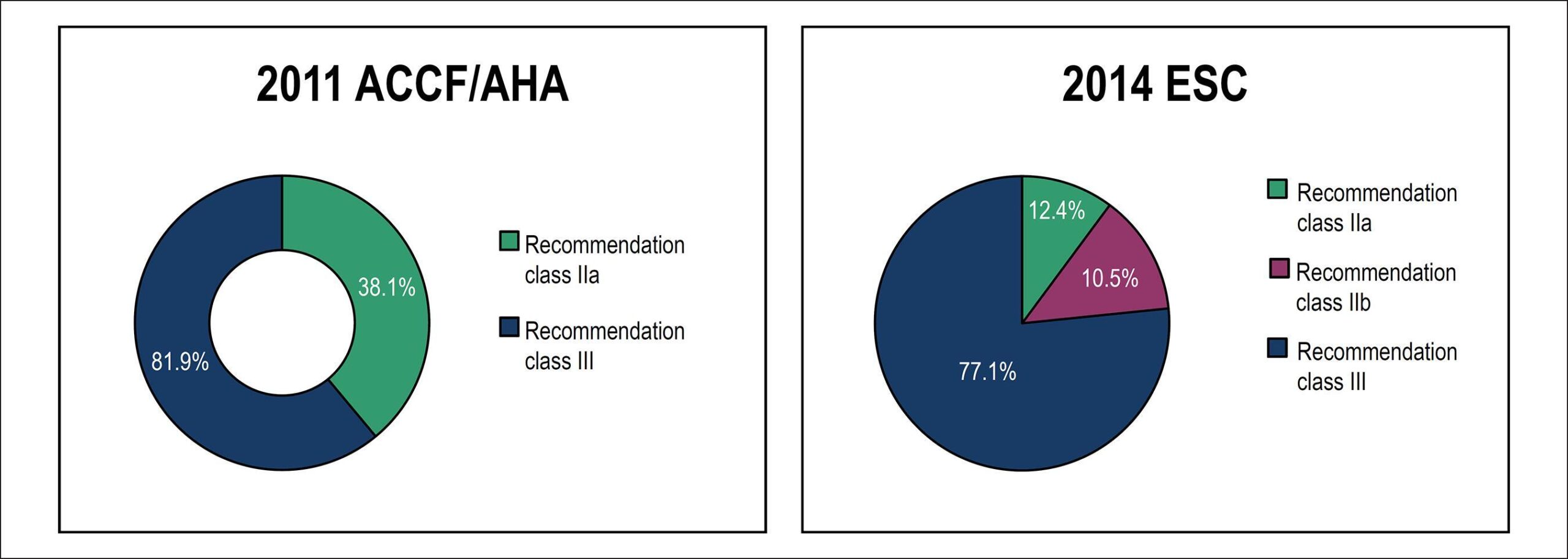
Regarding primary prevention, according to the 2011 ACCF/AHA recommendations, 39.0% of the patients had indication for ICD implantation (level of evidence IIa). Using the 2014 guidelines, only 12.4% of the patients had an indication for ICD implantation. Comparing the two risk stratification models for patients with HCM, we detected a significant reduction in the number of indications for ICD implantation (p < 0.001). Of the 41 patients classified as IIa according to the 2011 recommendations, 68.3% received a different classification according to the 2014 guidelines.

Conclusion:

Significant differences were found when comparing the SCD risk stratification for ICD implantation in the two guidelines. The current SCD risk score seems to identify many low-risk patients who are not candidates for ICD implantation. The use of this new score results in a significant reduction in the number of ICD implanted.

  • Cardiomyopathy, Hypertrophic / complications
  • Death, Sudden, Cardiac/prevention & control
  • Defibrillators, Implantable / trends
  • Diagnostic Imaging
  • Syncope
Read Full Article
Creative Commons Attribution (CC BY) Creative Commons license
01/06/2018 DOI: 10.5935/abc.20180099 Views 1

How to cite this article

EndNote RIS

Electronic Document Format (Vancouver)

Carmo A, Ribeiro ALP. Revisiting ICD Use in Chagas Cardiomyopathy: Current Evidence and Future Directions. Arquivos Brasileiros de Cardiologia 2024;121(6):e20240423.

Electronic Document Format (ABNT)

Carmo, André; Ribeiro, Antônio Luiz Pinho. Revisiting ICD Use in Chagas Cardiomyopathy: Current Evidence and Future Directions. Arquivos Brasileiros de Cardiologia, v. 121, n. 6, e20240423, Aug. 2024.

Electronic Document Format (APA)

Carmo, A., & Ribeiro, A. L. P. (2024). Revisiting ICD Use in Chagas Cardiomyopathy: Current Evidence and Future Directions. Arquivos Brasileiros de Cardiologia, 121(6), e20240423.

Electronic Document Format (ISO)

Carmo, André and Ribeiro, Antônio Luiz Pinho. Revisiting ICD Use in Chagas Cardiomyopathy: Current Evidence and Future Directions. Arquivos Brasileiros de Cardiologia [online]. 2024, vol. 121, n. 6, [cited 2026-10-14], e20240423. Available from: <https://journals.cardiol.br/en/article/revisiting-icd-use-in-chagas-cardiomyopathy-current-evidence-and-future-directions/>. ISSN 0066-782X

EndNote RIS

Electronic Document Format (Vancouver)

Galvão Filho SS. Impact of the Implantable Cardioverter Defibrillator on the Lives of its Patients. Arquivos Brasileiros de Cardiologia 2024;121(4):e20240196.

Electronic Document Format (ABNT)

Galvão Filho, Silas dos Santos. Impact of the Implantable Cardioverter Defibrillator on the Lives of its Patients. Arquivos Brasileiros de Cardiologia, v. 121, n. 4, e20240196, Jul. 2024.

Electronic Document Format (APA)

Galvão Filho, S. S. (2024). Impact of the Implantable Cardioverter Defibrillator on the Lives of its Patients. Arquivos Brasileiros de Cardiologia, 121(4), e20240196.

Electronic Document Format (ISO)

Galvão Filho, Silas dos Santos. Impact of the Implantable Cardioverter Defibrillator on the Lives of its Patients. Arquivos Brasileiros de Cardiologia [online]. 2024, vol. 121, n. 4, [cited 2026-10-14], e20240196. Available from: <https://journals.cardiol.br/en/article/impact-of-the-implantable-cardioverter-defibrillator-on-the-lives-of-its-patients/>. ISSN 0066-782X

EndNote RIS

Electronic Document Format (Vancouver)

Reis L, Teixeira R, Fernandes A, Almeida I, Madeira M, Silva J, Botelho A, et al. Prevention of Sudden Cardiac Death in Hypertrophic Cardiomyopathy: What has Changed in The Guidelines?. Arquivos Brasileiros de Cardiologia 2018;110(6):524-31.

Electronic Document Format (ABNT)

Reis, Liliana; Teixeira, Rogerio; Fernandes, Andreia; Almeida, Inês; Madeira, Marta; Silva, Joana; Botelho, Ana; Pais, João; Nascimento, José; Gonçalves, Lino. Prevention of Sudden Cardiac Death in Hypertrophic Cardiomyopathy: What has Changed in The Guidelines?. Arquivos Brasileiros de Cardiologia, v. 110, n. 6, p. 524-531, May. 2018.

Electronic Document Format (APA)

Reis, L., Teixeira, R., Fernandes, A., Almeida, I., Madeira, M., Silva, J., Botelho, A., Pais, J., Nascimento, J., & Gonçalves, L. (2018). Prevention of Sudden Cardiac Death in Hypertrophic Cardiomyopathy: What has Changed in The Guidelines?. Arquivos Brasileiros de Cardiologia, 110(6), 524-531.

Electronic Document Format (ISO)

Reis, Liliana and Teixeira, Rogerio and Fernandes, Andreia and Almeida, Inês and Madeira, Marta and Silva, Joana and Botelho, Ana and Pais, João and Nascimento, José and Gonçalves, Lino. Prevention of Sudden Cardiac Death in Hypertrophic Cardiomyopathy: What has Changed in The Guidelines?. Arquivos Brasileiros de Cardiologia [online]. 2018, vol. 110, n. 6, [cited 2026-10-14], pp. 524-531. Available from: <https://journals.cardiol.br/en/article/prevention-of-sudden-cardiac-death-in-hypertrophic-cardiomyopathy-what-has-changed-in-the-guidelines/>. ISSN 0066-782X

  • About ABC Family
  • Internal Regulation
  • Editorial Board
  • Brazilian Society of Cardiology (SBC)

Issues

SBC Guidelines

  • Videos
  • Podcasts
  • News