ABC Family Arquivos Brasileiros de Cardiologia International Journal of Cardiovascular Sciences ABC Heart Failure & Cardiomyopathy ABC Imagem Cardiovascular
Português English
ABC Family
Português English
  • About
    • About ABC Family
    • Internal Regulation
    • Editorial Board
    • Brazilian Society of Cardiology (SBC)
  • Issues
  • SBC Guidelines
  • Content
    • Videos
    • Podcasts
    • News
  • About
    • About ABC Family
    • Internal Regulation
    • Editorial Board
    • Brazilian Society of Cardiology (SBC)
  • Issues
  • SBC Guidelines
  • Content
    • Videos
    • Podcasts
    • News

ABC Family

  • ABC Family
  • Arquivos Brasileiros de Cardiologia
  • International Journal of Cardiovascular Sciences
  • ABC Heart Failure & Cardiomyopathy
  • ABC Imagem Cardiovascular
Search in

No content found.

Journals
Ordering
Article types
Others

  1. Home
  2. Keyword: Cerebrovascular Circulation
IJCS
Editorial

Small Exercise Breaks can Save your Brain from Prolonged Sitting

Eliza Prodel

A sedentary lifestyle is one of the major risk factors for the development of cardiovascular diseases. For instance, in 2019, stroke was the second-leading cause of death, as well as the primary cause of death and disability combined in the world. Active commuting to work is one strategy to decrease sedentary time and its impact, and the COVID-19 pandemic has changed work and daily routines worldwide. Moreover, the necessary social distancing has led to increased sedentary time, especially for those who are engaged in office desk work .

Acute prolonged sitting seems to lead to transient impairment of the endothelial function in the healthy population, whether this phenomenon is related to cardiovascular or cerebrovascular events is unknown. Nonetheless, prolonged sitting impairs the cerebrovascular function. , Conversely, exercise breaks from prolonged sitting seem to restore the endothelial and cerebrovascular function. Therefore, active breaks from prolonged sitting could be a good strategy to mitigate the effects of sedentary time. However, the ideal duration and intensity need further investigation. Additionally, the difficulty to implement exercise breaks as a daily routine for office workers must be considered.

[…]

  • Cerebrovascular Circulation
  • COVID-19
  • Exercise
  • Lifestyle
  • Pandemics
  • Physical activity
  • Sedentarism
  • Stroke, Risk Factors
Read Full Article
Creative Commons Attribution (CC BY) Creative Commons license
10/03/2023 DOI: 10.36660/ijcs.20210248 Views 1
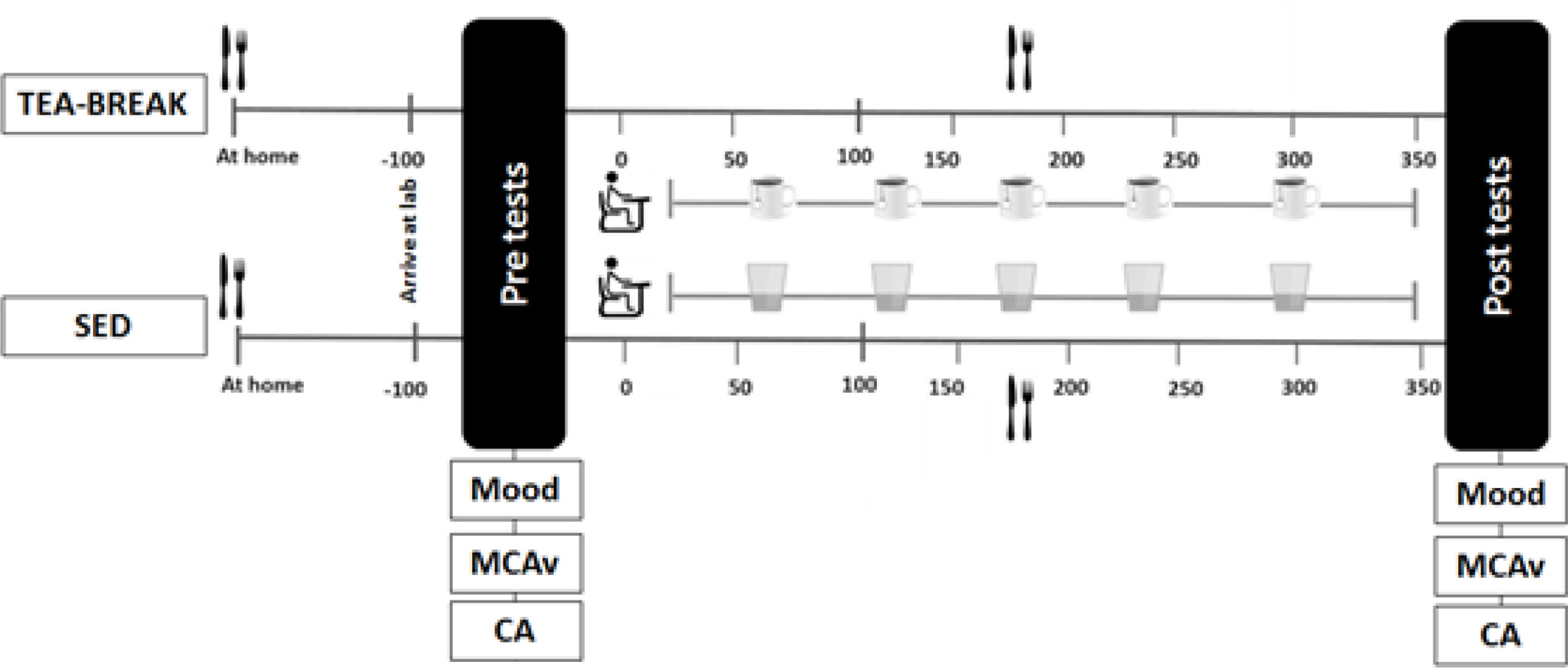
Figure 1
IJCS
Original Article

Effects of Breaking up Deskwork with Physical Activity Combined with Tea Consumption on Cerebrovascular Function, Mood, and Affect

Guilherme F. Speretta et al. Alessandro Fornasiero Jarrett A. Johns Nicola Hopkins … Dick H. Thijssen David A. Low

Abstract

Background:

Prolonged sitting, typical of desk work, decreases cerebral blood flow (CBF), mood and affect. Conversely, short physical activity breaks from sitting may prevent these detrimental effects and provide cardiometabolic benefits.

Objective:

We evaluated the effect of interrupting prolonged sitting with short breaks of light physical activity combined with tea consumption on CBF, cerebral autoregulation (CA), mood, and affect in desk workers.

Methods:

Nineteen healthy desk workers (ten male, 27±10 years) performed desk work in a laboratory for six hours on two separate intervention days: tea breaks (TEA-BREAK: short walk combined with ingestion of one cup of tea every hour) and sedentary (SED: ingestion of one cup of water every hour, while seated). Before and after desk work, we assessed mean arterial pressure (MAP), middle cerebral artery blood velocity (MCAv) and CA. Questionnaires were used to assess mood (Bond & Lader, PANAS) and affect (Affect grid) before and after the intervention. Data are expressed as mean ± standard deviation. Two-way ANOVA with repeated measurements followed by Sidak post hoc test was used for data analysis. Paired Student’s t-test was also used to compare changes (Δ) between trials. Statistical significance was at p<0.05.

Results:

Desk work increased MAP (4.6±4.6 Δ mmHg; P<0.05), and decreased MCAv (-5.2±7.0 Δ cm/s; P<0.05), with no difference between interventions in these parameters. TEA-BREAKS, but not SED, decreased gain (-0.08±0.12 Δ cm.s−1.mmHg.−1) and increased phase (5.26±8.84 Δ radians) at very low frequency (P<0.05), but not at low frequency. Small changes in positive affect were found after the six hours of desk work (-5.5±7.3 Δ scale; P<0.05), with no differences between interventions.

Conclusion:

Changes in MCAv and positive affect induced by prolonged desk work could not be prevented by TEA-BREAKS. However, TEA-BREAKS improved CA, suggesting a higher efficiency in maintaining MCAv in response to blood pressure fluctuations.

  • Black Tea
  • Blood Pressure
  • Cerebrovascular Circulation
  • Homeostasis Cerebral
  • Risk Factors
  • Tea
Read Full Article
Creative Commons Attribution (CC BY) Creative Commons license
09/08/2021 DOI: 10.36660/ijcs.20200209 Views 1
ABC
Editorial

Beyond CHA2DS2-VASc for Predicting the Risk of Thromboembolism and Stroke – Not That Simple!

M. Julia Machline-Carrion

Ischemic stroke can result from a variety of causes, such as atherosclerosis of the cerebral circulation, occlusion of cerebral small vessels, and cardiac embolism. Of these causes, cardioembolic stroke has a particular significance because cardiac embolism causes more severe strokes than other ischemic stroke subtypes. In about 20% of patients who have had ischemic stroke, a major risk cardiac source, such as atrial fibrillation (AF) and/or left ventricular thrombi, is identified. Thus, assessing the presence of AF, and the risk of thromboembolism associated to cardiac lesions play a key role in stroke prevention.

Age, male gender, hypertension, diabetes mellitus, valvular heart disease, congestive heart failure, coronary heart disease, chronic kidney disease, inflammatory disorders, sleep apnea, and tobacco use have all been established as risk factors for both AF and stroke. However, it may be that other atrial factors besides AF can result in thromboembolism, and in some cases, AF may be a lagging marker of these other thrombogenic atrial abnormalities. AF often occurs in the setting of atrial abnormalities such as mechanical dysfunction in the left atrial appendage. These abnormalities of atrial substrate have recently been associated with stroke risk independently of AF. The CHA2DS2-VASc (congestive heart failure, hypertension, age ≥ 75 years, diabetes mellitus, stroke or transient ischemic attack (TIA), vascular disease, age 65 to 74 years, sex category) score is a validated tool to predict the risk of stroke and systemic emboli in patients with non-valvular atrial fibrillation and has been widely used to guide clinical practice.–

[…]

  • Atherosclerosis
  • Atrial Fibrillation
  • Cerebrovascular Circulation
  • diabetes
  • Embolism and Thrombosis
  • Hypertension
  • Risk Factors
  • Stroke
Read Full Article
Creative Commons Attribution (CC BY) Creative Commons license
01/03/2021 DOI: 10.36660/abc.20201296 Views 1

How to cite this article

EndNote RIS

Electronic Document Format (Vancouver)

Prodel E. Small Exercise Breaks can Save your Brain from Prolonged Sitting. International Journal of Cardiovascular Sciences 2023;34(6):654-5.

Electronic Document Format (ABNT)

Prodel, Eliza. Small Exercise Breaks can Save your Brain from Prolonged Sitting. International Journal of Cardiovascular Sciences, v. 34, n. 6, p. 654-655, Mar. 2023.

Electronic Document Format (APA)

Prodel, E. (2023). Small Exercise Breaks can Save your Brain from Prolonged Sitting. International Journal of Cardiovascular Sciences, 34(6), 654-655.

Electronic Document Format (ISO)

Prodel, Eliza. Small Exercise Breaks can Save your Brain from Prolonged Sitting. International Journal of Cardiovascular Sciences [online]. 2023, vol. 34, n. 6, [cited 2026-10-14], pp. 654-655. Available from: <https://journals.cardiol.br/en/article/small-exercise-breaks-can-save-your-brain-from-prolonged-sitting/>. ISSN 2359-4802

EndNote RIS

Electronic Document Format (Vancouver)

Speretta GF, Fornasiero A, Johns JA, Hopkins N, Thijssen DH, Low DA. Effects of Breaking up Deskwork with Physical Activity Combined with Tea Consumption on Cerebrovascular Function, Mood, and Affect. International Journal of Cardiovascular Sciences 2021;34(6):644-53.

Electronic Document Format (ABNT)

Speretta, Guilherme F.; Fornasiero, Alessandro; Johns, Jarrett A.; Hopkins, Nicola; Thijssen, Dick H.; Low, David A.. Effects of Breaking up Deskwork with Physical Activity Combined with Tea Consumption on Cerebrovascular Function, Mood, and Affect. International Journal of Cardiovascular Sciences, v. 34, n. 6, p. 644-653, Aug. 2021.

Electronic Document Format (APA)

Speretta, G. F., Fornasiero, A., Johns, J. A., Hopkins, N., Thijssen, D. H., & Low, D. A. (2021). Effects of Breaking up Deskwork with Physical Activity Combined with Tea Consumption on Cerebrovascular Function, Mood, and Affect. International Journal of Cardiovascular Sciences, 34(6), 644-653.

Electronic Document Format (ISO)

Speretta, Guilherme F. and Fornasiero, Alessandro and Johns, Jarrett A. and Hopkins, Nicola and Thijssen, Dick H. and Low, David A.. Effects of Breaking up Deskwork with Physical Activity Combined with Tea Consumption on Cerebrovascular Function, Mood, and Affect. International Journal of Cardiovascular Sciences [online]. 2021, vol. 34, n. 6, [cited 2026-10-14], pp. 644-653. Available from: <https://journals.cardiol.br/en/article/effects-of-breaking-up-deskwork-with-physical-activity-combined-with-tea-consumption-on-cerebrovascular-function-mood-and-affect/>. ISSN 2359-4802

EndNote RIS

Electronic Document Format (Vancouver)

Machline-Carrion MJ. Beyond CHA2DS2-VASc for Predicting the Risk of Thromboembolism and Stroke – Not That Simple!. Arquivos Brasileiros de Cardiologia 2021;116(2):332-3.

Electronic Document Format (ABNT)

Machline-Carrion, M. Julia. Beyond CHA2DS2-VASc for Predicting the Risk of Thromboembolism and Stroke – Not That Simple!. Arquivos Brasileiros de Cardiologia, v. 116, n. 2, p. 332-333, Feb. 2021.

Electronic Document Format (APA)

Machline-Carrion, M. J. (2021). Beyond CHA2DS2-VASc for Predicting the Risk of Thromboembolism and Stroke – Not That Simple!. Arquivos Brasileiros de Cardiologia, 116(2), 332-333.

Electronic Document Format (ISO)

Machline-Carrion, M. Julia. Beyond CHA2DS2-VASc for Predicting the Risk of Thromboembolism and Stroke – Not That Simple!. Arquivos Brasileiros de Cardiologia [online]. 2021, vol. 116, n. 2, [cited 2026-10-14], pp. 332-333. Available from: <https://journals.cardiol.br/en/article/beyond-cha2ds2-vasc-for-predicting-the-risk-of-thromboembolism-and-stroke-not-that-simple/>. ISSN 0066-782X

  • About ABC Family
  • Internal Regulation
  • Editorial Board
  • Brazilian Society of Cardiology (SBC)

Issues

SBC Guidelines

  • Videos
  • Podcasts
  • News