ABC Family Arquivos Brasileiros de Cardiologia International Journal of Cardiovascular Sciences ABC Heart Failure & Cardiomyopathy ABC Imagem Cardiovascular
Português English
ABC Family
Português English
  • About
    • About ABC Family
    • Internal Regulation
    • Editorial Board
    • Brazilian Society of Cardiology (SBC)
  • Issues
  • SBC Guidelines
  • Content
    • Videos
    • Podcasts
    • News
  • About
    • About ABC Family
    • Internal Regulation
    • Editorial Board
    • Brazilian Society of Cardiology (SBC)
  • Issues
  • SBC Guidelines
  • Content
    • Videos
    • Podcasts
    • News

ABC Family

  • ABC Family
  • Arquivos Brasileiros de Cardiologia
  • International Journal of Cardiovascular Sciences
  • ABC Heart Failure & Cardiomyopathy
  • ABC Imagem Cardiovascular
Search in

No content found.

Journals
Ordering
Article types
Others

  1. Home
  2. Keyword: Pulmonary Atresia
Figure 1
ABC
Image

Oscillating Ductal Stent in Valvar Pulmonary Atresia

Arun Gopalakrishnan et al. Kavassery Mahadevan Krishnamoorthy Paidi Suresh Kumar Sivasankaran Sivasubramonian

A 2.7 kg term neonate was diagnosed on day 3 of life with Ebstein’s anomaly of the tricuspid valve, severe tricuspid regurgitation, valvar pulmonary atresia and duct-dependent pulmonary circulation. The cardiothoracic ratio was 90%, and GOSE score was 1.48. Oxygen saturation was 65% and improved to 88% on 0.005 mcg/kg/min of prostaglandin. The right ventricular systolic pressure was 40mmHg against a systolic blood pressure of 65mmHg. The child was taken up for stenting of the arterial duct on day 7 of life after the confirmation of anatomic pulmonary atresia. The long arterial duct was stented with 3.5x16mm and 3.5x8mm stents, using a 4F right femoral artery access. Both the pulmonary and aortic ends were well covered and systemic saturation improved to 85% on room air and off prostaglandin.

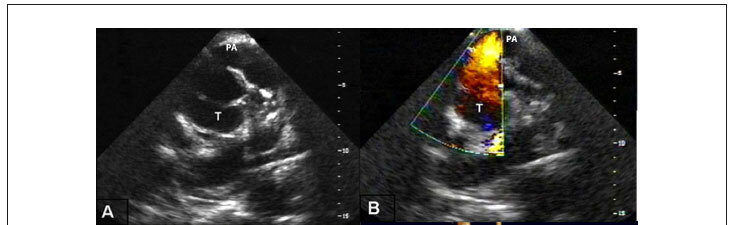
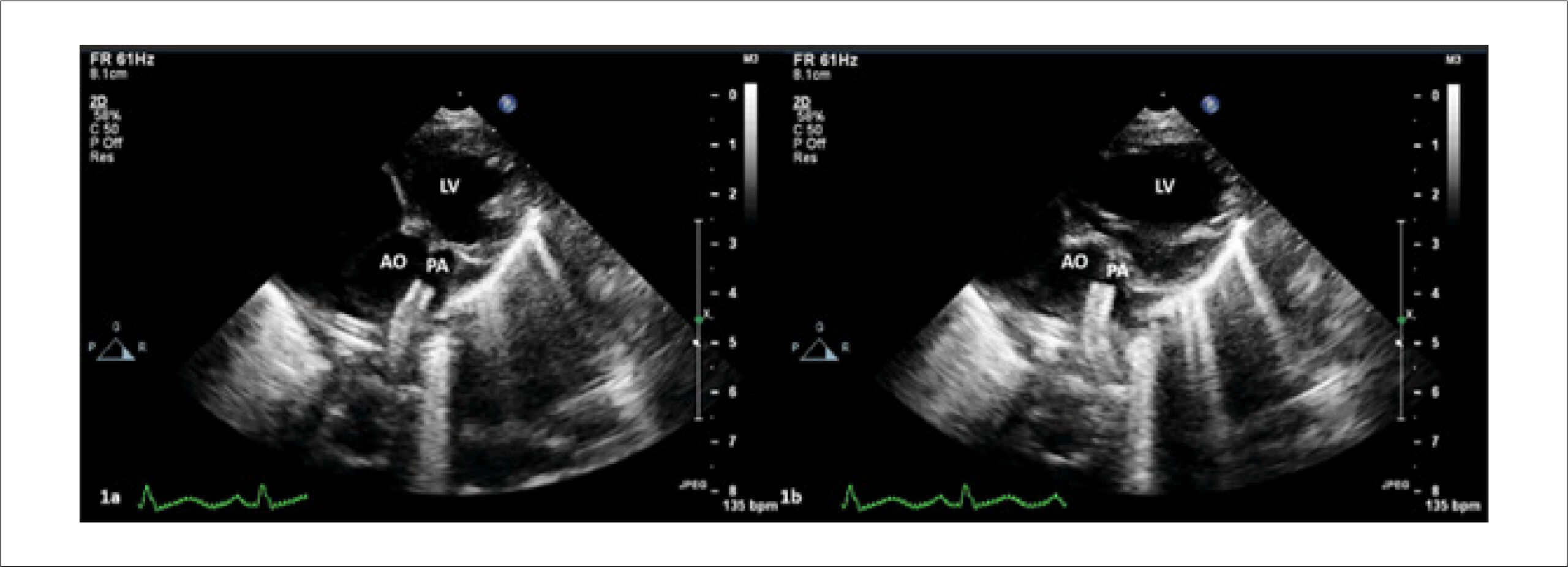
The post-procedure echocardiography confirmed a well-positioned stent with good flow. However, the stent appeared to oscillate with every cardiac cycle (, ). This “oscillating stent sign” was confirmed on the post-stenting aortic angiogram (). Valvar pulmonary atresia is associated with the well-described “seagull sign” on angiogram. Pooling of contrast in the main pulmonary artery that retains a fibrous attachment to pulmonary annular tissue leads to the seagull sign, with the branch pulmonary arteries assuming the shape of the wings of the ‘seagull’. Valvar pulmonary atresia is generally associated with a straight arterial duct inserted into the main pulmonary artery in half of the cases. Even when the duct is long and tortuous in the others, studies suggest that it is more readily negotiated during ductal stenting in valvar pulmonary atresia as opposed to long segment pulmonary atresia., The oscillation of the ductal stent in valvar pulmonary atresia with every cardiac cycle suggests that the pulmonary end of the stent is within the main pulmonary artery, which is an intrapericardial structure and faithfully reflects the mechanical contractions of the heart. We suggest that this echocardiographic finding may be utilized for the assessment of stent position with respect to the pulmonary end in valvar pulmonary atresia.

[…]
  • Ductus arteriosus, patent
  • Ebstein Anomaly
  • Echocardiography/methods
  • Heart Defects, Congenital
  • Pulmonary Atresia
Read Full Article
Creative Commons Attribution (CC BY) Creative Commons license
07/12/2020 DOI: 10.36660/abc.20190829 Views 1
Figure 1
ABC
Clinicoradiological Correlation

Case 4/2019 – Pulmonary Atresia, Ventricular Septal Defect, and Systemic-Pulmonary Collateral Circulation developing after prior Blalock-Taussig, in a Symptomatic 47-Year-Old Adult

Edmar Atik et al. Maria Angélica Binotto Alessandra Costa Barreto Walther Ishikawa

Clinical data

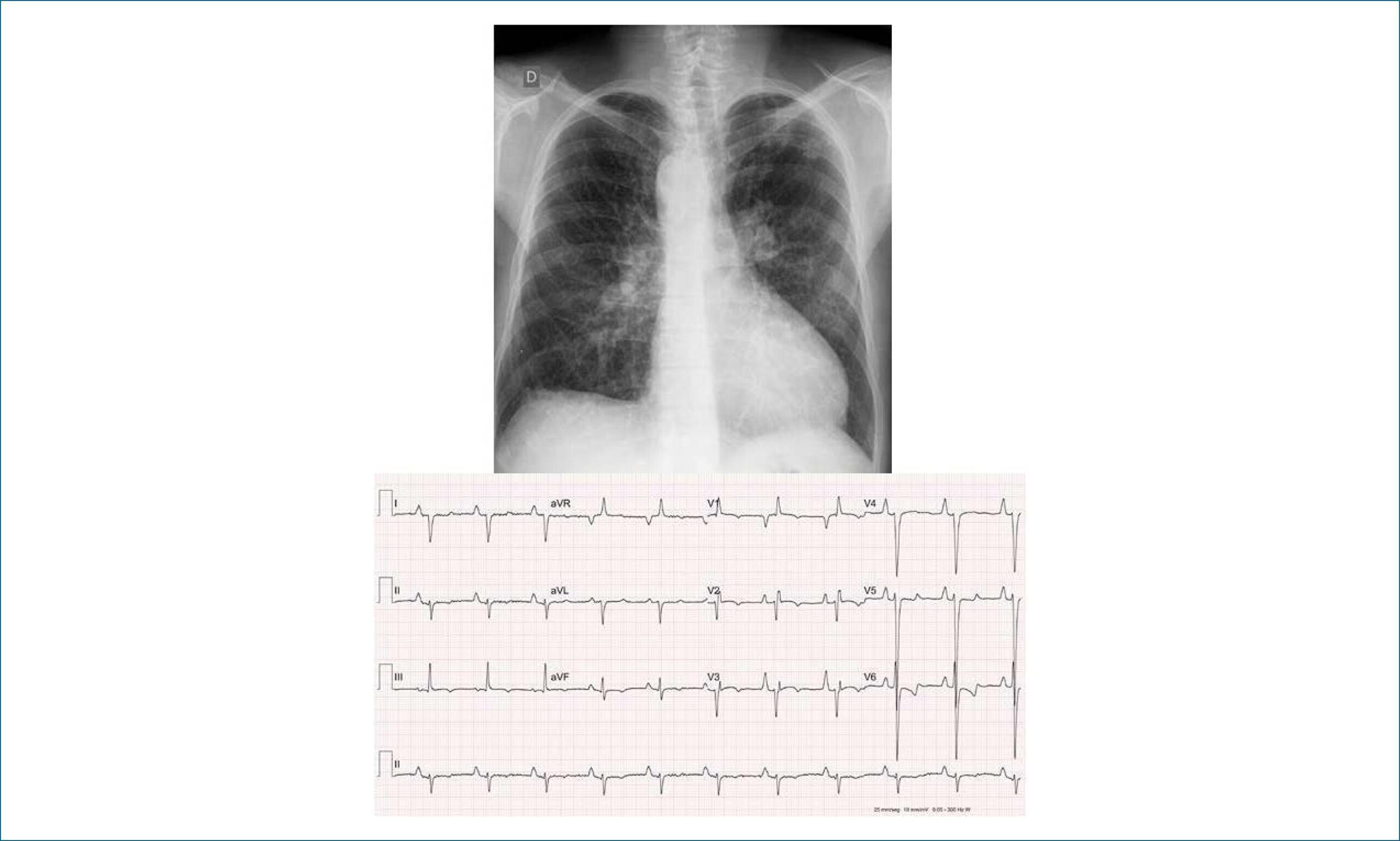
The patient had no symptoms from birth to young adulthood, when he developed more severe hypoxia, which required a Blalock-Taussig anastomosis on the right. Five years ago, worsening of hypoxia was again observed, with hemapheresis every 6 months, in addition to fatigue on small to medium exertion and with associated ventricular dysfunction. He used f warfarin, carvedilol and enalapril, in addition to nasal oxygen at night.

[…]

  • Adult
  • Clinical Evolution
  • Collateral Circulation
  • Heart Septal Defects, Ventricular
  • Pulmonary Atresia
Read Full Article
Creative Commons Attribution (CC BY) Creative Commons license
08/08/2019 DOI: 10.5935/abc.20190121 Views 2
Atypical truncus arteriosus operated at 28 years of age: importance of differential diagnosis
ABC
Case Report

Atypical truncus arteriosus operated at 28 years of age: importance of differential diagnosis

Lilian Maria Lopes et al. Jose Pedro da Silva Luciana da Fonseca Sonia Meiken … André Bavaresco Cristóvão Salvador Gustavo Spadaccia dos Santos Fernandes

This is the case of 28 year-old adult with suspected congenital heart disease since birth, not treated in childhood at the his family’s choice. At 27 years old, he was diagnosed with pulmonary atresia with ventricular septal defect and systemic-pulmonary collaterals, where surgery was contraindicated. A new review in our department showed that it was an atypical form of truncus arteriosus. The fact that a common arterial trunk with left-right shunt was viewed by echocardiography was a crucial fact for the indication of new catheterization, opening the prospect of surgical correction. Currently, the patient is well, with 7 years of postoperative outcome.

  • Congenital
  • Heart Defects
  • Heart Septal Defects, Ventricular
  • Pulmonary Atresia
  • truncus arteriosus
Read Full Article
Creative Commons Attribution (CC BY) Creative Commons license
04/10/2011 DOI: 10.1590/S0066-782X2011001100016 Views 1
Annuloplasty of cryopreserved pulmonary homograft with Delrin stent in pulmonary atresia with ventricular septal defect
ABC
Case Report

Annuloplasty of cryopreserved pulmonary homograft with Delrin stent in pulmonary atresia with ventricular septal defect

Ulisses Alexandre Croti et al. Domingo Marcolino Braile Moacir Fernandes de Godoy Vladimir Ramirez … Lilian Beani Aírton Camacho Moscadini

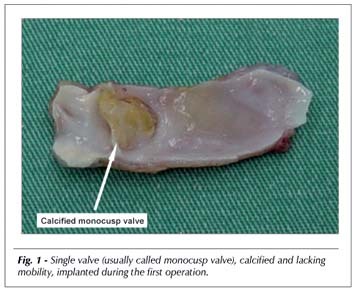
A six-year-old child was suffering from pulmonary atresia with ventricular septal defect after a total correction at 1 year of age using a bovine pericardial monocusp valve in the reconstruction of the right ventricle outflow tract. The infant evolved with significant pulmonary valve regurgitation (PVR) and right ventricle dysfunction. On reoperation, a cryopreserved pulmonary homograft (CPH) was implanted with annuloplasty utilizing a Delrin ring with the aim of avoiding geometric distortion of the vessel. After two years, an echocardiogram proved a similar state to the immediate postoperative period with slight pulmonary valve regurgitation and normal right ventricular function suggesting that this maneuver may be used as coadjuvant treatment to optimize the result of CPH implantation.

  • Bronchial arteries
  • Congenital
  • Heart Defects
  • Pulmonary Atresia
Read Full Article
Creative Commons Attribution (CC BY) Creative Commons license
15/06/2007 DOI: 10.1590/S0066-782X2007000500025 Views 2
Angiographic study of pulmonary circulation in tetralogy of Fallot with pulmonary atresia
ABC
Artigo Original

Angiographic study of pulmonary circulation in tetralogy of Fallot with pulmonary atresia

Marco Aurélio Santos et al. Vitor Manuel Pereira Azevedo

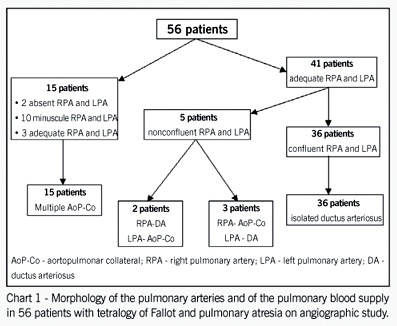
OBJECTIVE: To identify the types of pulmonary vascular blood supply in tetralogy of Fallot with pulmonary atresia by use of hemodynamic study. METHODS: Fifty-six patients with tetralogy of Fallot and pulmonary atresia, and ages ranging from 20 days to 4 years, underwent cineangiocardiographic study with contrast medium injections in the following vascular structures: 1) wedged pulmonary vein; 2) aortopulmonary collaterals; 3) thoracic aorta; and 4) ductus arteriosus or systemic-pulmonary shunt. RESULTS: In the 56 patients studied, pulmonary blood was supplied as follows: in 15, by aortopulmonary collaterals; in 36, only by the ductus arteriosus; and in 5, by the ductus arteriosus and aortopulmonary collaterals. The patients were classified into 6 types depending on the type of pulmonary vascular perfusion and the presence or absence of vascular structures that compose the pulmonary circulation in tetralogy of Fallot with pulmonary atresia. CONCLUSION: This type of approach enables the obtainment of information necessary for the correct clinicosurgical management of patients, due to the great complexity and extreme variability of the pulmonary blood supply in tetralogy of Fallot with pulmonary atresia.

  • angiocardiography
  • aortopulmonary collaterals
  • Pulmonary Atresia
  • Tetralogy of Fallot
Read Full Article
Creative Commons Attribution (CC BY) Creative Commons license
08/03/2005 DOI: 10.1590/S0066-782X2005000200007
Assessment of the pulmonary vascular blood supply in patients with pulmonary atresia, ventricular septal defect, and aortopulmonary collateral arteries
ABC
Artigo Original

Assessment of the pulmonary vascular blood supply in patients with pulmonary atresia, ventricular septal defect, and aortopulmonary collateral arteries

Ulisses Alexandre Croti et al. Miguel Lorenzo Barbero Marcial Carla Tanamati Marcelo Biscegli Jatene … Domingo Marcolino Braile Sergio Almeida de Oliveira

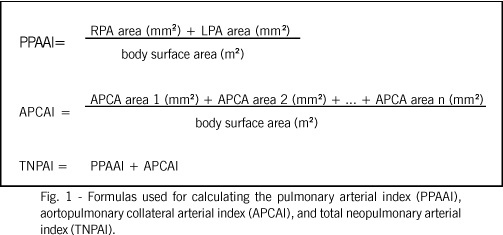
OBJECTIVE: To study the morphometric characteristics of the central pulmonary arteries and aortopulmonary collateral arteries by assessing the morphology of the pulmonary vascular blood supply, to determine their significance in surgical treatment. METHOD: From January 1990 to June 2001, 40 patients were studied. Those who had the complete cineangiocardiographic study prior to the first surgical intervention were included in the study. The morphometric characteristics of the central pulmonary arteries (PPAA) and aortopulmonary collateral arteries (APCA) were analyzed, as was the distribution of blood irrigation to the lungs. The following indices were calculated: pulmonary arterial index (PPAAI), aortopulmonary collateral arterial index (APCAI), and total neopulmonary arterial index (TNPAI = PPAAI + APCAI). The surgical treatment was considered palliative (PT), palliative definitive (PDT), and definitive (DT). RESULTS: The palliative treatment predominated. No statistically significant differences were observed in the patients undergoing PT, PDT, and DT, in regard to PPAAI, APCAI, and TNPAI. Comparing PPAAI and APCAI, no difference was observed for DT (P=0.4309); APCAI was greater than PPAAI for PT (P=0.0176); and APCAI was descriptively greater for PDT. The TNPAI of patients undergoing DT was greater than that of patients undergoing PT (P=0.0959). Five morphologically similar subgroups were identified and designated as B1, B2, B3, B4, and B5. Overall mortality was 17.5%. CONCLUSION: The morphometric characteristics are important, but the morphology of the pulmonary vascular blood supply of the PPAA and APCA proved to be better for guiding the surgical treatment. Independently of the didactical division into subgroups, PT predominated. Mortality was not correlated with the morphometric characteristics.

  • aortopulmonary collateral arteries
  • Pulmonary Atresia
  • ventricular septal defect
Read Full Article
Creative Commons Attribution (CC BY) Creative Commons license
14/02/2005 DOI: 10.1590/S0066-782X2005000100002
Angiographic morphologic characteristics in pulmonary atresia with intact ventricular septum
ABC
Artigo Original

Angiographic morphologic characteristics in pulmonary atresia with intact ventricular septum

Marco Aurélio Santos et al. Vitor Manuel Pereira Azevedo

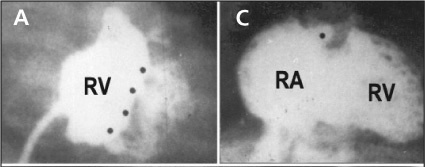
OBJECTIVE: To determine the morphological and functional changes in the right ventricle in pulmonary atresia with intact ventricular septum (PAIVS) for assessing the candidates for the different therapeutic procedures currently available. METHODS: Thirty-one patients underwent cineangiocardiographic study with axial projections. Their ages ranged from 1 to 50 days (x = 9.6), and 28 of them were studied during the first month of life. The statistical analysis comprised the following: chi-square test, Kruskal-Wallis test for the mean and standard deviation, multiple regression, and the 95% confidence interval (95%CI) was calculated. The significance level adopted was alpha < 0.05. RESULTS: The patients were divided into 3 groups according to the angiographic morphology of the right ventricle (RV): group A – tripartite RV (n=16); group B – bipartite RV (n=9); and group C – unipartite RV (n=6). The diameter of the tricuspid valve was 10.28 ± 2.67 mm (A); 7.82 ± 3.41 (B); and 5.27 ± 0.57 (C) (P=0.0005). Pulmonary atresia was of the valvular type in all group A patients and of the infundibular type in all group C patients (P<0.0001). Coronary-cavitary connections were rare (2/16) in group A patients, but occurred in all group C patients (P=0.0006), with retrograde opacity of the aorta (flow from the RV to the aorta) in 2 group A patients and in all group C patients (P=0.0003). Three patients (2 in group C and 1 in group A) had right-ventricular-dependent coronary circulation. Isolated moderate/severe tricuspid regurgitation showed a tendency towards being more frequent in group A (P=0.0525). The angle of the ductus arteriosus with the descending aorta was as follows: 104.06 ± 8.98 in group A; 79.17 ± 33.08 in group B; and 39.0 ± 6.52 in group C (P=0.0016). The correlation between the diameter of the tricuspid valve and the angle of the ductus arteriosus with the descending aorta was 0.6568 (P=0.0002). CONCLUSION: Because of the heterogeneity of the morphology of the RV in patients with pulmonary atresia with intact ventricular septum, knowledge about all these data is required for selecting candidates for the different therapeutic procedures.

  • Congenital Heart Disease
  • Ductus Arteriosus
  • prognostic factors
  • Pulmonary Atresia
  • pulmonary valvotomy
Read Full Article
Creative Commons Attribution (CC BY) Creative Commons license
09/06/2004 DOI: 10.1590/S0066-782X2004000500004

How to cite this article

EndNote RIS

Electronic Document Format (Vancouver)

Gopalakrishnan A, Krishnamoorthy KM, Kumar PS, Sivasubramonian S. Oscillating Ductal Stent in Valvar Pulmonary Atresia. Arquivos Brasileiros de Cardiologia 2020;115(5):961-3.

Electronic Document Format (ABNT)

Gopalakrishnan, Arun; Krishnamoorthy, Kavassery Mahadevan; Kumar, Paidi Suresh; Sivasubramonian, Sivasankaran. Oscillating Ductal Stent in Valvar Pulmonary Atresia. Arquivos Brasileiros de Cardiologia, v. 115, n. 5, p. 961-963, Dec. 2020.

Electronic Document Format (APA)

Gopalakrishnan, A., Krishnamoorthy, K. M., Kumar, P. S., & Sivasubramonian, S. (2020). Oscillating Ductal Stent in Valvar Pulmonary Atresia. Arquivos Brasileiros de Cardiologia, 115(5), 961-963.

Electronic Document Format (ISO)

Gopalakrishnan, Arun and Krishnamoorthy, Kavassery Mahadevan and Kumar, Paidi Suresh and Sivasubramonian, Sivasankaran. Oscillating Ductal Stent in Valvar Pulmonary Atresia. Arquivos Brasileiros de Cardiologia [online]. 2020, vol. 115, n. 5, [cited 2026-10-14], pp. 961-963. Available from: <https://journals.cardiol.br/en/article/oscillating-ductal-stent-in-valvar-pulmonary-atresia/>. ISSN 0066-782X

EndNote RIS

Electronic Document Format (Vancouver)

Atik E, Binotto MA, Barreto AC, Ishikawa W. Case 4/2019 – Pulmonary Atresia, Ventricular Septal Defect, and Systemic-Pulmonary Collateral Circulation developing after prior Blalock-Taussig, in a Symptomatic 47-Year-Old Adult. Arquivos Brasileiros de Cardiologia 2019;113(1):103-5.

Electronic Document Format (ABNT)

Atik, Edmar; Binotto, Maria Angélica; Barreto, Alessandra Costa; Ishikawa, Walther. Case 4/2019 – Pulmonary Atresia, Ventricular Septal Defect, and Systemic-Pulmonary Collateral Circulation developing after prior Blalock-Taussig, in a Symptomatic 47-Year-Old Adult. Arquivos Brasileiros de Cardiologia, v. 113, n. 1, p. 103-105, Aug. 2019.

Electronic Document Format (APA)

Atik, E., Binotto, M. A., Barreto, A. C., & Ishikawa, W. (2019). Case 4/2019 – Pulmonary Atresia, Ventricular Septal Defect, and Systemic-Pulmonary Collateral Circulation developing after prior Blalock-Taussig, in a Symptomatic 47-Year-Old Adult. Arquivos Brasileiros de Cardiologia, 113(1), 103-105.

Electronic Document Format (ISO)

Atik, Edmar and Binotto, Maria Angélica and Barreto, Alessandra Costa and Ishikawa, Walther. Case 4/2019 – Pulmonary Atresia, Ventricular Septal Defect, and Systemic-Pulmonary Collateral Circulation developing after prior Blalock-Taussig, in a Symptomatic 47-Year-Old Adult. Arquivos Brasileiros de Cardiologia [online]. 2019, vol. 113, n. 1, [cited 2026-10-14], pp. 103-105. Available from: <https://journals.cardiol.br/en/article/case-4-2019-pulmonary-atresia-ventricular-septal-defect-and-systemic-pulmonary-collateral-circulation-developing-after-prior-blalock-taussig-in-a-symptomatic-47-year-old-adult/>. ISSN 0066-782X

EndNote RIS

Electronic Document Format (Vancouver)

Lopes LM, Silva JP, Fonseca L, Meiken S, Salvador ABC, Fernandes GSS. Atypical truncus arteriosus operated at 28 years of age: importance of differential diagnosis. Arquivos Brasileiros de Cardiologia 2011;97(2):e29-32.

Electronic Document Format (ABNT)

Lopes, Lilian Maria; Silva, Jose Pedro da; Fonseca, Luciana da; Meiken, Sonia; Salvador, André Bavaresco Cristóvão; Fernandes, Gustavo Spadaccia dos Santos. Atypical truncus arteriosus operated at 28 years of age: importance of differential diagnosis. Arquivos Brasileiros de Cardiologia, v. 97, n. 2, p. e29-e32, Oct. 2011.

Electronic Document Format (APA)

Lopes, L. M., Silva, J. P. , Fonseca, L. , Meiken, S., Salvador, A. B. C., & Fernandes, G. S. S. (2011). Atypical truncus arteriosus operated at 28 years of age: importance of differential diagnosis. Arquivos Brasileiros de Cardiologia, 97(2), e29-e32.

Electronic Document Format (ISO)

Lopes, Lilian Maria and Silva, Jose Pedro da and Fonseca, Luciana da and Meiken, Sonia and Salvador, André Bavaresco Cristóvão and Fernandes, Gustavo Spadaccia dos Santos. Atypical truncus arteriosus operated at 28 years of age: importance of differential diagnosis. Arquivos Brasileiros de Cardiologia [online]. 2011, vol. 97, n. 2, [cited 2026-10-14], pp. e29-e32. Available from: <https://journals.cardiol.br/en/article/atypical-truncus-arteriosus-operated-at-28-years-of-age-importance-of-differential-diagnosis/>. ISSN 0066-782X

EndNote RIS

Electronic Document Format (Vancouver)

Croti UA, Braile DM, Godoy MF, Ramirez V, Beani L, Moscadini AC. Annuloplasty of cryopreserved pulmonary homograft with Delrin stent in pulmonary atresia with ventricular septal defect. Arquivos Brasileiros de Cardiologia 2007;88(5):e118-20.

Electronic Document Format (ABNT)

Croti, Ulisses Alexandre; Braile, Domingo Marcolino; Godoy, Moacir Fernandes de; Ramirez, Vladimir; Beani, Lilian; Moscadini, Aírton Camacho. Annuloplasty of cryopreserved pulmonary homograft with Delrin stent in pulmonary atresia with ventricular septal defect. Arquivos Brasileiros de Cardiologia, v. 88, n. 5, p. e118-e120, Jun. 2007.

Electronic Document Format (APA)

Croti, U. A., Braile, D. M., Godoy, M. F. , Ramirez, V., Beani, L., & Moscadini, A. C. (2007). Annuloplasty of cryopreserved pulmonary homograft with Delrin stent in pulmonary atresia with ventricular septal defect. Arquivos Brasileiros de Cardiologia, 88(5), e118-e120.

Electronic Document Format (ISO)

Croti, Ulisses Alexandre and Braile, Domingo Marcolino and Godoy, Moacir Fernandes de and Ramirez, Vladimir and Beani, Lilian and Moscadini, Aírton Camacho. Annuloplasty of cryopreserved pulmonary homograft with Delrin stent in pulmonary atresia with ventricular septal defect. Arquivos Brasileiros de Cardiologia [online]. 2007, vol. 88, n. 5, [cited 2026-10-14], pp. e118-e120. Available from: <https://journals.cardiol.br/en/article/annuloplasty-of-cryopreserved-pulmonary-homograft-with-delrin-stent-in-pulmonary-atresia-with-ventricular-septal-defect/>. ISSN 0066-782X

EndNote RIS

Electronic Document Format (Vancouver)

Santos MA, Azevedo VMP. Angiographic study of pulmonary circulation in tetralogy of Fallot with pulmonary atresia. Arquivos Brasileiros de Cardiologia 2005;84(2):130-6.

Electronic Document Format (ABNT)

Santos, Marco Aurélio; Azevedo, Vitor Manuel Pereira. Angiographic study of pulmonary circulation in tetralogy of Fallot with pulmonary atresia. Arquivos Brasileiros de Cardiologia, v. 84, n. 2, p. 130-136, Mar. 2005.

Electronic Document Format (APA)

Santos, M. A., & Azevedo, V. M. P. (2005). Angiographic study of pulmonary circulation in tetralogy of Fallot with pulmonary atresia. Arquivos Brasileiros de Cardiologia, 84(2), 130-136.

Electronic Document Format (ISO)

Santos, Marco Aurélio and Azevedo, Vitor Manuel Pereira. Angiographic study of pulmonary circulation in tetralogy of Fallot with pulmonary atresia. Arquivos Brasileiros de Cardiologia [online]. 2005, vol. 84, n. 2, [cited 2026-10-14], pp. 130-136. Available from: <https://journals.cardiol.br/en/article/angiographic-study-of-pulmonary-circulation-in-tetralogy-of-fallot-with-pulmonary-atresia/>. ISSN 0066-782X

EndNote RIS

Electronic Document Format (Vancouver)

Croti UA, Marcial MLB, Tanamati C, Jatene MB, Braile DM, Oliveira SA. Assessment of the pulmonary vascular blood supply in patients with pulmonary atresia, ventricular septal defect, and aortopulmonary collateral arteries. Arquivos Brasileiros de Cardiologia 2005;84(1):3-9.

Electronic Document Format (ABNT)

Croti, Ulisses Alexandre; Marcial, Miguel Lorenzo Barbero; Tanamati, Carla; Jatene, Marcelo Biscegli; Braile, Domingo Marcolino; Oliveira, Sergio Almeida de. Assessment of the pulmonary vascular blood supply in patients with pulmonary atresia, ventricular septal defect, and aortopulmonary collateral arteries. Arquivos Brasileiros de Cardiologia, v. 84, n. 1, p. 3-9, Feb. 2005.

Electronic Document Format (APA)

Croti, U. A., Marcial, M. L. B., Tanamati, C., Jatene, M. B., Braile, D. M., & Oliveira, S. A. (2005). Assessment of the pulmonary vascular blood supply in patients with pulmonary atresia, ventricular septal defect, and aortopulmonary collateral arteries. Arquivos Brasileiros de Cardiologia, 84(1), 3-9.

Electronic Document Format (ISO)

Croti, Ulisses Alexandre and Marcial, Miguel Lorenzo Barbero and Tanamati, Carla and Jatene, Marcelo Biscegli and Braile, Domingo Marcolino and Oliveira, Sergio Almeida de. Assessment of the pulmonary vascular blood supply in patients with pulmonary atresia, ventricular septal defect, and aortopulmonary collateral arteries. Arquivos Brasileiros de Cardiologia [online]. 2005, vol. 84, n. 1, [cited 2026-10-14], pp. 3-9. Available from: <https://journals.cardiol.br/en/article/assessment-of-the-pulmonary-vascular-blood-supply-in-patients-with-pulmonary-atresia-ventricular-septal-defect-and-aortopulmonary-collateral-arteries/>. ISSN 0066-782X

EndNote RIS

Electronic Document Format (Vancouver)

Santos MA, Azevedo VMP. Angiographic morphologic characteristics in pulmonary atresia with intact ventricular septum. Arquivos Brasileiros de Cardiologia 2004;82(5):413-9.

Electronic Document Format (ABNT)

Santos, Marco Aurélio; Azevedo, Vitor Manuel Pereira. Angiographic morphologic characteristics in pulmonary atresia with intact ventricular septum. Arquivos Brasileiros de Cardiologia, v. 82, n. 5, p. 413-419, Jun. 2004.

Electronic Document Format (APA)

Santos, M. A., & Azevedo, V. M. P. (2004). Angiographic morphologic characteristics in pulmonary atresia with intact ventricular septum. Arquivos Brasileiros de Cardiologia, 82(5), 413-419.

Electronic Document Format (ISO)

Santos, Marco Aurélio and Azevedo, Vitor Manuel Pereira. Angiographic morphologic characteristics in pulmonary atresia with intact ventricular septum. Arquivos Brasileiros de Cardiologia [online]. 2004, vol. 82, n. 5, [cited 2026-10-14], pp. 413-419. Available from: <https://journals.cardiol.br/en/article/angiographic-morphologic-characteristics-in-pulmonary-atresia-with-intact-ventricular-septum/>. ISSN 0066-782X

  • About ABC Family
  • Internal Regulation
  • Editorial Board
  • Brazilian Society of Cardiology (SBC)

Issues

SBC Guidelines

  • Videos
  • Podcasts
  • News