ABC Family Arquivos Brasileiros de Cardiologia International Journal of Cardiovascular Sciences ABC Heart Failure & Cardiomyopathy ABC Imagem Cardiovascular
Português English
ABC Family
Português English
  • About
    • About ABC Family
    • Internal Regulation
    • Editorial Board
    • Brazilian Society of Cardiology (SBC)
  • Issues
  • SBC Guidelines
  • Content
    • Videos
    • Podcasts
    • News
  • About
    • About ABC Family
    • Internal Regulation
    • Editorial Board
    • Brazilian Society of Cardiology (SBC)
  • Issues
  • SBC Guidelines
  • Content
    • Videos
    • Podcasts
    • News

ABC Family

  • ABC Family
  • Arquivos Brasileiros de Cardiologia
  • International Journal of Cardiovascular Sciences
  • ABC Heart Failure & Cardiomyopathy
  • ABC Imagem Cardiovascular
Search in

No content found.

Journals
Ordering
Article types
Others

  1. Home
  2. Keyword: prognostic factors
Evaluation of heart failure prognostic factors in patients referred for heart transplantation
ABC
Artigo Original

Evaluation of heart failure prognostic factors in patients referred for heart transplantation

Cleópatra Medina Noronha Areosa et al. Dirceu Rodrigues Almeida Antônio Carlos C. de Carvalho Angelo A. V. de Paola

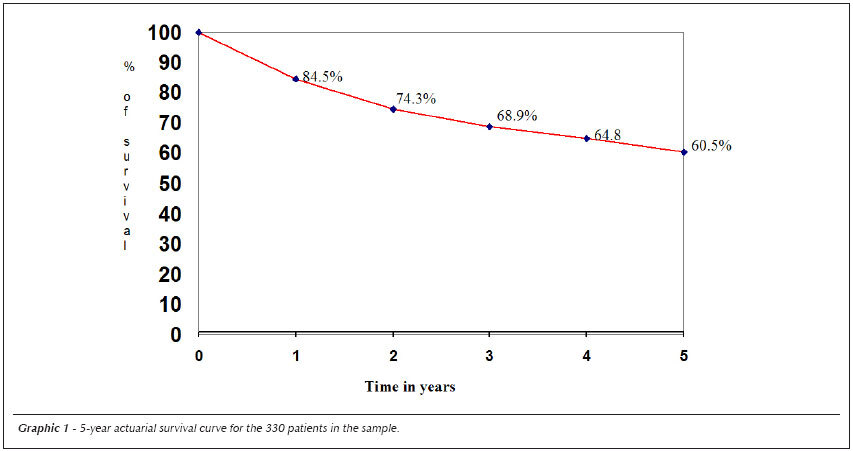
OBJECTIVES: To evaluate the survival of patients with heart failure submitted to cardiac transplantation screening as well as identify poor prognostic factors using a risk score to identify patients with higher death risk. METHODS: 330 male and female patients aged 12 to 74 years old, referred for heart transplantation from January 1986 to November 2001 were evaluated. Clinical, laboratory, electrocardiographic, Holter monitoring, echocardiographic and radionuclide ventriculography data were analyzed. RESULTS: The median follow up period was 5 years; patients’ survival rate was 84.5% in the first year, 74.3% in the second year, 68.9% in the third year and 60.5% in the fifth year. The prognostic variables selected through the univariate analysis were: age, Chagas’ disease etiology for cardiomyopathy, NYHA functional classes III and IV, orthopnea, systolic blood pressure, mean blood pressure, pulse pressure, plasma urea, sodium, glucose, albumin, bilirubin, hemoglobin, and mean heart rate. The prognostic variables at the multivariate analysis were: ejection fraction, blood urea, and hemoglobin. The risk score: RR=exp[(-0.0942401 x ejection fraction) + (0.0105207 x blood urea) + (-0.2974991 x hemoglobin) + (-0.0132898 x age) + (-0.0099115 x blood glucose)] discriminated the population with a higher death risk. CONCLUSION: Patients’ survival was satisfactory despite heart failure severity, suggesting they can be maintained on optimized clinical treatment until persistent clinical deterioration takes place. Ejection fraction, ventricular diameters, and clinical functional class alone should not be used as an indication for heart transplantation. The risk score could help discriminate the population with the poorest prognosis.
  • cardiac transplantation
  • Heart Failure
  • prognostic factors
  • Survival
Read Full Article
Creative Commons Attribution (CC BY) Creative Commons license
23/07/2007 DOI: 10.1590/S0066-782X2007000600007 Views 1
Angiographic morphologic characteristics in pulmonary atresia with intact ventricular septum
ABC
Artigo Original

Angiographic morphologic characteristics in pulmonary atresia with intact ventricular septum

Marco Aurélio Santos et al. Vitor Manuel Pereira Azevedo

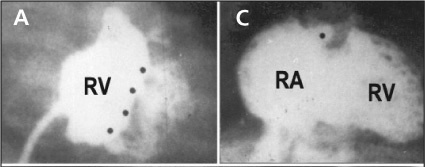
OBJECTIVE: To determine the morphological and functional changes in the right ventricle in pulmonary atresia with intact ventricular septum (PAIVS) for assessing the candidates for the different therapeutic procedures currently available. METHODS: Thirty-one patients underwent cineangiocardiographic study with axial projections. Their ages ranged from 1 to 50 days (x = 9.6), and 28 of them were studied during the first month of life. The statistical analysis comprised the following: chi-square test, Kruskal-Wallis test for the mean and standard deviation, multiple regression, and the 95% confidence interval (95%CI) was calculated. The significance level adopted was alpha < 0.05. RESULTS: The patients were divided into 3 groups according to the angiographic morphology of the right ventricle (RV): group A – tripartite RV (n=16); group B – bipartite RV (n=9); and group C – unipartite RV (n=6). The diameter of the tricuspid valve was 10.28 ± 2.67 mm (A); 7.82 ± 3.41 (B); and 5.27 ± 0.57 (C) (P=0.0005). Pulmonary atresia was of the valvular type in all group A patients and of the infundibular type in all group C patients (P<0.0001). Coronary-cavitary connections were rare (2/16) in group A patients, but occurred in all group C patients (P=0.0006), with retrograde opacity of the aorta (flow from the RV to the aorta) in 2 group A patients and in all group C patients (P=0.0003). Three patients (2 in group C and 1 in group A) had right-ventricular-dependent coronary circulation. Isolated moderate/severe tricuspid regurgitation showed a tendency towards being more frequent in group A (P=0.0525). The angle of the ductus arteriosus with the descending aorta was as follows: 104.06 ± 8.98 in group A; 79.17 ± 33.08 in group B; and 39.0 ± 6.52 in group C (P=0.0016). The correlation between the diameter of the tricuspid valve and the angle of the ductus arteriosus with the descending aorta was 0.6568 (P=0.0002). CONCLUSION: Because of the heterogeneity of the morphology of the RV in patients with pulmonary atresia with intact ventricular septum, knowledge about all these data is required for selecting candidates for the different therapeutic procedures.

  • Congenital Heart Disease
  • Ductus Arteriosus
  • prognostic factors
  • Pulmonary Atresia
  • pulmonary valvotomy
Read Full Article
Creative Commons Attribution (CC BY) Creative Commons license
09/06/2004 DOI: 10.1590/S0066-782X2004000500004
Prognostic factors of rheumatic mitral stenosis during pregnancy and puerperium
ABC
Original Article

Prognostic factors of rheumatic mitral stenosis during pregnancy and puerperium

Paulo José Bastos Barbosa et al. Antônio Alberto Lopes Gilson Soares Feitosa Rosângela Vasconcelos de Almeida … Rosenbert Mamédio da Silva José Carlos Brito Maria Lúcia Duarte Augusto José Gonçalves Almeida

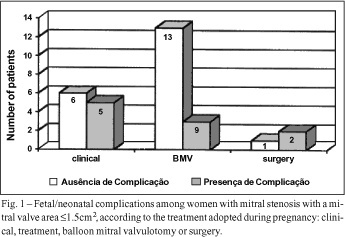
OBJECTIVE: To identifity characteristics associated with complications during pregnancy and puerperium in patients with rheumatic mitral stenosis. METHODS: Forty-one pregnant women (forty-five pregnancies) with mitral stenosis, followed-up from 1991 to 1999 were retrospectively evaluated. Predictor variables: the mitral valve area (MVA), measured by echocardiogram, and functional class (FC) before pregnancy (NYHA criteria).Maternal events: progression of heart failure, need for cardiac surgery or balloon mitral valvulotomy, death, and thromboembolism. Fetal/neonatal events: abortion, fetal or neonatal death, prematurity or low birth weight ( or = II and III versus I) was also associated with a risk for maternal events (RR=2.7; 95% CI=1.4-5.3).MVA and FC were not importantly associated with these events, although a smaller frequency of fetal/neonatal events was observed in patients who had undergone balloon valvulotomy. CONCLUSION: In pregnant women with mitral stenosis, the MVA and the FC are strongly associated with maternal complications but are not associated with fetal/neonatal events. Balloon mitral valvulotomy could have contributed to reducing the risks of fetal/neonatal events in the more symptomatic patients who had to undergo this procedure during pregnancy.

  • Mitral stenosis
  • Pregnancy
  • prognostic factors
Read Full Article
Creative Commons Attribution (CC BY) Creative Commons license
08/01/2002 DOI: 10.1590/S0066-782X2000000900003

How to cite this article

EndNote RIS

Electronic Document Format (Vancouver)

Areosa CMN, Almeida DR, Carvalho ACC, Paola AAV. Evaluation of heart failure prognostic factors in patients referred for heart transplantation. Arquivos Brasileiros de Cardiologia 2007;88(6):667-73.

Electronic Document Format (ABNT)

Areosa, Cleópatra Medina Noronha; Almeida, Dirceu Rodrigues; Carvalho, Antônio Carlos C. de; Paola, Angelo A. V. de. Evaluation of heart failure prognostic factors in patients referred for heart transplantation. Arquivos Brasileiros de Cardiologia, v. 88, n. 6, p. 667-673, Jul. 2007.

Electronic Document Format (APA)

Areosa, C. M. N., Almeida, D. R., Carvalho, A. C. C. , & Paola, A. A. V. (2007). Evaluation of heart failure prognostic factors in patients referred for heart transplantation. Arquivos Brasileiros de Cardiologia, 88(6), 667-673.

Electronic Document Format (ISO)

Areosa, Cleópatra Medina Noronha and Almeida, Dirceu Rodrigues and Carvalho, Antônio Carlos C. de and Paola, Angelo A. V. de. Evaluation of heart failure prognostic factors in patients referred for heart transplantation. Arquivos Brasileiros de Cardiologia [online]. 2007, vol. 88, n. 6, [cited 2026-10-14], pp. 667-673. Available from: <https://journals.cardiol.br/en/article/evaluation-of-heart-failure-prognostic-factors-in-patients-referred-for-heart-transplantation/>. ISSN 0066-782X

EndNote RIS

Electronic Document Format (Vancouver)

Santos MA, Azevedo VMP. Angiographic morphologic characteristics in pulmonary atresia with intact ventricular septum. Arquivos Brasileiros de Cardiologia 2004;82(5):413-9.

Electronic Document Format (ABNT)

Santos, Marco Aurélio; Azevedo, Vitor Manuel Pereira. Angiographic morphologic characteristics in pulmonary atresia with intact ventricular septum. Arquivos Brasileiros de Cardiologia, v. 82, n. 5, p. 413-419, Jun. 2004.

Electronic Document Format (APA)

Santos, M. A., & Azevedo, V. M. P. (2004). Angiographic morphologic characteristics in pulmonary atresia with intact ventricular septum. Arquivos Brasileiros de Cardiologia, 82(5), 413-419.

Electronic Document Format (ISO)

Santos, Marco Aurélio and Azevedo, Vitor Manuel Pereira. Angiographic morphologic characteristics in pulmonary atresia with intact ventricular septum. Arquivos Brasileiros de Cardiologia [online]. 2004, vol. 82, n. 5, [cited 2026-10-14], pp. 413-419. Available from: <https://journals.cardiol.br/en/article/angiographic-morphologic-characteristics-in-pulmonary-atresia-with-intact-ventricular-septum/>. ISSN 0066-782X

EndNote RIS

Electronic Document Format (Vancouver)

Barbosa PJB, Lopes AA, Feitosa GS, Almeida RV, Silva RM, Brito JC, Duarte ML, et al. Prognostic factors of rheumatic mitral stenosis during pregnancy and puerperium. Arquivos Brasileiros de Cardiologia 2002;75(3):220-4.

Electronic Document Format (ABNT)

Barbosa, Paulo José Bastos; Lopes, Antônio Alberto; Feitosa, Gilson Soares; Almeida, Rosângela Vasconcelos de; Silva, Rosenbert Mamédio da; Brito, José Carlos; Duarte, Maria Lúcia; Almeida, Augusto José Gonçalves. Prognostic factors of rheumatic mitral stenosis during pregnancy and puerperium. Arquivos Brasileiros de Cardiologia, v. 75, n. 3, p. 220-224, Jan. 2002.

Electronic Document Format (APA)

Barbosa, P. J. B., Lopes, A. A., Feitosa, G. S., Almeida, R. V. , Silva, R. M. , Brito, J. C., Duarte, M. L., & Almeida, A. J. G. (2002). Prognostic factors of rheumatic mitral stenosis during pregnancy and puerperium. Arquivos Brasileiros de Cardiologia, 75(3), 220-224.

Electronic Document Format (ISO)

Barbosa, Paulo José Bastos and Lopes, Antônio Alberto and Feitosa, Gilson Soares and Almeida, Rosângela Vasconcelos de and Silva, Rosenbert Mamédio da and Brito, José Carlos and Duarte, Maria Lúcia and Almeida, Augusto José Gonçalves. Prognostic factors of rheumatic mitral stenosis during pregnancy and puerperium. Arquivos Brasileiros de Cardiologia [online]. 2002, vol. 75, n. 3, [cited 2026-10-14], pp. 220-224. Available from: <https://journals.cardiol.br/en/article/prognostic-factors-of-rheumatic-mitral-stenosis-during-pregnancy-and-puerperium/>. ISSN 0066-782X

  • About ABC Family
  • Internal Regulation
  • Editorial Board
  • Brazilian Society of Cardiology (SBC)

Issues

SBC Guidelines

  • Videos
  • Podcasts
  • News