ABC Family Arquivos Brasileiros de Cardiologia International Journal of Cardiovascular Sciences ABC Heart Failure & Cardiomyopathy ABC Imagem Cardiovascular
Português English
ABC Family
Português English
  • About
    • About ABC Family
    • Internal Regulation
    • Editorial Board
    • Brazilian Society of Cardiology (SBC)
  • Issues
  • SBC Guidelines
  • Content
    • Videos
    • Podcasts
    • News
  • About
    • About ABC Family
    • Internal Regulation
    • Editorial Board
    • Brazilian Society of Cardiology (SBC)
  • Issues
  • SBC Guidelines
  • Content
    • Videos
    • Podcasts
    • News

ABC Family

  • ABC Family
  • Arquivos Brasileiros de Cardiologia
  • International Journal of Cardiovascular Sciences
  • ABC Heart Failure & Cardiomyopathy
  • ABC Imagem Cardiovascular
Search in

No content found.

Journals
Ordering
Article types
Others

  1. Home
  2. Keyword: Hypertension / genetic
Figure 1
ABC
Editorial

Obesity and Risk of Hypertension: A Growing Problem in Children and Adolescents

José Geraldo Mill

Arterial hypertension (AH) affects approximately 30% of adults in Brazil. A previously rare condition in children and adolescents, this situation has been changing given the obesity pandemic currently occurring in this age group.

Primary AH is a complex disease, as its appearance depends on genetic predisposition and factors linked to lifestyle. There is still no robust and easily obtainable genetic score to be used clinically as a predictor of AH. The same does not occur with the lifestyle factors, as it is known that a sedentary lifestyle, obesity, high salt intake and insulin resistance, predisposes to blood pressure increase throughout life.

[…]

  • Adiposity
  • Adolescent
  • Child
  • Exercise
  • Hypertension / genetic
  • Lifestyle
  • Obesity
Read Full Article
Creative Commons Attribution (CC BY) Creative Commons license
06/03/2023 DOI: 10.36660/abc.20220940
IJCS
Editorial

Are Wistar Rats the Most Suitable Normotensive Controls for Spontaneously Hypertensive Rats to Assess Blood Pressure and Cardiac Structure and Function?

Nazareth Novaes Rocha

The first animal models of hypertension involved constriction of renal arteries (the Goldblatt kidney) or parenchyma (the Page kidney). Although these human analogs closely mimicked the pathophysiology of the disease, renovascular hypertension and the Page kidney represent only a small fraction of human hypertension.

Most experimental studies of hypertension using animals have focused on understanding the mechanisms of primary hypertension. Models of primary hypertension have been more difficult to develop. Some models may have greater face validity than others with respect to phenotypic aspects of hypertension such as age at onset, temporal course, severity, variability, and associated comorbidities. Given the clinical importance of hypertension-related target organ damage, it is noteworthy that models exhibiting face validity for left ventricular hypertrophy, metabolic abnormalities, heart failure, renal damage, and stroke (e.g., spontaneously hypertensive rats [SHR] and Dahl salt-sensitive [DSS] rats) are also available. However, other conditions such as spontaneous development of atherosclerosis or acute myocardial infarction are not typically observed in current models.

[…]

  • Animal, Rats, Wistar
  • Blood Pressure
  • constriction, pathologic
  • Epigenesis,genetic
  • Heart Function Tests
  • Hypertension / genetic
  • renal artery
Read Full Article
Creative Commons Attribution (CC BY) Creative Commons license
09/03/2022 DOI: 10.36660/ijcs.20210286 Views 2
Figure 1
ABC
Original Article

Autonomic and Vascular Control in Prehypertensive Subjects with a Family History of Arterial Hypertension

Josária Ferraz Amaral et al. Diana de Medeiros Andrade Borsato Isabelle Magalhães Guedes Freitas Edgar Toschi-Dias … Daniel Godoy Martinez Mateus Camaroti Laterza

Abstract

Background:

Individuals with a family history of systemic arterial hypertension (FHSAH) and / or prehypertension have a higher risk of developing this pathology.

Objective:

To evaluate the autonomic and vascular functions of prehypertensive patients with FHSAH.

Methods:

Twenty-five young volunteers with FHSAH, 14 normotensive and 11 prehypertensive subjects were submitted to vascular function evaluation by forearm vascular conductance(VC) during resting and reactive hyperemia (Hokanson®) and cardiac and peripheral autonomic modulation, quantified, respectively, by spectral analysis of heart rate (ECG) and systolic blood pressure (SBP) (FinometerPRO®). The transfer function analysis was used to measure the gain and response time of baroreflex. The statistical significance adopted was p ≤ 0.05.

Results:

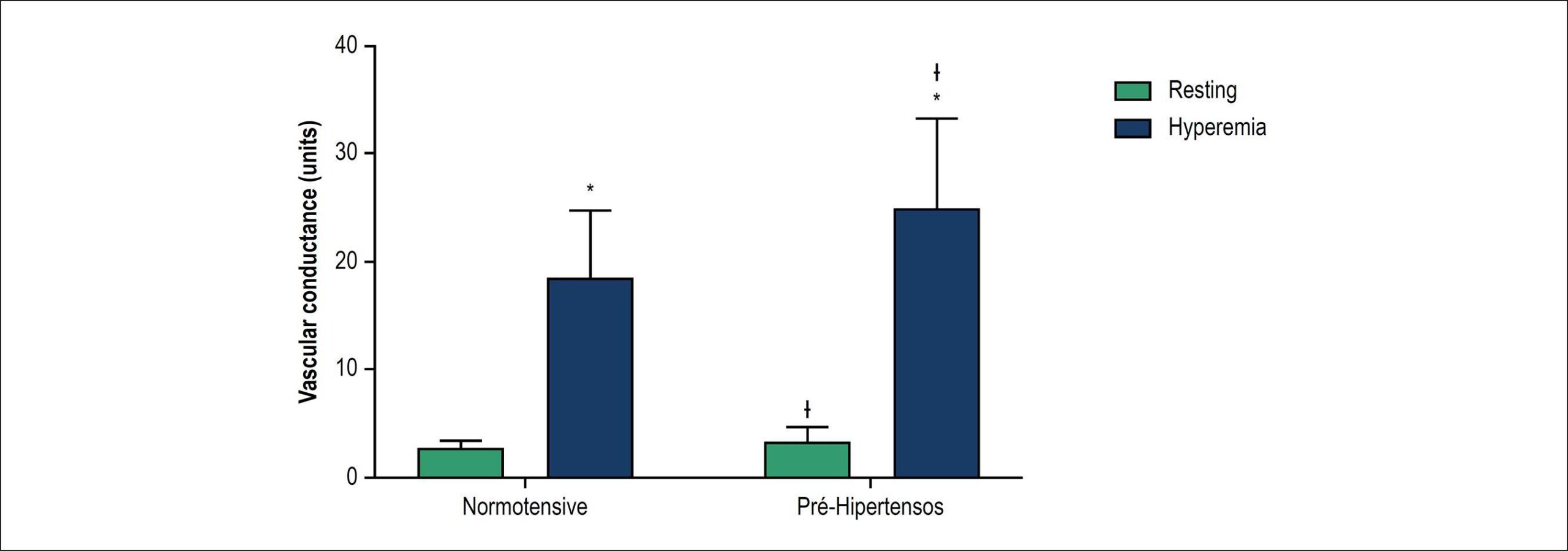
Pre-hypertensive individuals, in relation to normotensive individuals, have higher VC both at rest (3.48 ± 1.26 vs. 2.67 ± 0.72 units, p = 0.05) and peak reactive hyperemia (25, 02 ± 8.18 vs. 18.66 ± 6.07 units, p = 0.04). The indices of cardiac autonomic modulation were similar between the groups. However, in the peripheral autonomic modulation, greater variability was observed in prehypertensive patients compared to normotensive individuals (9.4 [4.9-12.7] vs. 18.3 [14.8-26.7] mmHg2; p < 0.01) and higher spectral components of very low (6.9 [2.0-11.1] vs. 13.5 [10.7-22.4] mmHg2, p = 0.01) and low frequencies (1.7 [1.0-3.0] vs. 3.0 [2.0-4.0] mmHg2, p = 0.04) of SBP. Additionally, we observed a lower gain of baroreflex control in prehypertensive patients compared to normotensive patients (12.16 ± 4.18 vs. 18.23 ± 7.11 ms/mmHg, p = 0.03), but similar delay time (-1.55 ± 0.66 vs. -1.58 ± 0.72 s, p = 0.90).

Conclusion:

Prehypertensive patients with FHSAH have autonomic dysfunction and increased vascular conductance when compared to normotensive patients with the same risk factor.

  • Autonomic Nervous System
  • Endothelium, Vascular / physiopathology
  • Hypertension / genetic
  • Risk Factors
Read Full Article
Creative Commons Attribution (CC BY) Creative Commons license
19/02/2018 DOI: 10.5935/abc.20180006 Views 1

How to cite this article

EndNote RIS

Electronic Document Format (Vancouver)

Mill JG. Obesity and Risk of Hypertension: A Growing Problem in Children and Adolescents. Arquivos Brasileiros de Cardiologia 2023;120(2):e20220940.

Electronic Document Format (ABNT)

Mill, José Geraldo. Obesity and Risk of Hypertension: A Growing Problem in Children and Adolescents. Arquivos Brasileiros de Cardiologia, v. 120, n. 2, e20220940, Mar. 2023.

Electronic Document Format (APA)

Mill, J. G. (2023). Obesity and Risk of Hypertension: A Growing Problem in Children and Adolescents. Arquivos Brasileiros de Cardiologia, 120(2), e20220940.

Electronic Document Format (ISO)

Mill, José Geraldo. Obesity and Risk of Hypertension: A Growing Problem in Children and Adolescents. Arquivos Brasileiros de Cardiologia [online]. 2023, vol. 120, n. 2, [cited 2026-10-14], e20220940. Available from: <https://journals.cardiol.br/en/article/obesity-and-risk-of-hypertension-a-growing-problem-in-children-and-adolescents/>. ISSN 0066-782X

EndNote RIS

Electronic Document Format (Vancouver)

Rocha NN. Are Wistar Rats the Most Suitable Normotensive Controls for Spontaneously Hypertensive Rats to Assess Blood Pressure and Cardiac Structure and Function?. International Journal of Cardiovascular Sciences 2022;35(2):172-3.

Electronic Document Format (ABNT)

Rocha, Nazareth Novaes. Are Wistar Rats the Most Suitable Normotensive Controls for Spontaneously Hypertensive Rats to Assess Blood Pressure and Cardiac Structure and Function?. International Journal of Cardiovascular Sciences, v. 35, n. 2, p. 172-173, Mar. 2022.

Electronic Document Format (APA)

Rocha, N. N. (2022). Are Wistar Rats the Most Suitable Normotensive Controls for Spontaneously Hypertensive Rats to Assess Blood Pressure and Cardiac Structure and Function?. International Journal of Cardiovascular Sciences, 35(2), 172-173.

Electronic Document Format (ISO)

Rocha, Nazareth Novaes. Are Wistar Rats the Most Suitable Normotensive Controls for Spontaneously Hypertensive Rats to Assess Blood Pressure and Cardiac Structure and Function?. International Journal of Cardiovascular Sciences [online]. 2022, vol. 35, n. 2, [cited 2026-10-14], pp. 172-173. Available from: <https://journals.cardiol.br/en/article/are-wistar-rats-the-most-suitable-normotensive-controls-for-spontaneously-hypertensive-rats-to-assess-blood-pressure-and-cardiac-structure-and-function/>. ISSN 2359-4802

EndNote RIS

Electronic Document Format (Vancouver)

Amaral JF, Borsato DMA, Freitas IMG, Toschi-Dias E, Martinez DG, Laterza MC. Autonomic and Vascular Control in Prehypertensive Subjects with a Family History of Arterial Hypertension. Arquivos Brasileiros de Cardiologia 2018;110(2):166-74.

Electronic Document Format (ABNT)

Amaral, Josária Ferraz; Borsato, Diana de Medeiros Andrade; Freitas, Isabelle Magalhães Guedes; Toschi-Dias, Edgar; Martinez, Daniel Godoy; Laterza, Mateus Camaroti. Autonomic and Vascular Control in Prehypertensive Subjects with a Family History of Arterial Hypertension. Arquivos Brasileiros de Cardiologia, v. 110, n. 2, p. 166-174, Feb. 2018.

Electronic Document Format (APA)

Amaral, J. F., Borsato, D. M. A., Freitas, I. M. G., Toschi-Dias, E., Martinez, D. G., & Laterza, M. C. (2018). Autonomic and Vascular Control in Prehypertensive Subjects with a Family History of Arterial Hypertension. Arquivos Brasileiros de Cardiologia, 110(2), 166-174.

Electronic Document Format (ISO)

Amaral, Josária Ferraz and Borsato, Diana de Medeiros Andrade and Freitas, Isabelle Magalhães Guedes and Toschi-Dias, Edgar and Martinez, Daniel Godoy and Laterza, Mateus Camaroti. Autonomic and Vascular Control in Prehypertensive Subjects with a Family History of Arterial Hypertension. Arquivos Brasileiros de Cardiologia [online]. 2018, vol. 110, n. 2, [cited 2026-10-14], pp. 166-174. Available from: <https://journals.cardiol.br/en/article/autonomic-and-vascular-control-in-prehypertensive-subjects-with-a-family-history-of-arterial-hypertension/>. ISSN 0066-782X

  • About ABC Family
  • Internal Regulation
  • Editorial Board
  • Brazilian Society of Cardiology (SBC)

Issues

SBC Guidelines

  • Videos
  • Podcasts
  • News