ABC Family Arquivos Brasileiros de Cardiologia International Journal of Cardiovascular Sciences ABC Heart Failure & Cardiomyopathy ABC Imagem Cardiovascular
Português English
ABC Family
Português English
  • About
    • About ABC Family
    • Internal Regulation
    • Editorial Board
    • Brazilian Society of Cardiology (SBC)
  • Issues
  • SBC Guidelines
  • Content
    • Videos
    • Podcasts
    • News
  • About
    • About ABC Family
    • Internal Regulation
    • Editorial Board
    • Brazilian Society of Cardiology (SBC)
  • Issues
  • SBC Guidelines
  • Content
    • Videos
    • Podcasts
    • News

ABC Family

  • ABC Family
  • Arquivos Brasileiros de Cardiologia
  • International Journal of Cardiovascular Sciences
  • ABC Heart Failure & Cardiomyopathy
  • ABC Imagem Cardiovascular
Search in

No content found.

Journals
Ordering
Article types
Others

  1. Home
  2. Keyword: renal artery
IJCS
Editorial

Are Wistar Rats the Most Suitable Normotensive Controls for Spontaneously Hypertensive Rats to Assess Blood Pressure and Cardiac Structure and Function?

Nazareth Novaes Rocha

The first animal models of hypertension involved constriction of renal arteries (the Goldblatt kidney) or parenchyma (the Page kidney). Although these human analogs closely mimicked the pathophysiology of the disease, renovascular hypertension and the Page kidney represent only a small fraction of human hypertension.

Most experimental studies of hypertension using animals have focused on understanding the mechanisms of primary hypertension. Models of primary hypertension have been more difficult to develop. Some models may have greater face validity than others with respect to phenotypic aspects of hypertension such as age at onset, temporal course, severity, variability, and associated comorbidities. Given the clinical importance of hypertension-related target organ damage, it is noteworthy that models exhibiting face validity for left ventricular hypertrophy, metabolic abnormalities, heart failure, renal damage, and stroke (e.g., spontaneously hypertensive rats [SHR] and Dahl salt-sensitive [DSS] rats) are also available. However, other conditions such as spontaneous development of atherosclerosis or acute myocardial infarction are not typically observed in current models.

[…]

  • Animal, Rats, Wistar
  • Blood Pressure
  • constriction, pathologic
  • Epigenesis,genetic
  • Heart Function Tests
  • Hypertension / genetic
  • renal artery
Read Full Article
Creative Commons Attribution (CC BY) Creative Commons license
09/03/2022 DOI: 10.36660/ijcs.20210286 Views 2
ABC
Revisão

Renal sympathetic denervation for resistant hypertension treatment : current perspectives

Andréa Araujo Brandão et al. Erika Maria Gonçalves Campana Maria Eliane Campos Magalhães Esmeralci Ferreira

The authors review the concept of resistant hypertension and the involvement of the sympathetic nervous system in hypertension as a rational basis for the technique of renal sympathetic denervation (RSD) performed percutaneously. This revision is the result of an active search for scientific articles with the term “renal denervation” in the Medline and PubMed databases. The techniques and devices used in the procedure are presented, as well as clinical outcomes at six, 12 and 24 months after the intervention with the Symplicity catheter. Significant decreases and progressively higher reductions of systolic and diastolic blood pressure were observed after RSD. The complication rate was minimal. New devices for RSD and its ongoing clinical studies are cited. In conclusion, the RSD presents itself as an effective and safe approach to resistant hypertension. Results from ongoing studies and longer follow-up of these patients are expected to confirm the initial results and put into perspective the expansion of the procedure use in hypertension approach.

  • Blood Pressure
  • Hypertension
  • renal artery
  • Sympathetic Nervous System
Read Full Article
Creative Commons Attribution (CC BY) Creative Commons license
13/09/2013 DOI: 10.5935/abc.20130187 Views 1
Clinical efficacy of percutaneous renal revascularization with stent placement in atherosclerotic renovascular disease
ABC
Artigo Original

Clinical efficacy of percutaneous renal revascularization with stent placement in atherosclerotic renovascular disease

Janaína Andréa Altemar Gonçalves et al. Jorge Eduardo Amorim Milton Macedo Soares Neto Artur Beltrame Ribeiro Valter Correa Lima

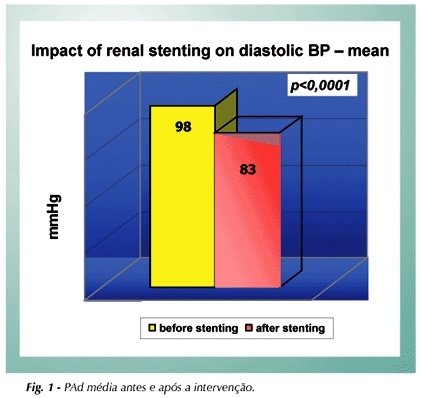
OBJECTIVE: To evaluate the clinical efficacy of percutaneous renal revascularization with stenting to control hypertension and preserve/restore renal function in patients with atherosclerotic renovascular disease. METHODS: From May/1999 to October/2003, 46 patients with atherosclerotic renal artery stenosis (ARAS) underwent revascularization with stenting. The indication for the procedure was hypertension control and/or renal function preservation/restoration. Clinical characteristics: age range: 33-84 years (median = 58.5 ±10.7), males: 26 (56.5%), 4 (10%) patients with dia betes mellitus, 21 (46%) patients with coronary artery disease, creatinine <2.0mg/dl: 39 (64%), 6 patients (14%) with congestive heart failure, 20 (43%) patients with ostial stenosis and 15 (33%) patients with bilateral stenosis. Hypertension control was evaluated by the number of drugs used before the procedure and at follow-up (FU) and by blood pressure (BP) measurement. RESULTS: The minimum follow-up was 7 months (range of 7-52, median: 23, mean: 24.2 ± 15.2). There were no major complications. No patient experience any cardiovascular event. There was only one non-cadiac death (2%) and one technical failure in the treatment(2%). There was no serious complication in the procedure. None of the patients presented cardiovascular events. The renal function improved or stabilized in 32 patients (82%) and worsened in 4 (10%). The BP control improved in 19/44 (43,8%) patients and worsened / stabilized in 6 patients (14%). CONCLUSION: Angioplasty with renal artery stenting for ARAS showed to be an effective treatment strategy to restore and preserve renal function and to control blood pressure.

  • Angioplasty
  • renal artery
  • Renovascular Hypertension
Read Full Article
Creative Commons Attribution (CC BY) Creative Commons license
07/03/2007 DOI: 10.1590/S0066-782X2007000100014
Vascular color Doppler ultrasound for assessing renovascular hypertension: accuracy of the direct technique for assessing the renal arteries
ABC
Artigo Original

Vascular color Doppler ultrasound for assessing renovascular hypertension: accuracy of the direct technique for assessing the renal arteries

Carlos Alberto Engelhorn et al. Ana Luiza Engelhorn Renata Pullig

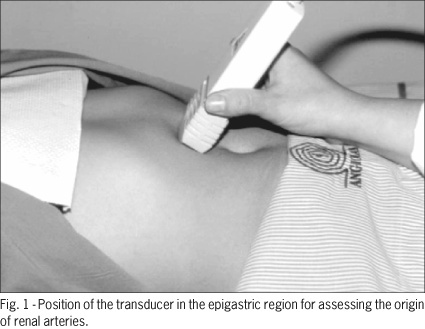
OBJECTIVE: To assess the accuracy of vascular color Doppler ultrasound as compared with digital subtraction arteriography for identifying hemodynamically significant renal artery stenoses. METHODS: One hundred and thirty-seven renal arteries from 69 adult patients suspected of having renovascular arterial hypertension were prospectively studied with ultrasound. The results obtained were compared in a double-blind manner with those obtained on digital subtraction arteriography, and the following parameters were calculated according to previously defined criteria: sensitivity, specificity, positive predictive value, negative predictive value, and overall accuracy. RESULTS: The inconclusive results (7 arteries) were excluded. The comparison of the 2 methods in regard to the 130 remaining arteries showed concordant results for 116 (89.2%) arteries and discordant results for 14 (10.8%) arteries. The sensitivity, specificity, positive predictive value, negative predictive value, and overall accuracy of vascular color Doppler ultrasound were, respectively, 95.33%, 88.14%, 89.86%, 94.55%, and 91.94%. CONCLUSION: A good correlation between the 2 examinations was observed in the evaluation of the hemodynamically significant renal artery stenoses, making vascular color Doppler ultrasound a noninvasive method useful for selecting patients with suspected renovascular hypertension.

  • Hypertension
  • renal artery
  • ultrasound
Read Full Article
Creative Commons Attribution (CC BY) Creative Commons license
08/06/2004 DOI: 10.1590/S0066-782X2004000500010 Views 1

How to cite this article

EndNote RIS

Electronic Document Format (Vancouver)

Rocha NN. Are Wistar Rats the Most Suitable Normotensive Controls for Spontaneously Hypertensive Rats to Assess Blood Pressure and Cardiac Structure and Function?. International Journal of Cardiovascular Sciences 2022;35(2):172-3.

Electronic Document Format (ABNT)

Rocha, Nazareth Novaes. Are Wistar Rats the Most Suitable Normotensive Controls for Spontaneously Hypertensive Rats to Assess Blood Pressure and Cardiac Structure and Function?. International Journal of Cardiovascular Sciences, v. 35, n. 2, p. 172-173, Mar. 2022.

Electronic Document Format (APA)

Rocha, N. N. (2022). Are Wistar Rats the Most Suitable Normotensive Controls for Spontaneously Hypertensive Rats to Assess Blood Pressure and Cardiac Structure and Function?. International Journal of Cardiovascular Sciences, 35(2), 172-173.

Electronic Document Format (ISO)

Rocha, Nazareth Novaes. Are Wistar Rats the Most Suitable Normotensive Controls for Spontaneously Hypertensive Rats to Assess Blood Pressure and Cardiac Structure and Function?. International Journal of Cardiovascular Sciences [online]. 2022, vol. 35, n. 2, [cited 2026-10-14], pp. 172-173. Available from: <https://journals.cardiol.br/en/article/are-wistar-rats-the-most-suitable-normotensive-controls-for-spontaneously-hypertensive-rats-to-assess-blood-pressure-and-cardiac-structure-and-function/>. ISSN 2359-4802

EndNote RIS

Electronic Document Format (Vancouver)

Brandão AA, Campana EMG, Magalhães MEC, Ferreira E. Renal sympathetic denervation for resistant hypertension treatment : current perspectives. Arquivos Brasileiros de Cardiologia 2013;101(4):364-71.

Electronic Document Format (ABNT)

Brandão, Andréa Araujo; Campana, Erika Maria Gonçalves; Magalhães, Maria Eliane Campos; Ferreira, Esmeralci. Renal sympathetic denervation for resistant hypertension treatment : current perspectives. Arquivos Brasileiros de Cardiologia, v. 101, n. 4, p. 364-371, Sep. 2013.

Electronic Document Format (APA)

Brandão, A. A., Campana, E. M. G., Magalhães, M. E. C., & Ferreira, E. (2013). Renal sympathetic denervation for resistant hypertension treatment : current perspectives. Arquivos Brasileiros de Cardiologia, 101(4), 364-371.

Electronic Document Format (ISO)

Brandão, Andréa Araujo and Campana, Erika Maria Gonçalves and Magalhães, Maria Eliane Campos and Ferreira, Esmeralci. Renal sympathetic denervation for resistant hypertension treatment : current perspectives. Arquivos Brasileiros de Cardiologia [online]. 2013, vol. 101, n. 4, [cited 2026-10-14], pp. 364-371. Available from: <https://journals.cardiol.br/en/article/renal-sympathetic-denervation-for-resistant-hypertension-treatment-current-perspectives/>. ISSN 0066-782X

EndNote RIS

Electronic Document Format (Vancouver)

Gonçalves JAA, Amorim JE, Soares Neto MM, Ribeiro AB, Lima VC. Clinical efficacy of percutaneous renal revascularization with stent placement in atherosclerotic renovascular disease. Arquivos Brasileiros de Cardiologia 2007;88(1):85-90.

Electronic Document Format (ABNT)

Gonçalves, Janaína Andréa Altemar; Amorim, Jorge Eduardo; Soares Neto, Milton Macedo; Ribeiro, Artur Beltrame; Lima, Valter Correa. Clinical efficacy of percutaneous renal revascularization with stent placement in atherosclerotic renovascular disease. Arquivos Brasileiros de Cardiologia, v. 88, n. 1, p. 85-90, Mar. 2007.

Electronic Document Format (APA)

Gonçalves, J. A. A., Amorim, J. E., Soares Neto, M. M., Ribeiro, A. B., & Lima, V. C. (2007). Clinical efficacy of percutaneous renal revascularization with stent placement in atherosclerotic renovascular disease. Arquivos Brasileiros de Cardiologia, 88(1), 85-90.

Electronic Document Format (ISO)

Gonçalves, Janaína Andréa Altemar and Amorim, Jorge Eduardo and Soares Neto, Milton Macedo and Ribeiro, Artur Beltrame and Lima, Valter Correa. Clinical efficacy of percutaneous renal revascularization with stent placement in atherosclerotic renovascular disease. Arquivos Brasileiros de Cardiologia [online]. 2007, vol. 88, n. 1, [cited 2026-10-14], pp. 85-90. Available from: <https://journals.cardiol.br/en/article/clinical-efficacy-of-percutaneous-renal-revascularization-with-stent-placement-in-atherosclerotic-renovascular-disease/>. ISSN 0066-782X

EndNote RIS

Electronic Document Format (Vancouver)

Engelhorn CA, Engelhorn AL, Pullig R. Vascular color Doppler ultrasound for assessing renovascular hypertension: accuracy of the direct technique for assessing the renal arteries. Arquivos Brasileiros de Cardiologia 2004;82(5):473-6.

Electronic Document Format (ABNT)

Engelhorn, Carlos Alberto; Engelhorn, Ana Luiza; Pullig, Renata. Vascular color Doppler ultrasound for assessing renovascular hypertension: accuracy of the direct technique for assessing the renal arteries. Arquivos Brasileiros de Cardiologia, v. 82, n. 5, p. 473-476, Jun. 2004.

Electronic Document Format (APA)

Engelhorn, C. A., Engelhorn, A. L., & Pullig, R. (2004). Vascular color Doppler ultrasound for assessing renovascular hypertension: accuracy of the direct technique for assessing the renal arteries. Arquivos Brasileiros de Cardiologia, 82(5), 473-476.

Electronic Document Format (ISO)

Engelhorn, Carlos Alberto and Engelhorn, Ana Luiza and Pullig, Renata. Vascular color Doppler ultrasound for assessing renovascular hypertension: accuracy of the direct technique for assessing the renal arteries. Arquivos Brasileiros de Cardiologia [online]. 2004, vol. 82, n. 5, [cited 2026-10-14], pp. 473-476. Available from: <https://journals.cardiol.br/en/article/vascular-color-doppler-ultrasound-for-assessing-renovascular-hypertension-accuracy-of-the-direct-technique-for-assessing-the-renal-arteries/>. ISSN 0066-782X

  • About ABC Family
  • Internal Regulation
  • Editorial Board
  • Brazilian Society of Cardiology (SBC)

Issues

SBC Guidelines

  • Videos
  • Podcasts
  • News