Marcos Danillo Oliveira et al. Ricardo Fonseca Oliveira Suruagy-Motta Leonardo Dexheimer da Silva Karlos Daniell Araújo dos Santos Adriano Caixeta
Abstract
Background
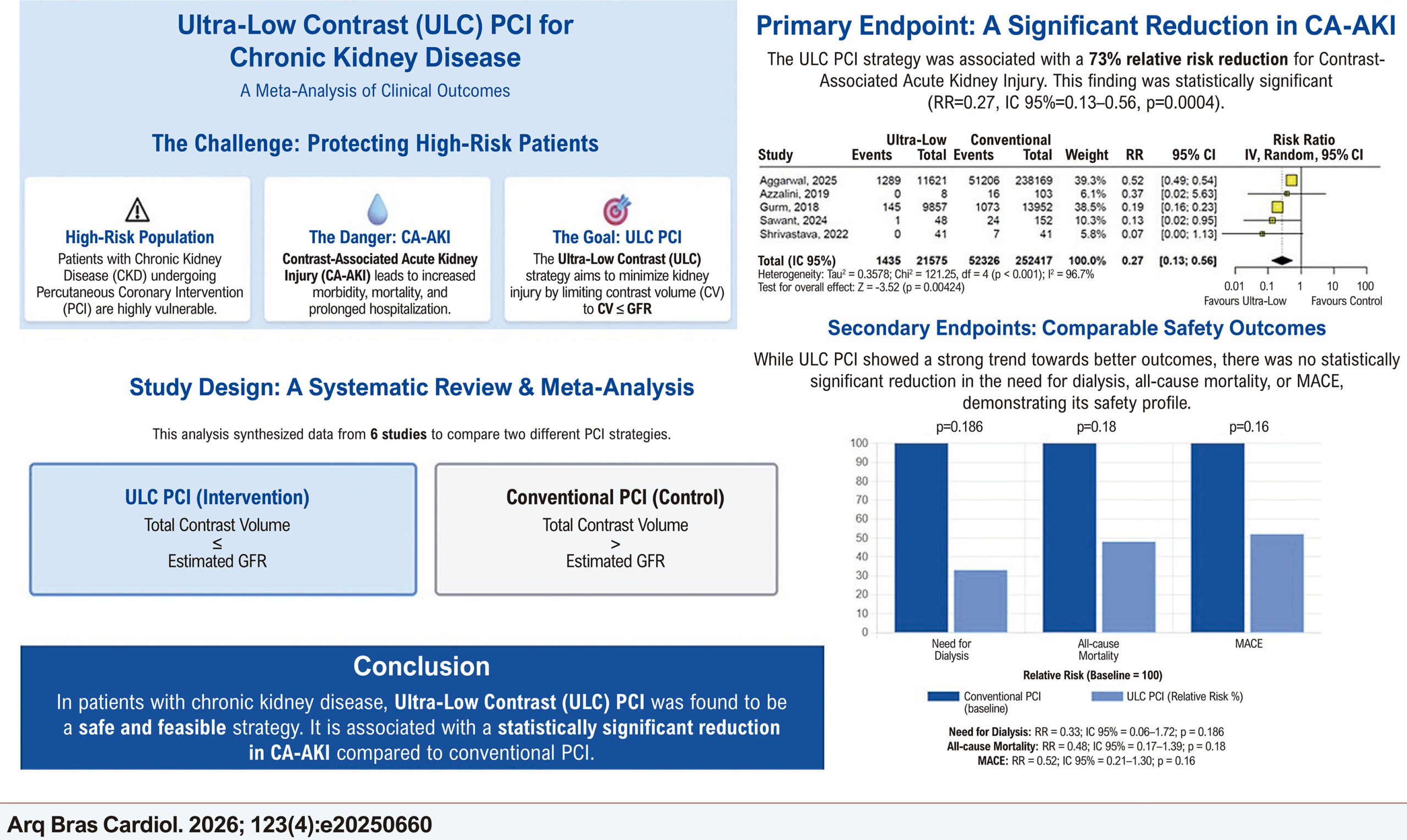
Contrast-associated acute kidney injury (CA-AKI) results in increased morbidity and mortality, prolonged hospitalization, and worse clinical outcomes. Prior studies have shown that limiting contrast volume (CV) to less than 3 times the estimated glomerular filtration rate (eGFR) implies a lower risk of CA-AKI, and both efficacy and superior outcomes are associated with ultra-low contrast (ULC) volume coronary procedures (total CV ≤ eGFR).
Objectives
This systematic review and meta-analysis aimed to compare clinical outcomes of ULC versus conventional percutaneous coronary intervention (PCI) in patients with chronic kidney disease.
Methods
The search was conducted in the databases PubMed/MEDLINE, Cochrane, Embase, Scopus, and Web of Science, including all studies reporting clinical outcomes of ULC PCI. The primary efficacy endpoint was the incidence of CA-AKI, and secondary endpoints were need for dialysis, all-cause mortality, and major adverse cardiovascular events (MACE), defined as the composite endpoint of all-cause mortality, non-fatal myocardial infarction, and clinically driven target lesion revascularization.
Results
Six studies met the inclusion criteria and were included in the final analysis, encompassing a total of 274,102 patients. ULC PCI was associated with a statistically significant reduction of CA-AKI (risk ratio=0.27; 95% CI=0.13–0.56; p=0.0004). In turn, ULC PCI did not result in statistically significant reduction of need for dialysis (risk ratio=0.33; 95% CI=0.06–1.72; p=0.186), all-cause mortality (risk ratio=0.48; 95% CI=0.17–1.39; p=0.18), and MACE (risk ratio=0.52; 95% CI= 0.21–1.30; p=0.16).
Conclusions
ULC, as compared to conventional PCI, in patients with chronic kidney disease, was found to be safe, feasible, and associated with a statistically significant reduction of CA-AKI. Further, larger, well-powered, randomized, and controlled trials are warranted in order to reassure these findings.