ABC Family Arquivos Brasileiros de Cardiologia International Journal of Cardiovascular Sciences ABC Heart Failure & Cardiomyopathy ABC Imagem Cardiovascular
Português English
ABC Family
Português English
  • About
    • About ABC Family
    • Internal Regulation
    • Editorial Board
    • Brazilian Society of Cardiology (SBC)
  • Issues
  • SBC Guidelines
  • Content
    • Videos
    • Podcasts
    • News
  • About
    • About ABC Family
    • Internal Regulation
    • Editorial Board
    • Brazilian Society of Cardiology (SBC)
  • Issues
  • SBC Guidelines
  • Content
    • Videos
    • Podcasts
    • News

ABC Family

  • ABC Family
  • Arquivos Brasileiros de Cardiologia
  • International Journal of Cardiovascular Sciences
  • ABC Heart Failure & Cardiomyopathy
  • ABC Imagem Cardiovascular
Search in

No content found.

Journals
Ordering
Article types
Others

  1. Home
  2. Keyword: Cerebrovascular Disease
Figure 1
IJCS
Original Article

The Influence of Primary Atherosclerotic Diseases on the Occurrence of Secondary Disease

Paula Monique Chiconi de Picoli et al. Creusa Sayuri Tahara Amaral Eliane Trovatti

Abstract

Background

Atherosclerosis is a condition in which fats, cholesterol, fibrin, and other substances accumulate into plaque on the arterial walls. Plaque can harden and narrow the arteries, in turn limiting the blood flow and resulting in diseases, such as acute myocardial infarction (AMI), ischemic stroke (IS), or peripheral arterial disease (PAD). There is a fairly high risk of a secondary atherosclerotic event if patients are not treated after the primary episode.

Objective

To calculate the statistical probability of developing AMI, IS, or PAD after treating the primary disease.

Methods

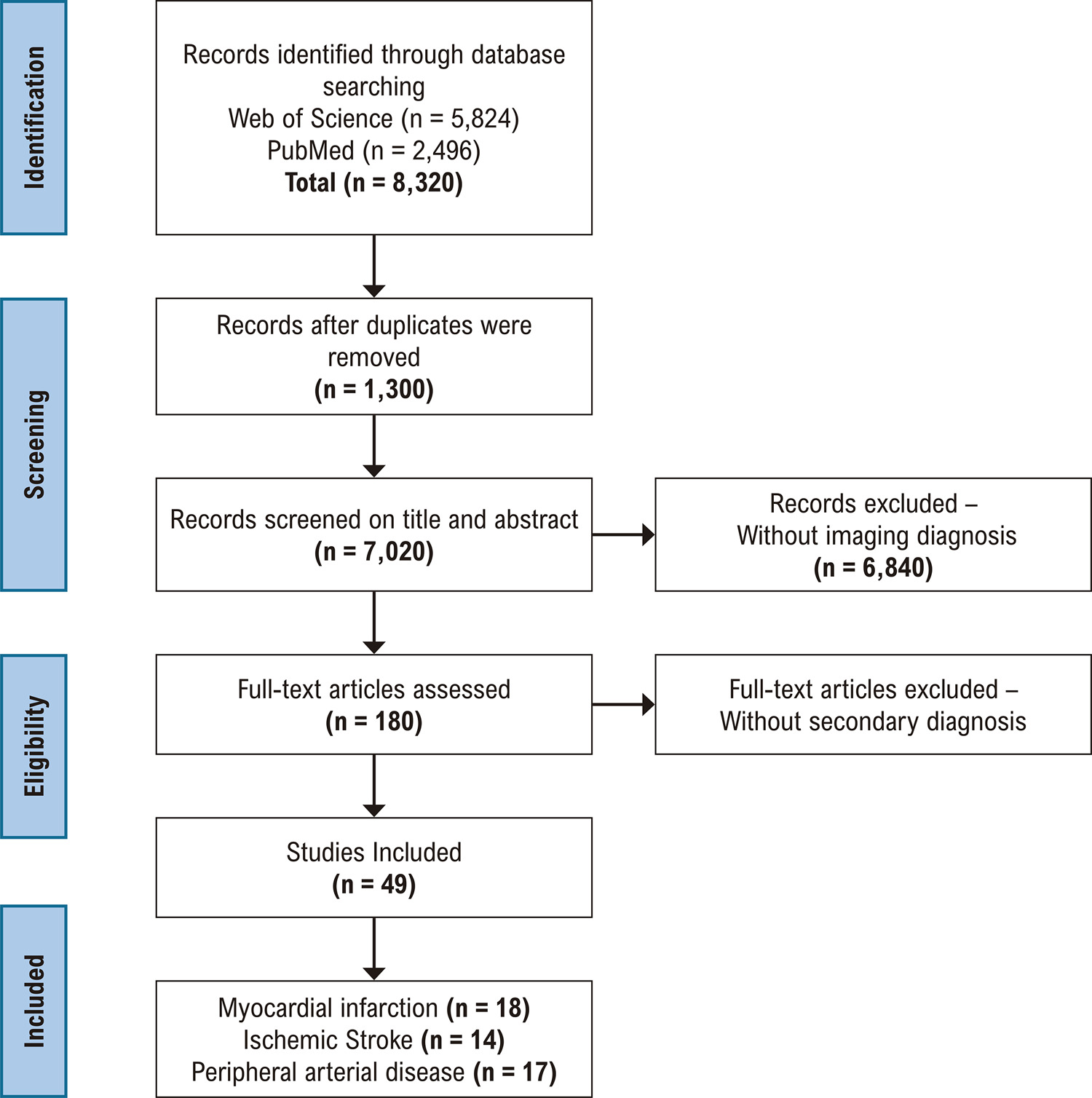
Data for statistical probability studies included 507,690 patients with primary atherosclerotic disease, who were in treatment during the study period and who did or did not develop a secondary atherosclerotic disease event.

Result

Statistical probability data indicate that few AMI patients can develop IS (2.99%) or PAD (2.86%) as a secondary disease. Patients with primary diagnoses of IS showed a 5.07% risk of developing PAD and a 0.95% risk of developing AMI; however, PAD patients showed a higher probability for both AMI (9.17%) and IS (8.79%).

Conclusion

Secondary atherosclerotic disease episodes after IS, AMI, and PAD were confirmed by statistical probability and are consistent with data from the literature. The study revealed that a primary PAD event leads to high rates of secondary episodes, and special attention should be given to the diagnosis and treatment of PAD in order to decrease the occurrence of secondary events.

  • aging
  • Amputation
  • Cerebrovascular Disease
  • Diabetes Mellitus
  • Lower Extremity
  • Myocardial Ischemia
  • Peripheral Arterial Disease
Read Full Article
Creative Commons Attribution (CC BY) Creative Commons license
01/08/2022 DOI: 10.36660/ijcs.20210251 Views 3
Figure 1
ABCIC
Case Report

Cerebrovascular Disease as the Initial Manifestation of Apical Hypertrophic Cardiomyopathy

Ana Lilia Rayas-Gómez et al. José Manuel González-Rayas Alejandro Rico-Rosas Pedro Daniel Landa-Alvarado … Ileana Maribel Ponce de León-Vargas José María Ramos-Verdugo José Manuel González-Yáñez

Introduction

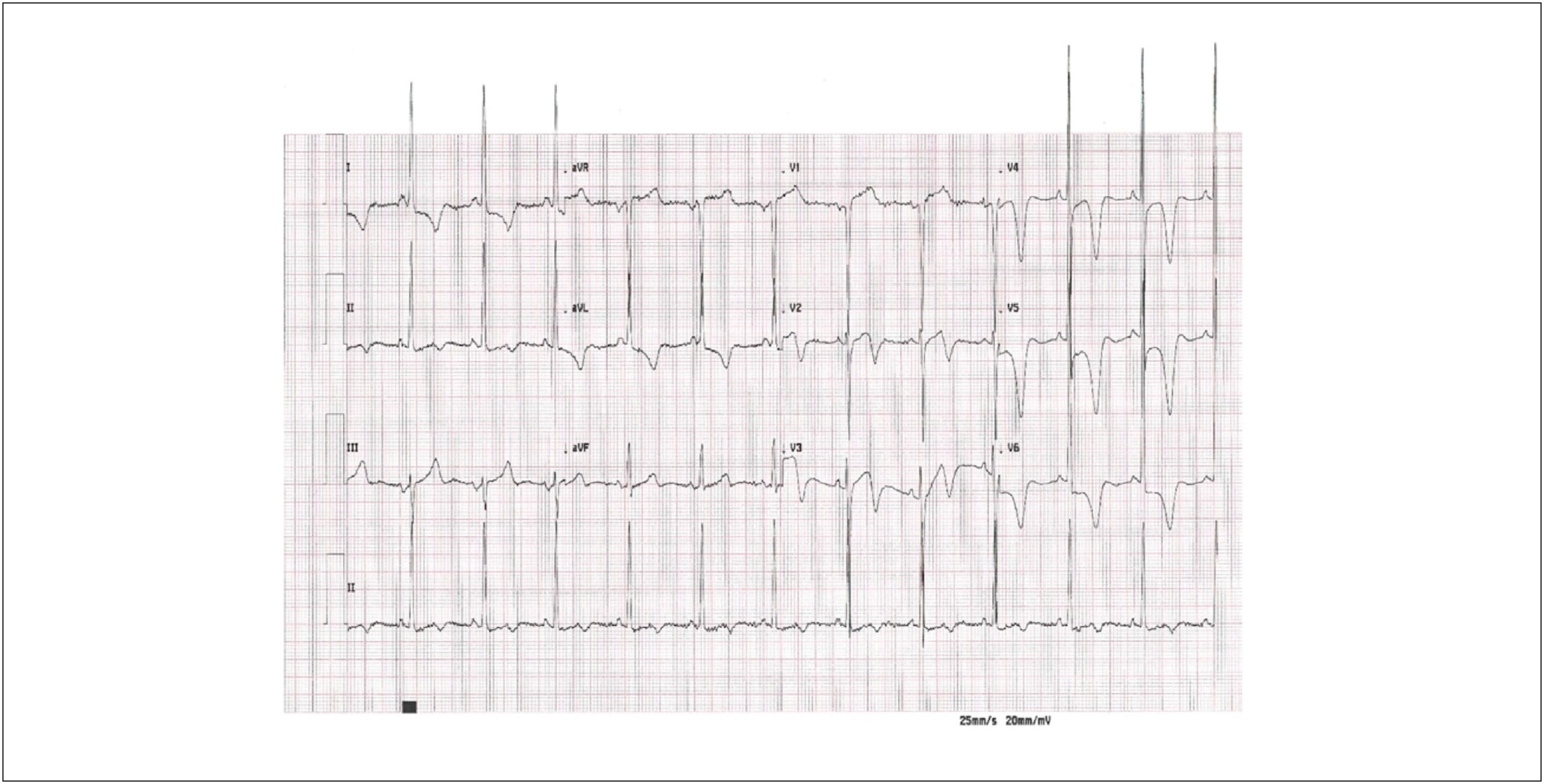
Apical hypertrophic cardiomyopathy (AHCM) is a condition that primarily involves the apex of the left ventricle. Two of its main characteristics are a non-obstructive physiology and apical hypertrophy of the left ventricle with giant negative T waves. AHCM is uncommon, and its prevalence is notably affected by ethnicity. The diagnosis is challenging to make and requires multimodal imaging techniques., Here we describe two cases of AHCM with cerebrovascular disease as the presenting condition: Patient 1 had atrial fibrillation (AF), while Patient 2 showed evidence of aortic plaques as the possible embolic source. Nonetheless, Patient 2 also presented an akinetic apex. Hence, it was impossible to rule out the previous migration of an apical thrombus as the cause of the ischemic stroke. The main clinical lesson learned from our cases is that stroke in patients with AHCM is a multifactorial complication potentially caused by AF, aortic plaques, and intracavitary thrombus. Therefore, although AHCM is uncommon, it should be considered when determining the cause of cerebrovascular embolic events.

[…]

  • Cerebrovascular Disease
  • Echocardiography
  • Embolism
  • Hypertrophic Cardiomyopathy
Read Full Article
Creative Commons Attribution (CC BY) Creative Commons license
16/06/2021 DOI: 10.47593/2675-312X/20213401eabc144 Views 1
ABC
Artigo Original

Prevalence of cardiovascular risk factors in a population of Brazilian industry workers

Roberta Soares Lara Cassani et al. Fernando Nobre Antônio Pazin Filho André Schmidt

BACKGROUND: Determining the cardiovascular risk factors is essential for the primary and secondary prevention of circulatory system diseases. OBJECTIVE: To obtain the prevalence of cardiovascular risk factors in a population of industry workers in Brazil. METHODS: Transversal cohort study, with a sociodemographic interview to identify cardiovascular risk factors, anthropometric and blood pressure measurements and capillary blood collection for blood glucose, cholesterol and triglyceride measurement in food industry workers of both sexes. RESULTS: A total of 1,047 workers were assessed, with 913 (87%) of them being males, with a mean age of 36 ± 8 years. The frequency of a sedentary lifestyle was 83% and of overweight, 63%. Systemic arterial hypertension was identified in 28% of the individuals and 45% were in the pre-hypertension range. Alterations in the blood glucose levels were identified in 49% of the participants, as well as high levels of cholesterol and triglycerides in 7% and 11% of the population, respectively. The body mass index (BMI) levels were not associated to income, but there was an inverse association with the level of schooling. CONCLUSION: Overweight and a sedentary lifestyle are the main cardiovascular risk factors in a population of industry workers.

  • Atherosclerosis
  • Brazil
  • Cerebrovascular Disease
  • Coronary Disease
  • Epidemiology
  • Risk Factors
Read Full Article
Creative Commons Attribution (CC BY) Creative Commons license
04/02/2009 DOI: 10.1590/S0066-782X2009000100004 Views 1
Economic burden of severe cardiovascular diseases in Brazil: an estimate based on secondary data
ABC
Artigo Original

Economic burden of severe cardiovascular diseases in Brazil: an estimate based on secondary data

Maria Inês Reinert Azambuja et al. Murilo Foppa Mário Fernando de Camargo Maranhão Aloyzio Cechella Achutti

BACKGROUND: The scarce amount of data available in Brazil on the economic burden of cardiovascular diseases (CVD) does not justify the growing concern in regard to the economic burden involved. OBJECTIVE: The present study aims at estimating the costs of severe CVD cases in Brazil. METHODS: Cases of severe CVD were estimated based on hospitalized cases lethality and total CVD mortality rates. National data bases and sample studies were used to estimate costs of hospitalization, outpatient care, and social security benefits. Loss of income was estimated from the Burden of Disease in Brazil data. RESULTS: Approximately two million cases of severe CVD were reported in 2004 in Brazil. That accounts for 5.2% of the population over 35 years of age. The resulting annual cost was at least R$ 30.8 billion (36.4% for health care, 8.4% for social security and employers’ reimbursements, and 55.2% due to loss in productivity). That corresponded to R$ 500.00 per capita (considering 35 year-old and older population) and R$ 9,400.00 per patient. Direct costs with health care from severe CVD cases accounted for 8% of total national expenditure on health and 0.52% of 2004 GNP (R$ 1,767 billion = US$ 602 billion). That corresponded to an yearly average direct cost of R$182.00 per capita (R$ 87.00 from public resources) and of R$ 3,514.00 per case. CONCLUSION: Total annual costs per severe CVD case were estimated to be significant. Costs per capita and total costs corresponding to this sub-group of CVD patients are expected to escalate as the population ages and the prevalence of severe cases increases.

  • Cardiovascular Diseases
  • Cerebrovascular Disease
  • health economics
  • ischemic heart disease
Read Full Article
Creative Commons Attribution (CC BY) Creative Commons license
02/10/2008 DOI: 10.1590/S0066-782X2008001500005 Views 1
Trends in death from circulatory diseases in Brazil between 1979 and 1996
ABC
Original Article

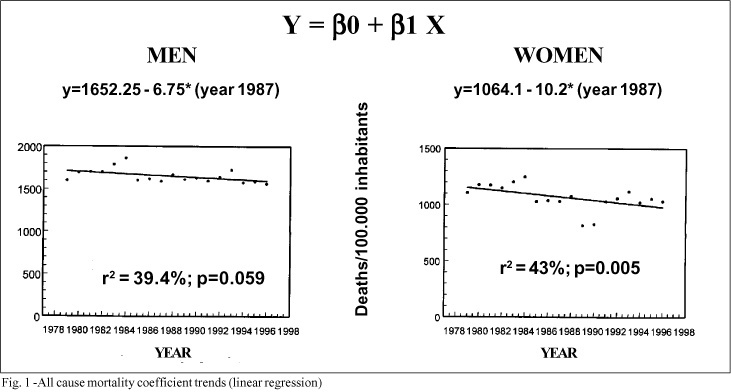
Trends in death from circulatory diseases in Brazil between 1979 and 1996

Antonio de Padua Mansur et al. Desidério Favarato Maria de Fátima Marinho de Souza Solange Desirée Avakian … José Mendes Aldrighi Luiz Antonio Machado César José Antonio Franchini Ramires

OBJECTIVE: To analyze the trends in mortality due to circulatory diseases in men and women aged > or = 30 years in Brazil from 1979 to 1996. METHODS: We analyzed population count data obtained from the IBGE Foundation and mortality data obtained from the System of Information on Mortality of the DATASUS of the Ministry of Health. RESULTS: Circulatory diseases, ischemic heart disease, and cerebrovascular disease were the major causes of death in men and women in Brazil. The standardized age coefficient for circulatory disease in men aged > or = 30 years ranged from 620 to 506 deaths/100,000 inhabitants and in women from 483 to 383 deaths/100,000 inhabitants for the years 1979 and 1996, respectively. In men, the mean coefficient for the period was 586.25 deaths with a significant trend towards a decrease (P<0.001) and a decline of 8.25 deaths/year. In women, the mean coefficient for the period was 439.58 deaths, a significant trend towards a decrease (P<0.001) and a rate of decline of 7.53 deaths/year. The same significant trend towards a decrease in death (P<0.001) was observed for ischemic heart disease and cerebrovascular disease. Risk of death from these causes was always higher for men of any age group (P<0.001). Cerebrovascular disease was the primary cause of death in women. CONCLUSION: Although circulatory diseases have been the major cause of mortality in men and women in the Brazilian population, with a greater participation by cerebrovascular diseases, a trend towards a decrease in the risk of death from these causes is being observed.

  • Cerebrovascular Disease
  • circulatory disease
  • ischemic heart disease
  • Mortality
  • trends
Read Full Article
Creative Commons Attribution (CC BY) Creative Commons license
13/06/2001 DOI: 10.1590/S0066-782X2001000600007

How to cite this article

EndNote RIS

Electronic Document Format (Vancouver)

Picoli PMC, Amaral CST, Trovatti E. The Influence of Primary Atherosclerotic Diseases on the Occurrence of Secondary Disease. International Journal of Cardiovascular Sciences 2022;36:e20210251.

Electronic Document Format (ABNT)

Picoli, Paula Monique Chiconi de; Amaral, Creusa Sayuri Tahara; Trovatti, Eliane. The Influence of Primary Atherosclerotic Diseases on the Occurrence of Secondary Disease. International Journal of Cardiovascular Sciences, v. 36, e20210251, Jul. 2022.

Electronic Document Format (APA)

Picoli, P. M. C. , Amaral, C. S. T., & Trovatti, E. (2022). The Influence of Primary Atherosclerotic Diseases on the Occurrence of Secondary Disease. International Journal of Cardiovascular Sciences, 36, e20210251.

Electronic Document Format (ISO)

Picoli, Paula Monique Chiconi de and Amaral, Creusa Sayuri Tahara and Trovatti, Eliane. The Influence of Primary Atherosclerotic Diseases on the Occurrence of Secondary Disease. International Journal of Cardiovascular Sciences [online]. 2022, vol. 36, [cited 2026-10-14], e20210251. Available from: <https://journals.cardiol.br/en/article/the-influence-of-primary-atherosclerotic-diseases-on-the-occurrence-of-secondary-disease-3/>. ISSN 2359-4802

EndNote RIS

Electronic Document Format (Vancouver)

Rayas-Gómez AL, González-Rayas JM, Rico-Rosas A, Landa-Alvarado PD, León-Vargas IMP, Ramos-Verdugo JM, González-Yáñez JM, et al. Cerebrovascular Disease as the Initial Manifestation of Apical Hypertrophic Cardiomyopathy. ABC Imagem Cardiovascular 2021;34(1):eabc144.

Electronic Document Format (ABNT)

Rayas-Gómez, Ana Lilia; González-Rayas, José Manuel; Rico-Rosas, Alejandro; Landa-Alvarado, Pedro Daniel; León-Vargas, Ileana Maribel Ponce de; Ramos-Verdugo, José María; González-Yáñez, José Manuel. Cerebrovascular Disease as the Initial Manifestation of Apical Hypertrophic Cardiomyopathy. ABC Imagem Cardiovascular, v. 34, n. 1, eabc144, Jun. 2021.

Electronic Document Format (APA)

Rayas-Gómez, A. L., González-Rayas, J. M., Rico-Rosas, A., Landa-Alvarado, P. D., León-Vargas, I. M. P. , Ramos-Verdugo, J. M., & González-Yáñez, J. M. (2021). Cerebrovascular Disease as the Initial Manifestation of Apical Hypertrophic Cardiomyopathy. ABC Imagem Cardiovascular, 34(1), eabc144.

Electronic Document Format (ISO)

Rayas-Gómez, Ana Lilia and González-Rayas, José Manuel and Rico-Rosas, Alejandro and Landa-Alvarado, Pedro Daniel and León-Vargas, Ileana Maribel Ponce de and Ramos-Verdugo, José María and González-Yáñez, José Manuel. Cerebrovascular Disease as the Initial Manifestation of Apical Hypertrophic Cardiomyopathy. ABC Imagem Cardiovascular [online]. 2021, vol. 34, n. 1, [cited 2026-10-14], eabc144. Available from: <https://journals.cardiol.br/en/article/cerebrovascular-disease-as-the-initial-manifestation-of-apical-hypertrophic-cardiomyopathy/>. ISSN 2318-8219

EndNote RIS

Electronic Document Format (Vancouver)

Cassani RSL, Nobre F, Pazin Filho A, Schmidt A. Prevalence of cardiovascular risk factors in a population of Brazilian industry workers. Arquivos Brasileiros de Cardiologia 2009;92(1):16-22.

Electronic Document Format (ABNT)

Cassani, Roberta Soares Lara; Nobre, Fernando; Pazin Filho, Antônio; Schmidt, André. Prevalence of cardiovascular risk factors in a population of Brazilian industry workers. Arquivos Brasileiros de Cardiologia, v. 92, n. 1, p. 16-22, Feb. 2009.

Electronic Document Format (APA)

Cassani, R. S. L., Nobre, F., Pazin Filho, A., & Schmidt, A. (2009). Prevalence of cardiovascular risk factors in a population of Brazilian industry workers. Arquivos Brasileiros de Cardiologia, 92(1), 16-22.

Electronic Document Format (ISO)

Cassani, Roberta Soares Lara and Nobre, Fernando and Pazin Filho, Antônio and Schmidt, André. Prevalence of cardiovascular risk factors in a population of Brazilian industry workers. Arquivos Brasileiros de Cardiologia [online]. 2009, vol. 92, n. 1, [cited 2026-10-14], pp. 16-22. Available from: <https://journals.cardiol.br/en/article/prevalence-of-cardiovascular-risk-factors-in-a-population-of-brazilian-industry-workers/>. ISSN 0066-782X

EndNote RIS

Electronic Document Format (Vancouver)

Azambuja MIR, Foppa M, Maranhão MFC, Achutti AC. Economic burden of severe cardiovascular diseases in Brazil: an estimate based on secondary data. Arquivos Brasileiros de Cardiologia 2008;91(3):163-71.

Electronic Document Format (ABNT)

Azambuja, Maria Inês Reinert; Foppa, Murilo; Maranhão, Mário Fernando de Camargo; Achutti, Aloyzio Cechella. Economic burden of severe cardiovascular diseases in Brazil: an estimate based on secondary data. Arquivos Brasileiros de Cardiologia, v. 91, n. 3, p. 163-171, Oct. 2008.

Electronic Document Format (APA)

Azambuja, M. I. R., Foppa, M., Maranhão, M. F. C., & Achutti, A. C. (2008). Economic burden of severe cardiovascular diseases in Brazil: an estimate based on secondary data. Arquivos Brasileiros de Cardiologia, 91(3), 163-171.

Electronic Document Format (ISO)

Azambuja, Maria Inês Reinert and Foppa, Murilo and Maranhão, Mário Fernando de Camargo and Achutti, Aloyzio Cechella. Economic burden of severe cardiovascular diseases in Brazil: an estimate based on secondary data. Arquivos Brasileiros de Cardiologia [online]. 2008, vol. 91, n. 3, [cited 2026-10-14], pp. 163-171. Available from: <https://journals.cardiol.br/en/article/economic-burden-of-severe-cardiovascular-diseases-in-brazil-an-estimate-based-on-secondary-data/>. ISSN 0066-782X

EndNote RIS

Electronic Document Format (Vancouver)

Mansur AP, Favarato D, Souza MFM, Avakian SD, Aldrighi JM, César LAM, Ramires JAF, et al. Trends in death from circulatory diseases in Brazil between 1979 and 1996. Arquivos Brasileiros de Cardiologia 2001;76(6):504-10.

Electronic Document Format (ABNT)

Mansur, Antonio de Padua; Favarato, Desidério; Souza, Maria de Fátima Marinho de; Avakian, Solange Desirée; Aldrighi, José Mendes; César, Luiz Antonio Machado; Ramires, José Antonio Franchini. Trends in death from circulatory diseases in Brazil between 1979 and 1996. Arquivos Brasileiros de Cardiologia, v. 76, n. 6, p. 504-510, Jun. 2001.

Electronic Document Format (APA)

Mansur, A. P., Favarato, D., Souza, M. F. M. , Avakian, S. D., Aldrighi, J. M., César, L. A. M., & Ramires, J. A. F. (2001). Trends in death from circulatory diseases in Brazil between 1979 and 1996. Arquivos Brasileiros de Cardiologia, 76(6), 504-510.

Electronic Document Format (ISO)

Mansur, Antonio de Padua and Favarato, Desidério and Souza, Maria de Fátima Marinho de and Avakian, Solange Desirée and Aldrighi, José Mendes and César, Luiz Antonio Machado and Ramires, José Antonio Franchini. Trends in death from circulatory diseases in Brazil between 1979 and 1996. Arquivos Brasileiros de Cardiologia [online]. 2001, vol. 76, n. 6, [cited 2026-10-14], pp. 504-510. Available from: <https://journals.cardiol.br/en/article/trends-in-death-from-circulatory-diseases-in-brazil-between-1979-and-1996/>. ISSN 0066-782X

  • About ABC Family
  • Internal Regulation
  • Editorial Board
  • Brazilian Society of Cardiology (SBC)

Issues

SBC Guidelines

  • Videos
  • Podcasts
  • News