ABC Family Arquivos Brasileiros de Cardiologia International Journal of Cardiovascular Sciences ABC Heart Failure & Cardiomyopathy ABC Imagem Cardiovascular
Português English
ABC Family
Português English
  • About
    • About ABC Family
    • Internal Regulation
    • Editorial Board
    • Brazilian Society of Cardiology (SBC)
  • Issues
  • SBC Guidelines
  • Content
    • Videos
    • Podcasts
    • News
  • About
    • About ABC Family
    • Internal Regulation
    • Editorial Board
    • Brazilian Society of Cardiology (SBC)
  • Issues
  • SBC Guidelines
  • Content
    • Videos
    • Podcasts
    • News

ABC Family

  • ABC Family
  • Arquivos Brasileiros de Cardiologia
  • International Journal of Cardiovascular Sciences
  • ABC Heart Failure & Cardiomyopathy
  • ABC Imagem Cardiovascular
Search in

No content found.

Journals
Ordering
Article types
Others

  1. Home
  2. Keyword: Rats Wistar
Figure 1
ABC
Original Article

Whole-Body Vibration Training Increases Myocardial Salvage Against Acute Ischemia in Adult Male Rats

Shahnaz Shekarforoush et al. Mohammad Reza Naghii

Abstract

Background:

Whole body vibration training (WBV) is a new training program, which is safe and effective. It can be followed by the public. However, data on the safety and efficacy of vibration on myocardial ischemia reperfusion (IR) injury are lacking.

Objective:

To examine the effect of WBV on the tolerance of the myocardium to acute IR injury in an experimental rat model.

Methods:

Twenty-four male Wistar rats were divided into control and vibration groups. Vibration training consisted of vertical sinusoidal whole body vibration for 30 min per day, 6 days per week, for 1 or 3 weeks (WBV1 and WBV3 groups, respectively). All the rats were submitted to myocardial IR injury. Myocardial infarct size and ischemia-induced arrhythmias were assessed. Differences between variables were considered significant when p < 0.05.

Results:

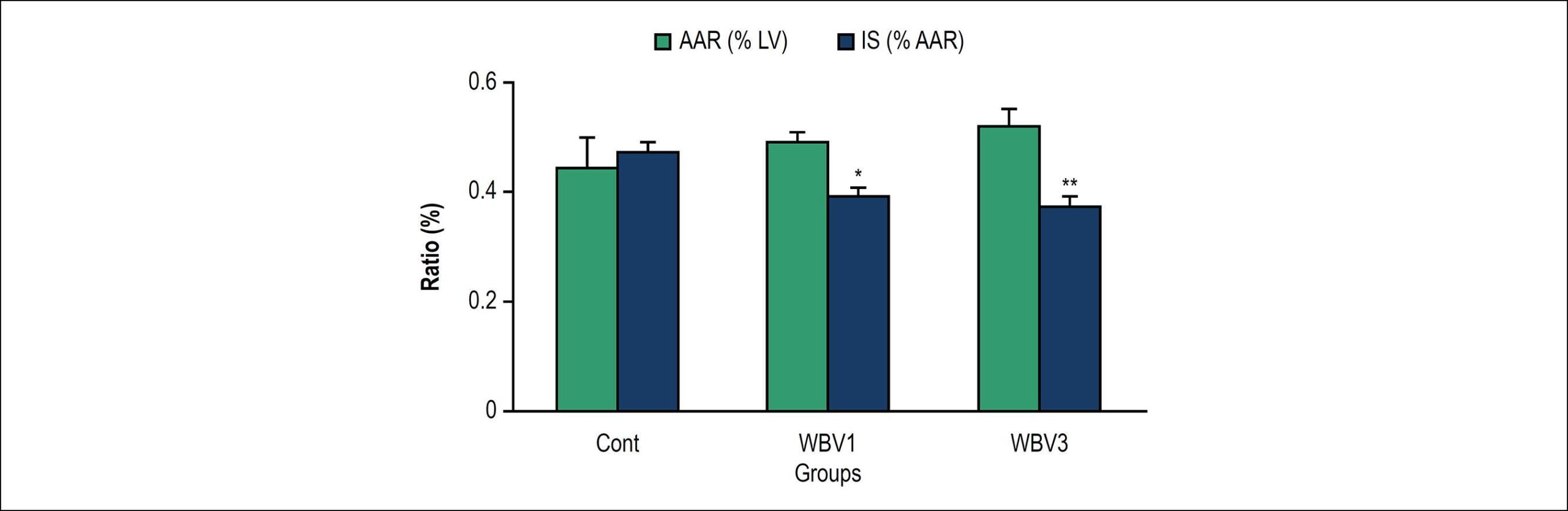
No differences were observed between the groups regarding the baseline hemodynamic parameters. Infarct size was smaller in the experimental group (control, 47 ± 2%; WBV1, 39 ± 2%; WBV3, 37 ± 2%; p < 0.05, vs. control). Vibration produced a significant decrease in the number and duration of ventricular tachycardia (VT) episodes compared to the control value. All ventricular fibrillation (VF) episodes in the vibration groups were self-limited, while 33% of the rats in the control group died due to irreversible VF (p = 0.02).

Conclusion:

The data showed that vibration training significantly increased cardiac tolerance to IR injury in rats, as evidenced by reduction in the infarct size and cardiac arrhythmias, and by facilitating spontaneous defibrillation.
  • Blood Viscosity
  • Body Composition
  • Cardiovascular Diseases
  • Ischemia
  • Ischemic Preconditioning
  • Osteoporosis/prevention and control
  • Rats Wistar
  • Vibration
Read Full Article
Creative Commons Attribution (CC BY) Creative Commons license
17/12/2018 DOI: 10.5935/abc.20180252 Views 1
IJCS
Original Article

Comparison betweent the Effects of Swimming and Treadmill-Based Aerobic Training Protocols in Diabetic Rats

Elizabeth de Orleans Carvalho de Moura et al. Kelvin Tanaka Moisés Felipe Pereira Gomes Evandro Nogueira … Ricardo Gomes Debora Estadella Katt Mattos Patrícia Chakur Brum Alessandra Medeiros

Abstract

Background:

Type 1 diabetes mellitus (DM1) can cause damage to several physiological systems.

Objectives:

To compare and characterize the effects of aerobic exercise training (ET) performed by swimming with those of ET performed on a treadmill on the skeletal muscle and heart of rats with DM1.

Methods:

41 male Wistar rats were randomized into four groups: nondiabetic control (CTR), diabetic control (DMC), diabetic trained on the treadmill (DMT), and diabetic trained by swimming (DMS). The trained groups performed aerobic exercise training for 8 weeks, 5 times a week, 60 min per day. Exercise tolerance, blood glucose, body weight, wet weight of the skeletal muscles and left ventricle (LV), muscle glycogen, cross-sectional area of skeletal muscles, and cross-sectional diameter and collagen volume fraction of the LV were evaluated.

Results:

The results were expressed as mean ± standard deviation of the mean and submitted to two-way ANOVA with post-hoc Bonferroni test. Aerobic ET protocols applied to animals with DM1, regardless of the ergometer, showed satisfactory results (p < 0.05) when compared to the control groups: improved exercise tolerance, increased glycogen content of the soleus and extensor digitorum longus (EDL) muscles and increased cross-sectional diameter of the left ventricular cardiomyocytes. In some variables, such as exercise tolerance and cross-sectional area of the soleus and EDL muscles, DMT showed better results than DMS (p < 0.05). On the other hand, DMS showed increased cross-sectional diameter of cardiomyocytes when compared with the DMT group.

Conclusion:

Both aerobic ET protocols offered benefits to animals with diabetes; however, due to the specific characteristics of each modality, different physiological adaptations were observed between the trained groups.

  • Diabetes Mellitus
  • Exercise
  • Exercise Test
  • muscle, skeletal
  • Physical Exertion
  • Rats Wistar
Read Full Article
Creative Commons Attribution (CC BY) Creative Commons license
23/08/2018 DOI: 10.5935/2359-4802.20180058 Views 2
Figure 1
ABC
Original Article

Resveratrol Treatment Normalizes the Endothelial Function and Blood Pressure in Ovariectomized Rats

Victor Fabricio et al. Jorge Camargo Oishi Bruna Gabriele Biffe Leandro Dias Gonçalves Ruffoni … Karina Ana da Silva Keico Okino Nonaka Gerson Jhonatan Rodrigues

Abstract

Background:

Despite knowing that resveratrol has effects on blood vessels, blood pressure and that phytostrogens can also improve the endothelium-dependent relaxation/vasodilation, there are no reports of reveratrol’s direct effect on the endothelial function and blood pressure of animals with estrogen deficit (mimicking post-menopausal increased blood pressure).

Objective:

To verify the effect of two different periods of preventive treatment with resveratrol on blood pressure and endothelial function in ovariectomized young adult rats.

Methods:

3-month old female Wistar rats were used and distributed in 6 groups: intact groups with 60 or 90 days, ovariectomized groups with 60 or 90 days, and ovariectomized treated with resveratrol (10 mg/kg of body weight per day) for 60 or 90 days. The number of days in each group corresponds to the duration of the experimental period. Vascular reactivity study was performed in abdominal aortic rings, systolic blood pressure was measured and serum nitric oxide (NO) concentration was quantified.

Results:

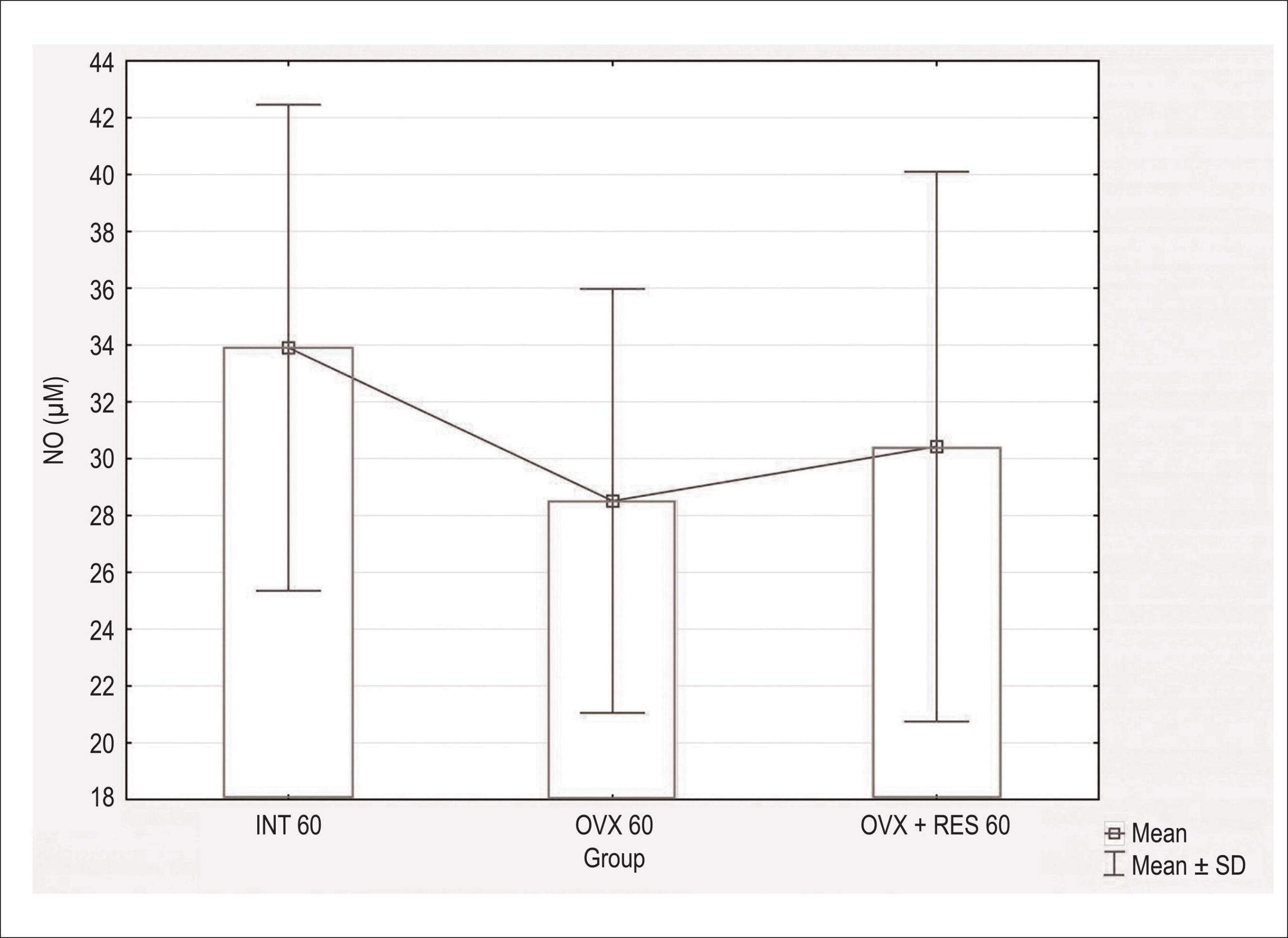
Ovariectomy induced blood pressure increase 60 and 90 days after surgery, whereas the endothelial function decreased only 90 days after surgery, with no difference in NO concentration among the groups. Only longer treatment (90 days) with resveratrol was able to improve the endothelial function and normalize blood pressure.

Conclusion:

Our results suggest that 90 days of treatment with resveratrol is able to improve the endothelial function and decrease blood pressure in ovariectomized rats.

  • Blood Pressure
  • Endothelium, Vascular
  • Ovariectomy
  • Phytoestrogens
  • Rats Wistar
  • Resveratrol
Read Full Article
Creative Commons Attribution (CC BY) Creative Commons license
01/02/2017 DOI: 10.5935/abc.20170012 Views 1

How to cite this article

EndNote RIS

Electronic Document Format (Vancouver)

Shekarforoush S, Naghii MR. Whole-Body Vibration Training Increases Myocardial Salvage Against Acute Ischemia in Adult Male Rats. Arquivos Brasileiros de Cardiologia 2018;112(1):32-7.

Electronic Document Format (ABNT)

Shekarforoush, Shahnaz; Naghii, Mohammad Reza. Whole-Body Vibration Training Increases Myocardial Salvage Against Acute Ischemia in Adult Male Rats. Arquivos Brasileiros de Cardiologia, v. 112, n. 1, p. 32-37, Dec. 2018.

Electronic Document Format (APA)

Shekarforoush, S., & Naghii, M. R. (2018). Whole-Body Vibration Training Increases Myocardial Salvage Against Acute Ischemia in Adult Male Rats. Arquivos Brasileiros de Cardiologia, 112(1), 32-37.

Electronic Document Format (ISO)

Shekarforoush, Shahnaz and Naghii, Mohammad Reza. Whole-Body Vibration Training Increases Myocardial Salvage Against Acute Ischemia in Adult Male Rats. Arquivos Brasileiros de Cardiologia [online]. 2018, vol. 112, n. 1, [cited 2026-10-14], pp. 32-37. Available from: <https://journals.cardiol.br/en/article/whole-body-vibration-training-increases-myocardial-salvage-against-acute-ischemia-in-adult-male-rats/>. ISSN 0066-782X

EndNote RIS

Electronic Document Format (Vancouver)

Moura EOC, Tanaka K, Gomes MFP, Nogueira E, Gomes R, Estadella D, Mattos K, et al. Comparison betweent the Effects of Swimming and Treadmill-Based Aerobic Training Protocols in Diabetic Rats. International Journal of Cardiovascular Sciences 2018;31(6):610-8.

Electronic Document Format (ABNT)

Moura, Elizabeth de Orleans Carvalho de; Tanaka, Kelvin; Gomes, Moisés Felipe Pereira; Nogueira, Evandro; Gomes, Ricardo; Estadella, Debora; Mattos, Katt; Brum, Patrícia Chakur; Medeiros, Alessandra. Comparison betweent the Effects of Swimming and Treadmill-Based Aerobic Training Protocols in Diabetic Rats. International Journal of Cardiovascular Sciences, v. 31, n. 6, p. 610-618, Aug. 2018.

Electronic Document Format (APA)

Moura, E. O. C. , Tanaka, K., Gomes, M. F. P., Nogueira, E., Gomes, R., Estadella, D., Mattos, K., Brum, P. C., & Medeiros, A. (2018). Comparison betweent the Effects of Swimming and Treadmill-Based Aerobic Training Protocols in Diabetic Rats. International Journal of Cardiovascular Sciences, 31(6), 610-618.

Electronic Document Format (ISO)

Moura, Elizabeth de Orleans Carvalho de and Tanaka, Kelvin and Gomes, Moisés Felipe Pereira and Nogueira, Evandro and Gomes, Ricardo and Estadella, Debora and Mattos, Katt and Brum, Patrícia Chakur and Medeiros, Alessandra. Comparison betweent the Effects of Swimming and Treadmill-Based Aerobic Training Protocols in Diabetic Rats. International Journal of Cardiovascular Sciences [online]. 2018, vol. 31, n. 6, [cited 2026-10-14], pp. 610-618. Available from: <https://journals.cardiol.br/en/article/comparison-betweent-the-effects-of-swimming-and-treadmill-based-aerobic-training-protocols-in-diabetic-rats/>. ISSN 2359-4802

EndNote RIS

Electronic Document Format (Vancouver)

Fabricio V, Oishi JC, Biffe BG, Ruffoni LDG, Silva KA, Nonaka KO, Rodrigues GJ, et al. Resveratrol Treatment Normalizes the Endothelial Function and Blood Pressure in Ovariectomized Rats. Arquivos Brasileiros de Cardiologia 2017;108(2):116-21.

Electronic Document Format (ABNT)

Fabricio, Victor; Oishi, Jorge Camargo; Biffe, Bruna Gabriele; Ruffoni, Leandro Dias Gonçalves; Silva, Karina Ana da; Nonaka, Keico Okino; Rodrigues, Gerson Jhonatan. Resveratrol Treatment Normalizes the Endothelial Function and Blood Pressure in Ovariectomized Rats. Arquivos Brasileiros de Cardiologia, v. 108, n. 2, p. 116-121, Jan. 2017.

Electronic Document Format (APA)

Fabricio, V., Oishi, J. C., Biffe, B. G., Ruffoni, L. D. G., Silva, K. A. , Nonaka, K. O., & Rodrigues, G. J. (2017). Resveratrol Treatment Normalizes the Endothelial Function and Blood Pressure in Ovariectomized Rats. Arquivos Brasileiros de Cardiologia, 108(2), 116-121.

Electronic Document Format (ISO)

Fabricio, Victor and Oishi, Jorge Camargo and Biffe, Bruna Gabriele and Ruffoni, Leandro Dias Gonçalves and Silva, Karina Ana da and Nonaka, Keico Okino and Rodrigues, Gerson Jhonatan. Resveratrol Treatment Normalizes the Endothelial Function and Blood Pressure in Ovariectomized Rats. Arquivos Brasileiros de Cardiologia [online]. 2017, vol. 108, n. 2, [cited 2026-10-14], pp. 116-121. Available from: <https://journals.cardiol.br/en/article/resveratrol-treatment-normalizes-the-endothelial-function-and-blood-pressure-in-ovariectomized-rats/>. ISSN 0066-782X

  • About ABC Family
  • Internal Regulation
  • Editorial Board
  • Brazilian Society of Cardiology (SBC)

Issues

SBC Guidelines

  • Videos
  • Podcasts
  • News