ABC Family Arquivos Brasileiros de Cardiologia International Journal of Cardiovascular Sciences ABC Heart Failure & Cardiomyopathy ABC Imagem Cardiovascular
Português English
ABC Family
Português English
  • About
    • About ABC Family
    • Internal Regulation
    • Editorial Board
    • Brazilian Society of Cardiology (SBC)
  • Issues
  • SBC Guidelines
  • Content
    • Videos
    • Podcasts
    • News
  • About
    • About ABC Family
    • Internal Regulation
    • Editorial Board
    • Brazilian Society of Cardiology (SBC)
  • Issues
  • SBC Guidelines
  • Content
    • Videos
    • Podcasts
    • News

ABC Family

  • ABC Family
  • Arquivos Brasileiros de Cardiologia
  • International Journal of Cardiovascular Sciences
  • ABC Heart Failure & Cardiomyopathy
  • ABC Imagem Cardiovascular
Search in

No content found.

Journals
Ordering
Article types
Others

  1. Home
  2. Keyword: Ischemic Preconditioning
Figure 1
ABC
Original Article

Whole-Body Vibration Training Increases Myocardial Salvage Against Acute Ischemia in Adult Male Rats

Shahnaz Shekarforoush et al. Mohammad Reza Naghii

Abstract

Background:

Whole body vibration training (WBV) is a new training program, which is safe and effective. It can be followed by the public. However, data on the safety and efficacy of vibration on myocardial ischemia reperfusion (IR) injury are lacking.

Objective:

To examine the effect of WBV on the tolerance of the myocardium to acute IR injury in an experimental rat model.

Methods:

Twenty-four male Wistar rats were divided into control and vibration groups. Vibration training consisted of vertical sinusoidal whole body vibration for 30 min per day, 6 days per week, for 1 or 3 weeks (WBV1 and WBV3 groups, respectively). All the rats were submitted to myocardial IR injury. Myocardial infarct size and ischemia-induced arrhythmias were assessed. Differences between variables were considered significant when p < 0.05.

Results:

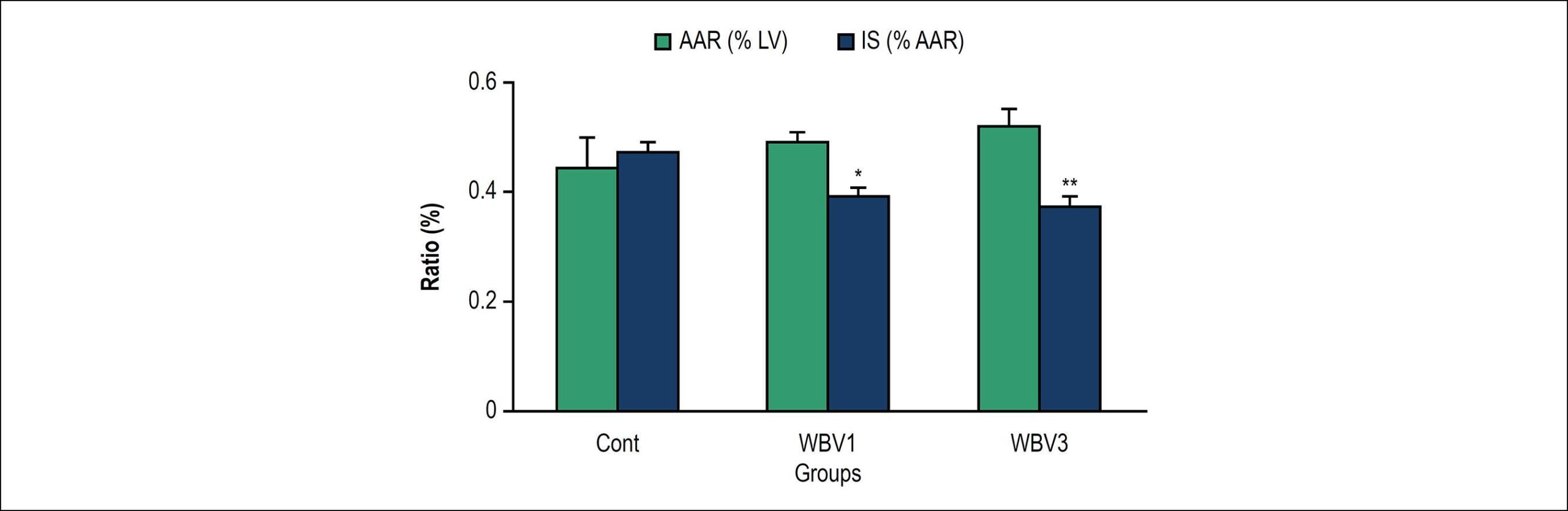
No differences were observed between the groups regarding the baseline hemodynamic parameters. Infarct size was smaller in the experimental group (control, 47 ± 2%; WBV1, 39 ± 2%; WBV3, 37 ± 2%; p < 0.05, vs. control). Vibration produced a significant decrease in the number and duration of ventricular tachycardia (VT) episodes compared to the control value. All ventricular fibrillation (VF) episodes in the vibration groups were self-limited, while 33% of the rats in the control group died due to irreversible VF (p = 0.02).

Conclusion:

The data showed that vibration training significantly increased cardiac tolerance to IR injury in rats, as evidenced by reduction in the infarct size and cardiac arrhythmias, and by facilitating spontaneous defibrillation.
  • Blood Viscosity
  • Body Composition
  • Cardiovascular Diseases
  • Ischemia
  • Ischemic Preconditioning
  • Osteoporosis/prevention and control
  • Rats Wistar
  • Vibration
Read Full Article
Creative Commons Attribution (CC BY) Creative Commons license
17/12/2018 DOI: 10.5935/abc.20180252 Views 1
Ischemic preconditioning and spinal cord function monitoring in the descending thoracic aorta approach
ABC
Artigo Original

Ischemic preconditioning and spinal cord function monitoring in the descending thoracic aorta approach

Bernardo Assumpção de Mônaco et al. Anderson Benício Ivan Salvador Bonillo Contreras Larissa Eckmann Mingrone … Gerson Ballester Luiz Felipe Pinho Moreira

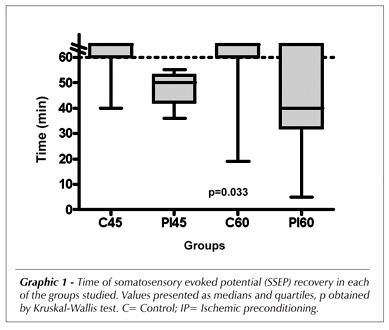
OBJECTIVES: To evaluate the effectiveness of acute ischemic preconditioning (IP), based on somatosensory evoked potentials (SSEP) monitoring, as a method of spinal cord protection and to asses SSEP importance in spinal cord neuromonitoring. METHODS: Twenty-eight dogs were submitted to spinal cord ischemic injury attained by descending thoracic aorta cross-clamping. In the C45 group, the aortic cross-clamping time was 45 min (n=7); in the IP45 group, the dogs were submitted to IP before the aortic cross-clamping for 45 min (n=7). In the C60 group, the dogs were submitted to 60 min of aortic cross-clamping (n=7), as in the IP60 group that was previously submitted to IP. The IP cycles were determined based on SSEP changes. RESULTS: Tarlov scores of the IP groups were significantly better than those of the controls (p = 0.005). Paraplegia was observed in 3 dogs from C45 and in 6 from C60 group, although all dogs from IP45 group were neurologically normal, as 4 dogs from IP60. There was a significant correlation between SSEP recovery time until one hour of aortic reperfusion and the neurological status (p = 0.011), showing sensitivity of 75% and specificity of 83%. CONCLUSION: Repetitive acute IP based on SSEP is a protection factor during spinal cord ischemia, decreasing paraplegia incidence. SSEP monitoring seems to be a good neurological injury assessment method during surgical procedures that involve spinal cord ischemia.

  • Aortic Aneurysm
  • evoked potencial
  • Ischemic Preconditioning
  • spinal cord
Read Full Article
Creative Commons Attribution (CC BY) Creative Commons license
21/05/2007 DOI: 10.1590/S0066-782X2007000300007 Views 2

How to cite this article

EndNote RIS

Electronic Document Format (Vancouver)

Shekarforoush S, Naghii MR. Whole-Body Vibration Training Increases Myocardial Salvage Against Acute Ischemia in Adult Male Rats. Arquivos Brasileiros de Cardiologia 2018;112(1):32-7.

Electronic Document Format (ABNT)

Shekarforoush, Shahnaz; Naghii, Mohammad Reza. Whole-Body Vibration Training Increases Myocardial Salvage Against Acute Ischemia in Adult Male Rats. Arquivos Brasileiros de Cardiologia, v. 112, n. 1, p. 32-37, Dec. 2018.

Electronic Document Format (APA)

Shekarforoush, S., & Naghii, M. R. (2018). Whole-Body Vibration Training Increases Myocardial Salvage Against Acute Ischemia in Adult Male Rats. Arquivos Brasileiros de Cardiologia, 112(1), 32-37.

Electronic Document Format (ISO)

Shekarforoush, Shahnaz and Naghii, Mohammad Reza. Whole-Body Vibration Training Increases Myocardial Salvage Against Acute Ischemia in Adult Male Rats. Arquivos Brasileiros de Cardiologia [online]. 2018, vol. 112, n. 1, [cited 2026-10-14], pp. 32-37. Available from: <https://journals.cardiol.br/en/article/whole-body-vibration-training-increases-myocardial-salvage-against-acute-ischemia-in-adult-male-rats/>. ISSN 0066-782X

EndNote RIS

Electronic Document Format (Vancouver)

Mônaco BA, Benício A, Contreras ISB, Mingrone LE, Ballester G, Moreira LFP. Ischemic preconditioning and spinal cord function monitoring in the descending thoracic aorta approach. Arquivos Brasileiros de Cardiologia 2007;88(3):291-6.

Electronic Document Format (ABNT)

Mônaco, Bernardo Assumpção de; Benício, Anderson; Contreras, Ivan Salvador Bonillo; Mingrone, Larissa Eckmann; Ballester, Gerson; Moreira, Luiz Felipe Pinho. Ischemic preconditioning and spinal cord function monitoring in the descending thoracic aorta approach. Arquivos Brasileiros de Cardiologia, v. 88, n. 3, p. 291-296, May. 2007.

Electronic Document Format (APA)

Mônaco, B. A. , Benício, A., Contreras, I. S. B., Mingrone, L. E., Ballester, G., & Moreira, L. F. P. (2007). Ischemic preconditioning and spinal cord function monitoring in the descending thoracic aorta approach. Arquivos Brasileiros de Cardiologia, 88(3), 291-296.

Electronic Document Format (ISO)

Mônaco, Bernardo Assumpção de and Benício, Anderson and Contreras, Ivan Salvador Bonillo and Mingrone, Larissa Eckmann and Ballester, Gerson and Moreira, Luiz Felipe Pinho. Ischemic preconditioning and spinal cord function monitoring in the descending thoracic aorta approach. Arquivos Brasileiros de Cardiologia [online]. 2007, vol. 88, n. 3, [cited 2026-10-14], pp. 291-296. Available from: <https://journals.cardiol.br/en/article/ischemic-preconditioning-and-spinal-cord-function-monitoring-in-the-descending-thoracic-aorta-approach/>. ISSN 0066-782X

  • About ABC Family
  • Internal Regulation
  • Editorial Board
  • Brazilian Society of Cardiology (SBC)

Issues

SBC Guidelines

  • Videos
  • Podcasts
  • News